
May 20, 2026
Local SEO for Service Businesses (Delhi NCR)
local SEO for service businesses Delhi NCR: practical 2026 guide with setup, pricing, checklist, roadmap, tracking, mistakes, FAQs, and Indian business tips.
Read articlePublished Updated
Plan Delhi NCR service-area pages with evidence gates, parent hubs, consolidation rules, internal links and measurement without creating doorway pages.
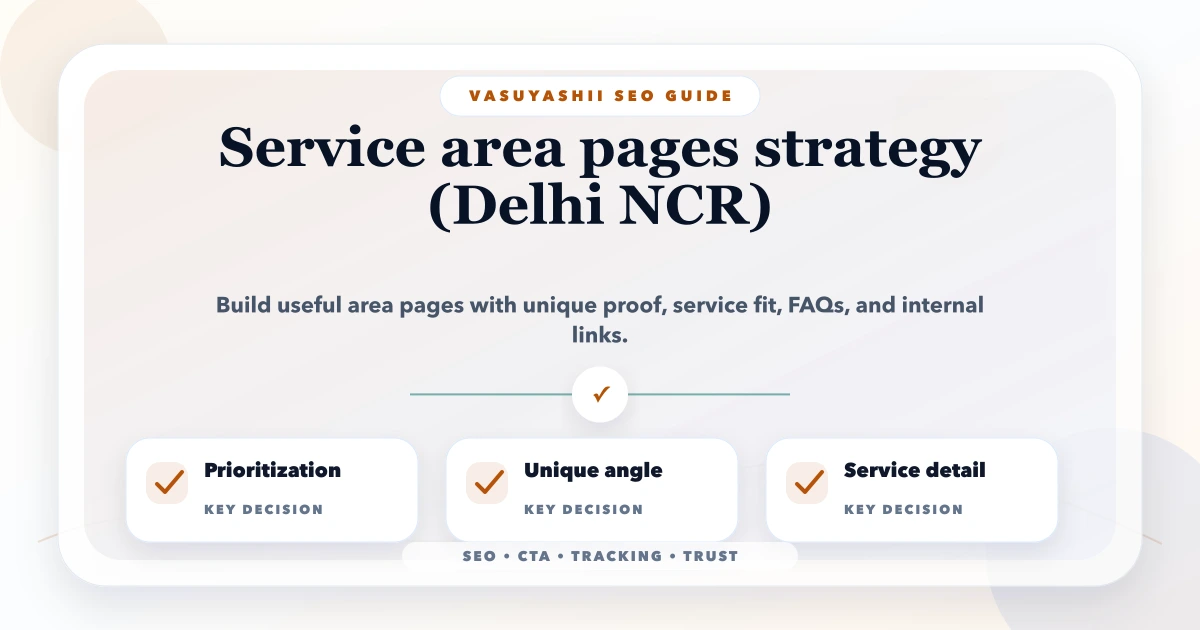
Service-area note: VASUYASHII is based in Delhi NCR and supports businesses remotely across India. A city-focused guide describes service and planning context; it does not claim a physical office in every location mentioned.
Explore the parent topic: Website Development Delhi NCR Hub →A service-area strategy should decide which local pages deserve to exist, not produce a page for every place name. That distinction matters in Delhi NCR, where one company may serve Delhi, Noida, Ghaziabad, Gurugram, Faridabad and nearby markets without maintaining a staffed office in each city.
The useful model is a strong regional hub supported by a limited number of evidence-backed local pages. Each retained page needs a distinct buyer job, genuine delivery context and a clear relationship with the main service page. Pages that cannot meet that standard should be consolidated, held from publication or redirected after review.
This guide provides the governance system: page types, evidence gates, ownership rules, consolidation decisions, internal linking and measurement. It does not recommend fake addresses, copied city pages or guaranteed rankings.
Use this three-level structure:
A city name alone is not evidence. Before publishing a local page, verify that the business serves the area, the query represents a meaningful buyer need, and the page can explain something that the parent hub cannot.
These page types have different jobs.
| Page type | Primary job | Appropriate content | Main risk |
|---|---|---|---|
| Main service page | Explain the offer and convert broad demand | scope, process, proof, outcomes, FAQs | competing with every local page |
| Delhi NCR hub | Explain regional coverage and route users | coverage model, major markets, delivery process, local-page links | becoming a thin list of cities |
| City or area page | Answer a distinct local buyer need | local operating context, relevant examples, service fit, next step | doorway or copy-swap content |
| Physical-location page | Represent a real staffed location | address, hours, directions, contact and location-specific proof | publishing a virtual or fake office |
| Informational guide | Educate around a local decision | checklist, comparisons, rules and examples | targeting the same commercial intent |
Do not use a blog post as a substitute for a weak service page. A guide may support a commercial page, but each URL needs one clear role.
Create a worksheet before writing. Include:
This exposes overlap. For example, “website developer in Noida,” “website development company in Noida” and “best website company Noida” may represent one buyer job. Three pages are not automatically more useful than one.
Use the Delhi NCR website-development keyword map to group variants before assigning URLs.
Publish or retain a local page only when several of these signals are available:
The evidence does not need to be a named case study. It may be a truthful service boundary, delivery model, response process, local regulatory consideration, industry mix or travel constraint. What matters is that the distinction is useful and supportable.
A clean architecture prevents local pages from becoming an isolated cluster.
The main service page owns the broad commercial intent. It should explain the offer, process, deliverables and contact path. For example:
The regional hub explains where and how the service is delivered. It should not repeat every section from the service page. It can cover:
Each local page should link back to both its service parent and relevant regional hub. Sibling links should be used only when they help the visitor compare nearby service areas.
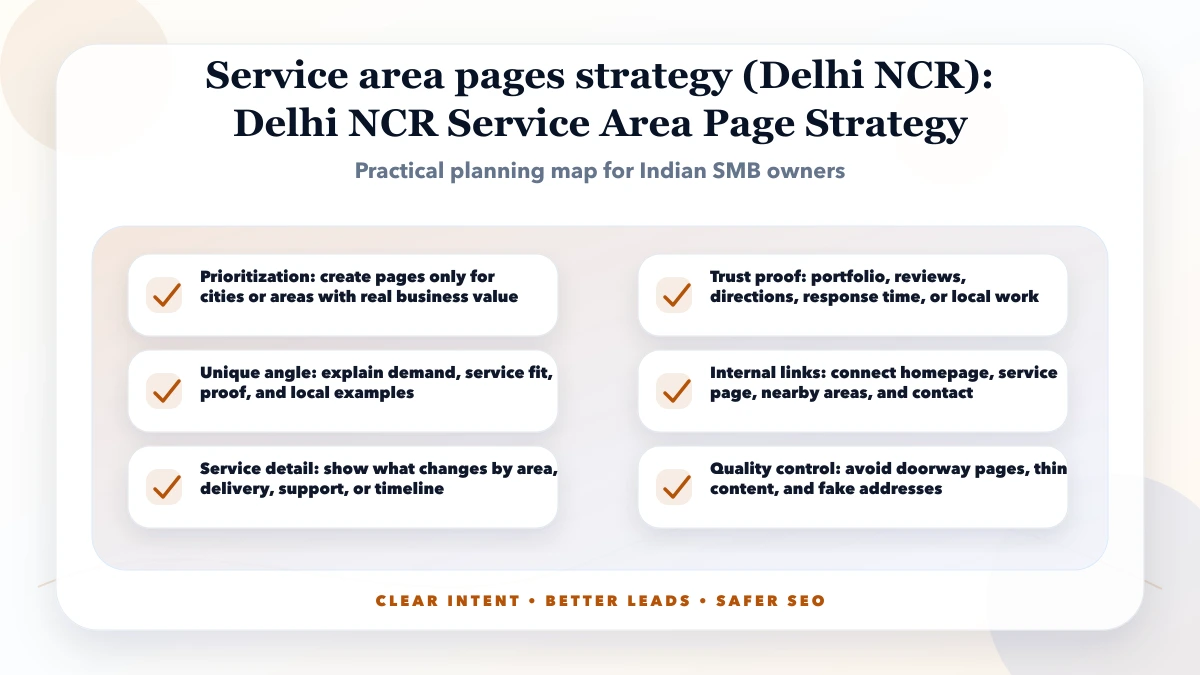
Changing the city name is not differentiation. Use a page brief with these fields:
One page may focus on enterprise procurement in Gurugram, another on an SME website brief in Ghaziabad, and another on an ecommerce setup in Noida. Use these differences only when they reflect the actual service and intended buyer.
The local landing-page guide explains how to turn that brief into a useful page.
Do not mass delete older URLs. Evaluate them individually.
| Condition | Recommended action |
|---|---|
| Unique intent, evidence and demand | keep and strengthen |
| Useful topic but weak execution | improve in place |
| Same intent as a stronger page | merge useful content and redirect |
| No evidence, demand or links | hold, noindex where appropriate, or remove after dependency review |
| Existing clicks or links but overlap | preserve value through a carefully mapped redirect |
| Unclear Google-selected canonical | inspect rendered canonical, internal links and content similarity before editing |
Before redirecting, check Search Console, analytics, inbound links, sitemap inclusion and navigation dependencies. Redirect to the closest equivalent page, not automatically to the homepage.
Google's spam policies describe doorway abuse as pages created to rank for similar queries that funnel users to an intermediate destination.
Warning signs include:
The remedy is not cosmetic rewriting. Reduce overlap, assign clear ownership and keep only pages that satisfy a real visitor need. Review the service-city page guide for page-level checks.
Internal links should explain relationships, not merely increase counts.
Use:
Use descriptive anchors, but vary them naturally. Do not repeat the same exact-match anchor in every paragraph.
The broader local SEO guide for web development companies connects these links with GBP, citations, proof and conversion tracking.
A website service area is not proof of a physical office. Google Business Profile eligibility and representation rules are separate from website architecture.
Google's business representation guidelines require accurate real-world business information. A service-area business should not create fake locations or use a virtual office merely to target another city.
Keep these records aligned:
Use the NAP consistency guide to control those records.
Review local pages by useful outcomes rather than rank snapshots alone.
Track:
A page with low traffic may still be useful if it answers a specific sales objection and assists conversions. A high-impression page may still need consolidation if it attracts the wrong intent and competes with a stronger page.
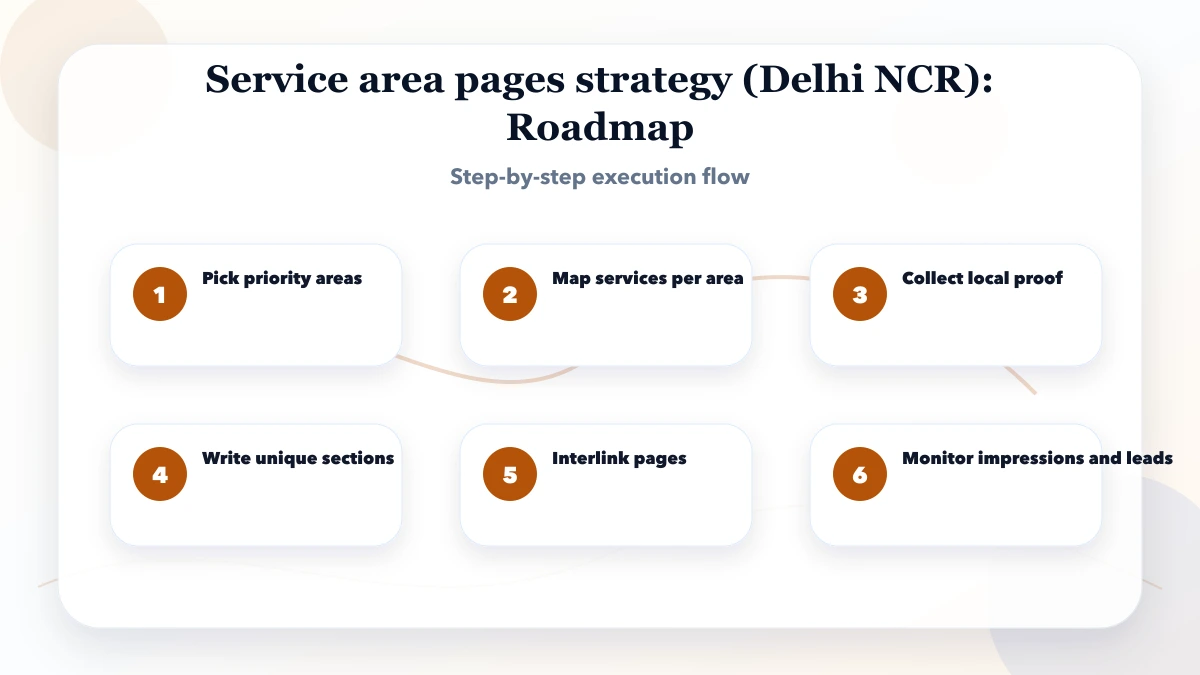
Current VASUYASHII content inventory contains a large location-intent cluster. That makes governance more important than publishing another city variant.
The current decision is:
This is a content-architecture boundary, not a claim that every existing location page already meets the standard.
The following retained pages now illustrate different reasons a location URL may exist. They are not proof of an office or client in the named area:
| Page | Distinct visitor decision |
|---|---|
| Janakpuri website buyer guide | compare provider scope, proof and ownership |
| Vaishali website rebuild plan | preserve URLs, content and lead routes during migration |
| East Delhi service-area plan | represent multi-area coverage without doorway pages |
| Indirapuram booking guide | choose appointment states and availability controls |
| Shahdara mobile lead plan | manage mobile actions and bilingual content |
| Baghpat B2B catalogue plan | structure products and RFQ operations |
| Gulaothi phased website plan | launch a controlled first website and upgrade by evidence |
| Loni quote-ready lead plan | collect estimate inputs and route quotations |
| Sahibabad industrial guide | publish capabilities, documents and industrial RFQs |
| Crossings Republik trust plan | govern proof, reviews and appointment trust |
This differentiation is a quality improvement, not automatic evidence that every URL should remain indexed forever. GSC demand, links, leads and real service coverage still inform later consolidation decisions.
The next review group uses another set of distinct operating decisions:
| Page | Distinct visitor decision |
|---|---|
| South Delhi buyer guide | evaluate premium-service scope, evidence and ownership |
| Connaught Place office guide | route office visitors, departments and appointments |
| Karol Bagh retail catalogue | choose catalogue, enquiry or ecommerce operations |
| Laxmi Nagar enquiry system | qualify course and service enquiries safely |
| Nehru Nagar continuity guide | protect identity, lead routes, accounts and recovery |
| Govindpuram first-build plan | choose the smallest complete launch and upgrade trigger |
| Noida Sector 63 due diligence | verify vendor scope, security and handover |
| Noida Sector 62 B2B system | connect account content, qualification and CRM feedback |
| Wave City upgrade path | compare packages by capability and future workflow |
| Kavi Nagar quote checklist | normalize scope, recurring cost and maintenance |
These pages still need current service coverage, GSC, link and lead evidence before any long-term index decision. Editorial differentiation alone is not a substitute for demand.
This review group separates procurement, cost, workflow, catalogue and product-marketing intent:
| Page | Distinct visitor decision |
|---|---|
| Rohini multi-service website | route enquiries across several service owners |
| RDC Raj Nagar professional website | accept consultations without unsafe document collection |
| Noida role-based web app | define permissions, states and operational acceptance |
| Ghaziabad field-work web app | control inventory, field activity and offline exceptions |
| Meerut dealer website | structure catalogue discovery and qualified RFQs |
| Delhi provider scorecard | select a website company using comparable evidence |
| Delhi spreadsheet replacement | migrate a spreadsheet workflow into controlled records |
| Noida website cost guide | compare total ownership rather than headline package price |
| Hapur supplier website | qualify product and dispatch enquiries |
| Noida SaaS marketing website | govern product claims, demos and release content |
These links expose the intended difference between the pages. Continued indexing still depends on truthful coverage, independent demand, useful engagement and ongoing maintenance.
| Page | Distinct visitor decision |
|---|---|
| Raj Nagar Extension society services | check coverage and route society-area service enquiries |
| Modinagar trade/service website | phase a quote-ready first release |
| Lucknow multilingual website | govern Hindi-English service and branch journeys |
| Karnal agri/dealer website | control catalogue, seasonal content and RFQs |
| Dehradun education website | manage programme facts and admission enquiries |
| Ghaziabad package guide | compare scope, acceptance, ownership and recurring cost |
| Bhopal programme website | publish accessible programme eligibility and enrolment routes |
| Chennai technical B2B website | move technical buyers from capability to qualified RFQ |
| Pune employer-brand website | separate candidate and B2B trust journeys |
| Bangalore startup website | test product assumptions without overstating availability |
The city names do not prove offices, customers, rankings or demand. Each page remains subject to service evidence, GSC performance, lead quality and continued maintenance.
This review group separates migration, field operations, booking and software-vendor evaluation:
| Page | Distinct visitor decision |
|---|---|
| Ghaziabad website cost | choose repair, redesign or a new build using total ownership cost |
| Meerut website migration | preserve valuable URLs and lead routes during a structured rebuild |
| Mohan Nagar business website | route calls, visits, directions and service-availability questions |
| Hapur service website | collect inspection, repair and maintenance requests |
| ERP developer evaluation | compare workflow discovery, migration, ownership and support |
| Noida field mobile app | plan offline task capture, syncing and controlled rollout |
| Roorkee contractor website | qualify site-inspection and project quotation requests |
| Kaushambi appointment website | distinguish appointment requests from confirmed visits |
| Near-me ranking framework | establish eligibility, relevance and prominence without local spam |
| CRM build-or-buy guide | compare SaaS, integration and custom workflow ownership |
Local wording does not make these pages valuable by itself. Each page is retained for a separate operational decision and remains subject to real coverage, demand and maintenance review.
| Page | Distinct visitor decision |
|---|---|
| Dwarka home-service website | verify locality, access, visit charges, and request status |
| Indore multi-branch website | govern branch records, offers, permissions, and lead routing |
| Kolkata B2B export website | qualify product, quantity, destination, document, and RFQ needs |
| Haridwar seasonal-demand website | control temporary availability, capacity, offers, and expiry |
| Chandigarh professional website | govern profiles, services, authorship, privacy, and intake |
| Faridabad industrial AMC website | qualify assets, site audits, maintenance scope, and contract enquiries |
| Jaipur product catalogue | manage variants, samples, wholesale routes, and lead times |
| Delhi NCR customer mobile app | define self-service accounts, documents, requests, and permissions |
| Sonipat food-supplier website | govern product facts, labels, documents, and buyer routes |
| Panipat textile catalogue | organise specifications, colours, samples, MOQ, and wholesale enquiries |
These pages are linked for separate operational decisions, not because a place name alone deserves a URL. Continued retention depends on truthful coverage, demand, link value, and maintenance ownership.
| Page | Distinct planning decision |
|---|---|
| Gurgaon website procurement | coordinate marketing, sales, IT, privacy, and launch approval |
| Affordable Ghaziabad website | phase scope and compare first-year ownership cost |
| Noida website developer | convert package promises into acceptance and handover tests |
| Mathura visitor website | manage seasonal information, visitor routes, and request states |
| Manesar industrial website | separate RFQs, vendor registration, support, and technical content |
| Aligarh catalogue website | govern product records, dealer enquiries, samples, and custom requests |
| Agra visitor-journey website | control evergreen information, availability, and production acceptance |
| Delhi NCR software partner | scope workflow replacement, migration, roles, integrations, and rollout |
| Ghaziabad shop website | choose store information, catalogue, reserve, or ecommerce scope |
| Business website redesign | decide improve, redesign, or rebuild with migration and rollback control |
The links represent separate scope decisions. They do not prove a local office, client engagement, ranking, or outcome in any named market.
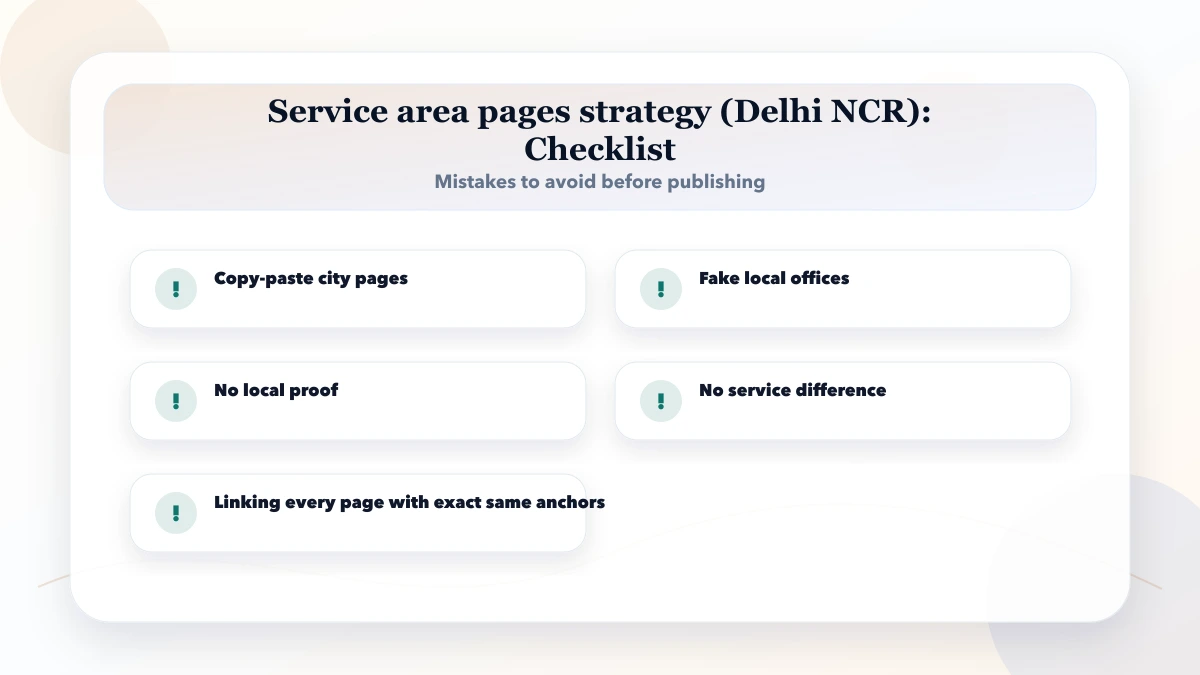
There is no fixed number. Create only the pages supported by meaningful demand, distinct value, truthful service coverage and the ability to maintain them.
It may be. A strong regional hub can serve broad demand. Add city pages only when they answer a distinct need that the hub cannot cover well.
Canonical tags are not a substitute for good architecture. If pages are true duplicates, consolidation may be more appropriate. If each page is meant to index, each needs unique value and a self-canonical.
The website can accurately explain a genuine service area, but it must not claim a physical office that does not exist. Google Business Profile has separate eligibility and representation rules.
Redirect after confirming that it overlaps a stronger destination and after preserving useful content, link value and visitor intent. Map it to the closest relevant page.
Use at least one comparable 28-day period, and often 56 days for search changes. Record the implementation date so later comparisons are meaningful.
Start with one service cluster. Build its inventory, choose the parent, apply the evidence gate and decide which URLs should be kept, improved, merged or held. For implementation support, review VASUYASHII services or discuss the architecture.
Related Articles
May 20, 2026
local SEO for service businesses Delhi NCR: practical 2026 guide with setup, pricing, checklist, roadmap, tracking, mistakes, FAQs, and Indian business tips.
Read article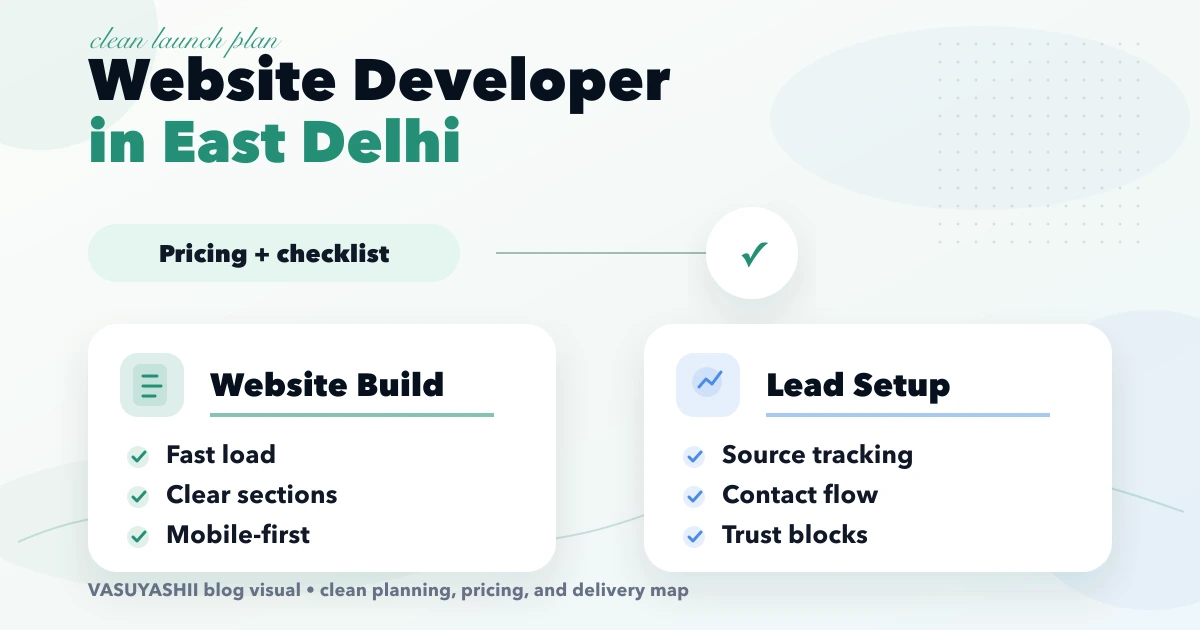
April 17, 2026
Plan an East Delhi service website with honest area coverage, mobile lead routes, page ownership, local SEO controls and developer checks.
Read article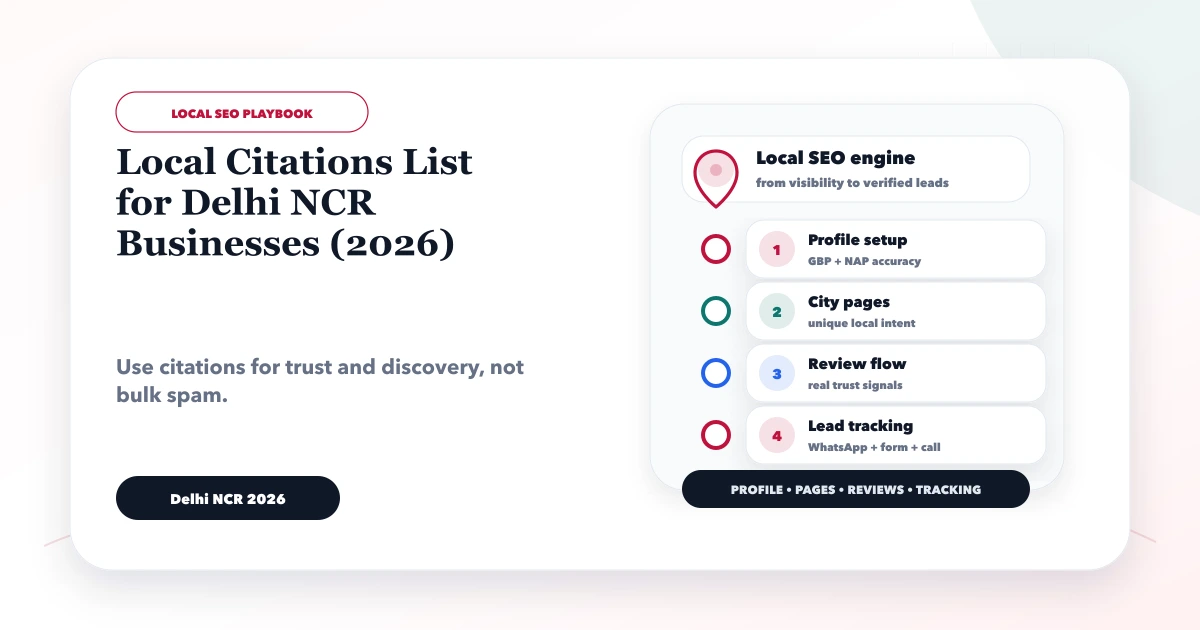
May 29, 2026
Evaluate local citation sources for Delhi NCR businesses by customer value, eligibility, data accuracy, ownership and maintenance instead of bulk submissions.
Read article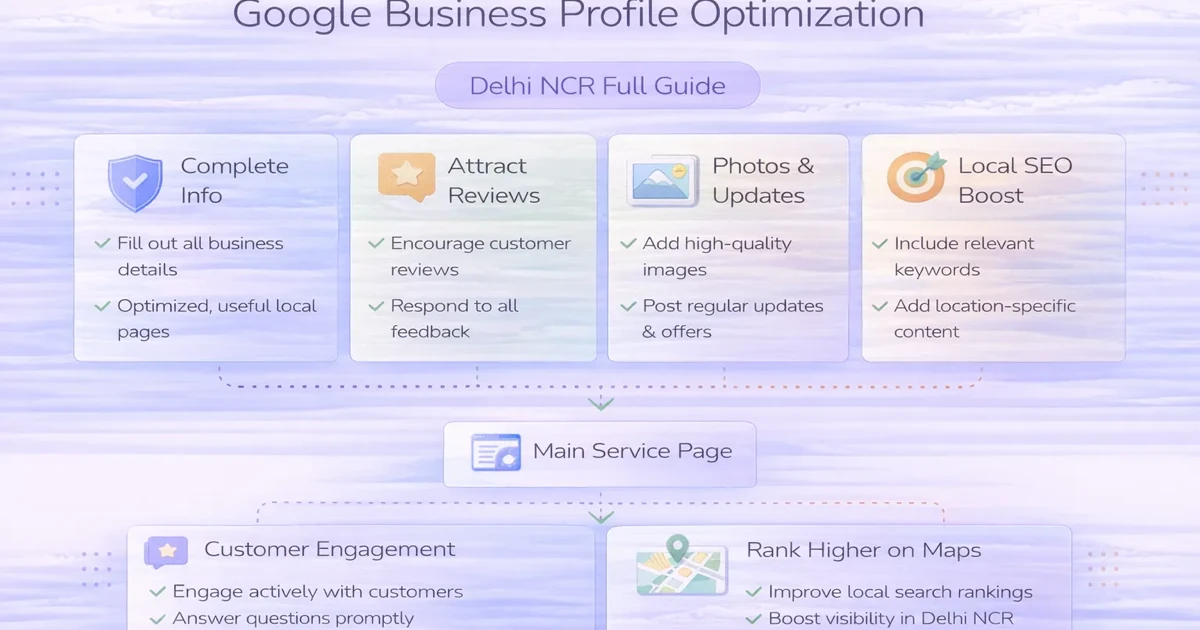
April 4, 2026
Operate a compliant Google Business Profile in Delhi NCR with eligibility checks, accurate details, reviews, website alignment and measurable maintenance.
Read article