
May 31, 2026
Noida Website Partner for SaaS and Product Marketing
Select a Noida website partner for SaaS or product marketing with positioning, demo routes, proof, documentation, analytics, handover, and growth controls.
Read articlePublished Updated
Plan a Bangalore startup website for product validation with claim controls, waitlist or demo journeys, analytics, experiments, handover, and governance.
Service-area note: VASUYASHII is based in Delhi NCR and supports businesses remotely across India. A city-focused guide describes service and planning context; it does not claim a physical office in every location mentioned.
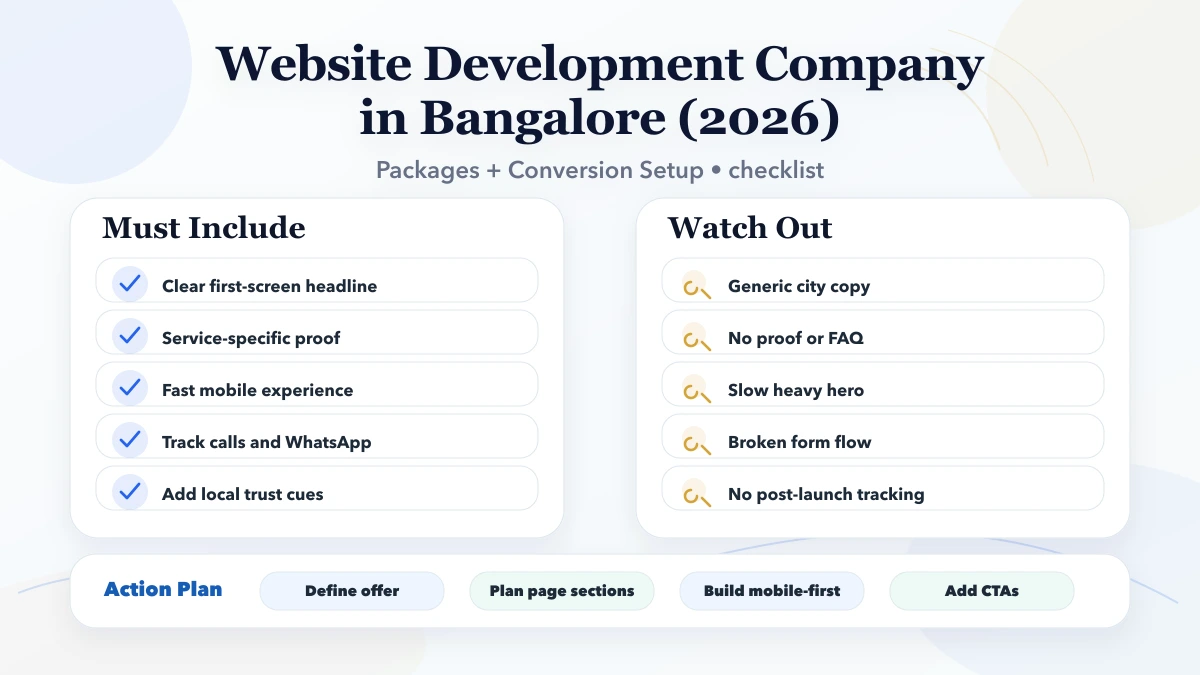
Explore the parent topic: Website Development Delhi NCR Hub →A founder evaluating a website development company in Bangalore may need a site before the product, positioning, pricing, and sales motion are fully stable. The website should help test a defined business assumption without presenting roadmap ideas as current capability or traffic as product validation.
This guide covers evidence-safe product positioning, demo or waitlist journeys, analytics, experiments, release governance, and ownership. It does not claim a VASUYASHII Bangalore office, startup client, funding result, product adoption, ranking, or guaranteed conversion.
Written by Tushar C. (Founder, VASUYASHII) using the current VASUYASHII product, website, and web-app planning process. Product features, security, integrations, customer logos, metrics, pricing, availability, funding, testimonials, and roadmap dates must be verified by the owner.
The website should test one specific assumption:
“Get more traffic” is not a validation question. Write the audience, problem, promise, action, and evidence needed to decide what happens next.
Use controlled labels:
| State | Acceptable wording |
|---|---|
| Available | current capability with tested access and owner |
| Limited/early access | current restrictions, audience, and support boundary |
| Beta | what is testable and how feedback/data are handled |
| Prototype/demo | illustrative or test environment, not production |
| Planned | roadmap direction without availability promise |
| Not supported | explicit exclusion where buyers may assume it |
Do not mix these states inside one feature grid. Keep an evidence register with claim, page, product owner, evidence, approval date, and update trigger.
If users need authenticated functionality, build it as a web application. Keep marketing, app, documentation, and status boundaries clear.
Use when access is not generally available. State what joining means, expected communication, data use, and that access is not guaranteed.
Show the current product or label the environment as illustrative. Remove personal/customer data and explain limitations.
Collect company/use-case fit and assign an owner. Avoid asking for unnecessary personal or confidential details.
Use only when onboarding, authentication, support, terms, privacy, security, and product readiness are operational.
A useful product message states:
Avoid unsupported superlatives such as best, revolutionary, guaranteed, or number one. Do not claim AI, automation, security, integration, or real-time capability without a precise current definition.
Early-stage proof can be honest:
Do not invent customer counts, savings, accuracy, adoption, uptime, or case outcomes. VASUYASHII's Business Suite is a real product page; demo websites are labelled examples, not customer evidence.
Record each experiment:
| Field | Example decision |
|---|---|
| Hypothesis | target buyers prefer workflow-led positioning |
| Audience | defined role/company type |
| Variant | approved headline, route, or CTA |
| Primary event | successful qualified demo request |
| Guardrail | no misleading product-state change |
| Duration/sample rule | agreed before reading results |
| Decision | retain, revise, stop, or investigate |
Do not run many simultaneous changes that make the result uninterpretable. Preserve accessibility and page stability. A/B testing does not permit inaccurate claims.
Track non-personal events:
Never send names, email, phone, organisation-sensitive notes, or form text to GA4. Define what counts as qualified before comparing conversion rates. Use the GA4 events guide.
Marketing copy must change with the product. For every release, review:
Assign product, marketing, legal/privacy, security, and technical approvers. A stale product website can create support and trust risk even when the application works.
Publish only verified controls. Distinguish:
Do not use a lock icon as proof. If collecting waitlist or lead data, explain purpose, access, retention, deletion/contact route, and third-party processors as required. Review web-app security and RBAC for operational controls.
Start with product and problem ownership:
Avoid mass-producing “software company in city” pages. Connect support articles to the strongest product/service parent. Use unique metadata, self-canonicals, sitemap controls, structured data matching visible facts, redirects, mobile usability, and performance.
Website price changes with:
Separate the marketing website from product development. A proposal should state whether it includes only web presence, a demo, authenticated app work, integrations, content, analytics, or ongoing experiments. Review SaaS MVP cost planning for product-scope boundaries.
Test:
Use harmless test records and delete them according to the approved process.
The company should control domain, hosting, source, deployment, CMS, analytics, forms, CRM, email, demo, and product accounts. Keep:
No. Start with the smallest complete validation journey and expand based on evidence.
Use the sales motion and product readiness. If shown, keep plans, inclusions, exclusions, taxes, and limits current.
It is one signal. Evaluate audience fit, intent, progression, and actual product use before claiming validation.
Yes, clearly label it, remove sensitive data, state limitations, and avoid implying production availability.
When users need authenticated records, roles, workflow, calculations, documents, or persistent product functionality.
Claims, feature/use-case pages, screenshots, demos, pricing, integrations, security wording, documentation, metadata, forms, and analytics.
Choose the decision before running the website experiment. For example: continue interviews, build a limited pilot, revise the audience, change the workflow, or stop the idea. Record the minimum evidence and guardrails in advance.
At review, separate visitor volume from suitable intent. Read qualified conversations, objections, demo behaviour, and reasons people decline. Check whether the page attracted the audience named in the hypothesis. Do not declare product-market fit from clicks, waitlist entries, or one successful conversation.
Archive the result with the page version, dates, traffic source, event definition, known limitations, and next decision. This protects the team from repeating weak experiments or rewriting history after the result is known.
Build the Bangalore startup website around one falsifiable validation question and truthful product states. Give claims, demos, analytics, experiments, releases, privacy, and accounts named owners. For SaaS and software development or a scoped website review, contact VASUYASHII.
Related Articles
May 31, 2026
Select a Noida website partner for SaaS or product marketing with positioning, demo routes, proof, documentation, analytics, handover, and growth controls.
Read article
March 15, 2026
Plan a startup website with the right pages, positioning, lead flow, technology, SEO, timeline, and cost decisions for an efficient 2026 launch.
Read article
March 31, 2026
Plan a Jaipur made-to-order product catalogue with variants, specifications, sample requests, wholesale and retail routes, lead times, and ownership.
Read article
April 24, 2026
Plan a Pune employer-brand website with role pages, truthful culture proof, candidate routing, B2B capability links, privacy, analytics, and ownership.
Read article