
May 16, 2026
SaaS MVP Scope Checklist for Indian Founders
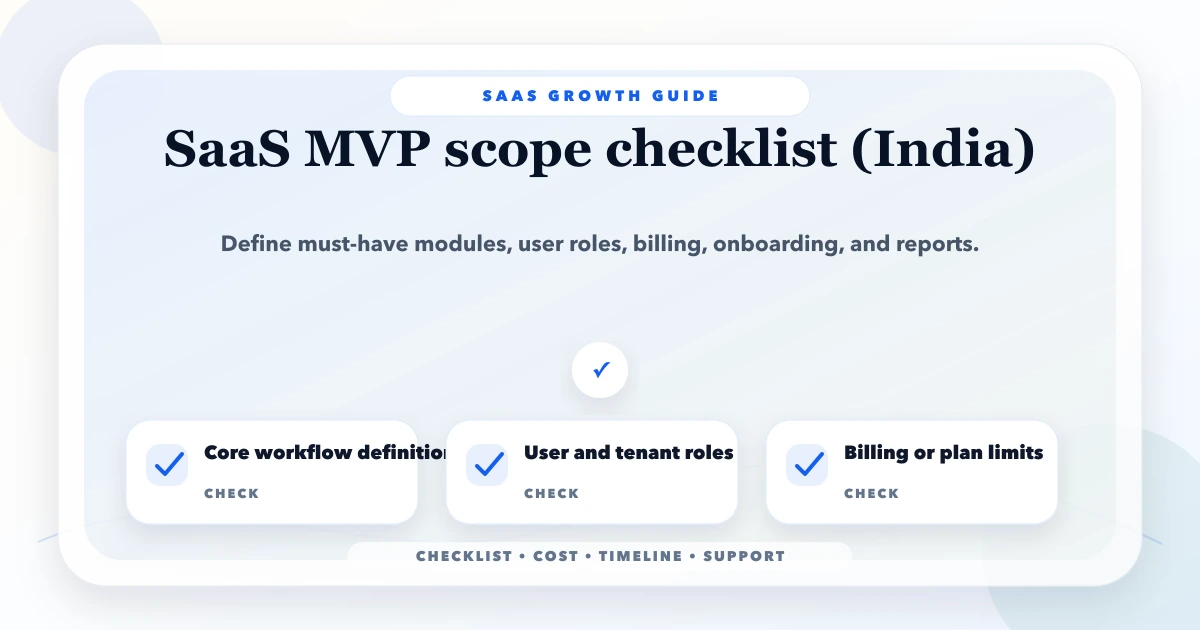
Plan a focused SaaS MVP with clear users, workflows, permissions, billing boundaries, acceptance checks, costs, and launch metrics for India.
Read articlePublished Updated
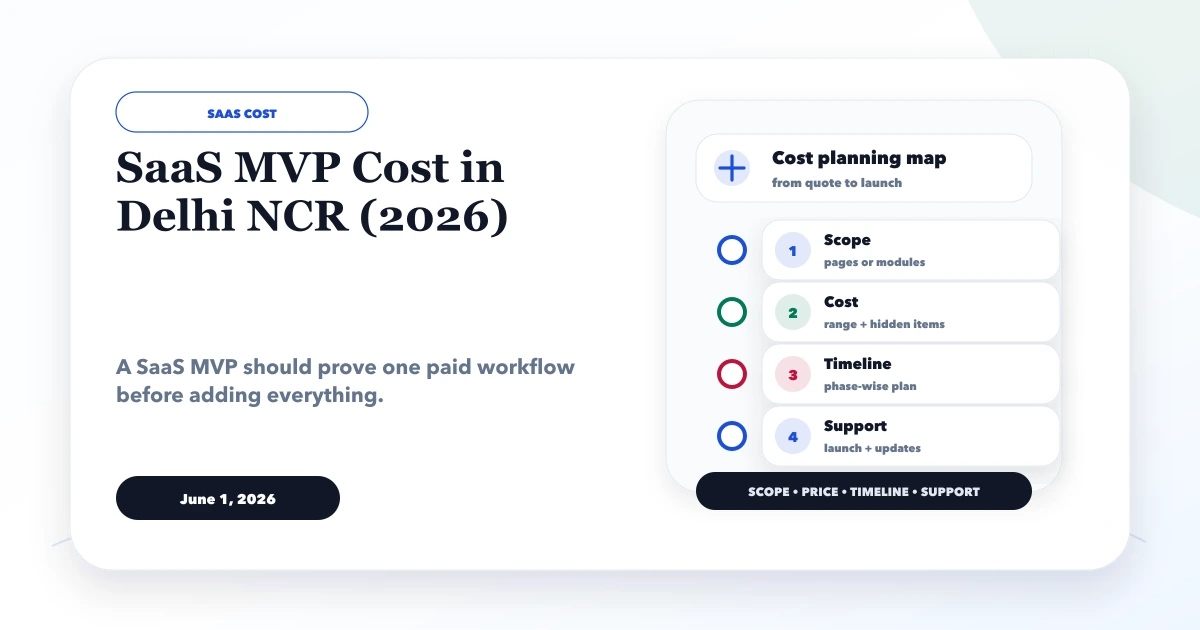
Estimate a Delhi NCR SaaS MVP using product risk, tenant model, core workflow, billing, security, analytics, support and staged budget bands.
Service-area note: VASUYASHII is based in Delhi NCR and supports businesses remotely across India. A city-focused guide describes service and planning context; it does not claim a physical office in every location mentioned.
Explore the parent topic: Website Development Delhi NCR Hub →SaaS MVP cost depends on what the product must learn and operate. A prototype that tests workflow demand is different from a subscription-ready product with tenant isolation, payment states, account recovery, support tools and monitoring.
This guide helps Delhi NCR founders build a budget from product risk and engineering scope. It separates validation, product foundation, billing and operations so proposals can be compared. The retained price bands are planning references, not fixed offers or verified market averages.
Define these before estimating:
Do not estimate from a feature wish list. Estimate the smallest complete system that can test the riskiest business assumption safely.
| MVP type | Purpose | Typical production expectation |
|---|---|---|
| Clickable prototype | test navigation and communication | no production data or integrations |
| Workflow pilot | test the core job with controlled users | limited operating controls |
| Production MVP | serve early customers reliably | security, support, monitoring and recovery |
| Subscription-ready MVP | charge multiple accounts | billing, entitlements and reconciliation |
Ask every provider which version their estimate represents.
Use a one-page hypothesis:
If these answers are unstable, spend on research and prototype learning before a broad production build.
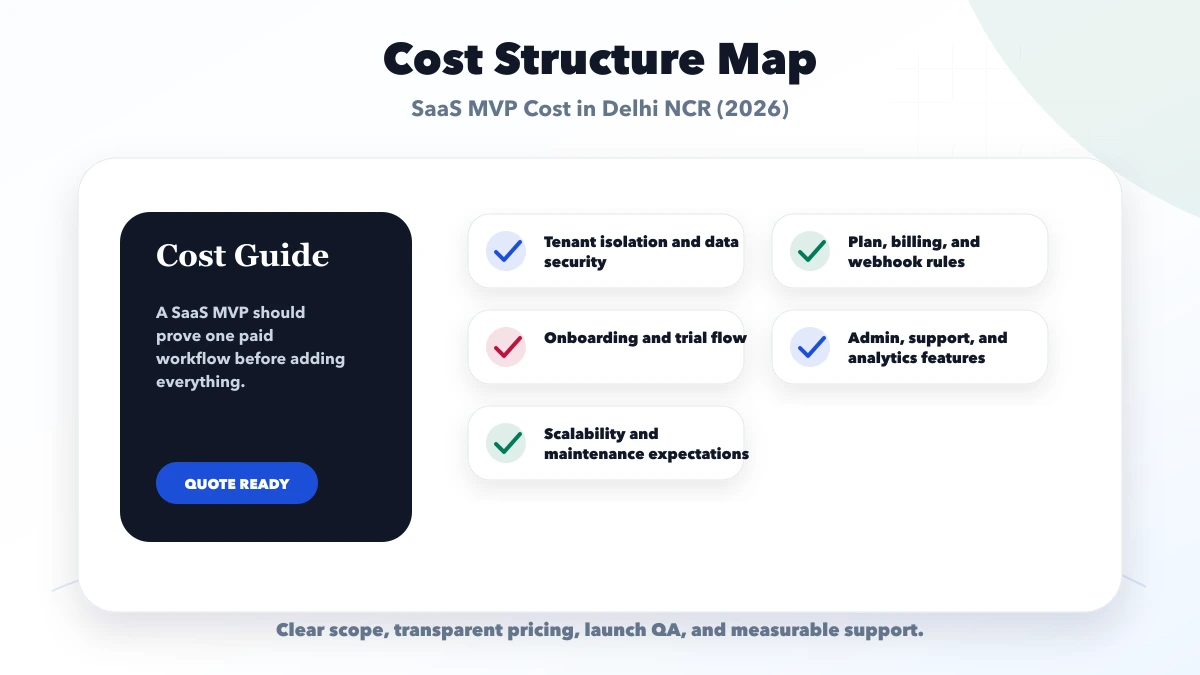
Define whether an account is a person, company, workspace, branch or agency. Decide how invitations, switching and removal work.
Define owner, admin, member and support actions. Plan limits must be enforced by the backend.
List the records needed for the repeated job. Avoid adding generic CRM, chat or dashboards unless they are required for learning.
Early users need account lookup, issue tracking, status visibility and a controlled correction process.
Include development, staging and production environments, logs, alerts, backup and recovery ownership.
Break the workflow into:
A workflow with imports, approvals and third-party data is not equivalent to a simple form even if both appear as one screen.
Include automated billing when it is necessary to test pricing or operate the launch cohort.
Billing scope may include:
For a small private beta, manual invoices or plan assignment may preserve learning while reducing initial complexity.
Keep a separate contingency for unresolved migration, provider approval and security questions. Do not silently consume feature budget when an external dependency changes during delivery.
Record every contingency decision in the delivery log.
| Scope | Existing planning band | Typical delivery window |
|---|---|---|
| Lean SaaS MVP | Rs. 4 lakh to Rs. 8 lakh | 8 to 14 weeks |
| Subscription-ready MVP | Rs. 8 lakh to Rs. 18 lakh | 3 to 5 months |
| Advanced SaaS foundation | Rs. 18 lakh to Rs. 40 lakh+ | 5 to 10 months |
These retained bands do not constitute a fixed VASUYASHII quote or a verified Delhi NCR market average.
| Category | Include |
|---|---|
| Product discovery | interviews, flows, prototypes, acceptance |
| Design | responsive UI, states, accessibility, design system |
| Engineering | frontend, API, database, jobs and integrations |
| Quality | tests, security, performance and migration |
| Infrastructure | environments, hosting, storage, monitoring, backup |
| Providers | payment, email, messaging, identity and analytics |
| Launch | data, onboarding, support and incident readiness |
| Ownership | documentation, source, accounts and handover |
Recurring provider and infrastructure charges should be separated from build cost.
Defer these only when the MVP remains safe and useful without them.
One clear user type produces cleaner workflow and onboarding decisions.
A user should reach a real outcome, not tour several partial modules.
Manual plan assignment, onboarding or support can be acceptable during a controlled beta when documented.
Use established identity, payment or messaging services when they fit requirements. Account ownership and provider cost still need review.
Build clear responsive states before extensive theme or customisation options.
Start with responsive web unless mobile-specific behavior is essential.
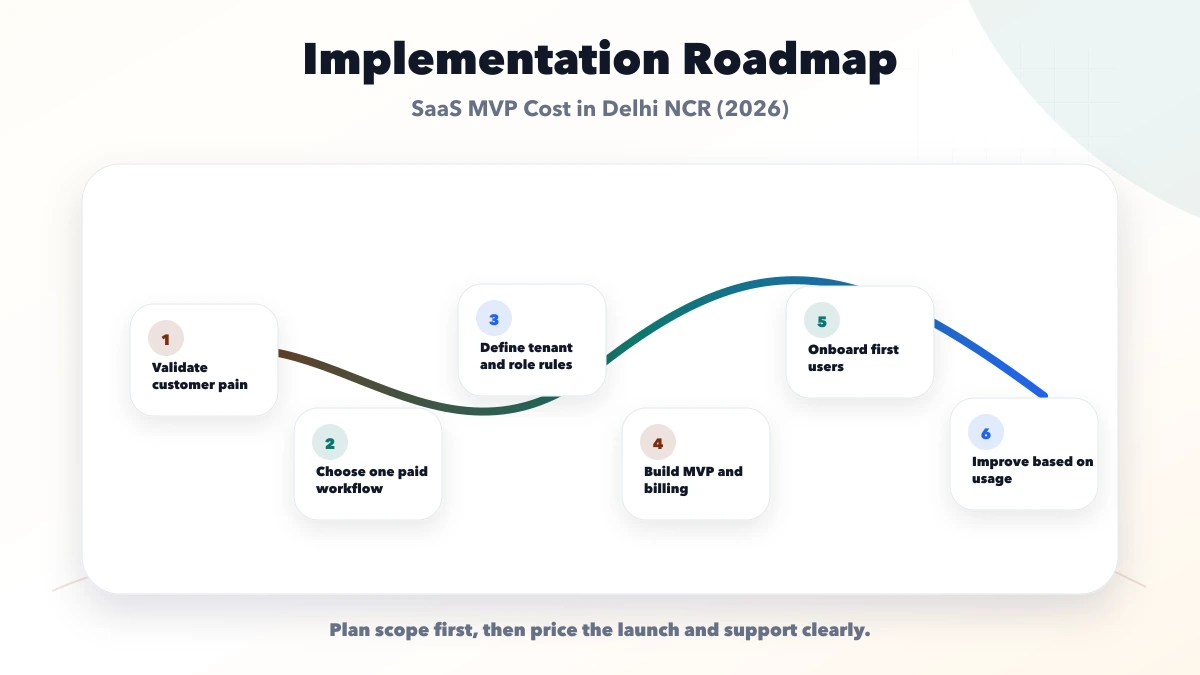
Interview users and inspect current workarounds.
Use a prototype or controlled manual service to validate the sequence.
Implement tenant, account, role, environment and monitoring basics.
Complete the recurring workflow with exception and support visibility.
Add billing and entitlements if required for the test.
Onboard a small cohort, measure activation and operate support.
Expand, adjust or stop based on evidence.
Examples:
Acceptance criteria convert budget into testable delivery.
Ask providers to identify:
Use selecting a SaaS development company for the broader partner evaluation. Use web app cost in Delhi NCR to compare screen, role and integration scope.
Current VASUYASHII evidence includes the Business Suite product, multi-company direction, authenticated APIs, role-aware operations, current billing and inventory modules, PDF workflows and a public live-demo route.
The product page distinguishes current functions from roadmap items. This is relevant product evidence but not proof that VASUYASHII has delivered every SaaS model or achieved a particular customer metric.
VASUYASHII does not use this article to promise:
Review Business Suite, software development services and custom software planning.
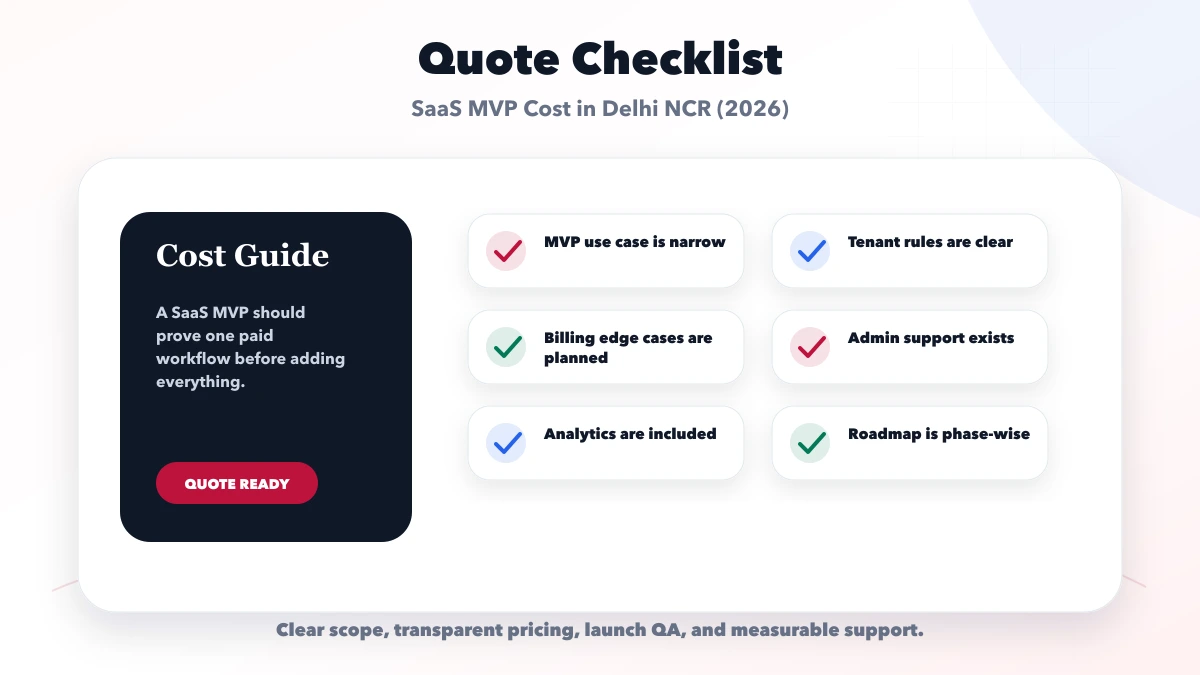
The narrowest complete product that tests one meaningful user job with required security, support and operational controls. There is no universal amount.
Yes, especially for a controlled beta. Manual commercial handling may be enough until automated billing becomes part of the learning.
Only when mobile-specific behavior is essential. Responsive web may be sufficient for the first release.
Use a cohort large and relevant enough to expose workflow and support issues. Quality of target users matters more than an arbitrary count.
Secondary personas, advanced reports, broad customisation, multiple billing models and speculative integrations are common candidates.
Project scope, team model and delivery process matter more. On-site work may affect logistics but does not define engineering quality.
Write the product hypothesis and choose the MVP type. Then define tenant, core job, activation event, billing assumption and launch cohort before requesting a detailed estimate. Contact VASUYASHII for a scoped discussion.
Related Articles
May 16, 2026
Plan a focused SaaS MVP with clear users, workflows, permissions, billing boundaries, acceptance checks, costs, and launch metrics for India.
Read article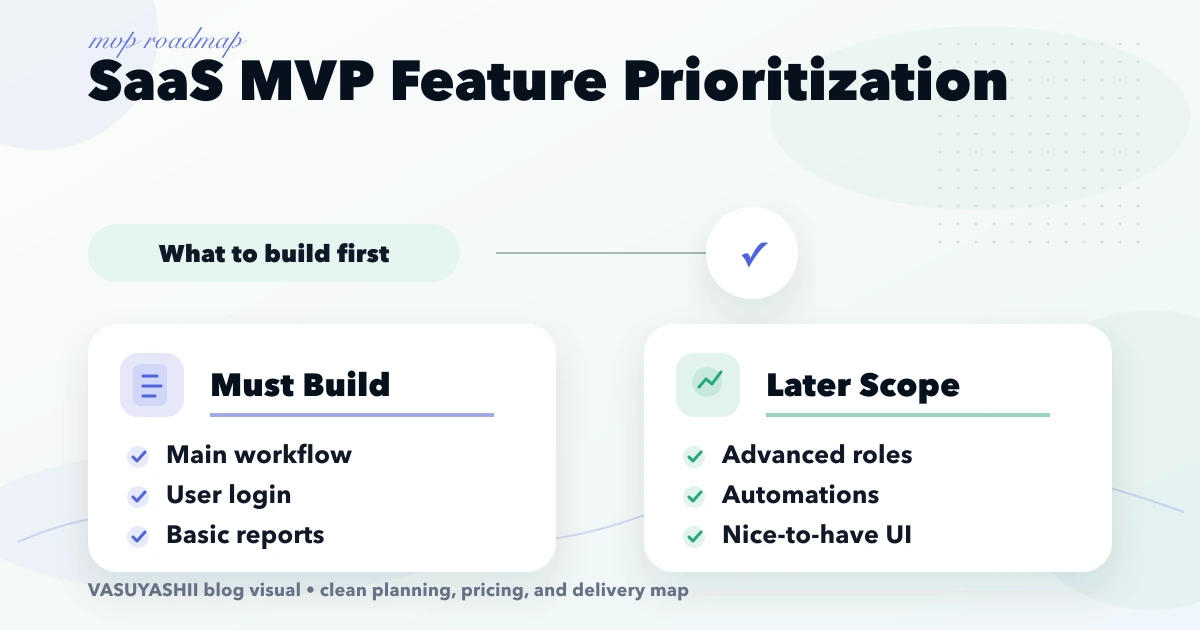
April 19, 2026
Prioritize a SaaS MVP using one core workflow, evidence, dependencies, acceptance metrics, security foundations, launch constraints, and a controlled roadmap.
Read article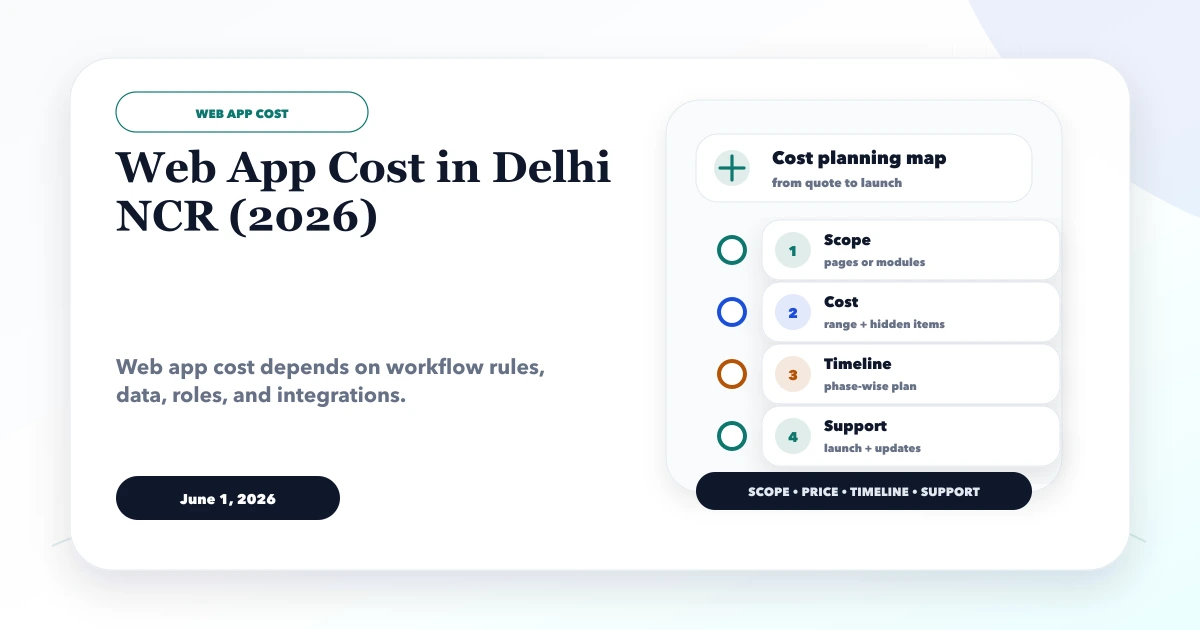
June 1, 2026
Estimate a Delhi NCR web app by workflows, roles, screens, integrations, data and acceptance—not page count—with practical planning bands.
Read article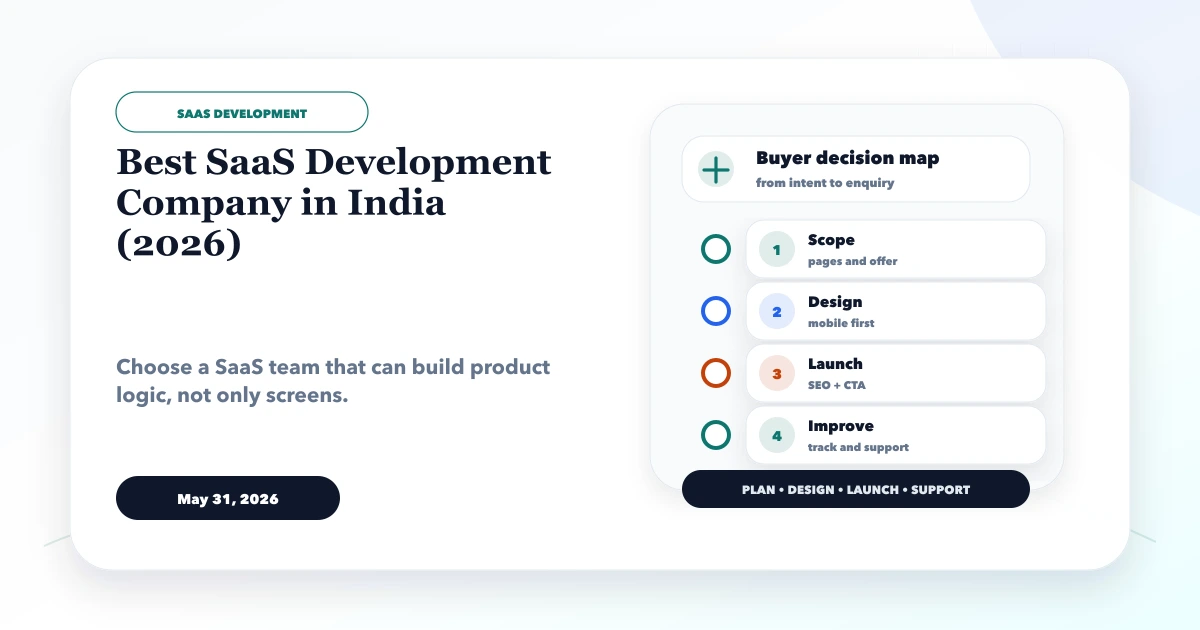
May 31, 2026
Evaluate SaaS development companies in India by product discovery, tenant security, billing, data ownership, testing, operations, handover, and support.
Read article