
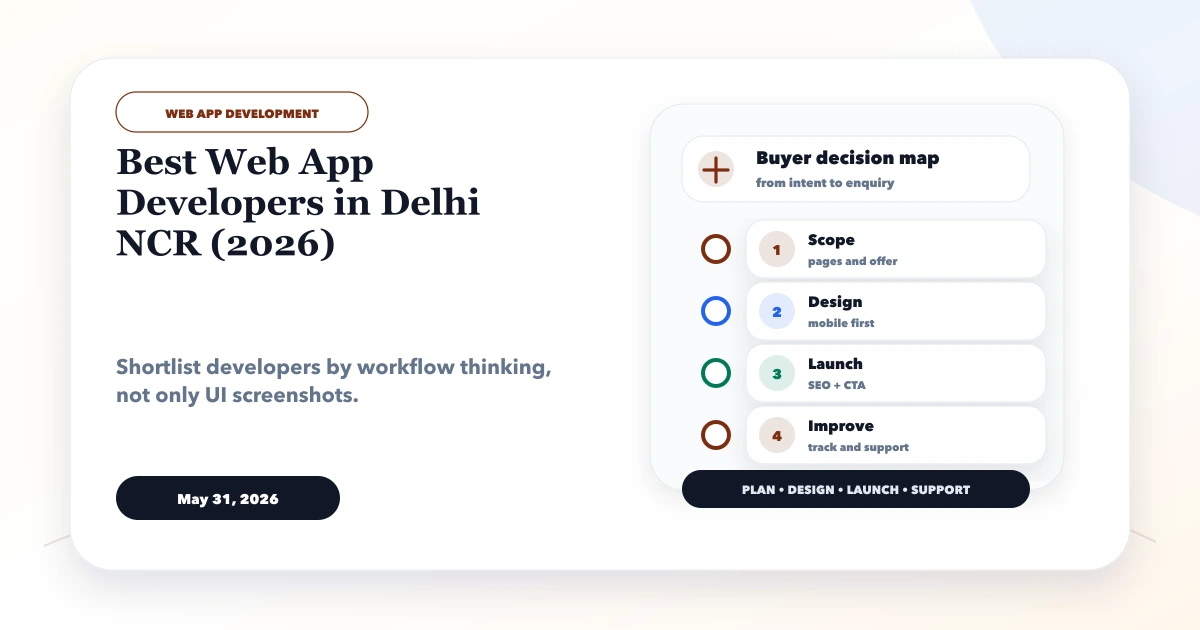
May 31, 2026
How to Select Web App Developers in Delhi NCR
Compare Delhi NCR web app developers using discovery, architecture, security, ownership, delivery evidence, support and a weighted vendor scorecard.
Read articlePublished Updated
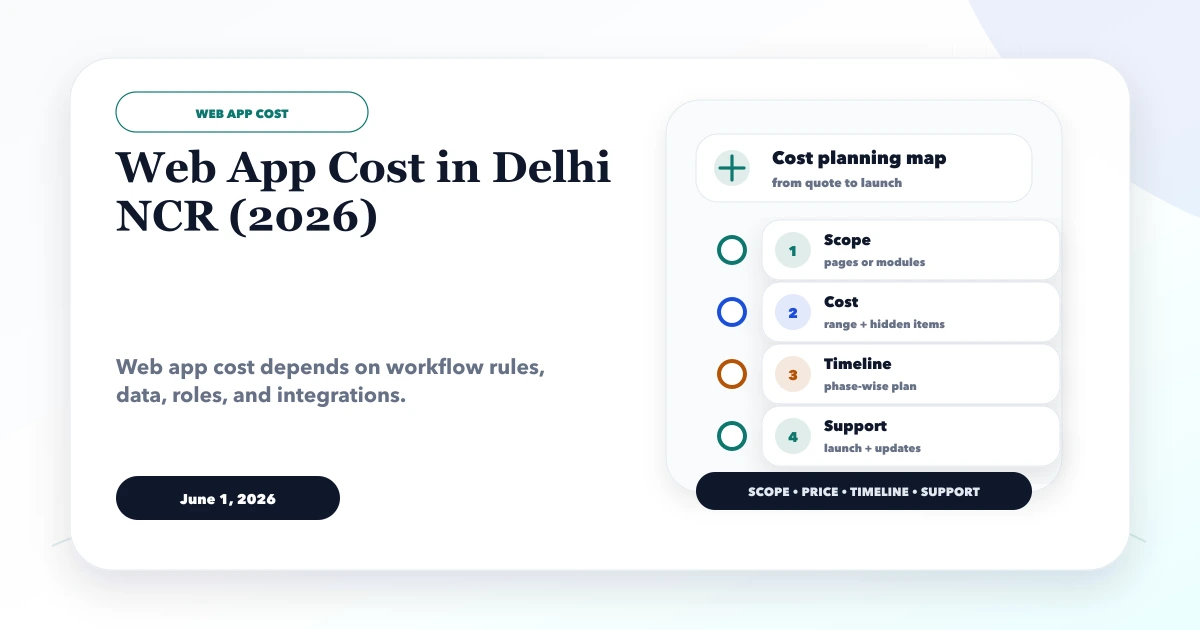
Estimate a Delhi NCR web app by workflows, roles, screens, integrations, data and acceptance—not page count—with practical planning bands.
Service-area note: VASUYASHII is based in Delhi NCR and supports businesses remotely across India. A city-focused guide describes service and planning context; it does not claim a physical office in every location mentioned.
Explore the parent topic: Web App Development Hub →Web application cost is driven by business behavior, not only screen count. Two systems may each show 20 screens, but one displays records while the other manages permissions, approvals, payments, imports, notifications and audit history.
This guide provides a scope-based estimation model for Delhi NCR businesses comparing quotes for dashboards, portals, CRM tools, booking systems and internal applications. The retained price bands are illustrative planning inputs, not fixed offers or market averages.
Estimate a web app across these units:
A useful quote states assumptions and exclusions for each unit. “Admin panel plus API” is not enough detail to control cost.
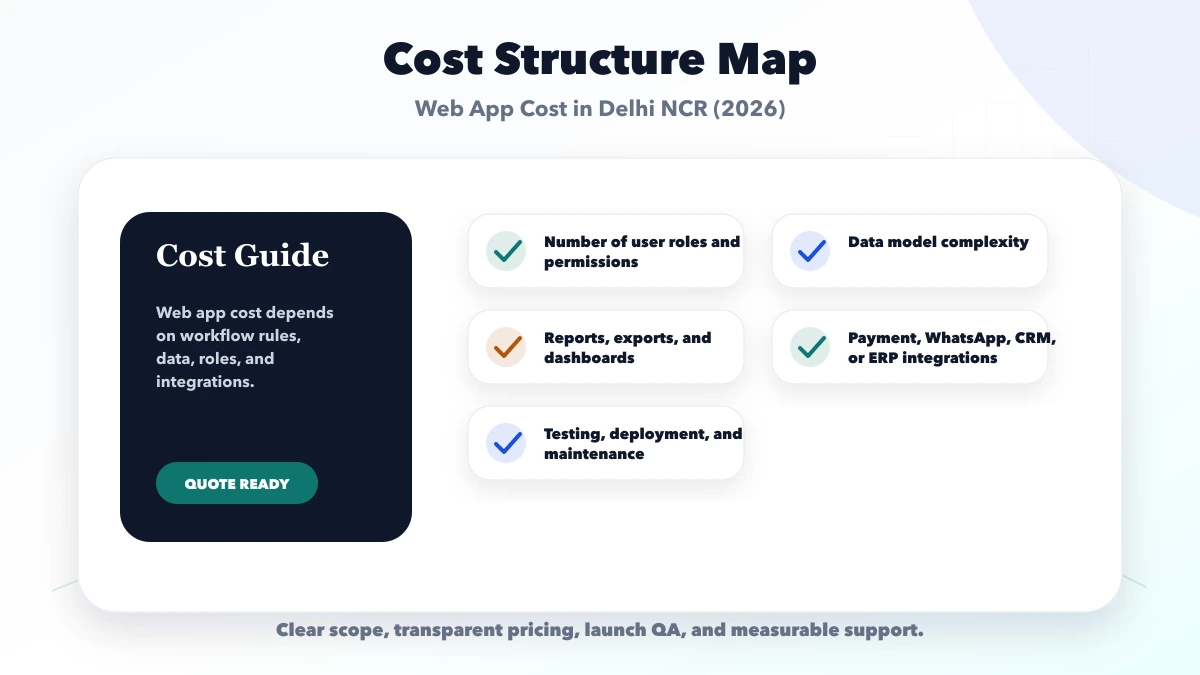
| Cost unit | Questions that change effort |
|---|---|
| Roles | How many permission groups and data scopes exist? |
| Records | Which entities, fields and relationships are required? |
| Workflows | Which approvals, cancellations and exceptions exist? |
| UI | Desktop, mobile web, responsive tables, accessibility, offline needs? |
| Integrations | Are APIs, sandboxes and webhooks available? |
| Data | Is migration clean, deduplicated and reconciled? |
| Reports | Are calculations and source records defined? |
| Documents | Are PDFs, templates, versions and signatures required? |
| Security | Audit logs, tenant isolation, sensitive-data controls? |
| Operations | Monitoring, backups, support and recovery expectations? |
Use this model to compare proposals line by line.
A vertical slice completes one useful workflow through:
For example, a quotation slice may let an authorised user select a customer and products, validate rates, save a draft, approve it, generate a PDF and record the activity. That produces clearer evidence than building unrelated screens across six modules.
Usually includes login, role-based work queues, forms, filters, exports and management reporting. Complexity grows with approval states, data volumes and permission boundaries.
Adds external identities, account recovery, company-scoped data, document access, support and activity history. Public-user security and privacy need stronger review.
Adds resources, availability, time zones, rescheduling, cancellation, reminders and potentially payments. Calendar edge cases often exceed the visible screen count.
Adds company/contact records, stages, tasks, follow-ups, notes, quotations, reports and integrations. Define which system owns customers and financial status.
Adds tenant onboarding, subscriptions, entitlements, support operations and product analytics. Use the SaaS MVP cost guide for that narrower product decision, then evaluate the delivery partner with the SaaS development company framework.
| Scope | Existing planning band | Typical delivery window |
|---|---|---|
| Focused web app MVP | Rs. 1.8 lakh to Rs. 5 lakh | 4 to 10 weeks |
| Business web app | Rs. 5 lakh to Rs. 12 lakh | 2 to 4 months |
| Advanced platform with integrations | Rs. 12 lakh to Rs. 35 lakh+ | 4 to 9 months |
These retained bands are for early planning only. They are not a fixed VASUYASHII quote or a verified Delhi NCR market average.
Simple staff login is different from multi-company roles, delegated administration, SSO and field-level restrictions.
Create-edit-delete is cheaper than approval, rejection, correction, cancellation, versioning and escalation.
Provider documentation, sandbox quality, webhook reliability, rate limits and certification can materially change effort.
Clean records with stable identifiers are cheaper than duplicate files, missing fields and unverified opening balances.
Simple filtered lists are different from reconciled financial or operational calculations.
Higher uptime, monitoring, incident response and recovery expectations require more engineering and operations.
Put recurring and one-time costs in separate columns.
Ask each provider to complete the same table.
| Area | Provider response |
|---|---|
| Included workflows | exact named flows |
| Roles and data scope | permission matrix |
| Integrations | provider, direction and failure behavior |
| Migration | source, volume and reconciliation |
| Deliverables | code, UI, APIs, schema, documents |
| Acceptance | testable examples |
| Environments | development, staging and production |
| Ownership | repository, cloud, data and accounts |
| Support | period, severity and response |
| Exclusions | explicit future scope |
The Delhi NCR web app developer guide covers provider evaluation beyond price.
Before approving custom development, compare:
Use custom software development in Delhi NCR for the broader build-versus-buy decision.
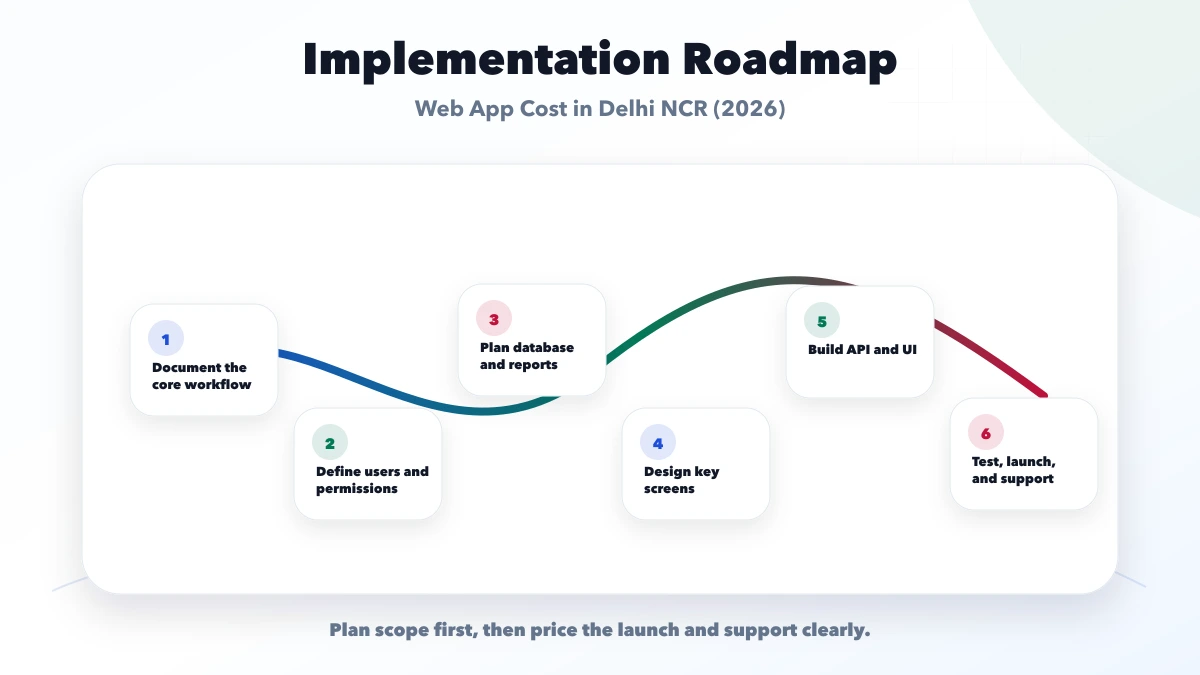
Provide sample records, roles, workflows, integrations and acceptance examples.
Resolve unknowns that could change architecture or cost.
Set up authentication, company scope, shared components, data model and environments.
Build the vertical slice and validate it with real operating examples.
Add approved modules in priority order.
Complete migration, security checks, acceptance, monitoring and handover.
Do not treat these labels as a universal calendar. Delivery depends on the accepted scope and team.
Not every number in an early proposal deserves the same confidence. Mark each estimate as exploratory, scoped or committed.
Ask the provider to identify which assumptions could move the estimate and who must resolve them. Migration quality, external API access, payment-provider approval and unclear permissions are common sources of variation. A proposal becomes more useful when uncertainty is labelled instead of hidden inside one confident total.
Fixed-price contracts still need change control. Agile delivery still needs budget and acceptance boundaries.
A web app quote should include:
Removing these items may lower the quote without lowering the business risk.
Current VASUYASHII public evidence includes web application and custom software service pages, industry demos and the VASUYASHII Business Suite.
The Business Suite provides inspectable current product workflows for multi-company access, billing, inventory, customers, vendors, purchases, payments, expenses, reports and PDFs. Its public product page also distinguishes current scope from roadmap items.
This article does not claim:
Review web application services, current service scope and Business Suite.
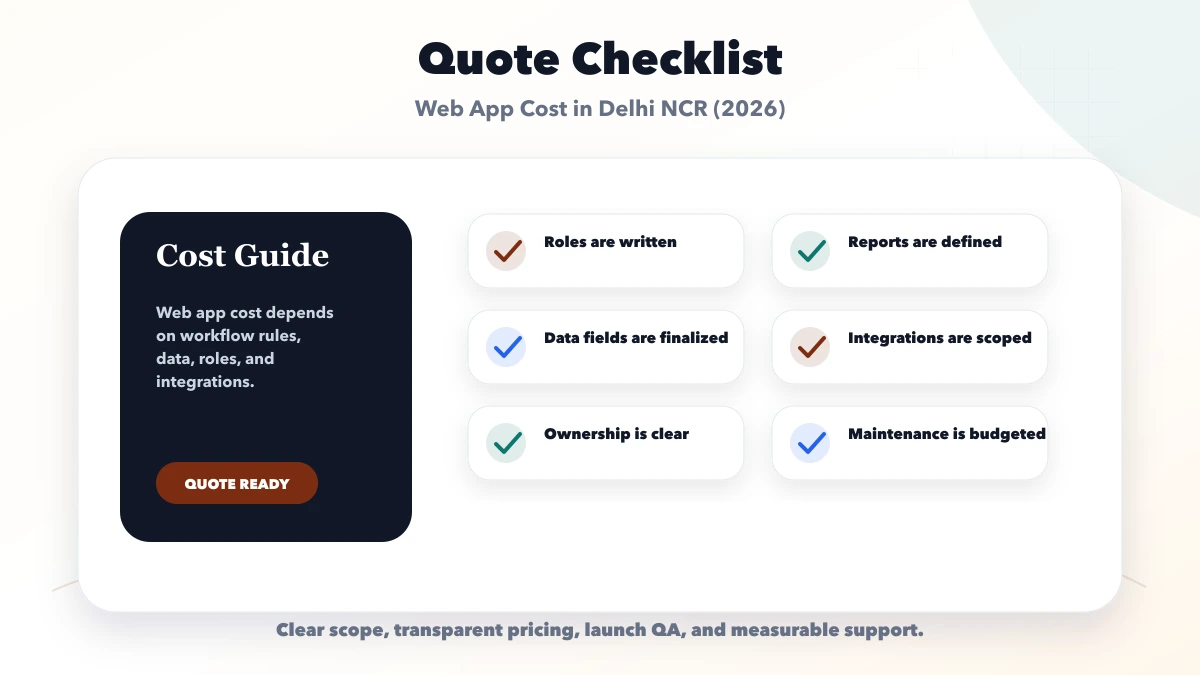
A planning range is possible, but a reliable quote needs users, records, workflows, integrations, migration and acceptance assumptions.
They may include different architecture, design, migration, testing, ownership and support. Compare assumptions and exclusions, not only totals.
Only when it limits scope while retaining a complete useful outcome. A collection of unfinished screens is not a useful MVP.
Not automatically. Ask whether cloud, storage, backups, messaging, monitoring and support are included or recurring.
Add native or Flutter apps only when mobile-specific workflows justify them. A responsive web app may be sufficient for the first release.
Include provider onboarding, checkout, server-side verification, webhook handling, reconciliation, refunds where needed and failure states.
Prepare a one-page estimate brief with users, records, first workflow, integrations, migration samples and acceptance conditions. Then request comparable written proposals or discuss the scope with VASUYASHII.
Related Articles
May 31, 2026
Compare Delhi NCR web app developers using discovery, architecture, security, ownership, delivery evidence, support and a weighted vendor scorecard.
Read article
May 10, 2026
Use this web app quotation checklist to compare scope, modules, user roles, integrations, milestones, pricing, ownership, support, and acceptance terms.
Read article
June 1, 2026
Estimate a Delhi NCR SaaS MVP using product risk, tenant model, core workflow, billing, security, analytics, support and staged budget bands.
Read article
June 1, 2026
Plan a Delhi NCR website redesign with content inventory, SEO migration, UX, performance, analytics, acceptance and practical budget bands.
Read article