
May 30, 2026
Website Redesign Services in Delhi NCR
Website redesign services in Delhi NCR guide for SEO-safe redesign, speed, UX, content, redirects, pricing, and launch checklist.
Read articlePublished Updated
Plan a Delhi NCR website redesign with content inventory, SEO migration, UX, performance, analytics, acceptance and practical budget bands.
Service-area note: VASUYASHII is based in Delhi NCR and supports businesses remotely across India. A city-focused guide describes service and planning context; it does not claim a physical office in every location mentioned.
Explore the parent topic: Website Development Delhi NCR Hub →A website redesign is not only a visual project. It may change URLs, headings, content, forms, analytics, performance, accessibility and the path from search to enquiry. An attractive launch can still lose traffic or leads when migration controls are missing.
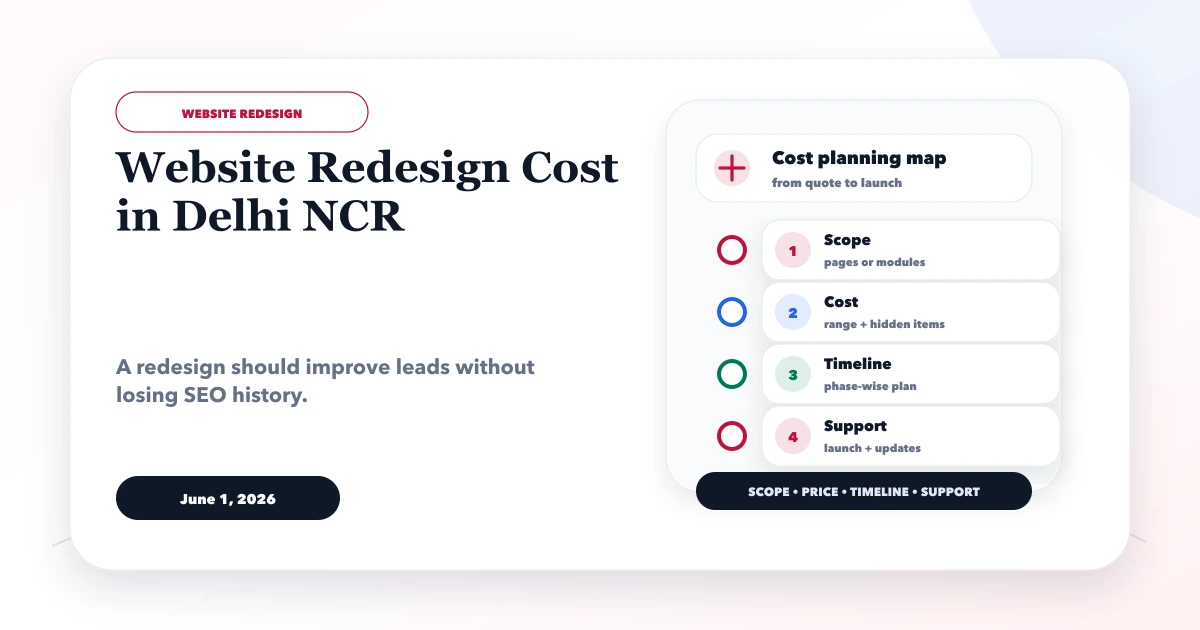
This guide helps Delhi NCR businesses estimate a redesign by risk and deliverables. It separates visual refresh, conversion work, content migration and technical SEO so quotes can be compared. The retained bands are planning references, not fixed offers or verified market averages.
Before requesting a redesign quote, prepare:
The quote should separate one-time redesign work from ongoing maintenance.
| Scope | What changes | Main risk |
|---|---|---|
| Visual refresh | typography, colour, spacing, components | underlying content and conversion remain weak |
| UX and content redesign | structure, copy, proof, forms, mobile flow | uncontrolled review and content delay |
| Platform migration | framework, CMS, routes, data, hosting | redirects, metadata, forms and analytics break |
Name the scope before comparing price.
A redesign is not always the correct first action. Classify the site before requesting proposals.
Choose repair when the information architecture, CMS or framework is still workable and the main problems are isolated: broken forms, weak mobile spacing, outdated sections, missing tracking or slow assets. Repair should have a short defect list and acceptance evidence. It is usually the least disruptive option because routes and publishing workflows remain stable.
Choose redesign when the platform can support the business but users struggle to understand the offer, find services, trust proof or complete the enquiry path. The project should change navigation, page hierarchy, content, components and conversion states while protecting useful URLs and search signals.
Choose rebuild when the current platform blocks required security, performance, integrations, content operations or maintainability. A rebuild needs migration samples, a route map, redirect rules, data reconciliation, rollback planning and ownership of the new infrastructure.
Do not let visual preference decide this classification. Record the constraint, its business impact, the evidence and the lowest-risk intervention. A proposal that recommends a rebuild should explain which requirements cannot be met safely through repair or redesign. This prevents budget from being spent on a new stack when the actual problem is content, lead routing or governance.
Capture:
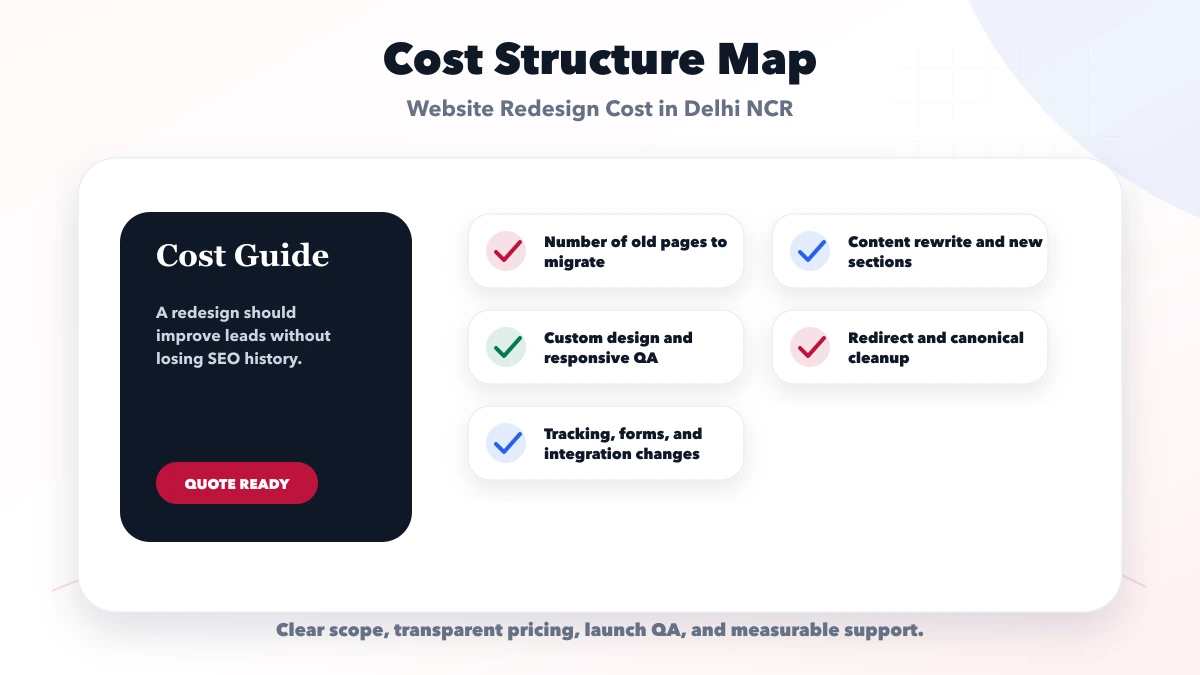
Do not delete a page merely because the design is old. It may carry query relevance, links or customer value.
Useful outcomes include:
Avoid goals such as “modern look” without acceptance examples.
For each page decide:
Content production may require:
If content is excluded, state who supplies final copy and by which date.
Google's developer guidance recommends crawlable links and search-friendly pages that work securely, quickly and across devices. A redesign should preserve those foundations.
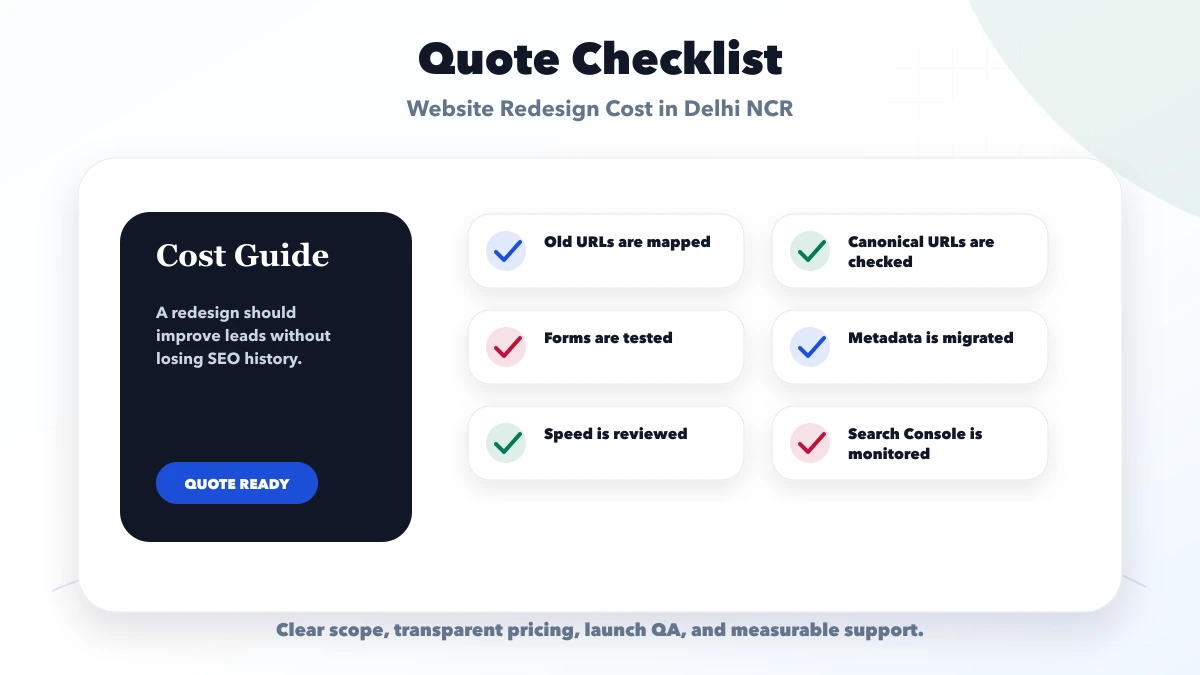
Create a redirect map before launch:
| Old URL | New URL | Action | Reason |
|---|---|---|---|
| retained page | same URL | no redirect | preserve public address |
| merged page | strongest equivalent | permanent redirect | consolidate intent |
| changed slug | final destination | permanent redirect | route migration |
| removed low-value page | closest valid equivalent or gone | case review | avoid irrelevant redirect |
Also validate:
Use SEO website development services in Delhi NCR for the build-time search requirements.
The redesign should define:
Google Analytics recommends generate_lead when a user submits a form or information request. Track the completed outcome, not only a button click.
For campaign-specific experiences, a focused landing page may be cheaper and safer than redesigning the entire site. See landing page cost in Delhi NCR.
Include:
Capture a before baseline and use the same test method after launch. Lab scores vary, so avoid guaranteeing one number.
At minimum:
Accessibility cannot be repaired only by a plugin at the end.
| Scope | Existing planning band | Typical delivery window |
|---|---|---|
| Visual refresh | Rs. 45,000 to Rs. 1.2 lakh | 2 to 5 weeks |
| SEO-safe business redesign | Rs. 1.2 lakh to Rs. 3 lakh | 5 to 9 weeks |
| Custom redesign with CMS or integrations | Rs. 3 lakh to Rs. 8 lakh+ | 2 to 5 months |
These retained bands are for early planning, not fixed VASUYASHII prices or verified Delhi NCR averages.
Ask whether taxes, licences, hosting, copy, images and support are included.
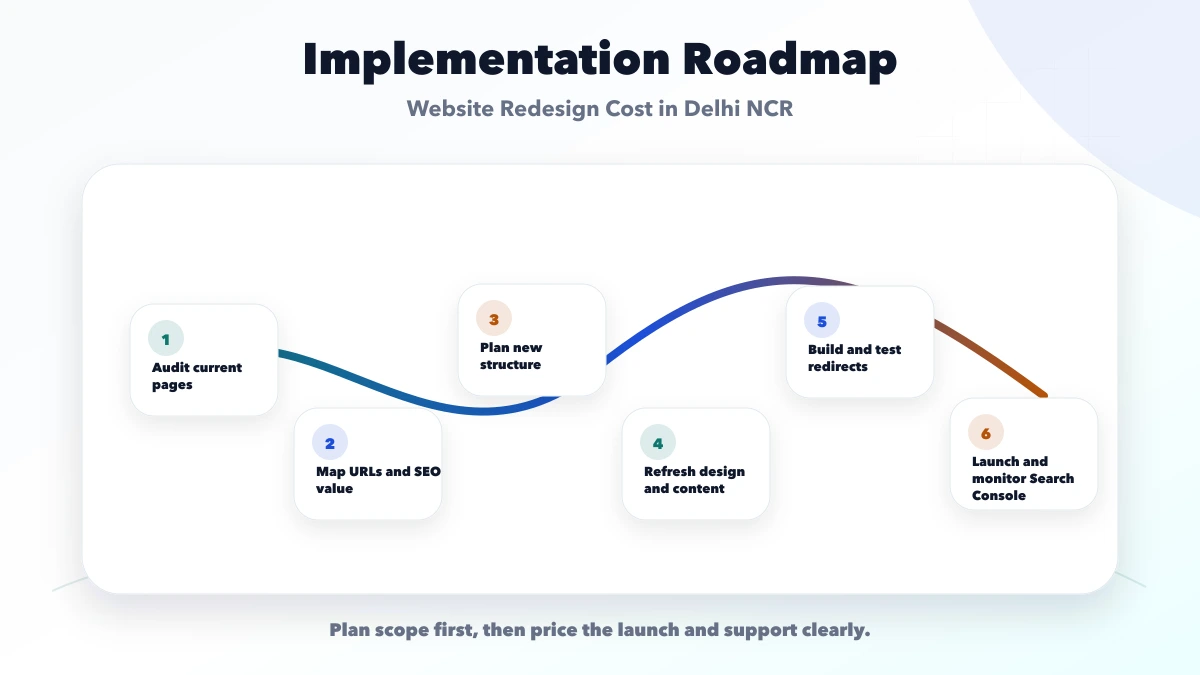
Crawl, analytics, forms, performance, screenshots and lead flow.
Audience, pages, information architecture, content plan and success measures.
Key responsive templates, components, states and accessibility.
Implement pages, CMS, forms, tracking and technical SEO.
Test redirects, metadata, content, assets and integrations on staging.
Deploy with backup and rollback. Validate critical routes immediately.
Monitor errors, analytics, Search Console, forms and rankings over comparable periods.
Current VASUYASHII public evidence includes a Next.js static website, final-www canonical system, sitemap, structured data, GA4 events, responsive service pages, public demos and the Business Suite product page.
The current site has also undergone internal-link, metadata, performance and content-quality work. These are implementation facts for this website, not proof of a documented redesign result for an external Delhi NCR client.
VASUYASHII does not use this article to claim:
Review website development services, current services and website maintenance cost.
No. Prioritise pages with business value, traffic, links or user problems. Some content may need consolidation rather than visual work.
Usually, valuable public URLs should stay stable unless there is a clear architecture reason to change them.
No. It can help when content, architecture, performance and usability improve, but poor migration can damage existing signals.
Assign an owner. The business supplies accurate expertise and proof; a writer can structure it. The quote should state what is included.
Monitor immediately for technical failures and continue comparing analytics and Search Console over several weeks.
Not always. Workshops may help, but migration discipline, evidence, communication, ownership and support are more important.
Export the current URL inventory and mark every page keep, improve, merge or retire. Then request a redesign estimate that includes content, migration, tracking and launch support. Contact VASUYASHII when the inventory is ready.
Related Articles
May 30, 2026
Website redesign services in Delhi NCR guide for SEO-safe redesign, speed, UX, content, redirects, pricing, and launch checklist.
Read article
March 24, 2026
Plan website redesign cost in India by auditing pages, content, templates, SEO migration, performance, integrations, accessibility, QA, and launch.
Read article
June 1, 2026
Estimate a Delhi NCR web app by workflows, roles, screens, integrations, data and acceptance—not page count—with practical planning bands.
Read article
June 12, 2026
Diagnose why a polished website loads slowly. Trace hero media, fonts, scripts, CSS, hosting, render delay and mobile bottlenecks before changing the design.
Read article