
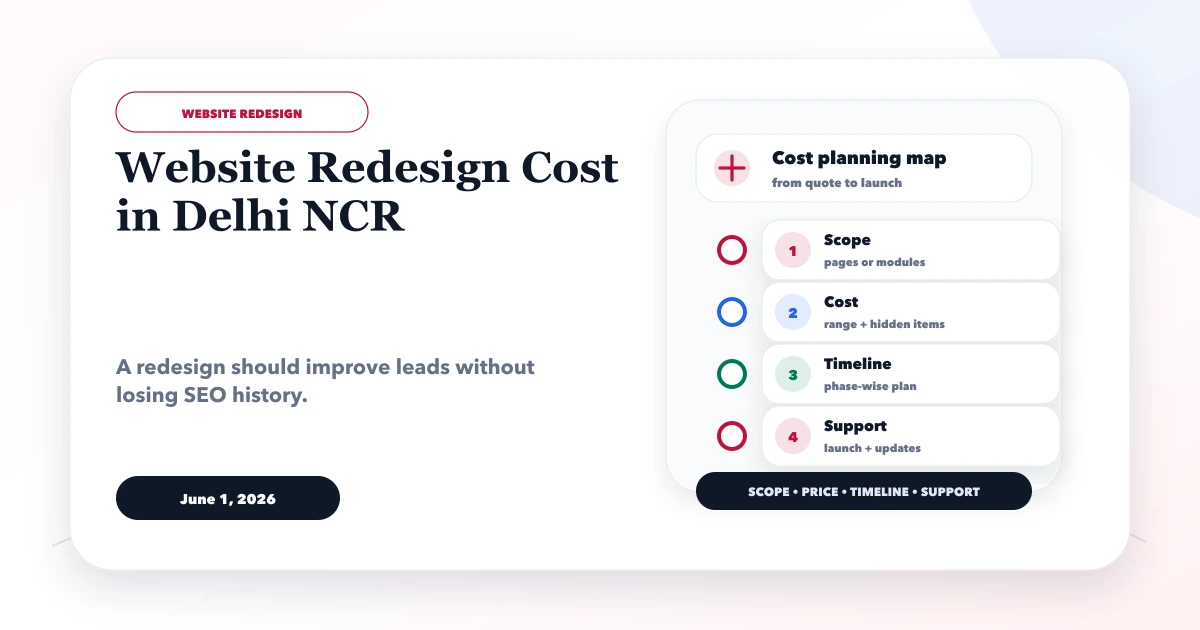
June 1, 2026
Website Redesign Cost in Delhi NCR: Safe Scope
Plan a Delhi NCR website redesign with content inventory, SEO migration, UX, performance, analytics, acceptance and practical budget bands.
Read articlePublished Updated
Website redesign services in Delhi NCR guide for SEO-safe redesign, speed, UX, content, redirects, pricing, and launch checklist.
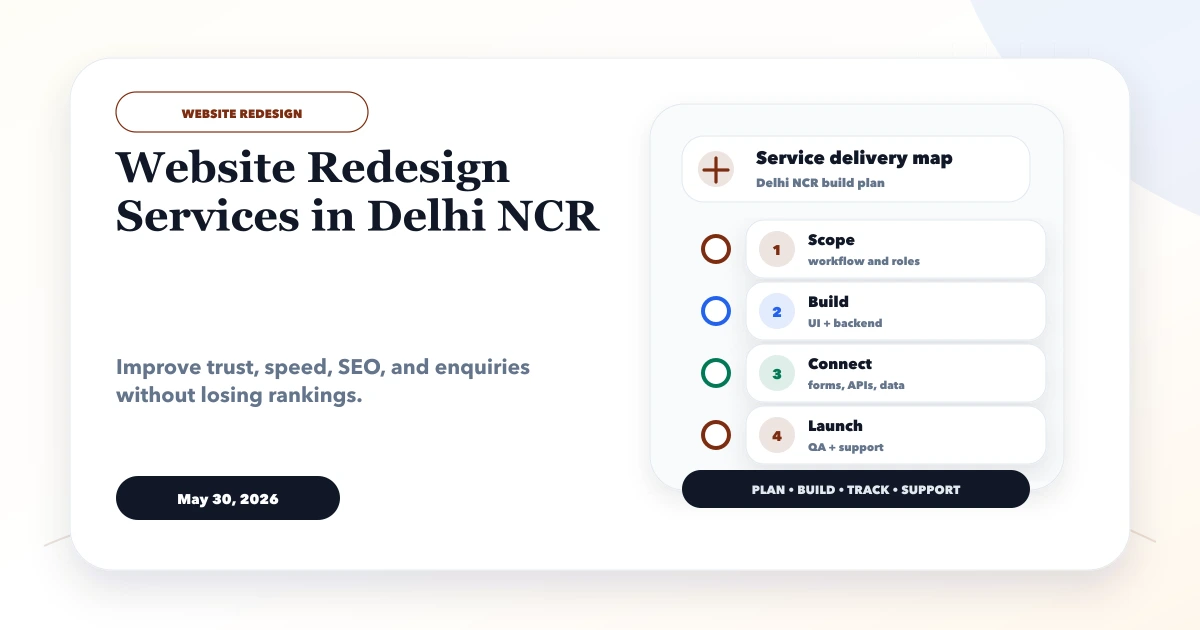
Service-area note: VASUYASHII is based in Delhi NCR and supports businesses remotely across India. A city-focused guide describes service and planning context; it does not claim a physical office in every location mentioned.
Explore the parent topic: Website Development Delhi NCR Hub →This guide explains website redesign services in Delhi NCR for businesses planning serious digital work in Delhi NCR. It focuses on practical scope, pricing, deliverables, timeline, and what to check before hiring a development partner.
For local service searches, a useful page should not only repeat the city name. It should explain what will be built, who it is for, what the business owner should prepare, and how the project will generate real leads or operational control.
By Tushar C. (Founder, VASUYASHII). Reviewed by VASUYASHII Editorial for practical project scoping, web app development, software delivery, local SEO, and conversion-focused website planning.
Website redesign services in Delhi NCR should improve UX, mobile speed, trust, copy, service pages, conversion flow, and SEO migration. A redesign should not break URLs, metadata, sitemap, redirects, or existing rankings.
Yes. A redesign can preserve the current domain, useful URLs, content, analytics properties, and integrations while replacing weak templates, navigation, responsive behaviour, components, or conversion paths. A full rebuild is necessary only when the platform, code quality, ownership, security, or content model prevents the required improvement.
Before choosing the approach, classify each major part as keep, improve, replace, migrate, or retire with evidence. Keeping a URL does not mean keeping weak copy or layout; changing the visual system does not require changing a URL that already serves the right intent.
A business may have an old website that looks outdated, loads slowly, and gets traffic without leads. Redesign should not only make it modern; it should protect SEO, improve page structure, and make contact paths clearer.
The goal is not to buy the largest package. The goal is to choose the smallest complete phase that solves a real business problem, gives reliable data, and can be improved safely.
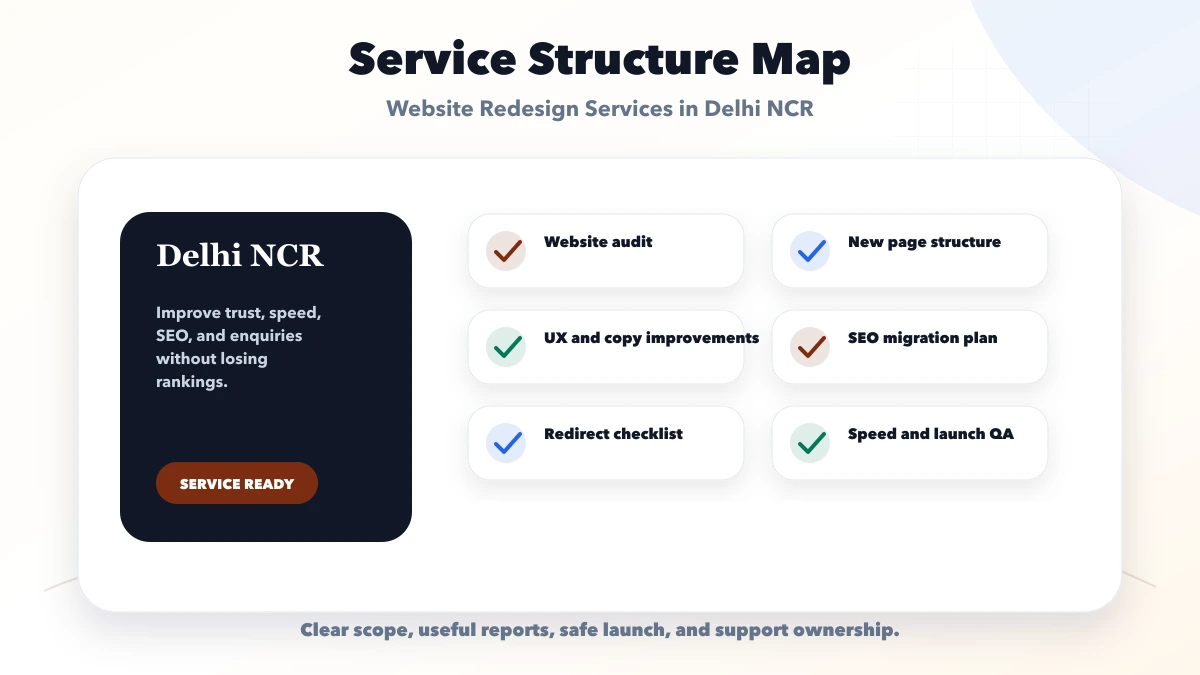
Each deliverable should have a clear owner, acceptance rule, and handover expectation. If the proposal only names features without explaining workflow, reports, security, or support, the estimate may look attractive but become risky later.
Provide the current domain, URL inventory, business goal, target audience, important landing pages, Search Console and analytics ownership, lead destinations, brand files, content owner, integrations, technical access, examples, deadline, and known defects. Sensitive credentials should be shared through controlled access, not pasted into an initial enquiry.
Ask the provider to return a written scope containing keep/change decisions, page and template counts, content responsibility, responsive states, redirect rules, analytics events, form testing, accessibility, performance, QA, launch, rollback, warranty, maintenance, and exclusions.
Final handover should include source access, domain and hosting ownership, production credentials, design source where included, approved URL map, dependency and subscription list, analytics/Search Console administration, form destinations, deployment notes, backup and rollback steps, known limitations, and support responsibility.
Use the website delivery checklist before final payment. A live homepage without business-controlled accounts, tested forms, and migration records is not a complete redesign handover.
| Scope | Practical price range | Timeline |
|---|---|---|
| Basic redesign | Rs. 35,000 to Rs. 90,000 | 2 to 4 weeks |
| SEO-safe business redesign | Rs. 90,000 to Rs. 2.5 lakh | 4 to 8 weeks |
| Large redesign and migration | Rs. 2.5 lakh to Rs. 7 lakh+ | 2 to 4 months |
These ranges are planning ranges, not fixed quotations. Final pricing depends on screens, user roles, reports, integrations, data migration, content, testing, deployment, and support.
This roadmap keeps the project practical. Start with a reliable phase one, then add advanced automation, reports, SEO content, integrations, or customer-facing modules after real usage is clear.
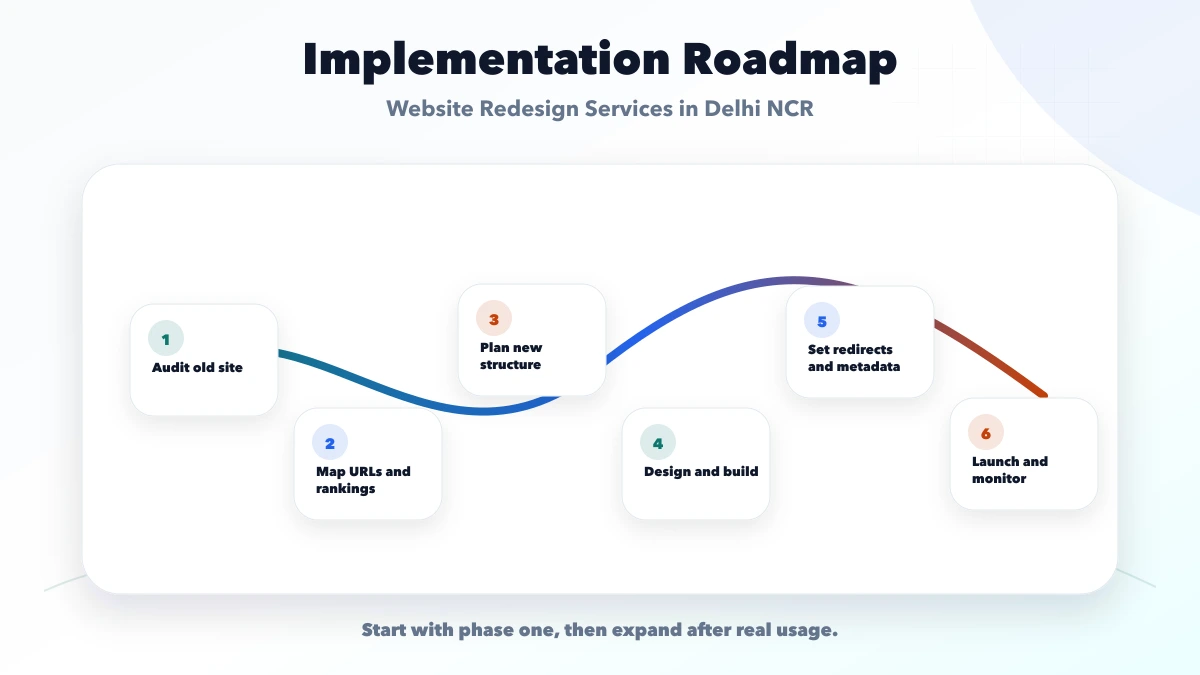
Use this checklist before approving a quote. A good vendor should be able to explain scope, timeline, exclusions, support, ownership, and what will be tested before launch.
VASUYASHII would first map the business goal, user roles, lead flow, data, reports, and launch priority. Then we would create a phase-wise scope instead of forcing everything into one unclear build.
Useful links: web application services, software development, integrations, services, and contact.
Avoid approving only a visual mockup. For website redesign, the real value comes from workflow clarity, fast mobile experience, reliable forms or data, secure handover, and post-launch support.
Before redesigning a Delhi NCR business website, list every important URL, ranking page, lead page, blog post, service page, project page, and landing page. The redesign should protect the pages that already bring impressions or enquiries. If a URL must change, prepare a redirect map before launch. If a page is weak but still relevant, refresh it instead of deleting it blindly.
A safe redesign should include:
This is especially important when the website has many blogs, city pages, or service pages. A redesign that ignores SEO can create indexing drops, duplicate canonical signals, broken internal links, and lost leads.
A modern design is useful only when it improves action. Redesign should make the offer clearer, reduce confusion, improve trust, and move users toward a call, WhatsApp message, form submission, demo request, or quote request.
For a service business, we usually review the hero section, service cards, proof blocks, FAQs, contact section, sticky CTA, mobile menu, footer, and page speed. For a software or web app business, we also review product screenshots, demo CTAs, comparison sections, pricing signals, and links to web application services, software development, services, and contact.
The best redesign outcome is not "new look". It is cleaner navigation, stronger content, faster mobile experience, safer SEO migration, and better lead tracking.
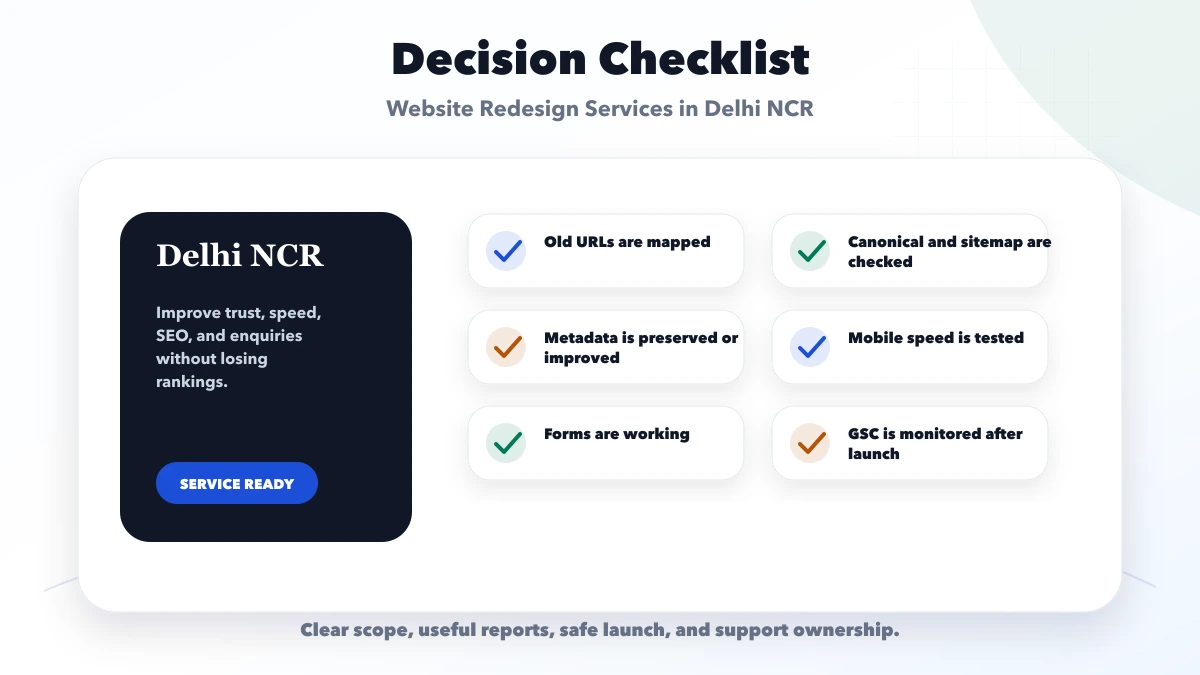
Yes, if URLs, content, metadata, internal links, or redirects are handled badly.
When it is slow, outdated, hard to update, not converting, or structurally weak for SEO.
Useful blogs should usually be preserved, refreshed, and linked properly.
URL mapping, content quality, speed, mobile UX, metadata, redirects, forms, and tracking.
No provider can guarantee unchanged rankings. VASUYASHII can preserve relevant URLs, plan direct redirects, validate metadata and canonicals, test the sitemap and internal links, and monitor the migration so avoidable technical losses are reduced and defects are corrected quickly.
The current VASUYASHII site uses a final-www canonical domain, generated sitemap, static Next.js pages, crawlable service hubs, contextual contact selection and confirmed-lead analytics. These implemented controls form the redesign baseline; a new visual layer should not discard them.
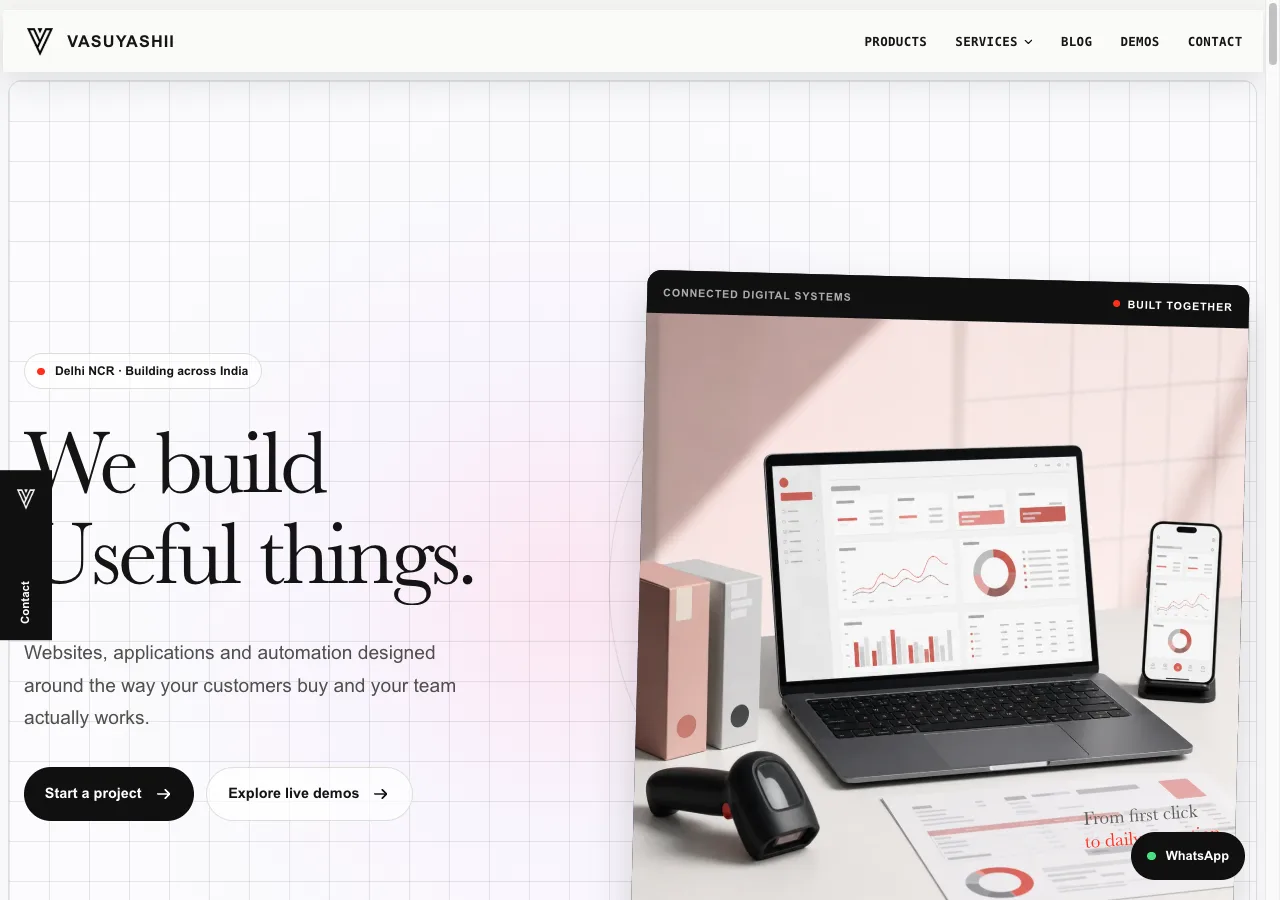
This screenshot is a visual baseline for navigation, message hierarchy and CTA placement. A redesign comparison should pair it with crawl, analytics and lead-delivery evidence rather than relying on appearance alone.
| Migration item | Pre-launch evidence | Rollback trigger |
|---|---|---|
| URL inventory | old-to-new map with keep/redirect decision | missing high-value route |
| metadata | canonical, title, description and OG sample | wrong host or generic canonical |
| content | approved page comparison | important proof/intent removed |
| forms | readable backend success and failure tests | false success or lost service context |
| analytics | contact and confirmed-lead events in DebugView | events fire before outcome |
| sitemap | only final indexable URLs | redirect/noindex URL listed |
Decision example: if the existing URL ranks and its intent remains valid, redesign the component and preserve the route. Redirect only when the destination truly replaces the old page. Combining unrelated pages to reduce page count can damage relevance even if the new design looks cleaner.
Limitations: VASUYASHII cannot guarantee preserved rankings because Google recrawls and re-evaluates changed pages. A staging Lighthouse score is not field performance. Third-party scripts, hosting, DNS and old backlinks can affect outcomes beyond the redesign code.
Google's sitemap guide recommends canonical absolute URLs intended for search. Use the Search developer guide for crawl/render checks and Web Vitals guidance for field-oriented performance monitoring.
Export the current route list, top landing pages, Search Console queries, contact destinations and analytics events before design work begins. Capture the page title, canonical, primary heading, important body copy and incoming internal links for each commercial route. This gives the team a recovery reference when the new template accidentally removes a meaningful signal.
Create a component migration list rather than approving screenshots page by page. Navigation, hero, proof, service grid, article layout, CTA, form, footer and structured data each need one owner and one acceptance rule. A consistent system reduces regression risk, but it must allow the content hierarchy of each page to remain different.
Run a staged crawl and compare counts: indexable pages, redirects, noindex routes, canonical hosts, broken links and sitemap entries. Then submit realistic test enquiries from service and product CTAs and confirm that the selected context reaches the saved lead. A visual approval without these checks is not a completed redesign.
Keep launch reversible. Preserve DNS and hosting access, document redirect rules, maintain a copy of the previous output and choose a monitoring window. If a high-value route breaks, forms stop saving or canonical URLs change unexpectedly, restore or patch the affected part immediately instead of waiting for ranking reports weeks later.
If you want a practical website redesign plan for Delhi NCR, VASUYASHII can help with scope, design, development, integrations, tracking, launch, and maintenance.
Related Articles
June 1, 2026
Plan a Delhi NCR website redesign with content inventory, SEO migration, UX, performance, analytics, acceptance and practical budget bands.
Read article
June 12, 2026
Diagnose why a polished website loads slowly. Trace hero media, fonts, scripts, CSS, hosting, render delay and mobile bottlenecks before changing the design.
Read article
March 21, 2026
Business website redesign guide for 2026 with SEO migration, speed, UX, trust signals, conversion upgrades, tracking, and launch checklist.
Read article
May 18, 2026
Improve WooCommerce speed with an India-focused audit of hosting, cache, database, plugins, themes, images, checkout safety, Core Web Vitals, and release QA.
Read article