
May 31, 2026
How to Choose a SaaS Development Company in India
Evaluate SaaS development companies in India by product discovery, tenant security, billing, data ownership, testing, operations, handover, and support.
Read articlePublished Updated
Evaluate a Delhi NCR SaaS development company through product discovery, tenancy, billing, security, ownership, launch operations and support evidence.
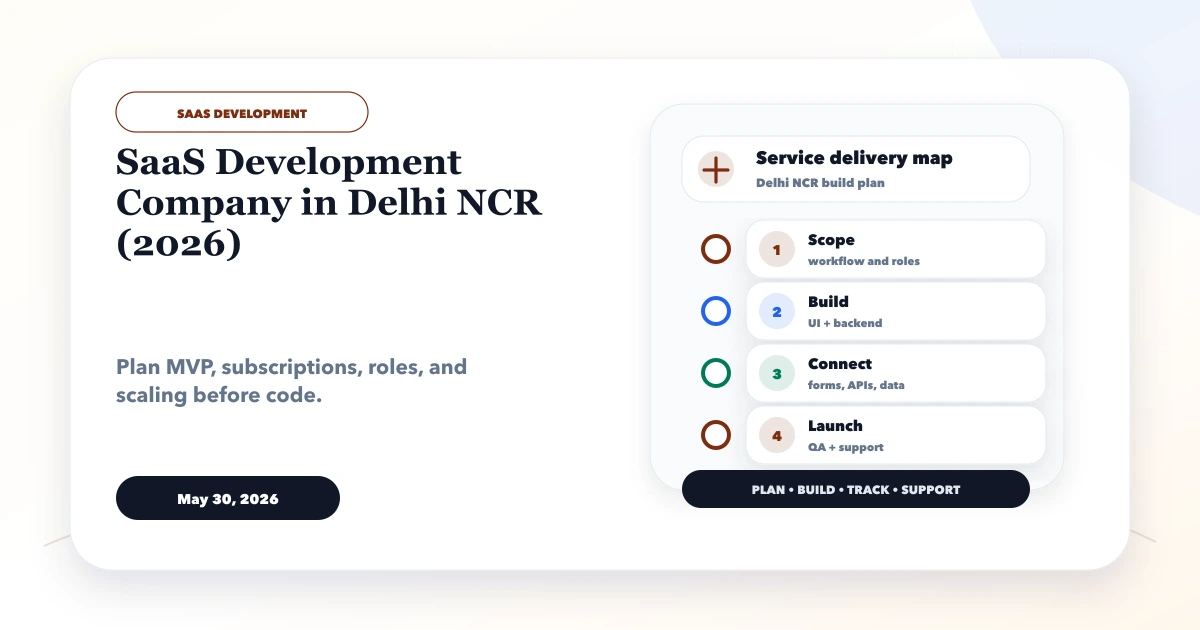
Service-area note: VASUYASHII is based in Delhi NCR and supports businesses remotely across India. A city-focused guide describes service and planning context; it does not claim a physical office in every location mentioned.
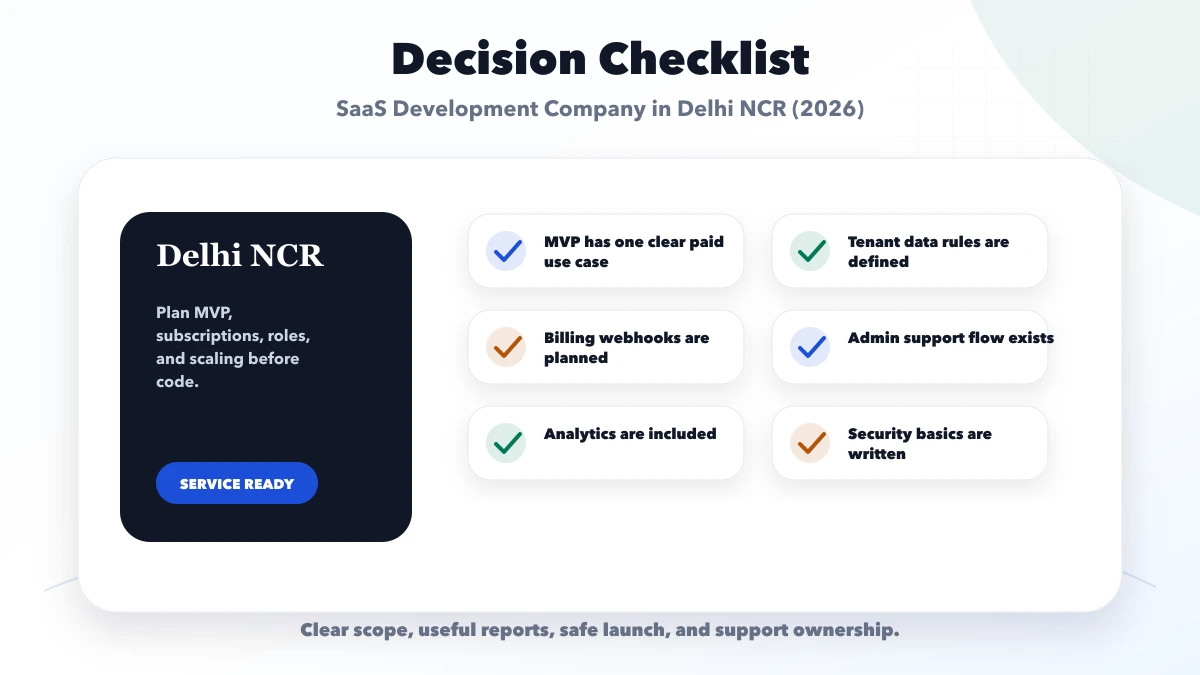
Explore the parent topic: Website Development Delhi NCR Hub →A SaaS development company must help create an operable product, not only a login screen and subscription page. The product needs a clear user job, tenant boundaries, onboarding, entitlements, billing states, support tools, analytics and a maintainable release process.
This guide gives Delhi NCR founders and businesses a vendor-evaluation framework. It explains which capabilities matter, what evidence to request, how to phase the product and which ownership terms reduce long-term risk. It does not rank providers or promise product-market fit.
Evaluate a SaaS partner across:
Ask the team to demonstrate how one core user job works from signup to repeat value. Features without that path do not prove an MVP.
SaaS risk is not only technical.
| Risk | Question | Early evidence |
|---|---|---|
| Problem | Is the user job frequent and important? | interviews and current workaround |
| Buyer | Who approves and pays? | buying process and budget signal |
| Activation | What first result proves value? | measurable activation event |
| Retention | Why does the user return? | repeated workflow |
| Delivery | Can the team build and operate it? | architecture and runbook |
| Economics | Can price support service and infrastructure? | cost and support model |
| Compliance | Which obligations apply? | data and legal review |
The development partner should distinguish these risks instead of treating all uncertainty as more features.
Write:
Then define the tenant model:
Tenant structure affects almost every permission, query, report and billing rule.
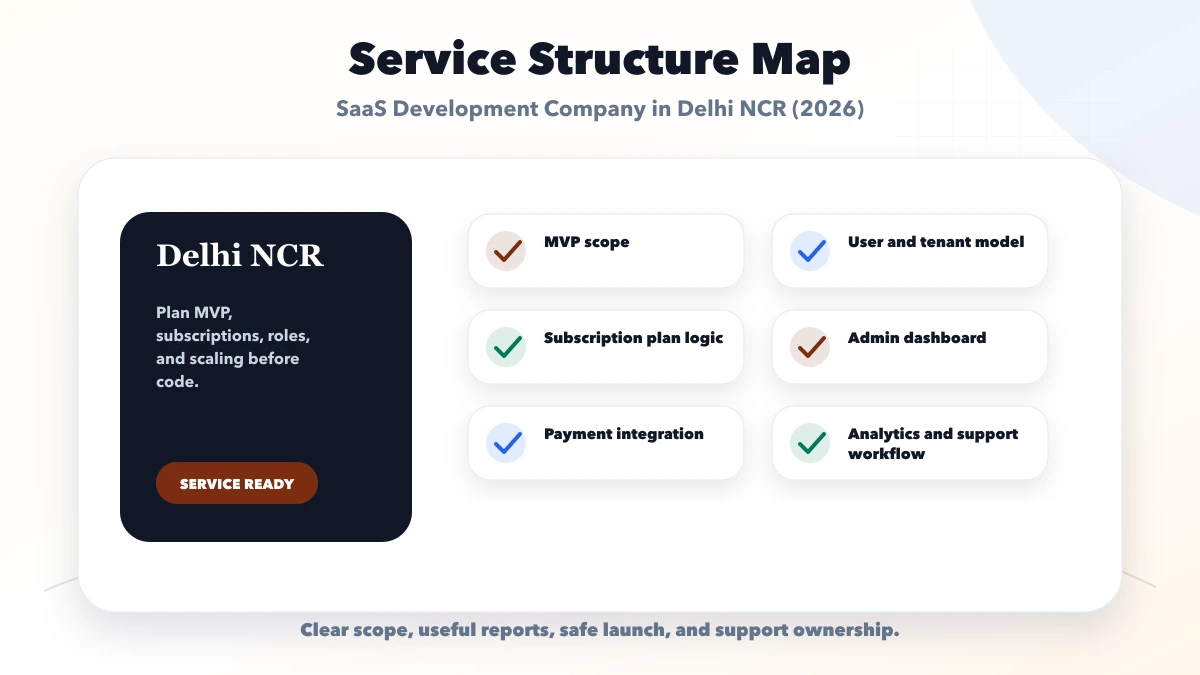
The team should convert assumptions into a testable release:
They should explain frontend, API, database, background jobs, storage, integrations and deployment without claiming that one stack is always best.
Every protected read and write needs a server-enforced tenant boundary. Tests should attempt cross-tenant access.
Sign-up, verification, login, logout, password recovery, invitations, suspended accounts and admin recovery need explicit states.
Access should be derived from plan, role, company and account state. Hiding a button is not entitlement enforcement.
The product needs plan selection, checkout, server-side verification, webhook processing, current subscription state, renewal, failure handling, cancellation and reconciliation.
Support users need privacy-safe tools to locate accounts, inspect status, resolve issues and record actions. Direct database editing is not a support interface.
Track activation, repeated value, errors and funnel exits. Do not send personal or sensitive content to analytics.
An MVP should be the smallest complete learning system.
| MVP includes | MVP can defer |
|---|---|
| one target segment | several unrelated personas |
| one core recurring job | broad module suite |
| secure tenant boundary | complex enterprise hierarchy |
| essential roles | granular custom permissions |
| one billing model where needed | many currencies and contract types |
| support and export baseline | advanced automation |
| activation measurement | broad BI warehouse |
Use the SaaS MVP cost guide to estimate that narrower first release.
Ask:
The application should not trust a browser success page as payment confirmation.
Ask for security acceptance examples rather than a “secure by default” statement.
After launch, the team needs:
A provider may be strong at initial development but weak at operating a subscription product. Evaluate both.
| Scope | Existing planning band | Typical delivery window |
|---|---|---|
| SaaS MVP | Rs. 4 lakh to Rs. 10 lakh | 8 to 16 weeks |
| Subscription SaaS platform | Rs. 10 lakh to Rs. 25 lakh | 4 to 7 months |
| Advanced SaaS product | Rs. 25 lakh to Rs. 60 lakh+ | 7 to 14 months |
These retained bands are not fixed VASUYASHII prices or verified Delhi NCR market averages.
Cost changes with:
Use the web app cost model to compare underlying workflow and integration units.
| Evidence | Review |
|---|---|
| Live SaaS or product | signup, activation, recurring workflow and error states |
| Architecture walkthrough | tenant boundary, jobs, billing and deployment |
| Permission tests | cross-tenant and unauthorised action prevention |
| Billing test cases | duplicate, failed, delayed and cancelled states |
| Product analytics plan | activation, retention and privacy |
| Support runbook | account, billing and incident workflow |
| Handover plan | repositories, cloud, data, docs and credentials |
Clearly labelled demos can demonstrate thinking, but they do not prove production operations or customer outcomes.
Write:
The founder or business should retain access to critical accounts. Avoid permanent vendor lock-in through hidden infrastructure.
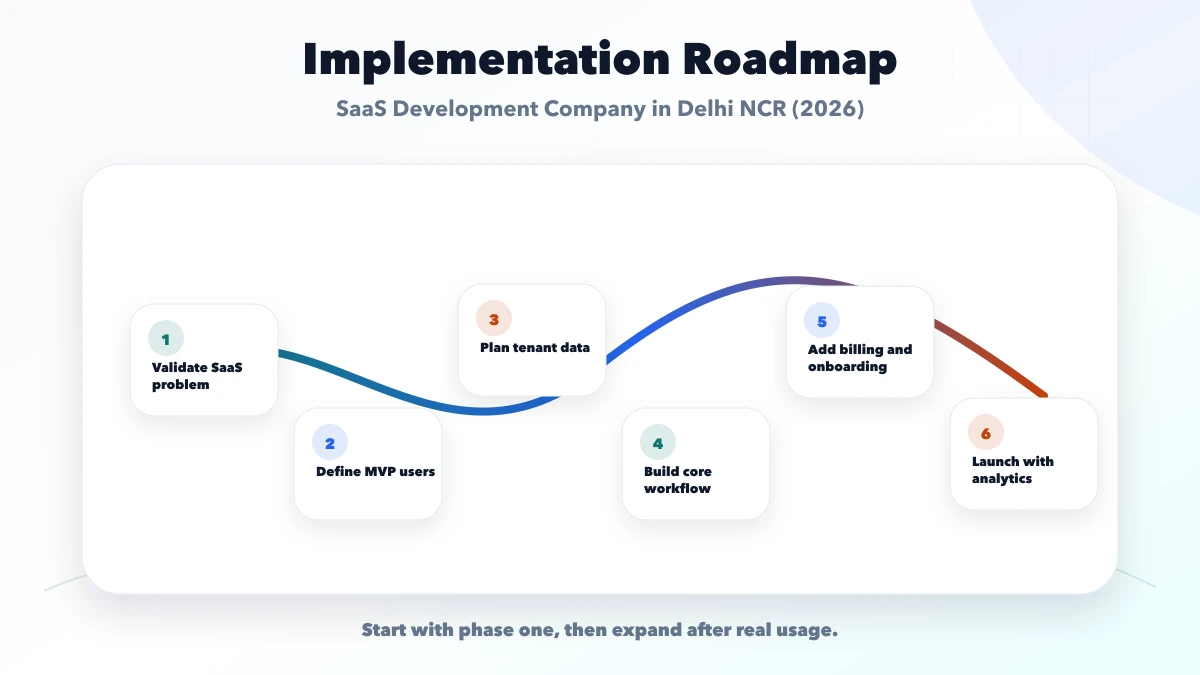
Validate user, problem, first value and recurring job.
Create account, tenant, role, environments, monitoring and data model.
Build the full repeated user job with support visibility.
Add subscription state only when the product and commercial model are ready.
Use a limited cohort, observe activation and resolve operational failures.
Complete support, analytics, documentation, recovery and ownership.
Prioritise changes from evidence, not only feature requests.
Current VASUYASHII evidence includes:
This is product evidence, not proof of every SaaS category or a named customer outcome.
VASUYASHII does not claim through this article:
Review custom software development, Business Suite and software services.
A web app describes delivery through a browser. SaaS usually adds repeatable product access, multiple customers or tenants, subscriptions or entitlements and ongoing product operations.
Only when payment and plan validation are necessary for learning. A controlled beta may use manual commercial handling first.
Ask for backend authorization design and tests that attempt access across company or account boundaries.
The same backend can often support several clients, but mobile workflows, offline needs, notifications and store delivery create separate scope.
Not always. Local workshops may help, but product reasoning, technical evidence, ownership and support matter more.
The operating business should generally control merchant and financial accounts, subject to provider onboarding and contract terms.
Prepare a product brief with one user, one recurring job, tenant model, activation event and commercial assumption. Then compare providers using evidence and written ownership terms. Contact VASUYASHII for a focused discovery discussion.
Related Articles
May 31, 2026
Evaluate SaaS development companies in India by product discovery, tenant security, billing, data ownership, testing, operations, handover, and support.
Read article
March 22, 2026
Compare SaaS and traditional software across cost, ownership, updates, security, offline use, data control, customisation, and exit planning.
Read article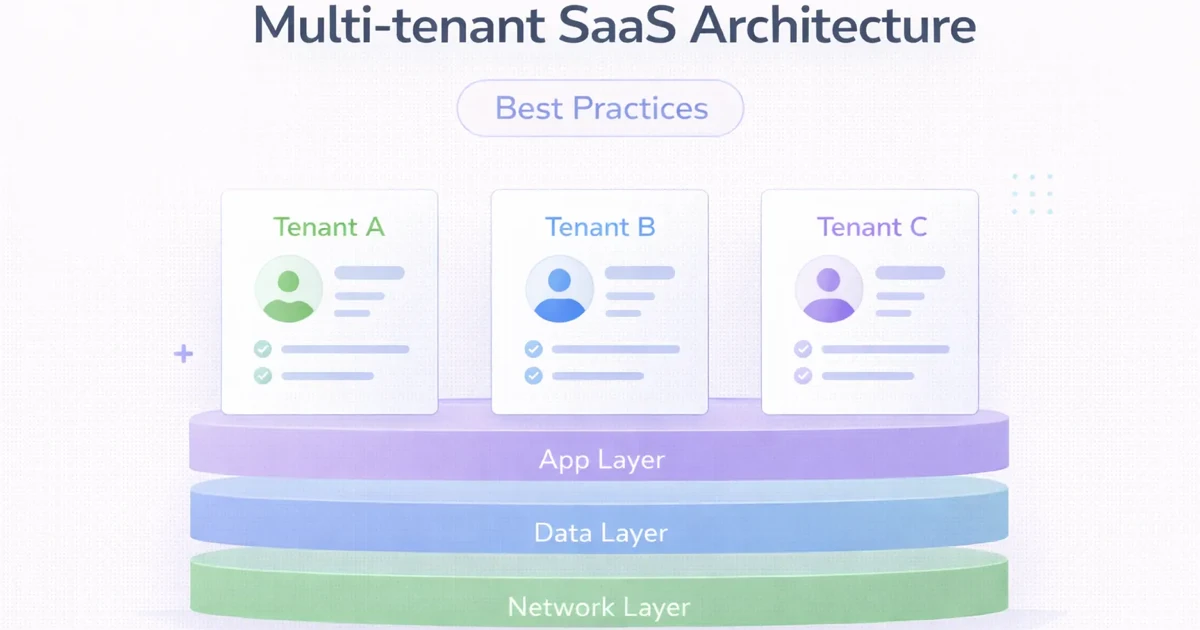
March 31, 2026
Multi-tenant SaaS architecture best practices for 2026: tenancy models, isolation, billing, observability, and what to decide early.
Read article
March 22, 2026
Understand SaaS product development from customer problem and MVP scope through tenancy, onboarding, billing, security, metrics, release and ongoing operations.
Read article