
April 19, 2026
SaaS Security: Authentication and Tenant Isolation
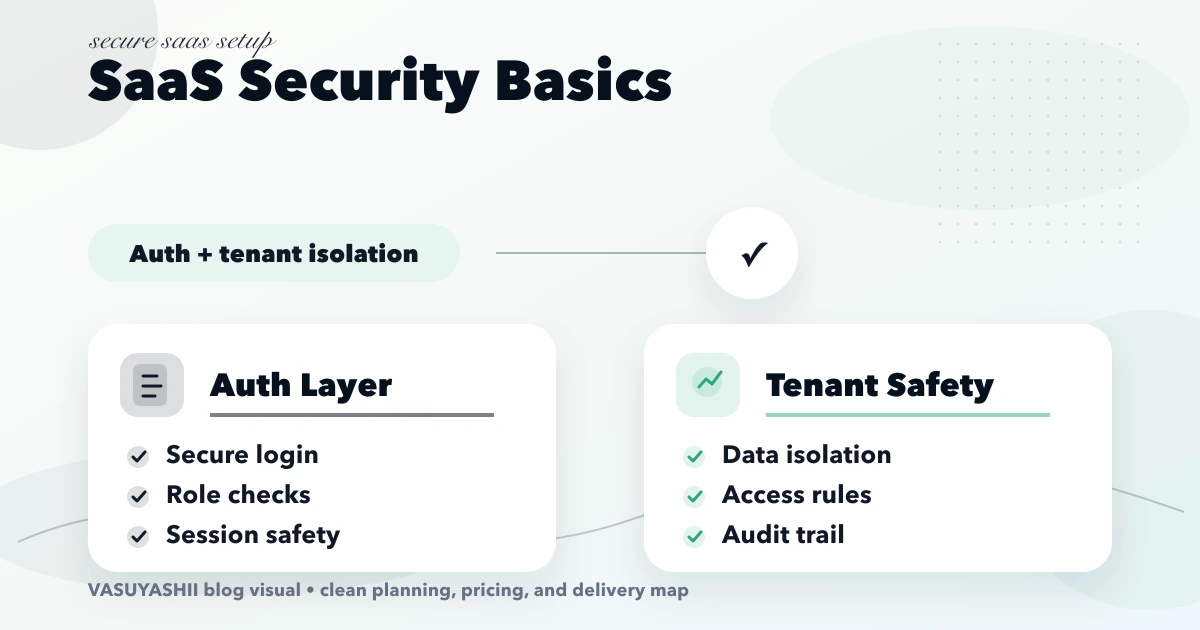
Plan SaaS authentication, server-side authorization, tenant isolation, role tests, session controls, audit logs, backups, and incident-ready operations.
Read articlePublished Updated
Multi-tenant SaaS architecture best practices for 2026: tenancy models, isolation, billing, observability, and what to decide early.
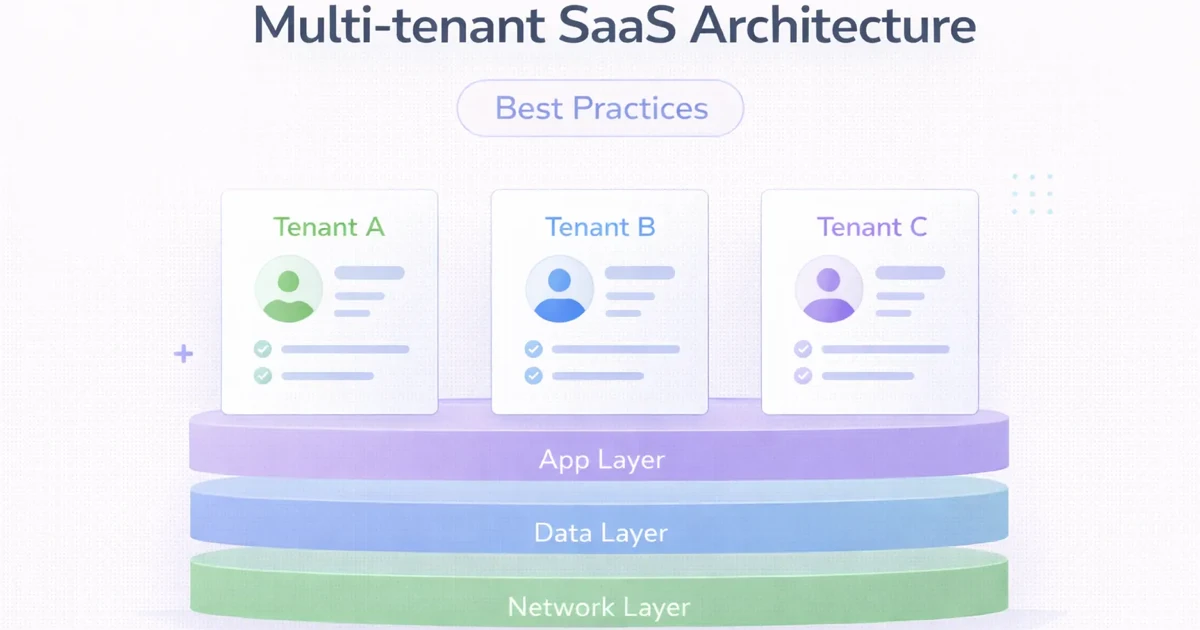
Many SaaS products start as a single-customer application and only later try to "make it multi-tenant." That usually creates messy access control, weak data isolation, brittle configuration handling, and painful billing logic. Multi-tenancy should be designed intentionally, even if the first version is simple.
The goal is not only to put multiple customers inside one application. The goal is to do it safely, efficiently, and in a way that still supports growth. A weak tenancy model can slow the entire product team later.
This guide explains the main multi-tenant architecture choices, what to decide early, and what best practices matter most in 2026.
For most early B2B SaaS products, the best starting point is:
The most important rule is simple: tenant identity should be a core system concept, not a later patch.
Best for:
Risk:
Access control mistakes become dangerous if tenant scoping is weak.
Best for:
Risk:
Operational complexity rises quickly.
Some SaaS teams keep standard customers in a shared model and larger enterprise tenants in a more isolated setup.
That can be practical, but only if the product team manages the added complexity deliberately.
Related reading:
Every important record should know which tenant it belongs to.
User roles, admin privileges, and cross-tenant restrictions must be designed early.
Some tenants need different feature flags, branding, limits, or workflows. Decide where that lives.
Subscription state should influence tenant-level capabilities cleanly.
Do not rely on UI assumptions. Tenant boundaries should exist in backend logic and data queries.
Login tells you who the user is. Authorization tells you what they can do inside a tenant.
Logs, metrics, and error traces should help you identify tenant-specific issues quickly.
Even if you start shared, plan for future isolation or data movement paths.
Too many per-customer custom branches destroy product maintainability.
Next.js or React frontend with tenant-aware routing where neededNode.js or equivalent backend for authorization, tenancy, and API logicPostgreSQL with disciplined tenant scopingThe biggest cost drivers are:
If your product is becoming multi-customer, do not keep adding tenant logic ad hoc. The right time to define tenancy boundaries is before data and permission mistakes become expensive.
It is an architecture where one SaaS platform serves multiple customers while keeping their data and access separated.
Not necessarily. It can work very well if tenant scoping and authorization are implemented carefully.
Usually when isolation, compliance, or enterprise requirements are stronger.
Treating tenant identity as an afterthought.
In most B2B SaaS products, tenant-level billing is more practical.
Yes, but the migration is easier if you design for it from the start.
Often yes, especially when plans or enterprise requirements vary.
Both matter, but a weak tenant-aware data model causes deeper long-term pain.
If you want a SaaS architecture that supports more customers, safer isolation, and clearer product control, the next step is to define tenancy, authorization, and configuration rules before scaling feature work.
A tenant is the customer or organizational boundary that owns configuration, data, billing, and access policy. A user is an identity that may belong to one or more tenants. Treating user_id as the tenancy model fails as soon as an accountant works across companies, an agency supports several clients, or an owner switches between firms.
A request should resolve:
These checks must run on the server. Hiding another tenant's menu item in the frontend is useful for clarity, but it is not an authorization control.
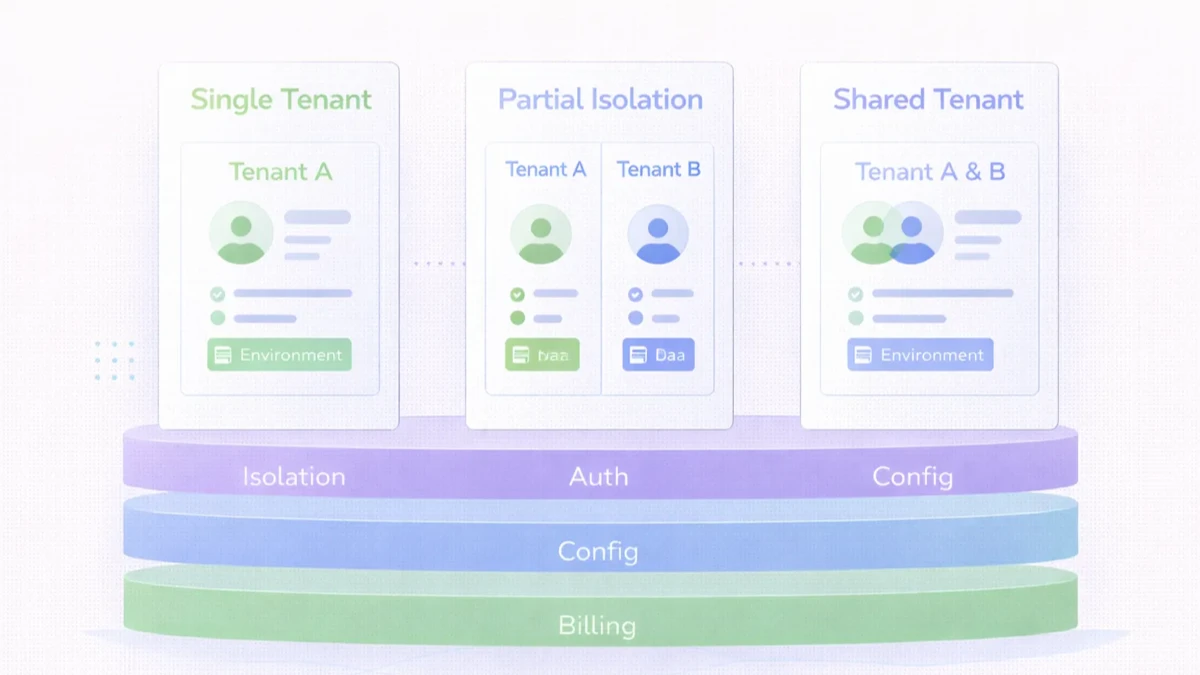
Microsoft's current Azure multitenant tenancy guidance explains that tenancy choices involve trade-offs across isolation, cost, performance, reliability, and operational complexity. A practical design may combine models rather than forcing every customer into one pattern.
| Model | Operational benefit | Main control needed |
|---|---|---|
| Shared tables with tenant key | Efficient onboarding and migrations | Every query, unique constraint, and cache key must be tenant-aware |
| Separate schema per tenant | Stronger logical separation | Migration orchestration and connection handling |
| Separate database per tenant | Backup and isolation flexibility | Fleet management, cost, upgrades, and monitoring |
| Dedicated deployment | Highest customization or isolation | Deployment-stamp automation and version discipline |
| Hybrid tiers | Match isolation to customer requirements | Clear placement rules and portability between tiers |
Do not choose database-per-tenant only because it sounds secure, and do not choose shared tables only because they are cheaper. Document the threat model, contractual needs, expected tenant count, data volume, noisy-neighbour risk, restore requirements, and engineering capacity.
Leaks happen in supporting systems too. Include tenant identity in:
A safe queue message should carry an immutable tenant reference and a business record reference. The worker must re-check access and record ownership rather than trusting display data copied into the message.
Multi-tenancy is also an operating process. Define what happens when a customer:
Provisioning should be repeatable and observable. If an administrator manually creates database rows and storage folders for every signup, inconsistencies will accumulate.
One tenant may import a large file, request a heavy report, or generate thousands of webhook calls. Protect shared capacity with per-tenant quotas, queue fairness, pagination, rate limits, report scheduling, and resource budgets. Metrics should show workload by tenant without exposing customer data broadly to support staff.
For higher-value or regulated customers, a hybrid architecture can place selected tenants into dedicated databases or deployment stamps while retaining a common control plane. Design the tenant-placement record and migration path before promising this tier.
The most important automated tests attempt cross-tenant access:
Also test support impersonation, super-admin tools, and background scripts. Privileged paths deserve stronger logging and explicit approval rules.
The public VASUYASHII Business Suite positioning includes multi-company operation and company-scoped data. That product direction is relevant first-party evidence for tenant-aware billing and inventory workflows; it is not a claim of independent security certification or proof that its architecture fits another SaaS product unchanged.
For a new platform, use the role-based security guide, SaaS MVP scope checklist, and custom software service to define identity, permissions, data ownership, and rollout independently.
Before coding, record:
| Decision | Required answer |
|---|---|
| Tenant definition | Company, branch, franchise, customer account, or workspace? |
| Membership | Can one identity join multiple tenants? |
| Isolation | Shared, schema, database, dedicated, or hybrid? |
| Authorization | Which roles and resource-level rules apply? |
| Entitlements | Which limits and features vary by plan? |
| Data lifecycle | Export, retention, deletion, suspension, and restore rules |
| Operations | Tenant-aware logs, alerts, quotas, and support access |
| Migration | How can a tenant move to another isolation tier? |
Revisit this record when enterprise requirements appear. Intentional evolution is safer than hidden tenant-specific exceptions inside shared code.
Related Articles
April 19, 2026
Plan SaaS authentication, server-side authorization, tenant isolation, role tests, session controls, audit logs, backups, and incident-ready operations.
Read article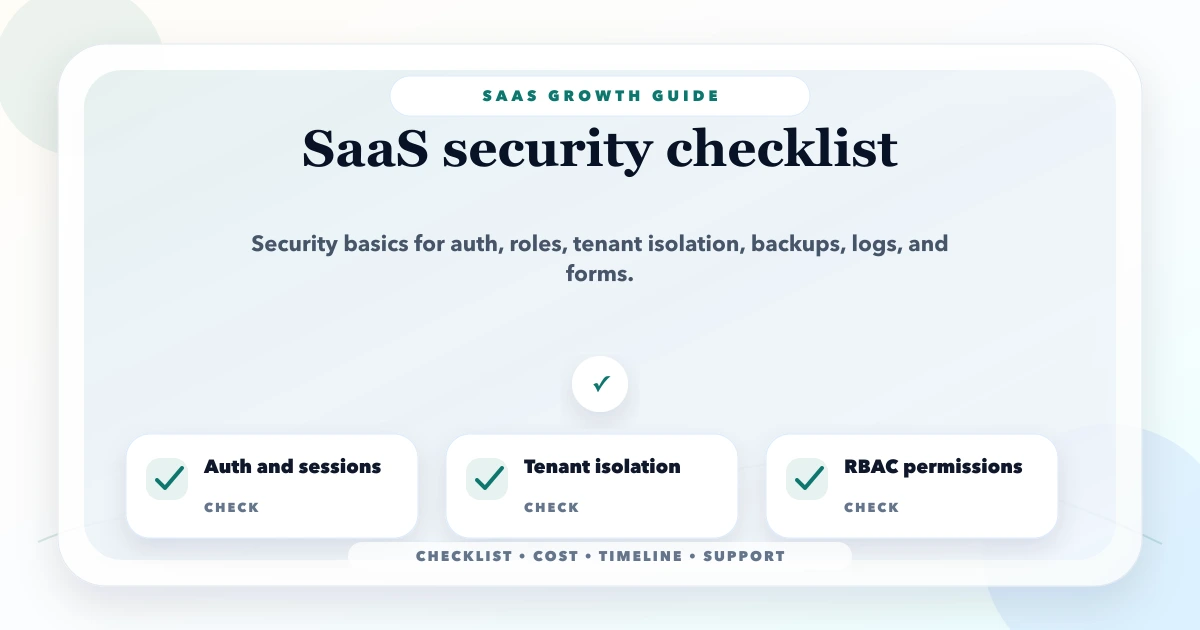
May 16, 2026
Use this SaaS security checklist for tenant isolation, authentication, authorization, secrets, uploads, logging, backups, incident response, and testing.
Read article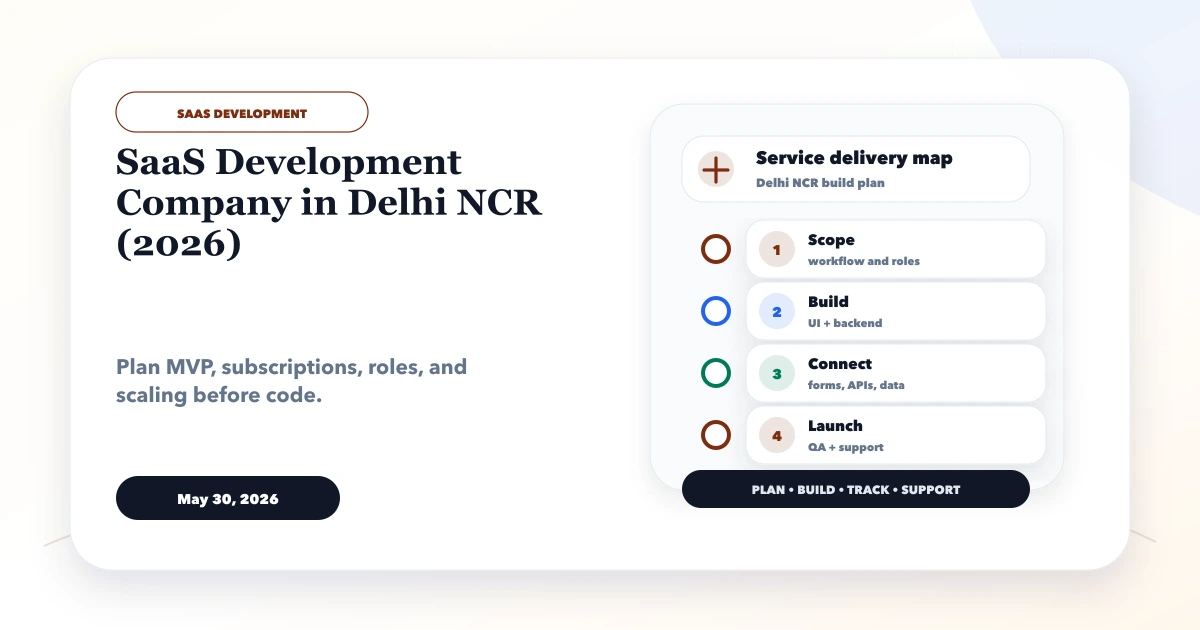
May 30, 2026
Evaluate a Delhi NCR SaaS development company through product discovery, tenancy, billing, security, ownership, launch operations and support evidence.
Read article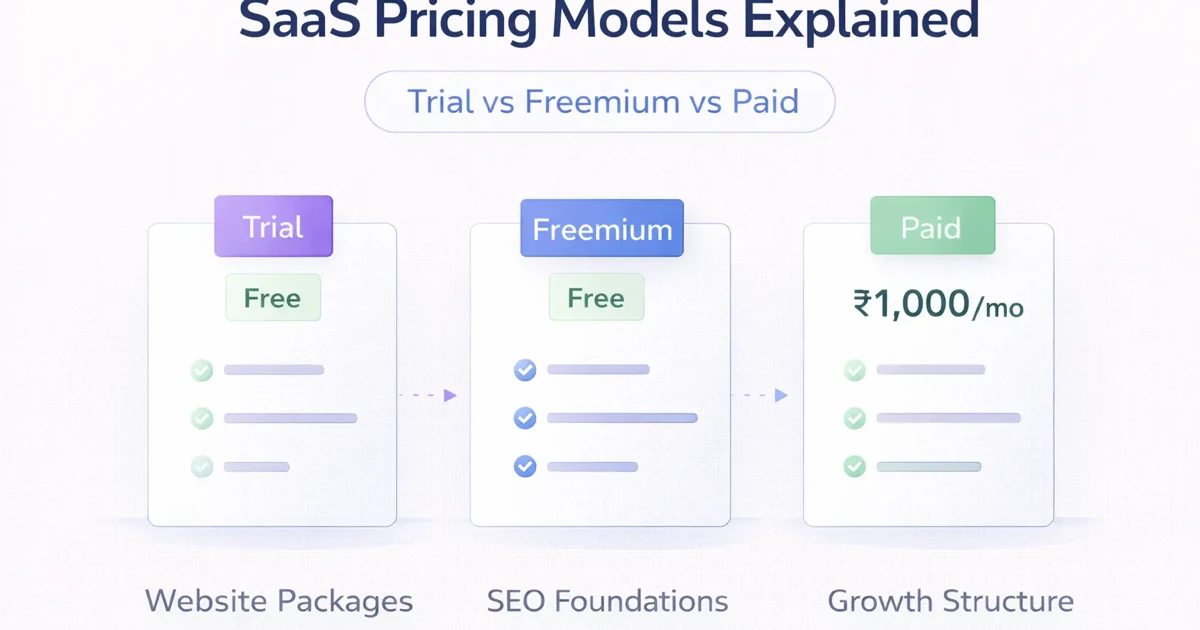
March 31, 2026
SaaS pricing models explained for India: trial vs freemium vs paid, plus flat-rate, seat-based, and usage pricing advice for founders.
Read article