
May 16, 2026
SaaS Pricing Page Best Practices for 2026
Improve a SaaS pricing page with clear plans, value metrics, feature limits, billing terms, trust signals, FAQs, comparison tables, and conversion tracking.
Read articlePublished Updated
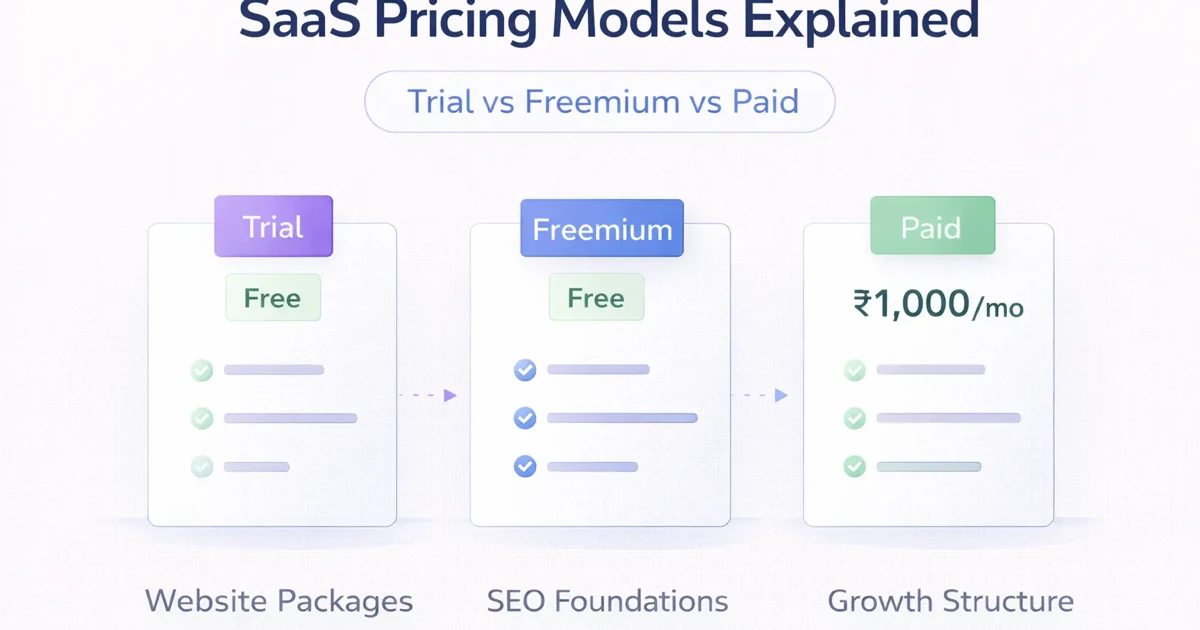
SaaS pricing models explained for India: trial vs freemium vs paid, plus flat-rate, seat-based, and usage pricing advice for founders.
Many SaaS founders spend months building product features and only later realise they still have not made a clean pricing decision. That usually hurts conversion, sales conversations, onboarding, and revenue quality at the same time.
Pricing is not just a number. It shapes who signs up, how serious users are, what support load you create, and how fast the product can move from experimentation to sustainable growth.
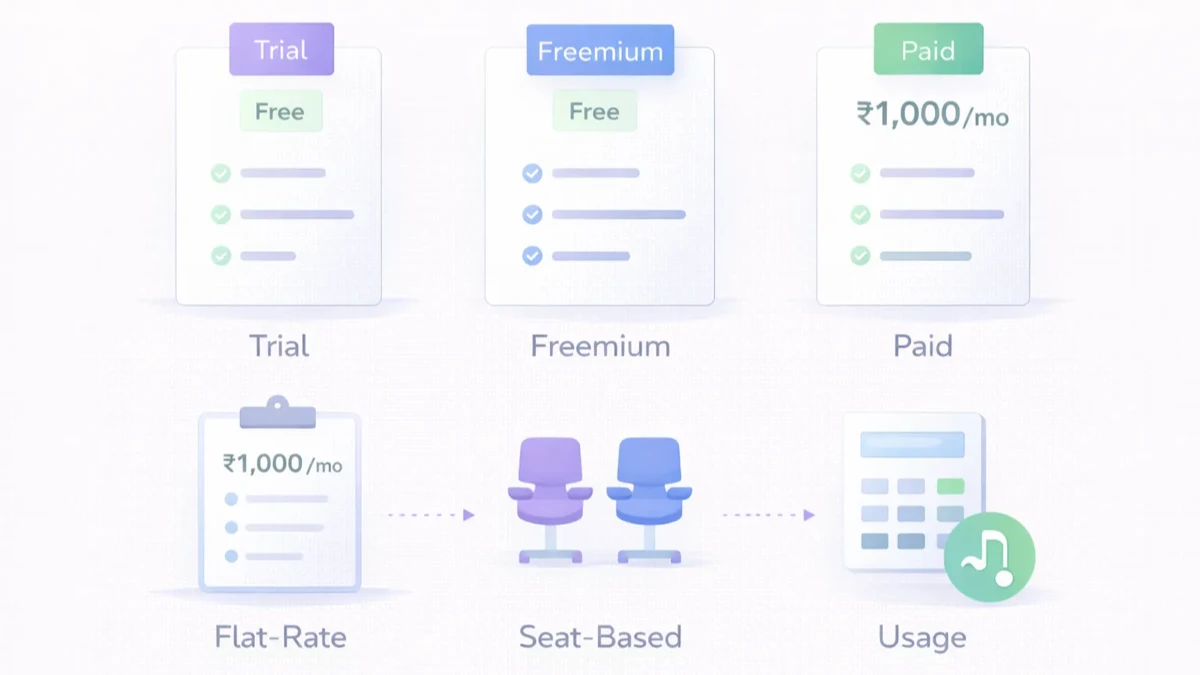
This guide explains the three common acquisition models, trial, freemium, and paid, and then shows how they connect to practical SaaS pricing structures such as flat-rate, per-seat, tiered, and usage-based billing.
There is no universal best SaaS pricing model. The right model depends on:
In simple terms:
Best when:
Pros:
Risk:
If onboarding is weak, users run out of trial before understanding the product.
Best when:
Pros:
Risk:
Many teams collect inactive users, not qualified customers.
Best when:
Pros:
Risk:
If trust and value clarity are weak, conversion suffers badly.
Related reading:
According to Stripe's subscription documentation, recurring SaaS pricing commonly uses patterns such as flat-rate, per-seat, tiered, and usage-based billing. That is the pricing engine layer. Trial, freemium, and paid are the acquisition layer. Both decisions must fit together.
Good for:
Good for:
Good for:
Good for:
For Indian SaaS buyers, especially SMB and mid-market teams, pricing clarity matters more than clever packaging.
Practical patterns that usually work:
Before choosing a model, write down the buyer, first measurable value, buying approval, support load, and cost that grows with usage. A pricing page cannot fix a product whose activation event is unclear.
| Decision question | What it changes |
|---|---|
| Can users experience value alone in one session? | A guided trial may work |
| Does setup require data migration or team training? | Demo-led or paid onboarding may be safer |
| Does each extra user create more value? | Per-seat pricing becomes easier to explain |
| Does infrastructure cost rise directly with usage? | Base fee plus usage can protect margins |
| Is the product useful forever without upgrading? | Freemium may create cost without conversion |
| Is the buyer an owner or procurement team? | Annual contracts and assisted sales may fit better |
For a small Indian B2B product, start with two or three clear choices. State who each plan is for, the usage or role boundary, onboarding included, support expectation, tax treatment, cancellation terms, and what happens when a limit is reached. Do not hide essential workflow access in a plan only to make the cheaper tier look attractive.
Connect pricing to the product architecture. The Web App Development hub explains the parent SaaS planning route. Use SaaS MVP feature prioritization to keep phase one focused, SaaS onboarding UX best practices to improve activation, and the subscription billing system guide to scope renewals, invoices, payment failures, upgrades, and access changes.
Review pricing with real evidence every four to eight weeks during the pilot stage: qualified signup rate, activation, assisted-support time, conversion, expansion, cancellation reasons, and gross margin. Change one major variable at a time so the team can understand what improved. For a practical model and billing scope, share the SaaS workflow.
The VASUYASHII Business Suite is positioned for Indian traders, wholesalers, retailers, distributors, and growing businesses that need GST billing, inventory, purchases, payments, expenses, reports, PDF invoices, and WhatsApp sharing. Its early-access positioning is a practical example of assisted paid-first validation rather than an unlimited freemium model.
That approach fits several current realities:
This is not proof that paid-first is best for every SaaS. A self-serve design tool, developer API, or collaboration product may benefit from a free tier. The lesson is to align the acquisition model with time-to-value, setup effort, support cost, and the evidence needed at the current product stage.
For an assisted early-access plan, publish what is included, plan duration, support boundary, renewal expectation, data ownership, and exclusions. Do not label roadmap items as available features. When renewal volume and plan changes become operationally significant, use the subscription billing guide to design provider events, invoices, entitlements, retries, and reconciliation.
Review one cohort at a time instead of changing price after every conversation.
| Signal | What it may reveal | Avoid assuming |
|---|---|---|
| Qualified visitor to demo | Offer and buyer fit | Low rate does not automatically mean price is high |
| Demo to activated account | Onboarding and product value | Signup alone is not activation |
| Support time per account | Delivery cost and usability | All support will disappear with documentation |
| Trial or pilot to paid | Willingness to pay after value | More free days always improve conversion |
| Renewal and cancellation reason | Ongoing value and expectation match | Every cancellation is a pricing objection |
| Gross margin by plan | Sustainability of service and infrastructure | Revenue alone proves a healthy plan |
Record the pricing version, included features, onboarding route, and acquisition source for each cohort. Without that context, a conversion change cannot be attributed safely.
If your SaaS pricing feels confusing, the real issue is often not the number. It is the mismatch between acquisition model, onboarding depth, and value delivery speed.
No. It works only when free-user economics and upgrade logic are healthy.
When product value is quick to show and support cost is not worth carrying indefinitely for free users.
No. Paid-first can work very well for high-value B2B tools.
Usually flat-rate or simple tiered pricing.
When usage maps directly to delivered value or infrastructure cost.
Yes. It is often one of the clearest models for team software.
Usually two to three clean choices are enough.
Both matter, but weak onboarding can kill even a strong pricing model.
If you want a pricing model that filters better users, reduces confusion, and supports long-term revenue, the next step is to align pricing, onboarding, and billing logic together instead of treating them separately.
Related Articles
May 16, 2026
Improve a SaaS pricing page with clear plans, value metrics, feature limits, billing terms, trust signals, FAQs, comparison tables, and conversion tracking.
Read article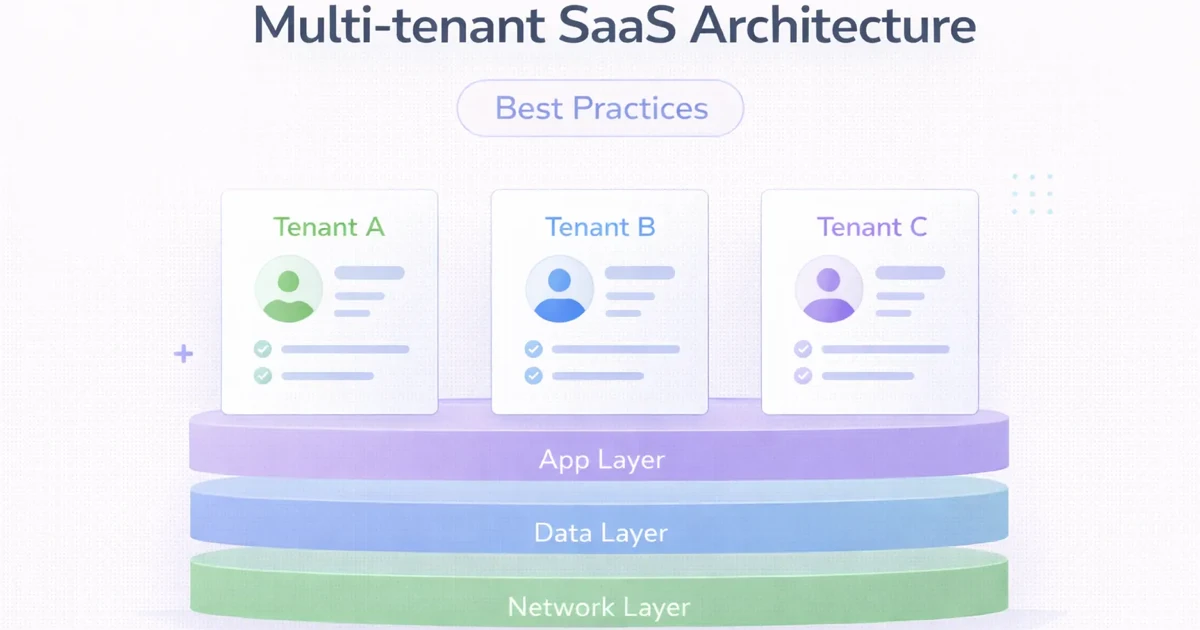
March 31, 2026
Multi-tenant SaaS architecture best practices for 2026: tenancy models, isolation, billing, observability, and what to decide early.
Read article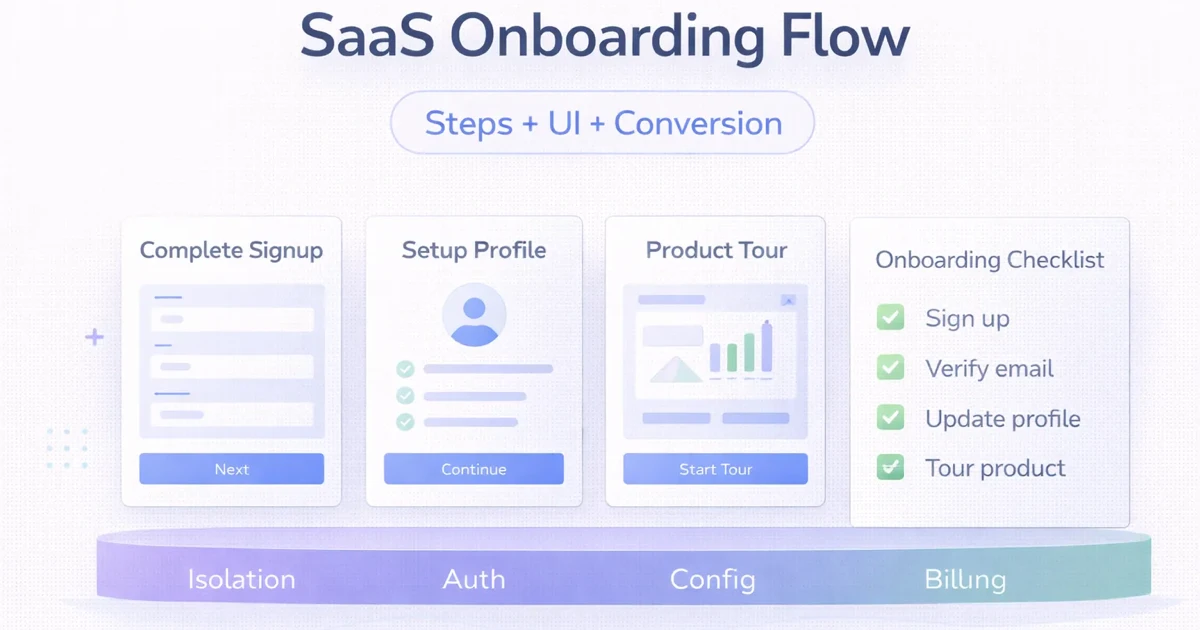
March 31, 2026
Design a SaaS onboarding flow with an activation checklist, setup dependencies, role-specific guidance, useful empty states, recovery, and measurable progress.
Read article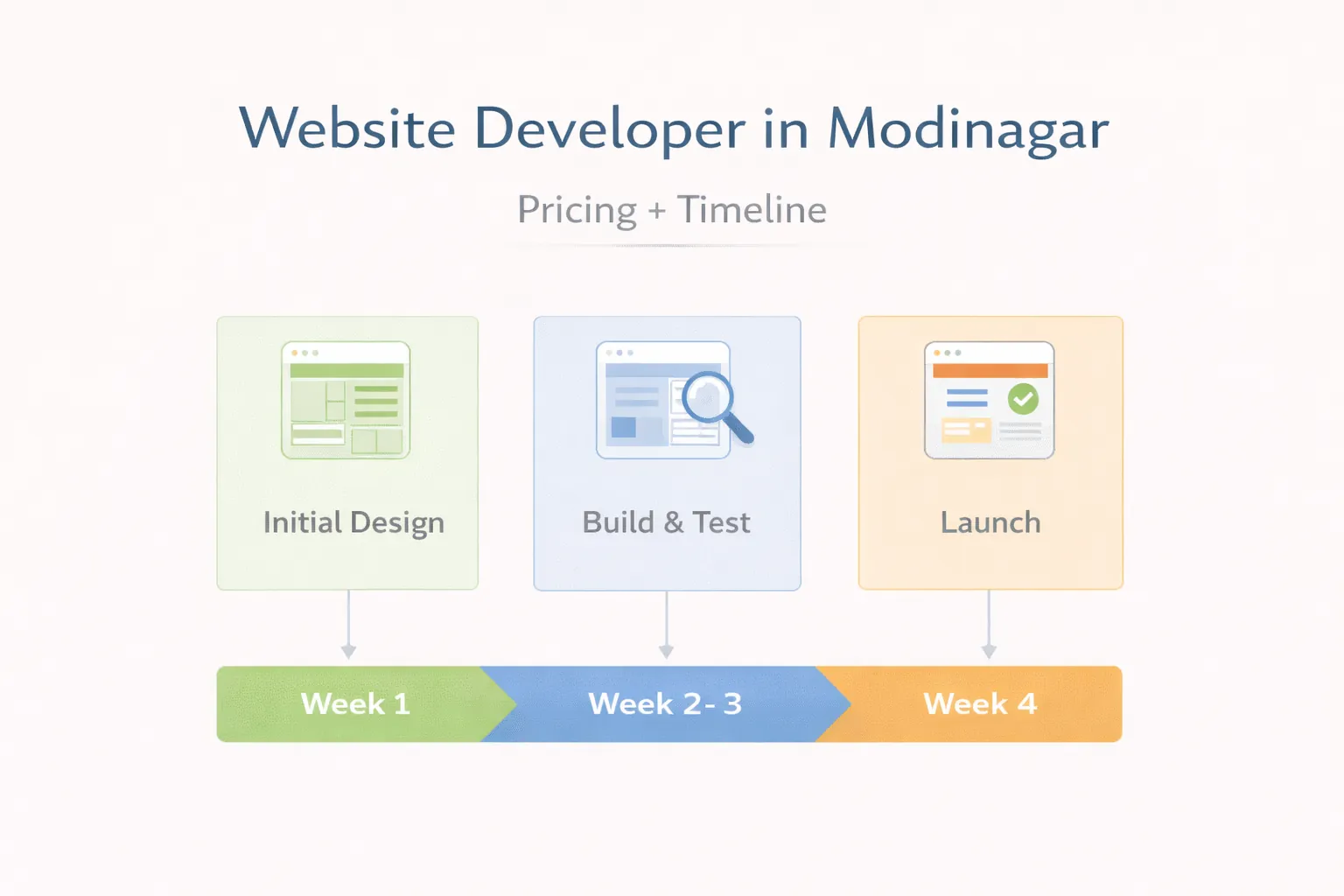
March 30, 2026
Plan a Modinagar trade or service website with phased scope, quote inputs, product-service routes, timeline controls, proof, handover, and lead ownership.
Read article