
April 19, 2026
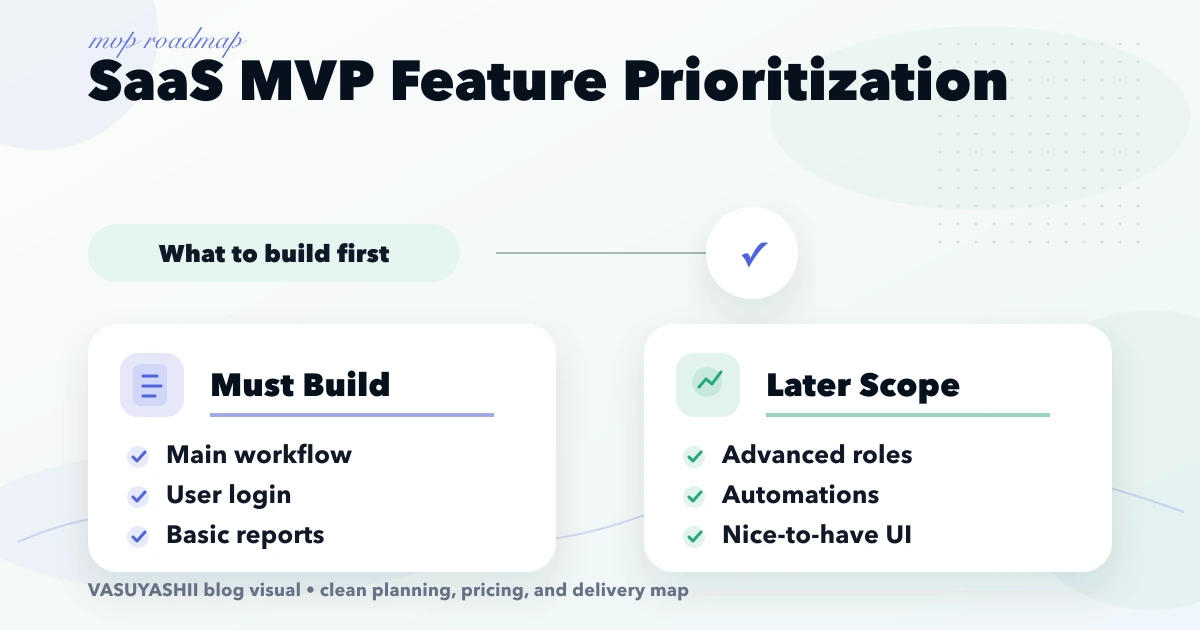
SaaS MVP Prioritization: What to Build First
Prioritize a SaaS MVP using one core workflow, evidence, dependencies, acceptance metrics, security foundations, launch constraints, and a controlled roadmap.
Read articlePublished Updated
Estimate SaaS MVP development cost in India using validation scope, tenant isolation, roles, billing, onboarding, analytics, integrations and operating risk.
SaaS MVP development cost in India depends on the business assumption being tested, tenant model, roles, billing states, onboarding, integrations, reporting, support tooling and production risk.
A SaaS MVP is not a normal website with login and payment added. It is a repeatable software product that must serve multiple customer accounts safely, operate subscriptions or access plans, support users and provide enough evidence to decide what to build next.
This guide provides indicative planning ranges and a scoping method. It is not a fixed market rate or a VASUYASHII quotation.
| SaaS stage | Indicative planning band | Typical validation scope |
|---|---|---|
| Product discovery and clickable prototype | ₹1.5–₹4 lakh | workflow, screens, data model, technical risks |
| Focused SaaS MVP | ₹4–₹9 lakh | one core workflow, basic tenant/user controls |
| Standard multi-tenant MVP | ₹9–₹20 lakh | roles, plans, onboarding, admin, integrations |
| Advanced MVP | ₹20–₹45 lakh+ | complex workflows, deep integrations, analytics, migration |
Hosting, third-party subscriptions, taxes, payment-provider charges, extensive data migration, formal security testing, mobile apps and post-launch support may be separate.
A good MVP tests a specific assumption:
“Build an all-in-one platform” is not a testable MVP brief.
| Area | Internal web app | SaaS MVP |
|---|---|---|
| Customers | One organisation | Multiple customer accounts |
| Data scope | One business | Tenant or company isolation |
| Billing | Internal budget | Plans, trials or subscriptions |
| Onboarding | Staff rollout | Repeatable customer setup |
| Admin | Company admin | Platform and tenant admin |
| Support | Known users | Product support workflow |
| Analytics | Operational reports | Product activation and usage |
| Releases | One owner | Shared product releases |
These additional product responsibilities affect cost.
Estimate work as:
Product discovery + UX states + application build + data and permissions + integrations + QA/security + deployment + launch operations
Screen count alone is unreliable because one screen may contain complex permissions, calculations and external events.
Document:
For a quotation SaaS:
That workflow is more estimable than “quotation module.”
Tenant design must answer:
Tenant isolation is a security and data-integrity requirement, not just a database field.
See the multi-tenant SaaS architecture guide.
Define a permission matrix:
| Resource | Owner | Manager | Staff | Platform admin |
|---|---|---|---|---|
| Company settings | Manage | View | No | Support policy only |
| Users | Manage | Limited | No | Platform operations |
| Core records | Full | Approved scope | Assigned scope | No default access |
| Billing plan | Manage | View | No | Platform plan tools |
| Reports | Full | Role-based | Limited | Aggregated usage only |
Every protected backend action needs authorisation. Hiding a menu is not enough.
Billing-ready SaaS requires states:
Also define:
A payment button is a small part of subscription operations.
The MVP should lead a new account to one activation event.
Possible onboarding work:
Use the SaaS onboarding flow guide to define this separately from feature development.
Budget for:
Without platform operations, every customer problem becomes a database task.
Track events needed to validate the product:
Avoid sending sensitive customer data in analytics events. Define event names and parameters before launch.
Business reports help the customer run operations. Product analytics help the SaaS team understand adoption. They are different scopes.
Examples:
For each integration, define:
Payments, WhatsApp, email and accounting integrations should not be priced as identical “API connections.”
Migration may include:
Importing current masters is much smaller than migrating years of financial or operational history.
| Phase | Typical work |
|---|---|
| Discovery | assumptions, workflow, roles, data, acceptance |
| Prototype | risky interactions and onboarding |
| Foundation | tenant model, authentication, permissions |
| Core build | primary workflow and states |
| Integrations | payments, email or external systems |
| QA | role, tenant, exception and device tests |
| Pilot | controlled users, feedback and fixes |
| Launch | monitoring, support and measurement |
A focused MVP may take 10–20 weeks. Complex products can take longer. Team size does not reduce every dependency.
Plan:
Building the MVP is not the final cost.
Do not reduce cost by removing tenant isolation, validation, backups or ownership controls.
Ask every vendor to state:
Compare equivalent scope, not only total price.
VASUYASHII Business Suite is an operating example of a multi-company SaaS/ERP-lite product for Indian SMEs. Current scope includes GST billing, products and inventory, clients, vendors, purchases, payments, expenses, reports, PDF generation and secure WhatsApp sharing.
The product context also shows why SaaS scope includes company separation, team permissions, platform usage visibility, backup/restore and onboarding, beyond the visible invoice screens.
It should not be described as a full accounting or enterprise ERP replacement. Roadmap items such as advanced accounting and statutory integrations must remain separate from current capability.
There is no universal minimum. A focused custom MVP often requires several lakh rupees once tenant, security, onboarding, QA and deployment are included.
A prototype or very narrow validation build may fit, but a production multi-tenant product with billing, roles and operations usually needs more scope.
A focused production MVP may take 10–20 weeks. Integrations, migration, compliance and role complexity can extend it.
Only if paid self-service conversion is part of the validation. Manual plan activation can be acceptable for an early controlled pilot.
It can suit some products, but architecture should be chosen from data, query, tenant, portability and team requirements, not speed alone.
Not always. Validate the workflow with responsive web first unless offline, device or distribution requirements make native apps essential.
Tenant isolation, authorisation, validation, backups, ownership and critical acceptance testing.
No. It creates a controlled way to test assumptions with real users and evidence.
For a SaaS MVP, product portal or multi-company business system, start with the web app development hub, then review web application development, software development or share the validation goal.
Related Articles
April 19, 2026
Prioritize a SaaS MVP using one core workflow, evidence, dependencies, acceptance metrics, security foundations, launch constraints, and a controlled roadmap.
Read article
March 25, 2026
Understand SaaS development services in 2026: MVP scope, multi-tenant architecture, onboarding, billing, scale planning, and the key factors that affect cost.
Read article
March 22, 2026
Understand SaaS product development from customer problem and MVP scope through tenancy, onboarding, billing, security, metrics, release and ongoing operations.
Read article
May 16, 2026
Validate a SaaS idea in India with problem interviews, workflow evidence, pricing tests, pilots, decision gates, risks, and a practical founder checklist.
Read article