
March 25, 2026
SaaS Development Services: MVP to Scale (2026)
Understand SaaS development services in 2026: MVP scope, multi-tenant architecture, onboarding, billing, scale planning, and the key factors that affect cost.
Read articlePublished Updated
Understand SaaS product development from customer problem and MVP scope through tenancy, onboarding, billing, security, metrics, release and ongoing operations.
SaaS product development is the continuing process of designing, building, operating and improving software that multiple customers access as a service.
The work is broader than creating a web application and charging a subscription. A SaaS team must decide who the product serves, which workflow it standardises, how customer data is isolated, how plans and entitlements work, how users activate, how releases are operated and how customers can leave with their data.
This guide focuses on the product decisions that connect an idea to an operable service. Cost estimation is covered separately in the SaaS MVP cost guide.
A SaaS product normally has:
Not every cloud-hosted custom application is SaaS. Software built for one company’s private process may be custom software even if users access it through a browser.
| Type | Primary purpose | Product owner | Reuse pattern |
|---|---|---|---|
| Marketing website | Explain and convert | One business | Content and components |
| Custom business software | Support one organisation’s workflow | Client or commissioning business | Limited or internal |
| SaaS product | Solve a repeatable market problem | Product company | Shared product across customers |
These categories can coexist. A SaaS company needs a marketing website, and its internal support team may use custom tools.
A useful product hypothesis states:
“CRM for every business” is too broad. “A follow-up and quotation workflow for small service teams that currently lose leads across WhatsApp and spreadsheets” is easier to test.
Interview users about actual recent work rather than hypothetical feature preferences. Ask to see forms, spreadsheets, reports, approvals and exceptions with sensitive data removed.
Before development, produce:
Discovery does not need to become a long document. It needs to remove enough uncertainty to choose a focused first release.
An MVP should complete one useful end-to-end job. A list of disconnected modules is not a workflow.
For a B2B billing product, an initial slice might be:
create company → add customer → add product → issue invoice → record payment → view due status
The first release can postpone advanced accounting, payroll, manufacturing and complex integrations while still completing the chosen job.
Use the SaaS feature-prioritisation guide to separate:
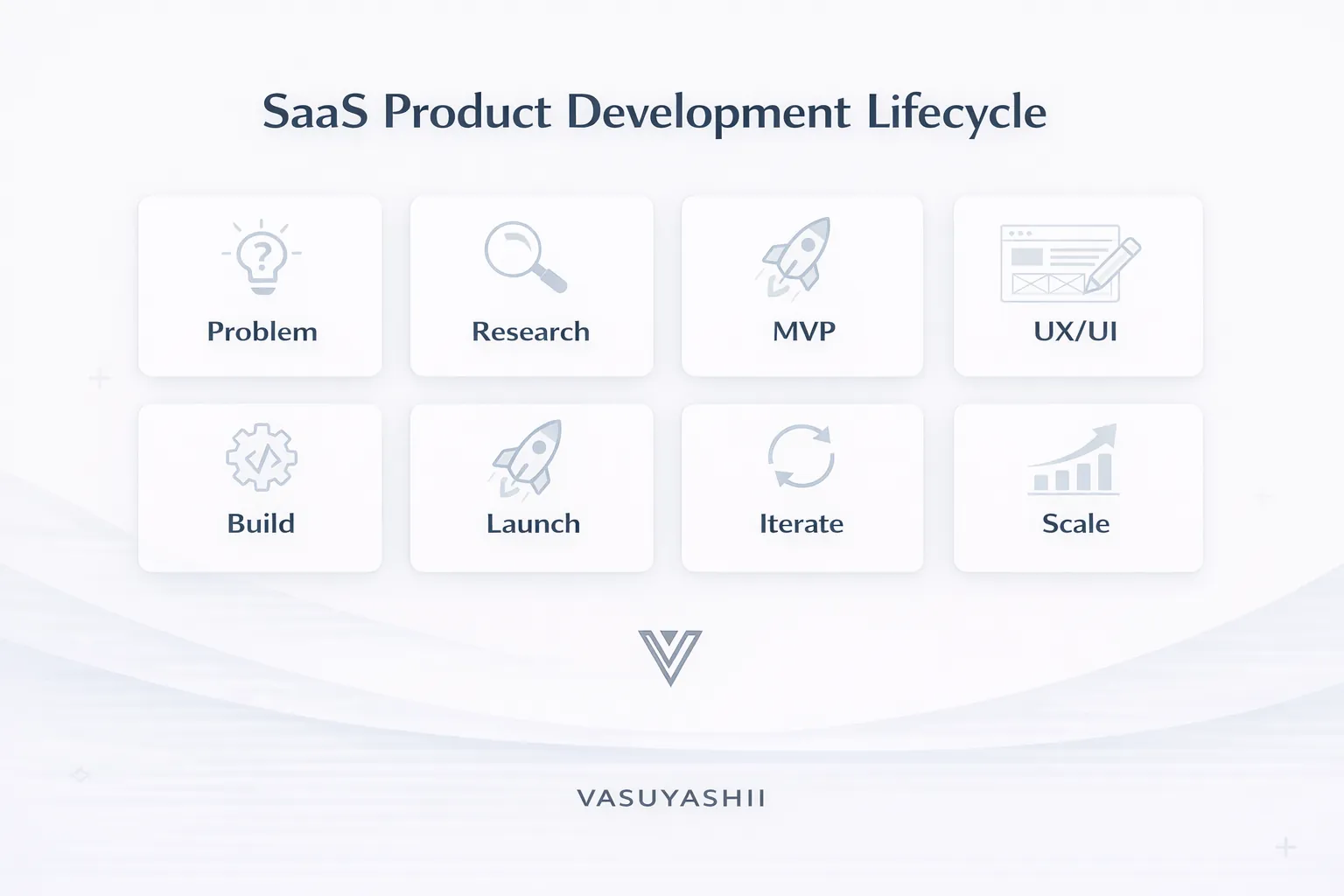
Decide how customer organisations are represented and how every business record receives a tenant or company boundary.
Define user identity, login recovery, session controls and invitation flows.
Enforce permissions on the server. UI hiding alone is not access control.
Model core business facts before screens. Identify unique constraints, historical records, status transitions and deletion rules.
Keep the frontend dependent on stable product APIs rather than database assumptions.
Email, PDF generation, imports, webhooks and scheduled jobs need retries, idempotency and observable status.
Review the multi-tenant architecture guide before choosing a tenancy pattern.
Possible patterns include:
The correct choice depends on scale, operational maturity, compliance, migration needs and customer requirements. Whatever pattern is selected, tenant filtering must be difficult to omit accidentally and covered by tests.
A plan is a commercial package. An entitlement is the product capability or limit the customer receives.
Model entitlements explicitly:
Do not scatter plan-name checks throughout UI components. Central entitlement logic makes upgrades and grandfathered plans safer.
Subscription billing also needs:
See the subscription billing system guide.
Signup is not activation. Activation is the first point at which the user experiences the product’s intended value.
An onboarding flow may include:
Track where users stop and why. Avoid forcing every role through the same product tour. The SaaS onboarding flow guide covers role branches, sample data and recovery.
A SaaS MVP still needs baseline controls:
Security scope depends on the product and data. Use the SaaS security checklist and obtain specialist review for higher-risk systems.
Track events that represent product usage rather than every click.
| Question | Example event or measure |
|---|---|
| Do users reach first value? | First completed invoice or workflow |
| Where does onboarding stop? | Last completed activation step |
| Is a feature adopted? | Eligible accounts using it in a period |
| Are customers returning? | Active accounts by cohort |
| Is reliability acceptable? | Failed jobs and workflow errors |
| Is support load changing? | Tickets by product area |
Define each metric with its unit, eligible population and time window. “Active user” needs a product-specific meaning.
Before launch, define:
A feature is not complete if nobody can detect or recover from its failure.
Use controlled releases:
Do not promise a fixed public launch date before payment, authentication or migration risks are understood.
Build the roadmap from evidence:
Votes and loud requests can inform discovery, but they should not replace product judgement. A customer-specific feature may belong in an integration or services layer rather than the shared product.
An early team may combine roles, but responsibilities still exist:
Clarify who can accept scope, release risk and customer commitments.
Do not build every capability:
| Capability | Often sensible starting point |
|---|---|
| Authentication | Proven managed or framework solution |
| Payments | Regulated payment provider |
| Email delivery | Transactional email provider |
| File storage | Managed object storage |
| Analytics | Product analytics platform or controlled events |
| Core differentiating workflow | Build and own |
Evaluate lock-in, data export, reliability, pricing and failure modes for every external service.
VASUYASHII Business Suite is a current ERP-lite SaaS product for Indian SMEs. Its implemented scope includes GST billing, products and inventory, clients, vendors, purchases, payments, expenses, reports, PDF invoices, secure WhatsApp sharing and multi-company data separation.
The product is deliberately not presented as a full enterprise ERP, full accounting replacement, payroll system or manufacturing suite. Mobile and desktop directions and advanced accounting features remain separately labelled by current status. This is first-party product evidence of scope control, not proof that the same architecture or feature set fits every SaaS idea.
Review the Business Suite product page for its current public scope.
Not necessarily. SaaS usually involves a repeatable market product and ongoing service operation. A hosted application for one client can remain custom software.
It depends on workflow, risk, integrations, team and readiness. Estimate a defined release scope rather than using one universal timeline.
Include billing when paid self-service is part of the validation. A controlled pilot may use manual commercial handling while the core product is tested.
If the intended product serves multiple organisations, tenant boundaries should be designed early even if the first release has few customers.
Choose a stack the team can operate securely and that supports the product’s workload. Framework popularity is less important than maintainability and operational competence.
Refuse or isolate a request when it weakens the shared product, creates unsupported complexity or serves only one customer without strategic value.
Write the target user, painful job, current workaround, minimum end-to-end workflow and three explicit non-goals. Then contact VASUYASHII for a focused SaaS discovery and architecture discussion.
Related Articles
March 25, 2026
Understand SaaS development services in 2026: MVP scope, multi-tenant architecture, onboarding, billing, scale planning, and the key factors that affect cost.
Read article
March 24, 2026
Estimate SaaS MVP development cost in India using validation scope, tenant isolation, roles, billing, onboarding, analytics, integrations and operating risk.
Read article
March 22, 2026
Plan secure SaaS architecture with tenant isolation, authentication, database patterns, billing, jobs, caching, observability, and practical scaling decisions.
Read article
May 30, 2026
Evaluate a Delhi NCR SaaS development company through product discovery, tenancy, billing, security, ownership, launch operations and support evidence.
Read article