
March 24, 2026
SaaS MVP Development Cost in India: 2026 Guide
Estimate SaaS MVP development cost in India using validation scope, tenant isolation, roles, billing, onboarding, analytics, integrations and operating risk.
Read articlePublished Updated
Prioritize a SaaS MVP using one core workflow, evidence, dependencies, acceptance metrics, security foundations, launch constraints, and a controlled roadmap.
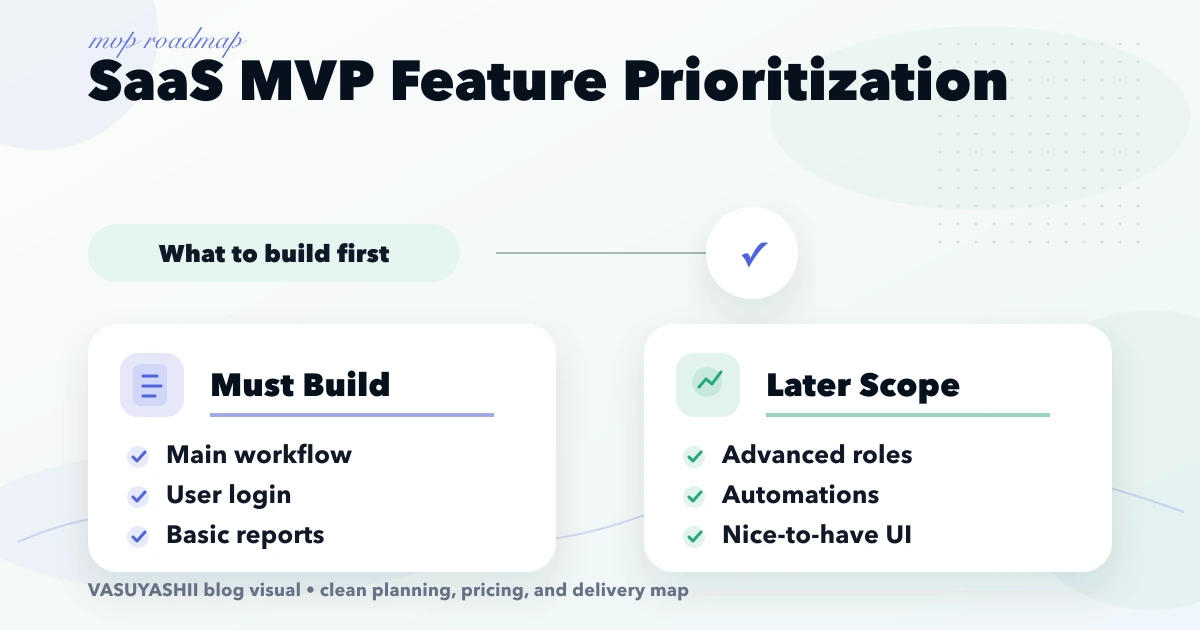
SaaS MVP feature prioritization is important for founders and business teams planning a SaaS MVP but unsure which features belong in phase one. SaaS MVP feature prioritization decides whether your first build launches fast or gets stuck in endless scope. This guide is for founders who need to choose what to build first, what to delay, and what to validate before spending too much. This guide is written for Indian SMB owners who want practical scope, cost, timeline, and decision clarity without generic theory.
By Tushar C. (Founder, VASUYASHII). Reviewed by VASUYASHII Editorial for practical scope, pricing, implementation clarity, and local business relevance.
The VASUYASHII Business Suite provides a useful example of visible prioritization. Its current product scope focuses on GST billing, products and stock, clients, vendors, purchases, payments, expenses, reports, PDF invoices, WhatsApp sharing, multi-company operations, and company-scoped access. Advanced accounting, payroll, manufacturing, direct e-invoice or e-way bill integration, bank reconciliation, and other larger modules are not presented as complete current capabilities.
That boundary is an MVP discipline decision. A trader must be able to create and share an invoice, update stock through real operations, record purchases or payments, and review company-specific information reliably before a long roadmap creates value. A roadmap item should not appear as a launch dependency merely because it is commercially attractive.
Use the same test for another SaaS product: write the one repeatable job the buyer is paying to complete, then identify the minimum account, permission, data, support, and reporting capabilities required to make that job trustworthy.
| Scope | Typical range |
|---|---|
| MVP scoping sprint | ₹30,000 to ₹80,000 |
| SaaS MVP build | ₹3 lakh to ₹9 lakh |
| MVP + billing + analytics | ₹9 lakh to ₹18 lakh+ |
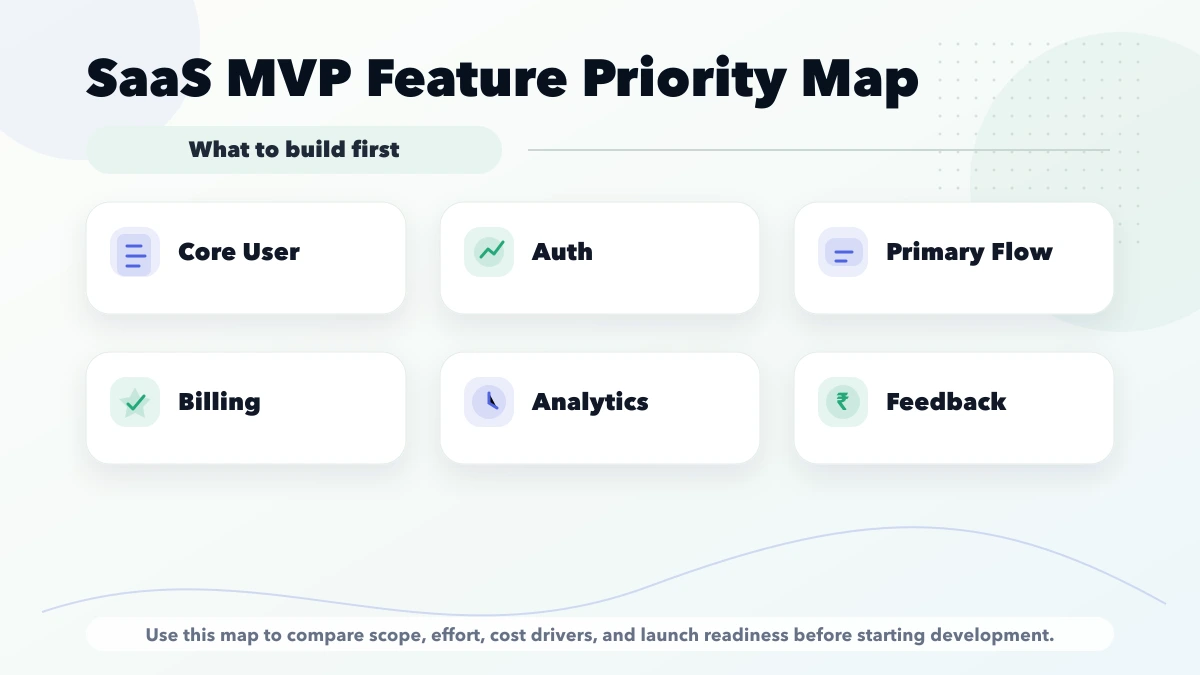
Create a simple score for customer pain, frequency, revenue or retention relevance, launch necessity, evidence strength, implementation effort, dependency risk, and support cost. A feature requested by one prospect should not automatically outrank a smaller capability required by every user to complete the core workflow.
Mark assumptions clearly. Evidence can come from customer interviews, manual-service usage, prototype tests, support requests, or pre-sales objections. “Competitors have it” is context, not proof that phase one needs it.
Some invisible work cannot be removed safely. Authentication, tenant-aware data access, backups, auditability, error handling, and basic admin support may be necessary even when users never see them as headline features. Conversely, a polished dashboard is not essential if the underlying workflow is not producing reliable data.
Group work into core value, operational foundation, compliance or security, launch support, and later enhancement. This prevents teams from cutting safety work while keeping cosmetic preferences.
| Question | Example measure |
|---|---|
| Can users reach value? | Percentage completing the core action |
| How quickly? | Time from signup to first successful outcome |
| Can the team support it? | Failed tasks and manual interventions |
| Will users return? | Relevant weekly or monthly account activity |
| Is payment intent real? | Trial-to-paid or qualified pilot conversion |
Choose metrics before development so analytics events and admin visibility are part of the scope.
Do not place delayed features in an unranked backlog. Give each one a trigger such as ten paying customers requesting it, a repeated manual task exceeding a weekly threshold, or a required integration blocking a signed pilot. Review triggers after launch and remove ideas that no longer support the product direction.
For phase-one architecture and cost planning, use the Web App Development hub and web application services.
Before calling the product an MVP, test the full core journey with representative data and more than one role. Confirm empty states, validation, retries, permissions, emails or notifications, support visibility, backups, and analytics. Record known limitations in the release notes and give pilot users a clear channel for reporting failures. An MVP can be narrow, but its promised workflow still needs to be dependable.
Launch scope should be small enough to support and complete enough to trust.
Imagine a distributor-facing SaaS product where sales teams create orders and managers review fulfilment. The core proof is not a large dashboard. It is whether an authorized user can create a valid order, the operations team can update it, and the manager can see reliable status without calling multiple people.
| Candidate capability | Phase-one decision | Reason |
|---|---|---|
| Login and company-scoped roles | Build | Required for safe account access |
| Create and update the core order | Build | Proves the primary workflow |
| Owner status dashboard | Build | Gives the buyer a measurable outcome |
| Guided first-use checklist | Build | Helps users reach activation |
| Multiple pricing tiers | Delay | One pilot plan can validate willingness to pay |
| Advanced forecasting | Delay | Needs reliable usage history first |
| White-label themes | Delay | Does not prove workflow value |
| Ten third-party integrations | Trigger-based | Add when a signed customer is blocked |
This matrix connects product scope with commercial evidence. Use the Web App Development hub as the parent planning route. Compare SaaS pricing models in India before designing tiers, and align the first release with SaaS onboarding UX best practices. If installability or offline behavior matters, evaluate the narrower progressive web app decision rather than assuming a native app is required.
The result should be a written phase-one boundary, named acceptance metrics, and explicit triggers for deferred work. That gives founders a roadmap they can defend during sales conversations and gives the delivery team a testable definition of done.
The product can be delivered remotely, so geography does not determine feature priority. Customer workflow, support capacity, legal requirements, and evidence from pilot users should drive the release boundary.
Start with one phase-one workflow, one activation event, one support owner, and written triggers for everything deferred. That gives the pilot a testable purpose instead of a feature-count target.
Start with a short discovery checklist that defines users, workflow, required outputs, and success metric.
Yes. A phased build is usually safer because it keeps cost and adoption under control.
Avoid building too many advanced features before the core workflow is tested with real users.
Compare exact deliverables, timeline, ownership, support, and reporting instead of only the final price.
No. Custom development is useful when workflow, roles, reports, or integrations are specific to your business.
Yes, if the first phase is scoped around one clear business problem.
Share the target user, repeated problem, current workaround, first successful outcome, and buying constraint. VASUYASHII can turn those inputs into a testable phase-one scope, dependency map, timeline, and acceptance checklist.
Before removing or keeping a feature, ask:
Do not cut validation, tenant isolation, backups, or support visibility simply because users do not see them. Also do not keep a decorative analytics dashboard when the system has not yet collected reliable operational events.
For every retained feature, add one acceptance statement in business language. “Order management” is vague. “An authorized sales user can create an order with approved products, the operations user can update fulfilment, and the company owner can see the current status and history” is testable.
Related Articles
March 24, 2026
Estimate SaaS MVP development cost in India using validation scope, tenant isolation, roles, billing, onboarding, analytics, integrations and operating risk.
Read article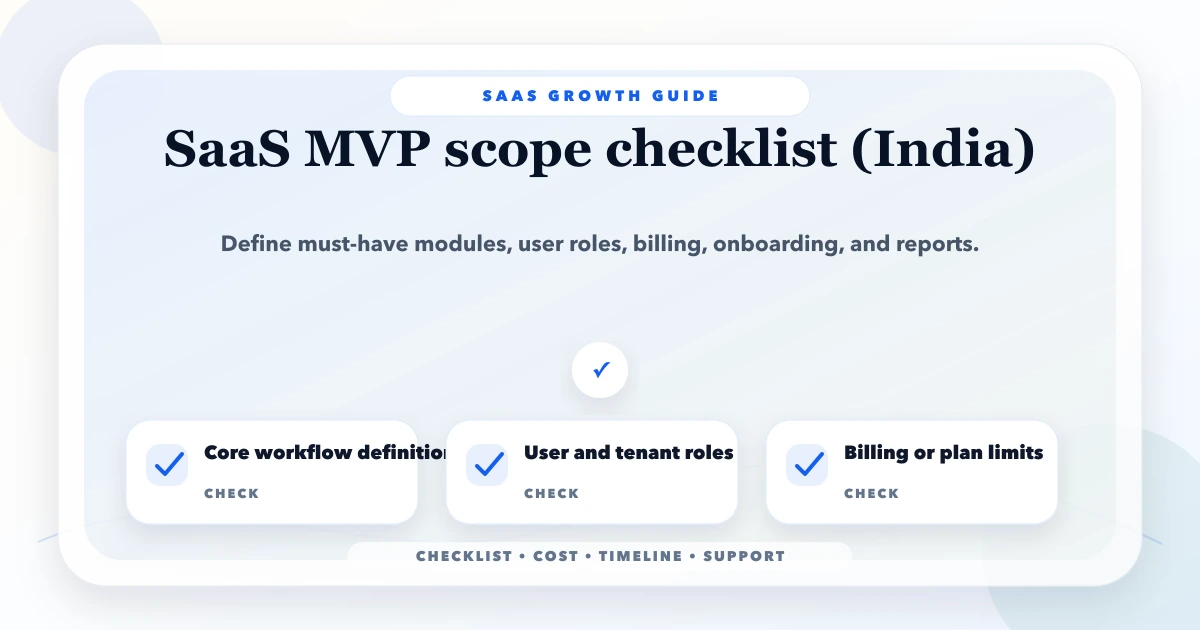
May 16, 2026
Plan a focused SaaS MVP with clear users, workflows, permissions, billing boundaries, acceptance checks, costs, and launch metrics for India.
Read article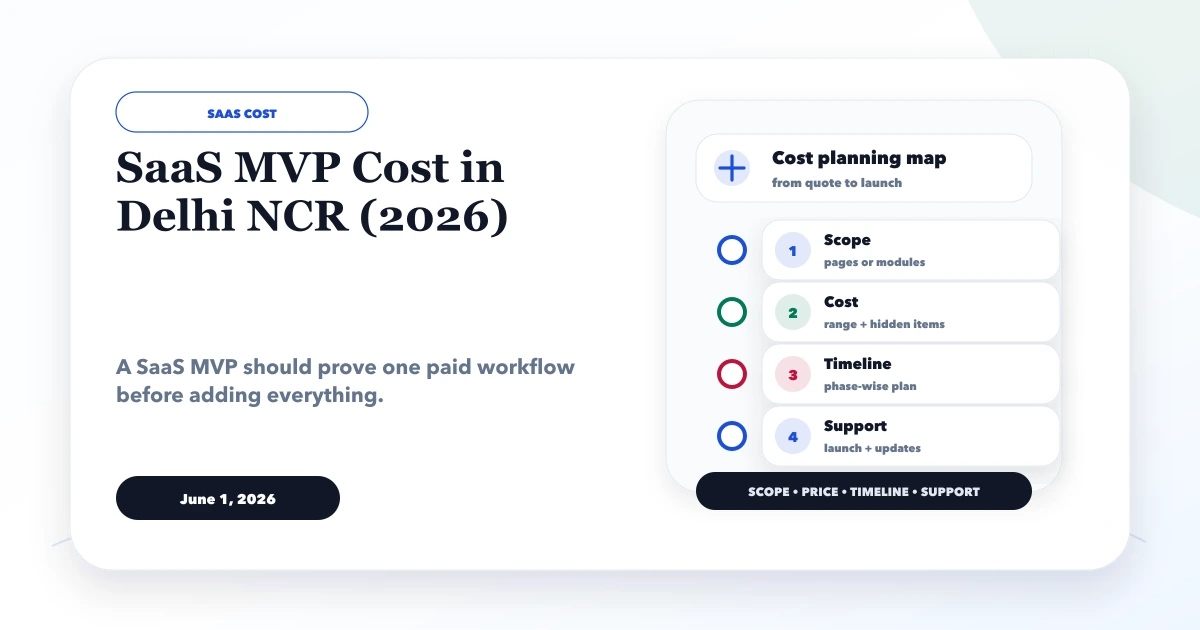
June 1, 2026
Estimate a Delhi NCR SaaS MVP using product risk, tenant model, core workflow, billing, security, analytics, support and staged budget bands.
Read article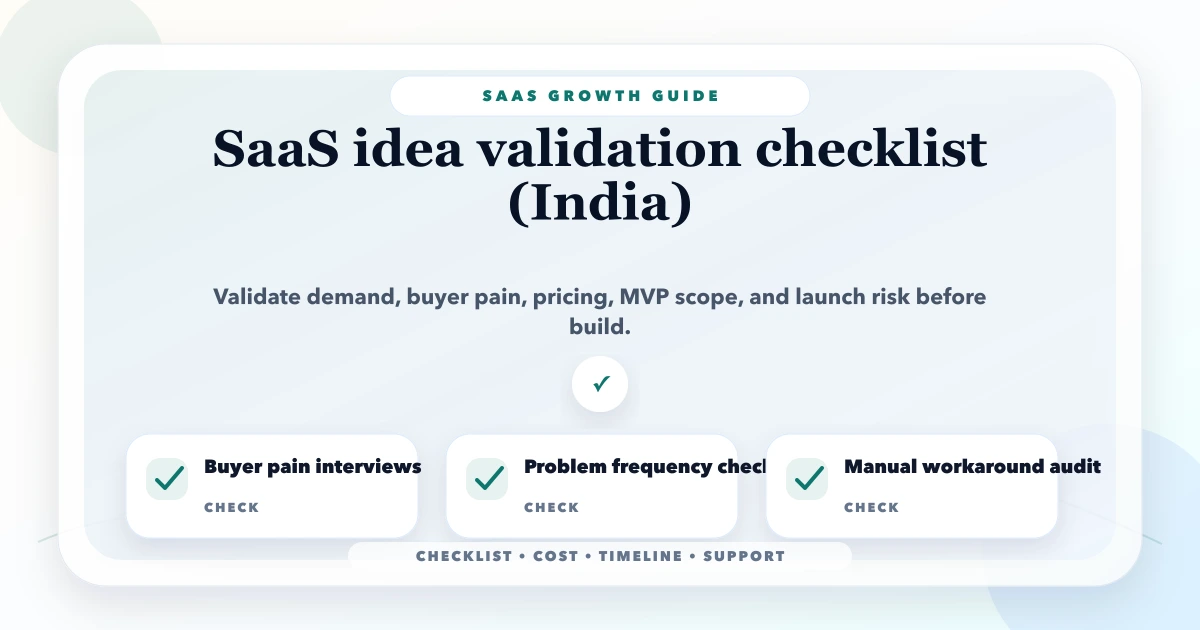
May 16, 2026
Validate a SaaS idea in India with problem interviews, workflow evidence, pricing tests, pilots, decision gates, risks, and a practical founder checklist.
Read article