
April 19, 2026
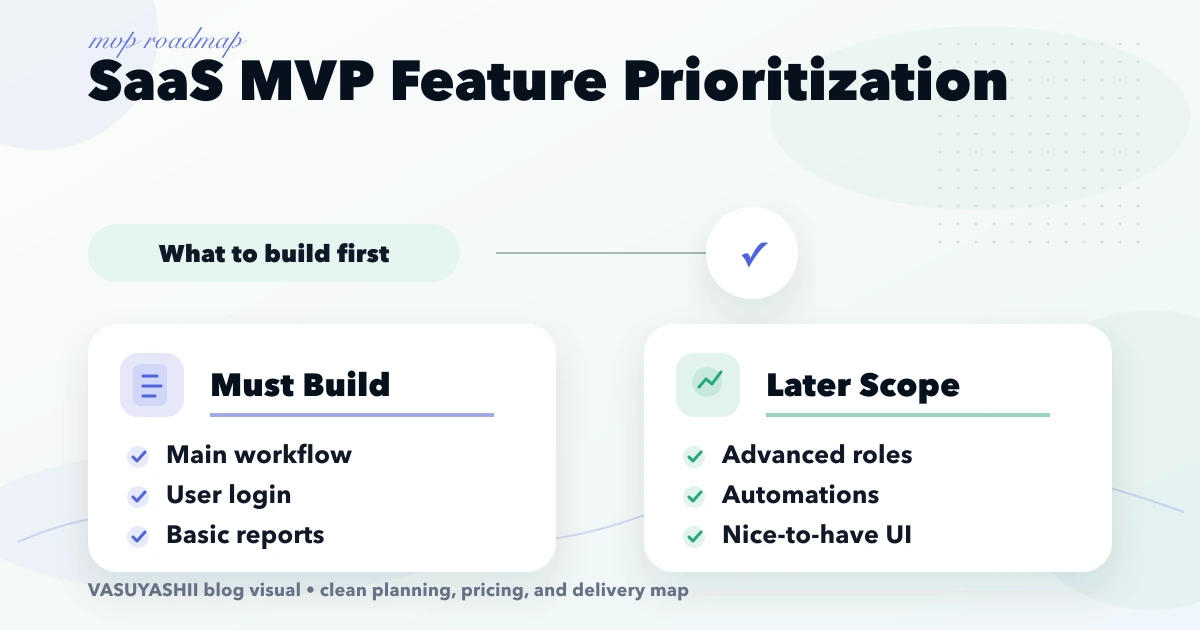
SaaS MVP Prioritization: What to Build First
Prioritize a SaaS MVP using one core workflow, evidence, dependencies, acceptance metrics, security foundations, launch constraints, and a controlled roadmap.
Read articlePublished Updated
Plan a focused SaaS MVP with clear users, workflows, permissions, billing boundaries, acceptance checks, costs, and launch metrics for India.
A useful SaaS MVP is not a smaller copy of a mature product. It is the smallest reliable system that lets one clearly defined customer complete one valuable job, lets the team support that customer, and produces enough evidence to decide what should be built next.
For an Indian founder, the hardest scope decisions are usually not about the framework. They are about who the first user is, which workflow must work end to end, how access is controlled, what is charged manually or online, and what operational work the founder can handle during the pilot. This checklist turns those decisions into an executable release boundary.
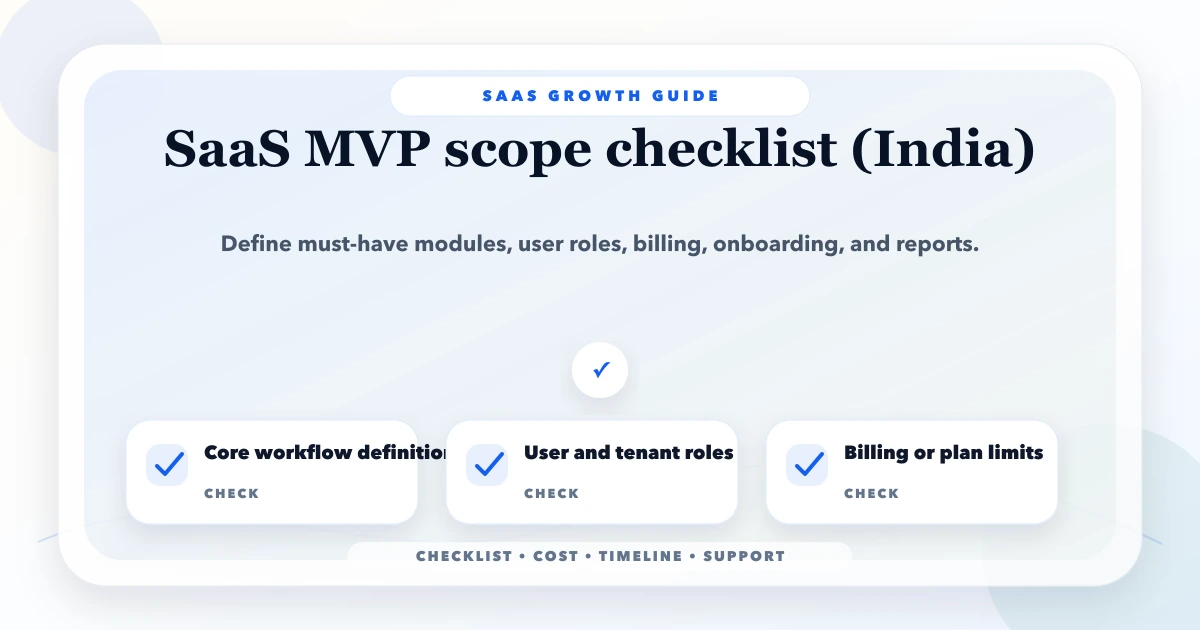
Scope the first release around one buyer, one primary workflow, one measurable outcome, and one support process. Include authentication, tenant or account separation, role permissions, the core workflow, a basic admin view, essential notifications, audit-worthy events, backups, and a way to measure activation. Delay advanced dashboards, complex integrations, native apps, multiple plan combinations, and rarely used configuration until pilot usage proves the need.
If the product is mainly an authenticated operational tool, review the capabilities of a custom web application. If the workflow is unique to the business, start with software development scoping instead of selecting technology first.
Complete this sentence before creating a feature list:
For [specific user], the MVP helps them [complete one job] without [current costly workaround], and success is measured by [observable result].
For example: "For a regional distributor's sales coordinator, the MVP captures dealer orders, applies the approved price list, and gives dispatch staff a confirmed queue without copying WhatsApp messages into spreadsheets; success is 80% of pilot orders entered through the portal within four weeks."
That statement is testable. "Build a distributor SaaS platform" is not.
| Area | Must decide before build | Sensible MVP boundary | Usually later |
|---|---|---|---|
| Customer | First buyer and daily user | One segment and one operating model | Multiple unrelated industries |
| Access | Account, company, and role ownership | Login, password reset, 2-3 roles | Custom permission builder |
| Core job | Start and finish states | One complete workflow | Parallel workflow variants |
| Data | Required records and ownership | Validated forms, import template | Large self-service migration studio |
| Billing | Who pays and how | Manual subscription status or one simple plan | Coupons, usage tiers, proration |
| Admin | Support and correction needs | Account lookup, status, safe correction | Full analytics command centre |
| Notifications | Critical user moments | Email or one approved channel | Multi-channel campaign automation |
| Measurement | Adoption decision | Activation, completion, errors, retention | Predictive scoring |
Do not call a collection of screens an MVP. Write the workflow as states and transitions. A booking product might use draft -> requested -> confirmed -> completed -> cancelled. A B2B order product might use draft -> submitted -> approved -> allocated -> dispatched -> delivered.
For every transition, document:
This prevents expensive ambiguity. A button named "Approve" may affect stock, payment eligibility, customer communication, and reports. Those consequences belong in the scope, not in a discussion after development starts.
A SaaS MVP still needs a trustworthy ownership model. Decide whether the top-level unit is a user, organisation, company, branch, school, clinic, or workspace. Every business record should belong to that unit, and server-side checks should enforce the boundary.
A practical first permission model often has three roles:
Avoid a configurable permission matrix in phase one unless it is essential to the buying decision. But do not replace permissions with hidden menu items; restricted actions must be blocked by the backend as well as the interface.
Many MVPs do not need automated subscription billing on day one. A founder can invoice a small pilot cohort manually while the product validates retention. If online billing is required, define only one or two plans and document:
Payment gateway integration is separate from product pricing logic. The gateway confirms a transaction; your application decides what that transaction unlocks. For webhook and notification design, use the integrations and automation service as a planning reference.
Pilot users will enter wrong data, forget passwords, misunderstand a status, and ask why an action failed. Include a minimal internal support view with account search, subscription status, recent key events, and clearly authorised correction actions.
Our implementation scoping method treats support operations as a first-class workflow. Before approving a feature, we ask how the team will diagnose it when a user reports a problem. This is first-party process evidence, not a claim that every SaaS requires the same admin design.
If customers already use Excel, define an import template with exact columns, formats, required values, duplicate policy, and an error report. Import into a staging area first and reconcile record counts before publishing data to the live account.
Also define a basic export. Early customers are more willing to test a product when they know their data is not trapped. The Excel-to-system data import checklist covers dry runs, validation, and rollback in detail.
Even a pilot needs:
Security scope should follow the data risk. A product storing medical, financial, identity, or high-value commercial data requires deeper review than a public content planner.
Move a feature to later when it does not change the pilot buying decision, activation, retention, or supportability. Common deferrals include:
Maintain a written "not in MVP" list. It protects the release when new ideas arrive during development.
| Test | Acceptance evidence |
|---|---|
| New account | User can register or be invited and reaches the correct workspace |
| Access control | Restricted role cannot read or perform blocked actions |
| Core workflow | Pilot user completes the full job without developer intervention |
| Failure state | API, validation, and payment errors produce useful recovery guidance |
| Mobile use | Critical workflow works on the actual devices used by pilot staff |
| Data quality | Required fields, duplicates, totals, and exports reconcile |
| Support | Team can find the account and understand recent actions |
| Recovery | Backup exists and a restore drill has been completed |
| Measurement | Activation and workflow-completion events are recorded |
Price depends on workflow depth, number of roles, external APIs, data migration, compliance, platform coverage, and the quality bar for testing and support. A simple single-workflow web MVP is materially different from a multi-tenant product with billing, granular permissions, mobile apps, real-time data, and several integrations.
Ask for a work-breakdown estimate rather than one unexplained number. The quote should separate discovery, UX, frontend, backend, integrations, migration, testing, deployment, and post-launch support. Third-party fees for messaging, maps, email, storage, payment gateways, app stores, and monitoring should be shown separately.
This is a planning pattern, not a guaranteed delivery promise. Integration approvals, migration quality, and workflow complexity can extend the schedule.
Track a small set of behavioural measures:
Page views and registrations alone cannot validate a SaaS product. The strongest signal is repeated completion of the job the product was designed to improve.
If separate customers will use the same product, their records need a reliable account boundary. The implementation can be simple, but data ownership and server-side isolation should not be postponed.
Only when device capabilities, offline work, background location, scanning, or app-store distribution are essential. A responsive web application is often faster to validate for office and browser-based workflows.
No. Manual invoices can be appropriate for a small assisted pilot. Automate billing when self-service purchase is part of the validation goal or manual administration becomes a measurable constraint.
Use a small cohort that represents the chosen segment and can provide repeated workflow evidence. The quality of usage and interviews matters more than an arbitrary sign-up count.
Prepare the release sentence, user roles, workflow states, required records, integrations, platform needs, migration volume, security constraints, and acceptance evidence. Share the "not in MVP" list too.
Review relevant VASUYASHII work and capabilities, then contact the team with the current workflow, pilot user, required launch date, and constraints. The first goal should be a defensible scope, not the largest feature list.
Approve the MVP only when every included feature supports activation, delivery of the core job, safe operation, support, or measurement. Everything else belongs in a later release until customer behaviour earns it.
Use the SaaS idea validation checklist for India before approving that scope, then apply the SaaS development-company evaluation framework when selecting an implementation partner.
Related Articles
April 19, 2026
Prioritize a SaaS MVP using one core workflow, evidence, dependencies, acceptance metrics, security foundations, launch constraints, and a controlled roadmap.
Read article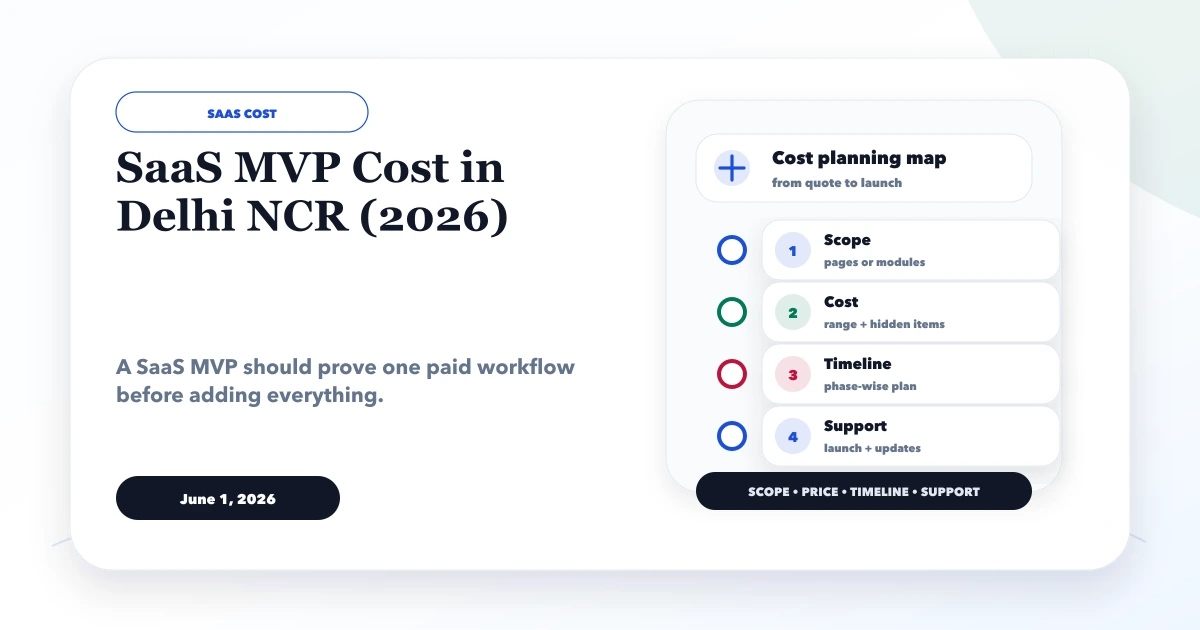
June 1, 2026
Estimate a Delhi NCR SaaS MVP using product risk, tenant model, core workflow, billing, security, analytics, support and staged budget bands.
Read article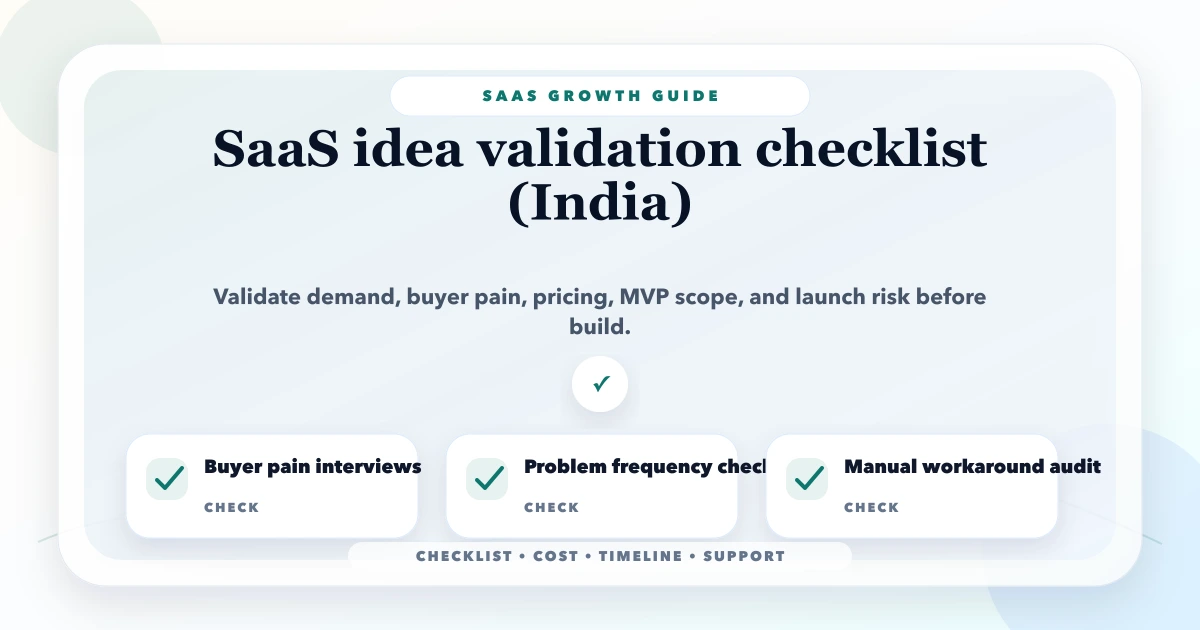
May 16, 2026
Validate a SaaS idea in India with problem interviews, workflow evidence, pricing tests, pilots, decision gates, risks, and a practical founder checklist.
Read article
May 16, 2026
Improve a SaaS pricing page with clear plans, value metrics, feature limits, billing terms, trust signals, FAQs, comparison tables, and conversion tracking.
Read article