
March 28, 2026
Software Development Company in Delhi NCR
Software development company in Delhi NCR: pricing, process, deliverables, timelines, and how businesses choose the right partner in 2026.
Read articlePublished Updated
Plan custom software in Delhi NCR with build-versus-buy criteria, module scope, data controls, pricing bands, delivery stages and vendor checks.
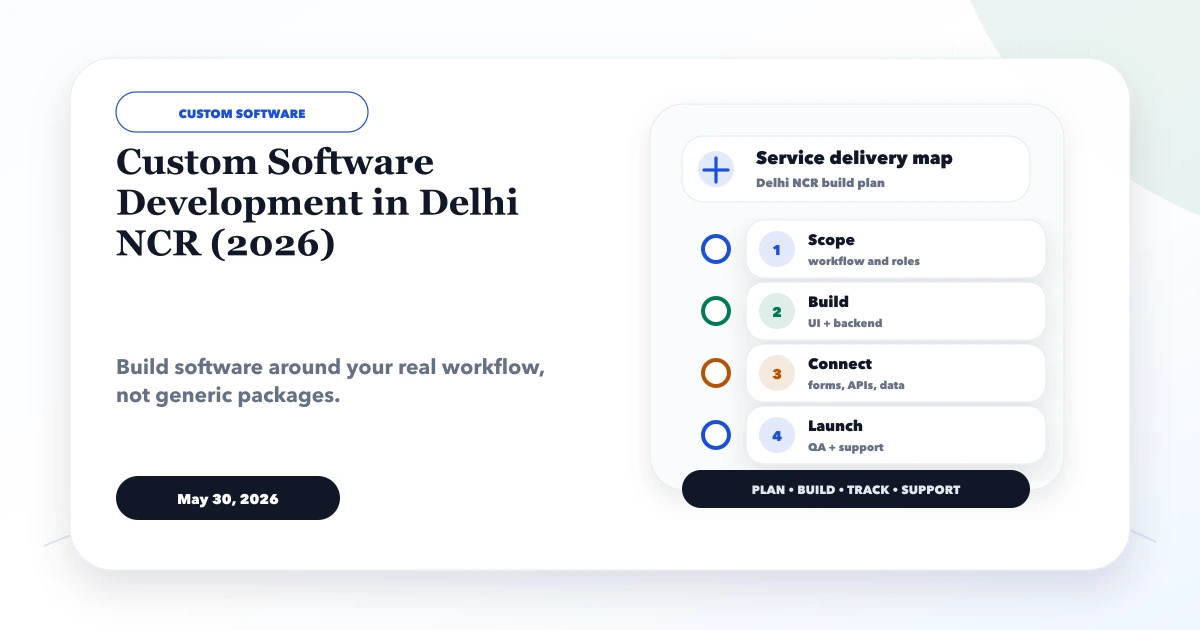
Service-area note: VASUYASHII is based in Delhi NCR and supports businesses remotely across India. A city-focused guide describes service and planning context; it does not claim a physical office in every location mentioned.
Explore the parent topic: Custom Software, CRM and ERP Hub →Custom software is justified when a business process creates important value or risk and available products cannot support it without excessive workarounds. It is not automatically better than SaaS, spreadsheets or an existing ERP.
This guide helps Delhi NCR businesses make the build-versus-buy decision, define modules and records, estimate a realistic delivery sequence, compare providers and protect ownership. It preserves the existing public URL while replacing generic location copy with a decision framework.
Custom development is worth investigating when:
Buy or configure an existing product when the process is standard, the product covers most requirements, switching cost is acceptable and custom differences do not create a durable advantage.
| Option | Best fit | Main limitation |
|---|---|---|
| Existing SaaS | standard CRM, support or collaboration process | recurring cost and product constraints |
| Configured platform | stable workflow that fits platform primitives | complexity can accumulate in hidden rules |
| Integration | reliable systems already exist but do not exchange data | source ownership and API limitations |
| Custom software | distinctive records, roles, decisions and operations | higher delivery and maintenance responsibility |
| Spreadsheet-led process | early low-volume learning | weak concurrency, permissions and audit at scale |
Do not ask only, “Can this be built?” Ask, “Which option produces the safest useful outcome at the lowest total ownership cost?”
The automation services guide is a better starting point when the business already has suitable source systems and only needs a controlled workflow between them.
A weak brief begins with “we need CRM, ERP and dashboard.” A useful brief states:
Example:
Sales staff cannot see stock availability and outstanding dues while preparing a quotation, causing repeated calls and inconsistent commitments.
This problem suggests records and rules. It does not automatically require a complete ERP.
Custom software is easier to design when the nouns are clear.
Typical business records include:
For each record, define identity, required fields, status lifecycle, relationships, owner, retention and who may view or change it.
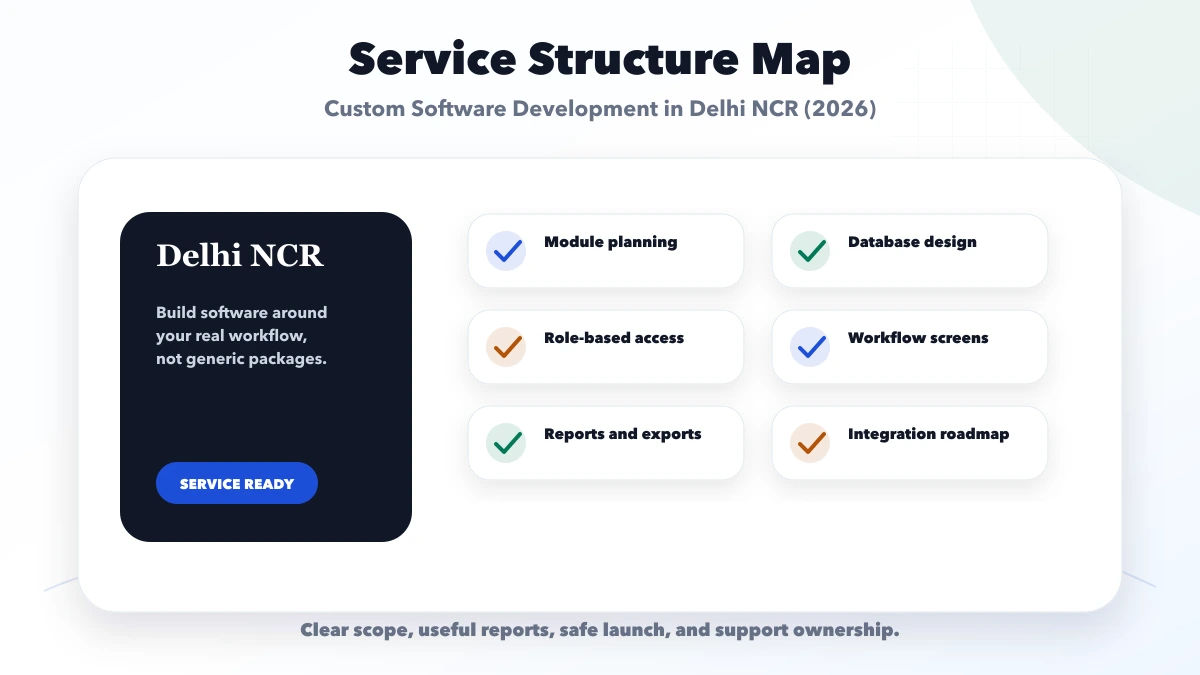
May include enquiries, companies, contacts, pipeline, quotations, follow-ups and conversion states. Avoid creating a generic CRM if sales users only need a narrower operating flow.
May include SKU, unit, GST fields, price, stock location, reservation and movement history. Current quantity should be derived through a controlled inventory rule, not freely edited without evidence.
May include requisitions, approvals, purchase orders, receipts, supplier bills and returns. Define who can commit spend and how exceptions are handled.
May include invoices, tax calculation, receipts, outstanding amounts and reminders. Accounting and statutory scope must be written separately rather than implied by the word “ERP.”
Reports should define source records, filters, calculation rules, freshness and reconciliation. A dashboard is not reliable merely because it looks complete.
Include role permissions, company settings, audit history, import/export, backup controls and support tools where required.
Use the web application cost guide when the main question is effort across screens, roles and integrations.
If the proposed system will serve several customer organisations with subscriptions, tenant isolation and product operations, use the SaaS development company framework before finalising the architecture.
Write acceptance examples, not only feature names.
For each workflow:
Example:
Given an approved quotation with valid customer and product records, when an authorised sales user creates an order, the system reserves available stock once, records the quotation relationship and rejects a repeated request with the same idempotency key.
This can be tested. “Order management module” cannot.
Legacy data often creates more risk than screens.
Define:
Do not import every old field merely because it exists. Preserve what the new process needs and archive historical evidence safely.
Use deny-by-default access. Define permissions by action and data scope:
Frontend visibility is not authorization. Backend APIs must enforce company and role boundaries.
Multi-company software also needs rules for shared masters, company-specific transactions, switching context and reports. The Business Suite provides an inspectable example of company-scoped business operations without being presented as a full enterprise ERP.
List every external dependency before estimating:
Verify API access, rate limits, webhooks, sandbox availability, provider charges, data ownership and outage behavior. “Integration included” is too vague for a contract.
| Scope | Existing planning band | Typical delivery window |
|---|---|---|
| Focused custom tool | Rs. 1.5 lakh to Rs. 4.5 lakh | 4 to 8 weeks |
| Business software system | Rs. 4.5 lakh to Rs. 12 lakh | 2 to 4 months |
| ERP-style custom platform | Rs. 12 lakh to Rs. 40 lakh+ | 4 to 9 months |
These retained amounts are early planning bands, not a fixed VASUYASHII quote or a verified Delhi NCR market average.
Cost is driven by:
Request a phase breakdown with assumptions, exclusions and change-control rules.
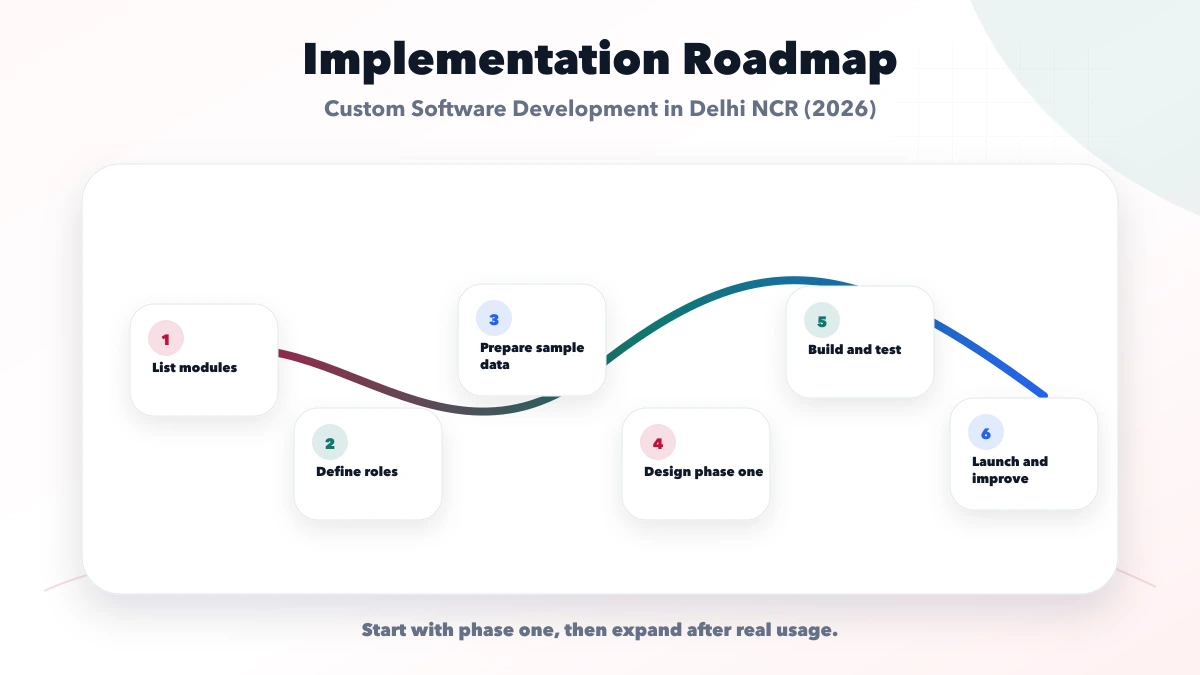
Observe current work, select the first outcome and prepare the record map.
Implement authentication, company scope, roles, master records and audit conventions.
Build one complete workflow through UI, API, database, notifications and reporting.
Use controlled users and safe data. Compare new results with the source process.
Add adjacent modules after the first workflow is accepted.
Transfer code, accounts, documentation, data export, deployment instructions and support process.
Location can help workshops, but it does not replace engineering evidence.
Ask:
Use the web app developer selection guide for provider due diligence.
Budget beyond initial development:
A smaller stable first release is usually easier to own than a broad system with unfinished modules.
Current VASUYASHII public evidence includes:
This evidence supports capability discussion. It does not prove every module or outcome for every industry.
VASUYASHII does not use this article to claim a full SAP-style ERP, full accounting, payroll, manufacturing BOM, a staffed office in every Delhi NCR city or undocumented customer results.
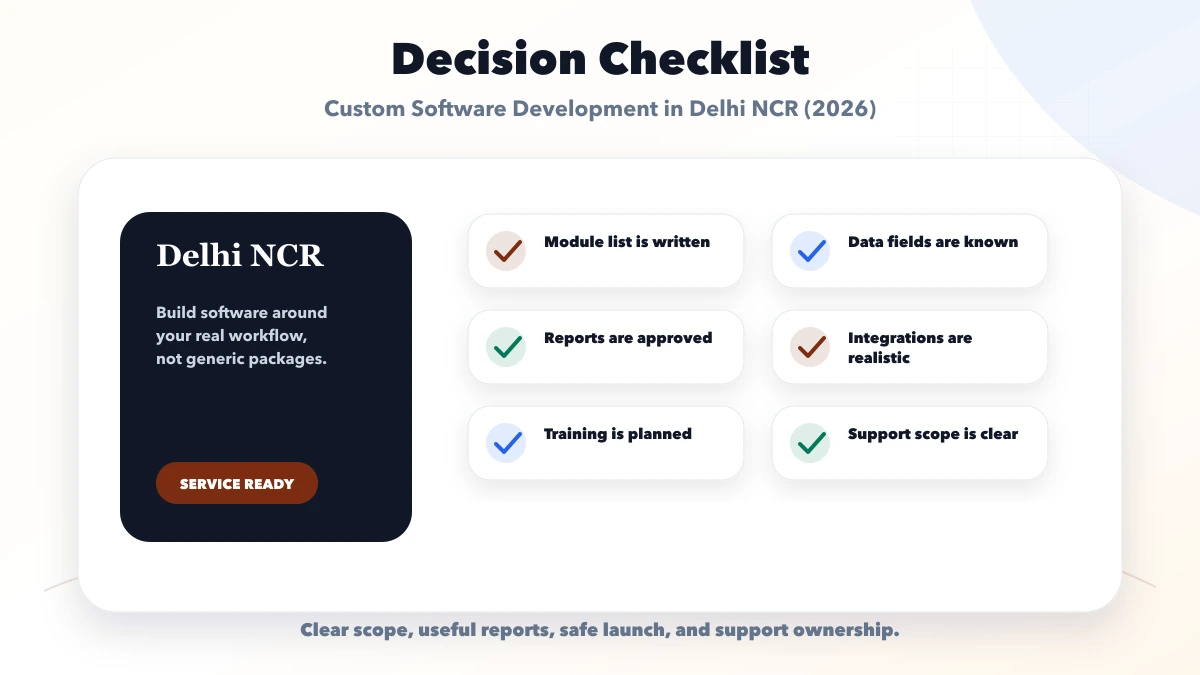
Compare the workflow against existing products. Custom work is more defensible when the process is valuable, specific, measurable and poorly supported by available tools.
Only if one accepted first workflow genuinely requires both boundaries. Otherwise phase them around business outcomes.
Often yes, subject to approved provider accounts, API availability, usage rules, consent, security and transaction reconciliation.
Ownership, licence terms, repositories, cloud accounts, third-party components and handover should be written in the agreement before development.
It depends on workflows, roles, integrations, migration and acceptance. A focused vertical slice can be delivered earlier than a broad multi-module system.
No. Evaluate process, evidence, communication, security, ownership and support. Use location only as one practical factor.
Write one problem statement and collect recent examples of the workflow. Map records, actors and exceptions before requesting a detailed estimate. The Delhi NCR software-company SEO plan explains how this commercial intent should connect to narrower module and decision guides. Contact VASUYASHII when the first outcome and ownership model are clear.
Related Articles
March 28, 2026
Software development company in Delhi NCR: pricing, process, deliverables, timelines, and how businesses choose the right partner in 2026.
Read article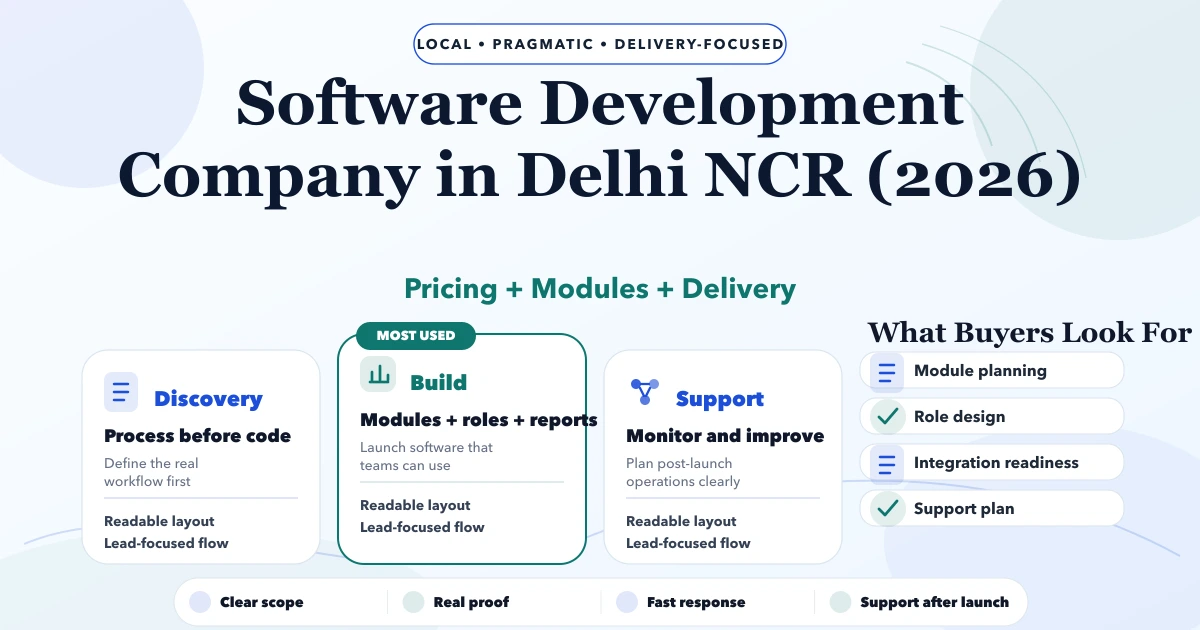
May 5, 2026
Compare a software development company in Delhi NCR by workflow discovery, data migration, permissions, integrations, rollout, ownership, and support.
Read article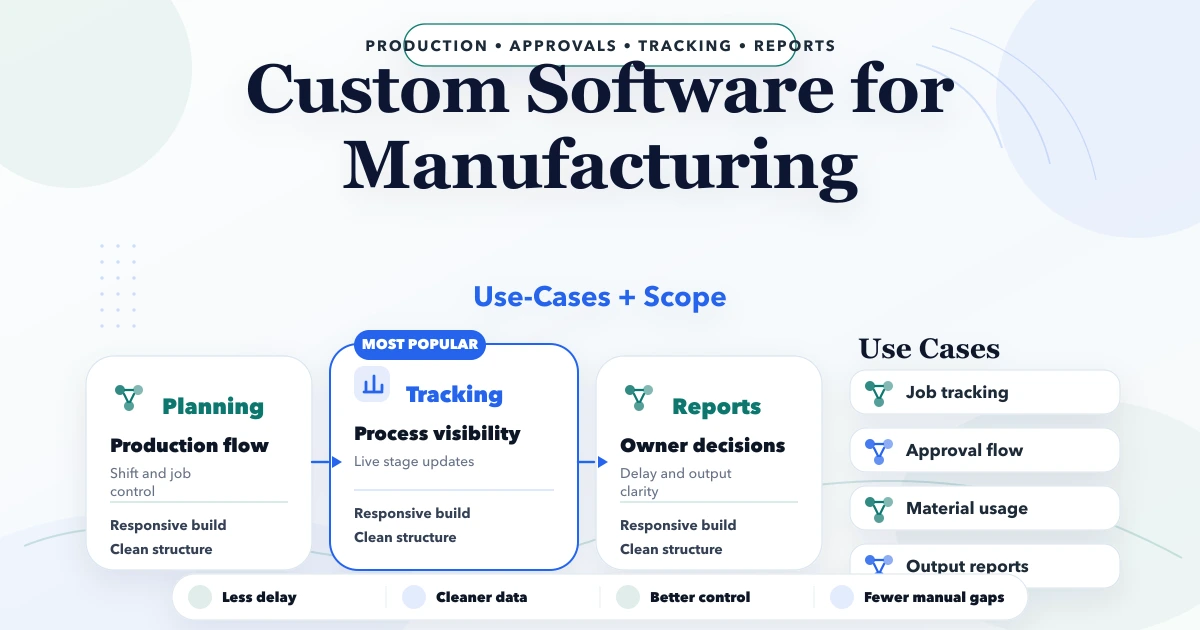
April 22, 2026
Evaluate custom manufacturing software for production tracking, material movement, quality, maintenance and reports with a phased Indian SME roadmap.
Read article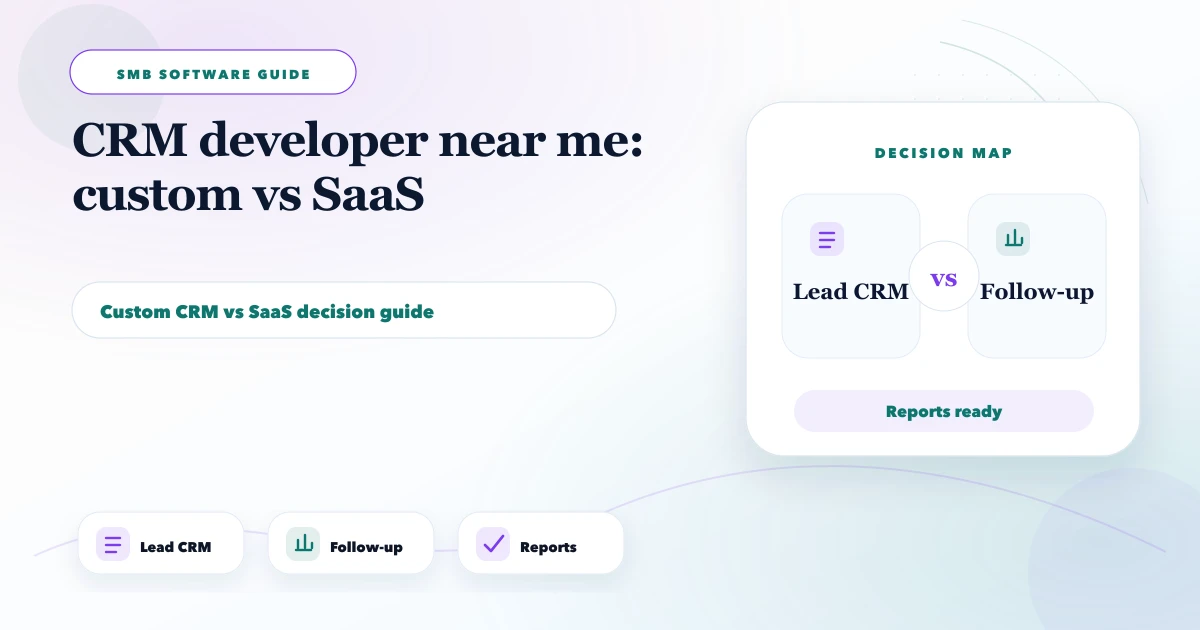
May 9, 2026
Compare a custom CRM developer with SaaS CRM using workflow fit, ownership, integrations, migration, permissions, adoption, support, and total cost.
Read article