
April 24, 2026
Bangalore Startup Website for Product Validation
Plan a Bangalore startup website for product validation with claim controls, waitlist or demo journeys, analytics, experiments, handover, and governance.
Read articlePublished Updated
Select a Noida website partner for SaaS or product marketing with positioning, demo routes, proof, documentation, analytics, handover, and growth controls.
Service-area note: VASUYASHII is based in Delhi NCR and supports businesses remotely across India. A city-focused guide describes service and planning context; it does not claim a physical office in every location mentioned.
Explore the parent topic: Website Development Delhi NCR Hub →The best website development company in Noida for a SaaS, software, or technology product must do more than design a corporate homepage. Product buyers need to understand the problem, workflow, users, security boundary, pricing or sales motion, proof, and next step. The website must also keep demos, documentation, support, and the application itself clearly separated.
This guide is for founders and product teams choosing a website partner. VASUYASHII should be evaluated using the same criteria. It does not claim an award, Noida office, customer result, or guaranteed product growth.
Written by Tushar C. (Founder, VASUYASHII) using the current VASUYASHII product-page and web-app experience. Product capabilities, metrics, testimonials, and roadmap statements must be verified by the owner.
Choose a partner who can connect:
A generic agency site template may look polished while failing to explain the product.
| Product motion | Primary website action | Supporting content |
|---|---|---|
| Self-serve trial | Start trial | Setup, limitations, pricing, support |
| Sales-assisted demo | Request demo | Use cases, qualification, security |
| Early access | Apply or contact | Current scope, eligibility, roadmap boundary |
| Paid setup | Try demo then request setup | Features, migration, support, recurring cost |
| Enterprise sale | Contact sales | Roles, integration, security, procurement |
Do not use “Start free” when no self-serve flow exists. Label demo, trial, sandbox, and production accurately.
The first screen should state:
Avoid broad claims such as “all-in-one solution for every business.” A narrower truthful promise helps qualified buyers self-select.
Organize features around jobs and workflows, not only module names.
For each feature:
If a capability is in development, label it as roadmap rather than current. Do not publish fabricated interface screenshots as live production evidence.
Show a controlled sample environment with fictional data clearly labelled. Prevent access to production or private customer records.
Keep it current, captioned, and focused on a real workflow. Record product version or date where helpful.
Use qualification appropriate to sales. Explain what the request does and expected follow-up.
Remove sensitive information and obtain rights. Alt text should describe the meaningful interface.
VASUYASHII uses a working demo approach for the Business Suite, with current capabilities and future boundaries stated separately.
| Claim | Evidence needed |
|---|---|
| Time saved | Method, baseline, period, and context |
| Active users | Defined count and current period |
| Secure | Specific controls and boundary |
| Integrated | Named current integration and status |
| Customer quote | Permission, source, accurate wording |
| Best or leading | Credible comparative basis |
If evidence is unavailable, explain the process or capability without an unsupported metric.
Show:
For sales-assisted products, explain which factors determine the quote. Avoid hidden mandatory setup behind a low headline amount.
Product marketing should link to appropriate:
Do not place customer support inside the new-sales form. Separate support and sales routes.
The marketing site is public and indexable. The application may include:
Use separate security, deployment, analytics, and caching policies. Do not send private app data to marketing analytics.
For product application work, review web application development.
Track the product decision path:
Connect lead quality or trial activation to the appropriate internal system without exposing personal data in GA4.
Build a hierarchy:
Avoid generating many thin industry or city pages. Internal links should help visitors understand the product, not exist solely to manipulate crawlers.
Product content changes as software changes. Define:
| Content | Approver | Trigger |
|---|---|---|
| Feature status | Product owner | Release or removal |
| Pricing | Authorized commercial owner | Plan change |
| Security claim | Technical/security owner | Control change |
| Integration | Product/integration owner | Availability change |
| Screenshot | Product and privacy review | UI change |
| Roadmap | Leadership | Priority/status change |
Maintain a release checklist so the website does not promise unavailable functionality.
Ask candidates to:
Evaluate judgement, not only visual style.
VASUYASHII provides website development, software development, and integrations. We can build marketing pages and product applications as distinct layers.
We do not guarantee signups, rankings, funding, or revenue. Use contact to request a written product website scope.
Show accurate plans when possible. For custom or enterprise sales, explain pricing factors and what happens after contact.
No. A demo shows a controlled experience; a trial lets a user operate the product for a period. Label access and limitations clearly.
Usually keep roadmap information controlled and accurate. Do not create search pages that imply unavailable functionality.
Yes. Clearly use fictional data and prevent any private customer information from appearing.
Meaningful steps such as feature interest, demo interaction, trial or lead success, and documentation paths—not personal field values.
When positioning, product, audience, evidence, or observed buyer behaviour changes enough to justify it. Do not redesign only because a visual trend changed.
Product websites become unreliable when marketing copy changes faster than the application. Maintain a small evidence register for every material claim. Record the claim, responsible product owner, current evidence, affected pages, approval date, and review trigger.
Claims that need control include supported integrations, security features, platform availability, response times, customer counts, performance metrics, roadmap dates, and plan entitlements. A screenshot is not sufficient if the underlying capability is restricted by role, plan, geography, or configuration. Those conditions belong on the page.
Before each release, product and marketing owners should review:
Ask the shortlisted website partner to plan one realistic change, such as launching a new feature page or revising a plan boundary. The response should show how content, screenshots, navigation, metadata, analytics, QA, redirects, and approval fit together. This exposes whether the team understands a product website as a maintained system.
The exercise does not need free design work. A paid release plan, content model, or prototype is enough to assess reasoning and handover. Prefer a partner who identifies evidence gaps and ownership decisions over one who immediately produces polished claims.
After launch, measure qualified demo or contact progression, documentation paths, feature-page engagement, and failed journeys. Do not optimise for traffic alone. The website should help suitable buyers understand the product and help unsuitable buyers self-select before consuming sales time.
Choose a Noida product website partner who can translate software into a truthful buyer journey. Separate current capability from roadmap, connect proof to claims, protect the application boundary, and give product owners control over every release.
Related Articles
April 24, 2026
Plan a Bangalore startup website for product validation with claim controls, waitlist or demo journeys, analytics, experiments, handover, and governance.
Read article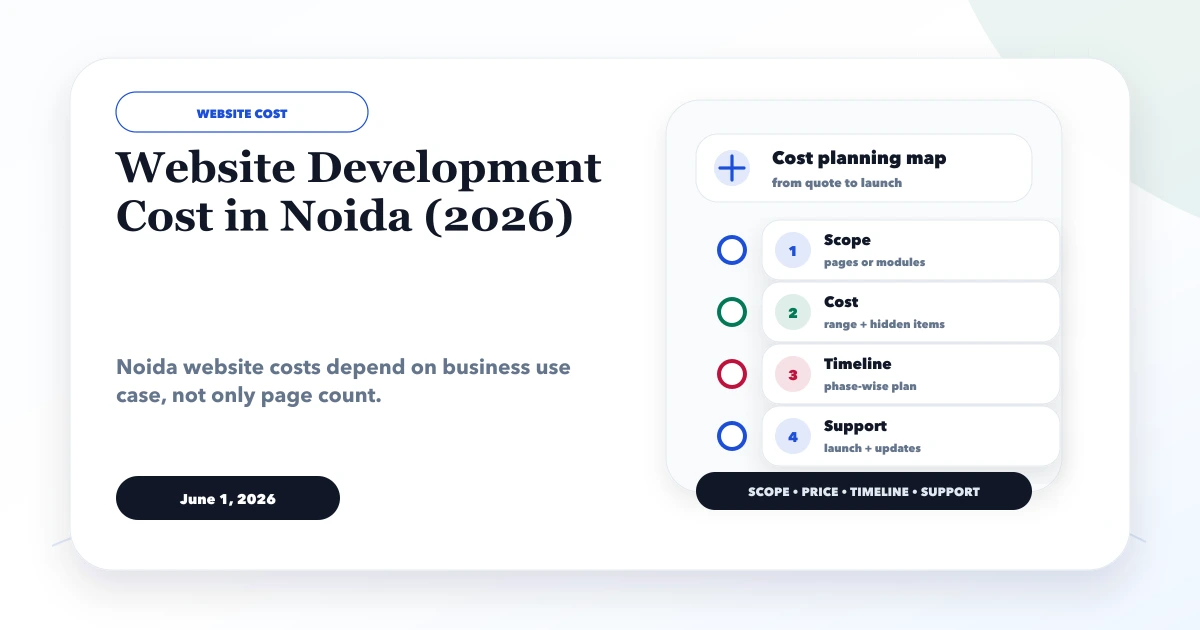
June 1, 2026
Estimate website development cost in Noida using discovery, content, design, build, integrations, migration, recurring fees, maintenance, and ownership.
Read article
March 22, 2026
Website development company in Noida: low starting packages, mobile-first UX, SEO structure, web apps, and WhatsApp lead generation strategy in 2026.
Read article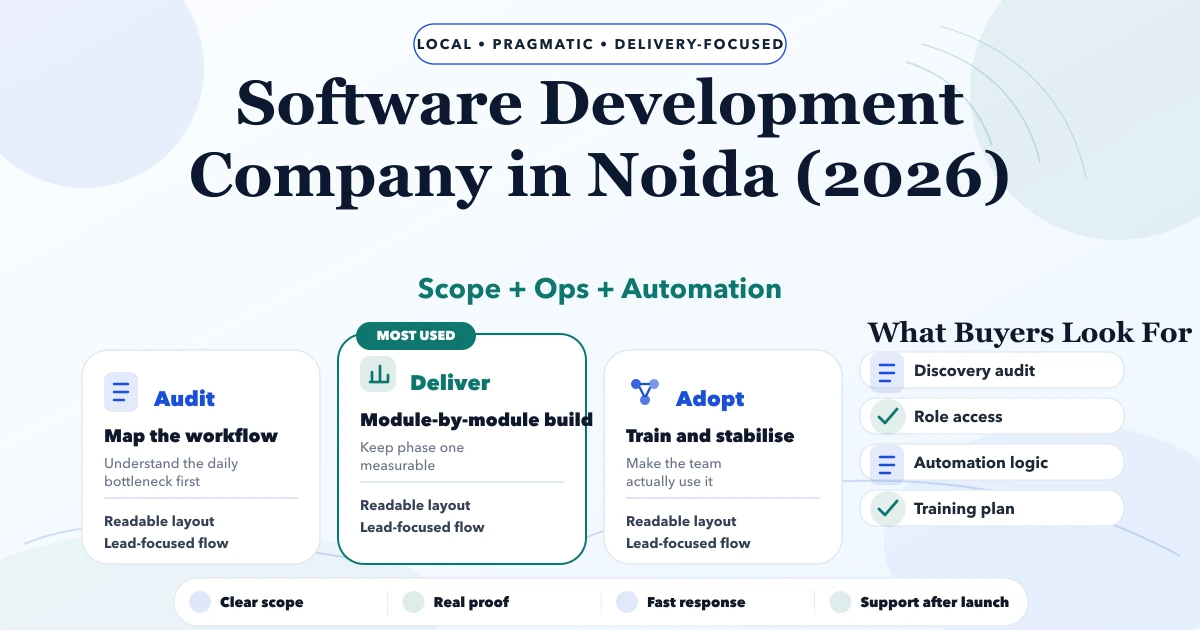
May 5, 2026
Compare a software development company in Noida by architecture, environments, release controls, testing, ownership, security, support, and handover.
Read article