
May 5, 2026
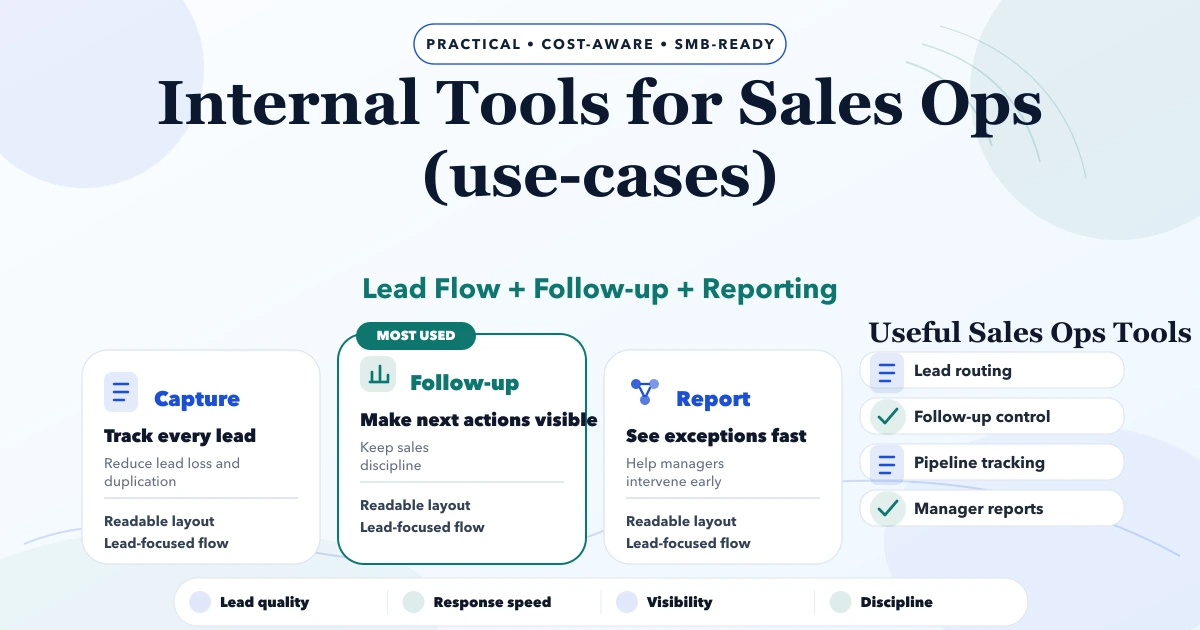
Internal Tools for Sales Operations: Use Cases
Explore internal sales tools for lead assignment, follow-up queues, quotation tracking, WhatsApp reminders, dashboards, and practical rollout planning.
Read articlePublished Updated
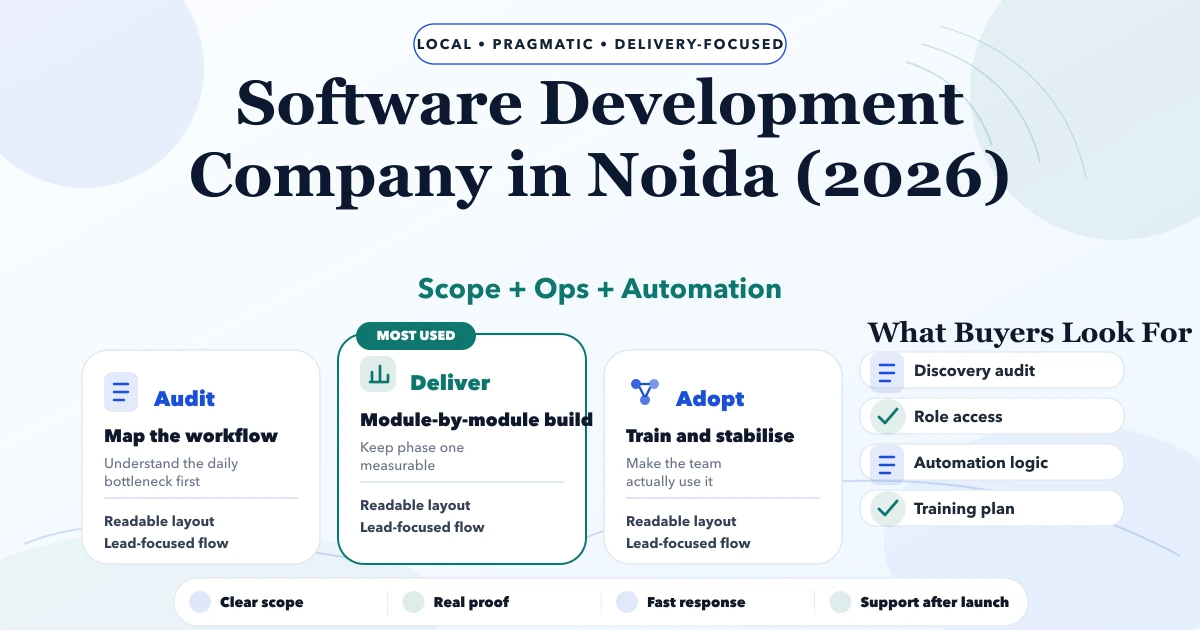
Compare a software development company in Noida by architecture, environments, release controls, testing, ownership, security, support, and handover.
Service-area note: VASUYASHII is based in Delhi NCR and supports businesses remotely across India. A city-focused guide describes service and planning context; it does not claim a physical office in every location mentioned.
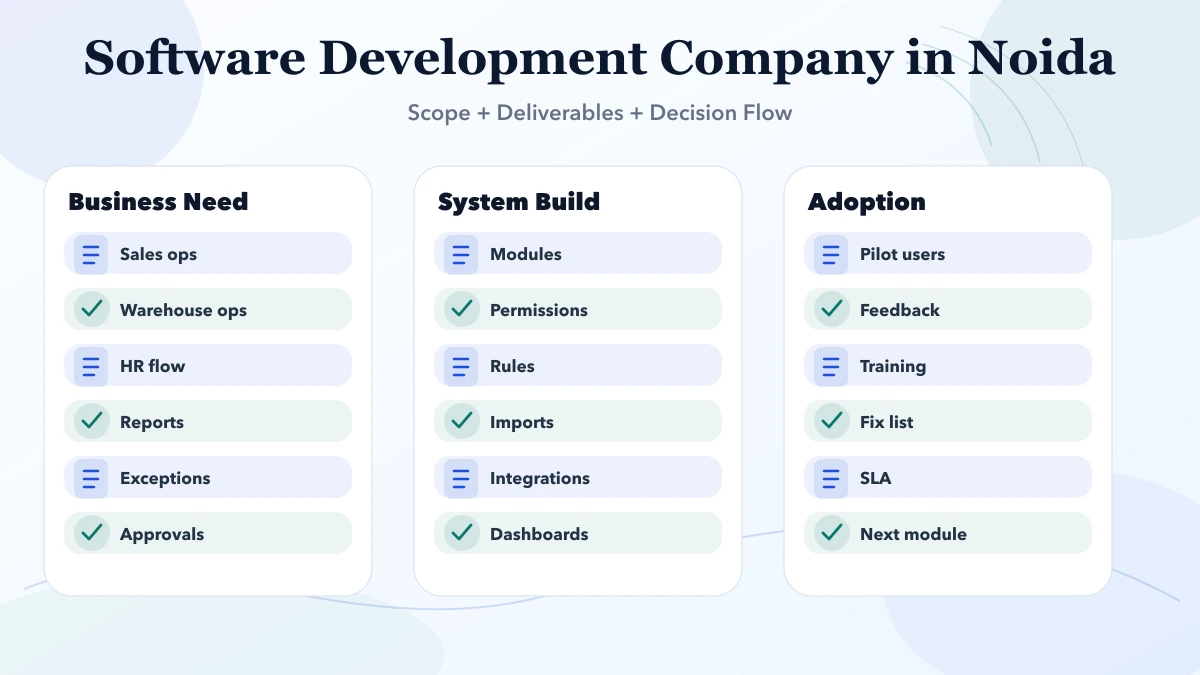
Explore the parent topic: Custom Software, CRM and ERP Hub →Choosing a software development company in Noida requires more than comparing screens, hourly rates, or a list of frameworks. The important question is whether the delivery team can turn an approved business scope into software that is testable, deployable, secure, recoverable, and maintainable after launch.
This guide focuses on technical and delivery due diligence: architecture decisions, environments, release control, source ownership, testing, observability, security, support, and handover. For workflow discovery and migration planning, also use the Delhi NCR software development guide.
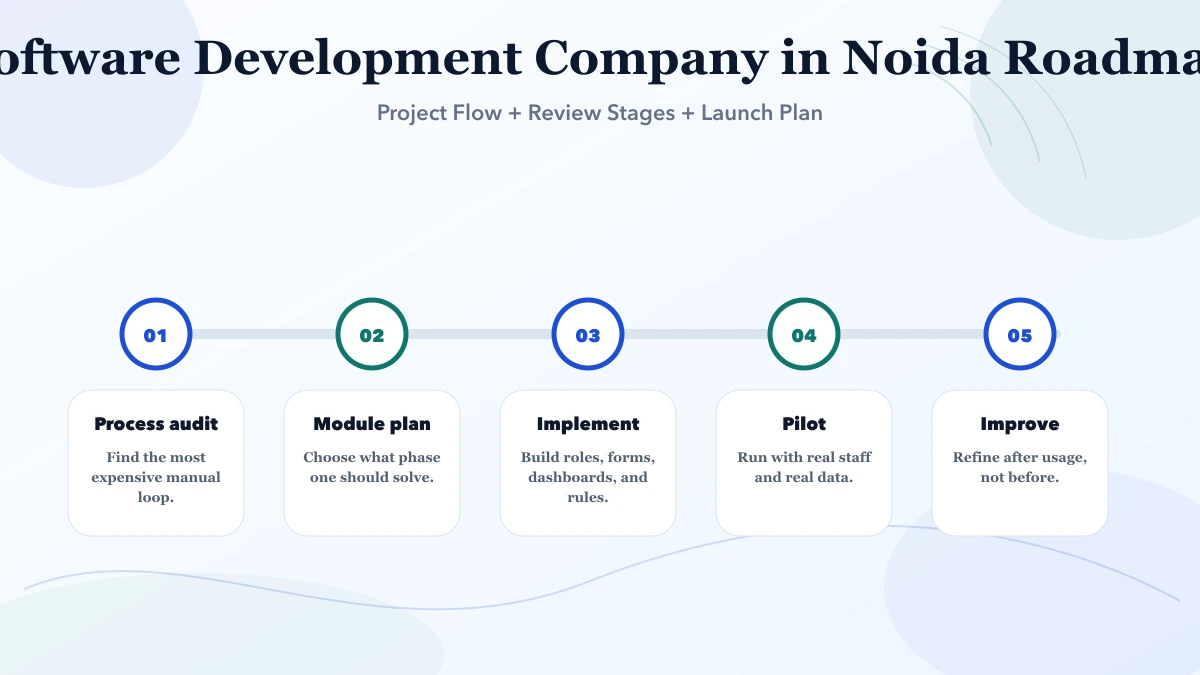
Shortlist providers that can show how they move from requirement to reviewed release. Ask for the architecture boundary, environment plan, source-control model, acceptance process, security responsibilities, deployment ownership, rollback route, and post-launch support terms.
A demo proves that a screen can work. It does not prove that the production system will isolate users correctly, survive integration failures, preserve data, or remain maintainable when the original developer is unavailable.
A feature name such as “approval module” is too broad. Write a representative scenario:
A staff user submits a request within one company. A manager can approve it only within the assigned branch. A second approval is required above a defined amount. Rejected requests retain the reason. An unauthorised user cannot view, approve, export, or alter the record. The audit history records every sensitive action.
This scenario reveals states, roles, ownership, thresholds, notifications, reports, and audit requirements. It also gives the development and testing teams the same definition of complete.
Prepare normal, invalid, duplicate, cancelled, reversed, permission-denied, and integration-failure cases before approving the build.
The proposal should explain why the selected architecture fits the current workload and foreseeable change. It does not need to be unnecessarily complex, but important tradeoffs should be recorded.
| Decision | What the provider should explain |
|---|---|
| Frontend and backend boundary | Where validation and business rules execute |
| Database model | Relationships, transactions, reporting, and retention |
| Authentication | Identity, sessions, recovery, and account lifecycle |
| Authorization | Role, ownership, company, and branch checks |
| File storage | Access, expiry, backup, and deletion |
| Background work | Queues, retries, idempotency, and monitoring |
| Deployment | Environments, configuration, rollback, and ownership |
Avoid choosing technology only because it is popular. The web development technologies guide and database comparison can support a structured discussion.
Production should not be the first place a feature is tested. Define at least a development route and a controlled production route; a staging environment is useful when stakeholders need to verify releases with production-like configuration.
Each environment should have:
Do not copy production personal data into a test environment without an approved need and protection method.
The business should know where source code is stored, who controls the repository, how branches or changes are reviewed, and what triggers deployment. Individual developer machines should not be the only copy.
For each release, record:
Emergency fixes need the same traceability, even if the review is faster. Unrecorded production edits make future failures difficult to diagnose.
“Testing included” is not a sufficient deliverable. Separate responsibilities:
| Test area | Example checks |
|---|---|
| Unit or logic | Calculation, validation, state transition |
| API | Authentication, permission, invalid input, response contract |
| Integration | Signature, retry, duplicate event, provider failure |
| Workflow | Representative user scenario from start to finish |
| Migration | Accepted, rejected, transformed, and duplicate records |
| Security | Access denial, tenant separation, sensitive export |
| Production smoke | Login, critical route, notification, report, monitoring |
Business users should perform acceptance against agreed scenarios. Developers can prove technical behaviour, but the operating owner must confirm that statuses, reports, and exceptions match the approved process.
Hiding a button in the interface does not protect an action. The backend must verify identity, role, resource ownership, company or tenant, and any state-specific rule for every protected operation.
Test a user attempting to access another record by changing an identifier, using an old link, calling an API directly, or exporting data. Review privileged actions such as user management, deletion, cancellation, approval, configuration, impersonation, and bulk export.
Use the RBAC security guide and permission matrix template before finalising role names.
An API connection is not complete merely because one successful request works. Define authentication, timeouts, rate limits, retries, idempotency, duplicate handling, event order, reconciliation, logging, and manual recovery.
Payment and order events may arrive more than once or out of order. Notification providers may accept a request and later fail delivery. An accounting or inventory source may be temporarily unavailable. The software should expose these states instead of silently displaying stale or incorrect information.
The webhook and API guide explains the operational controls that should appear in scope and acceptance.
The support team needs enough evidence to answer: what failed, for whom, when, in which environment, and after which release?
Define:
Logs should not expose passwords, tokens, full payment data, or unnecessary personal information. Monitoring without an owner is only stored noise.
Ask what is backed up, how often, where it is stored, how access is controlled, and how long it is retained. Then require a restore test using non-production conditions. A successful backup message does not prove that the system can recover.
Rollback may involve application code, configuration, database schema, and data. Some database changes cannot be safely reversed after new writes begin, so the release needs a forward-repair or maintenance plan.
Document the decision owner for a rollback and the production checks that must pass before a release is considered stable.
| Evaluation area | Evidence to request |
|---|---|
| Scope | Scenarios, exclusions, assumptions, acceptance |
| Architecture | Decision record and dependency map |
| Quality | Test plan and representative evidence |
| Security | Authorization model and secret handling |
| Operations | Logging, monitoring, backup, recovery |
| Ownership | Repository, environments, data, accounts |
| Support | Severity, response route, stabilisation, maintenance |
| Handover | Documentation and recovery demonstration |
Do not demand confidential client code or data as proof. A provider can demonstrate process using its own product, a labelled demo, diagrams, sample documentation, or a controlled walkthrough.
Tie review and payment milestones to inspectable outputs:
Percentage complete is difficult to verify. A working scenario with known exceptions gives both sides a clearer delivery state.
VASUYASHII currently describes software development, web application development, and integration services. The current website and VASUYASHII Business Suite provide first-party context for static deployment, business workflows, company-scoped access, billing, inventory, reports, PDFs, and integrations.
This context shows current product and service direction. It does not establish a Noida office, named local client, uptime history, certification, cost saving, or guaranteed software outcome.
For a scoped discussion, share one representative scenario, user roles, data sensitivity, expected integrations, deployment constraint, and acceptance owner through contact.
They should show scope scenarios, architecture boundaries, delivery stages, ownership, acceptance, and the process for handling change.
Not for every small project, but stakeholders need a safe review route. Production should not be the first environment used for meaningful validation.
Ownership should match the contract, but the business needs continuity rights and controlled access. The repository must not exist only on a developer machine.
Compare the same scenarios, migration volume, integrations, environments, tests, documentation, support, and exclusions. Price alone is not comparable when assumptions differ.
Server-side authorization and company or tenant separation are essential for business systems. Test denied access directly, not only through hidden interface controls.
Run production smoke tests, monitor errors and integrations, support pilot users, stabilise defects, and schedule controlled improvements.
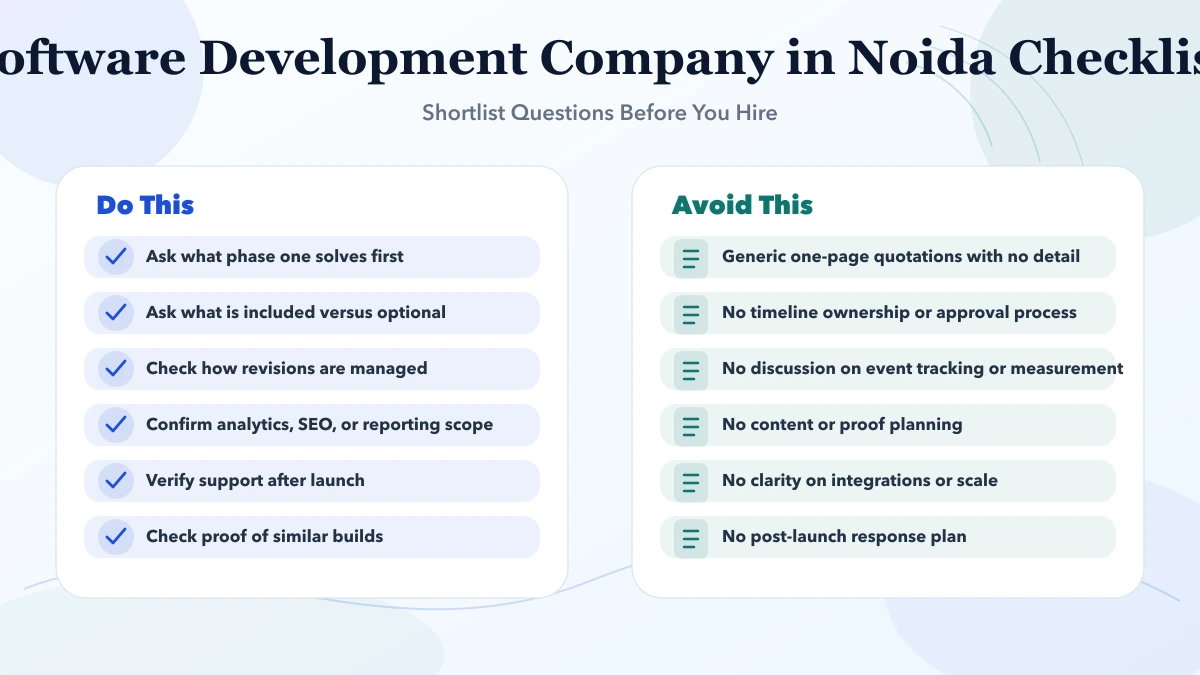
Write one scenario and one failure case before asking for estimates. Use the software project requirement template, then share the technical and ownership constraints through contact.
Related Articles
May 5, 2026
Explore internal sales tools for lead assignment, follow-up queues, quotation tracking, WhatsApp reminders, dashboards, and practical rollout planning.
Read article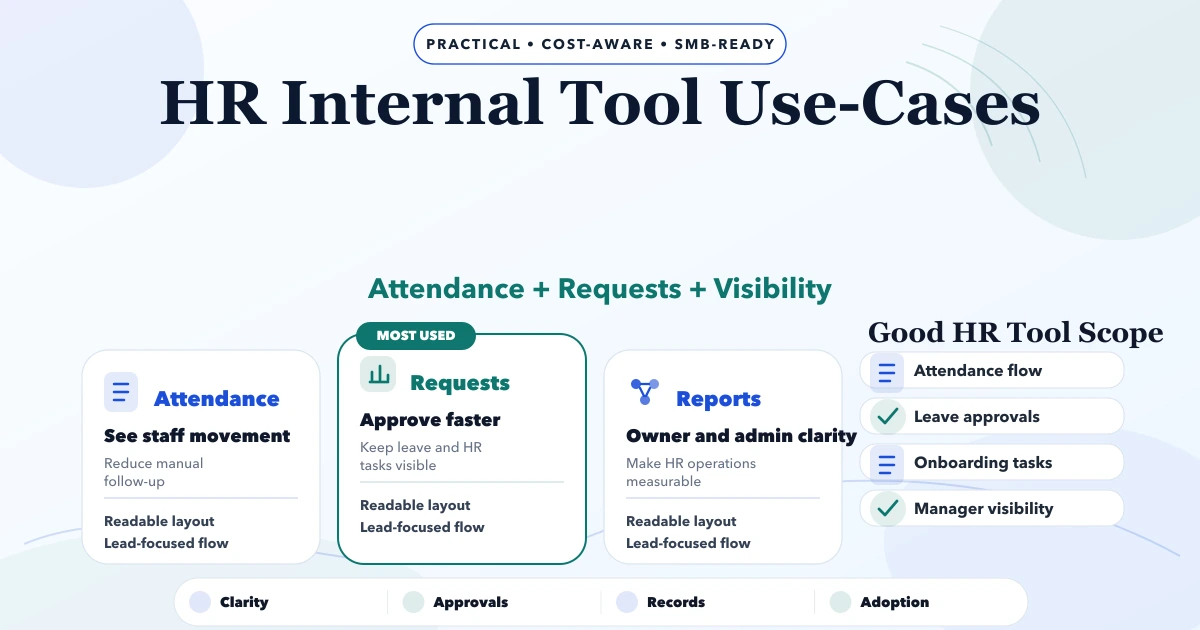
May 6, 2026
Plan HR internal tools for employee records, onboarding, attendance inputs, leave, documents, requests, approvals, assets, permissions, reports, and audits.
Read article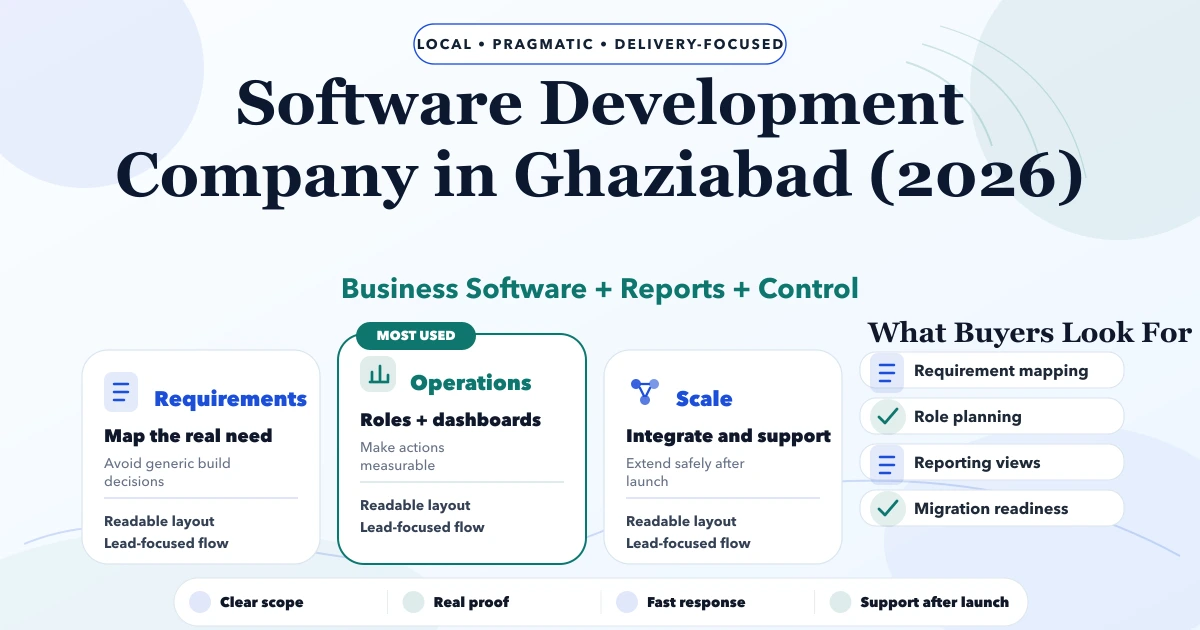
May 5, 2026
Software Development Company in Ghaziabad (2026) guide with pricing, process, timeline, deliverables, proof links, and practical planning for businesses in.
Read article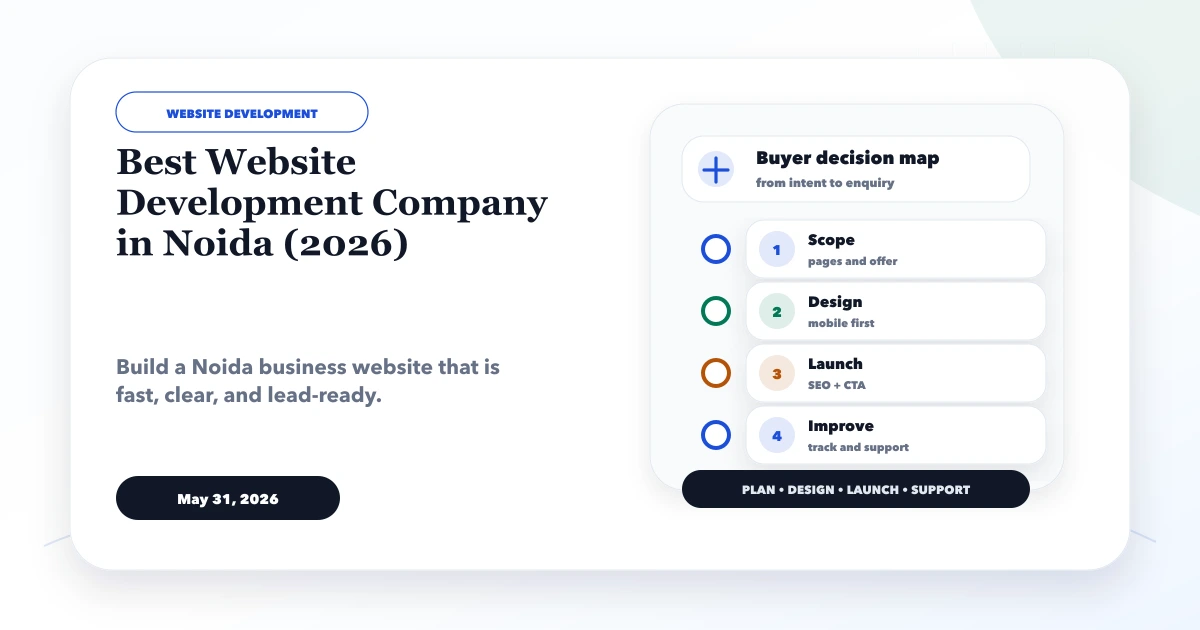
May 31, 2026
Select a Noida website partner for SaaS or product marketing with positioning, demo routes, proof, documentation, analytics, handover, and growth controls.
Read article