
May 31, 2026
Noida Website Partner for SaaS and Product Marketing
Select a Noida website partner for SaaS or product marketing with positioning, demo routes, proof, documentation, analytics, handover, and growth controls.
Read articlePublished Updated
Estimate website development cost in Noida using discovery, content, design, build, integrations, migration, recurring fees, maintenance, and ownership.
Service-area note: VASUYASHII is based in Delhi NCR and supports businesses remotely across India. A city-focused guide describes service and planning context; it does not claim a physical office in every location mentioned.
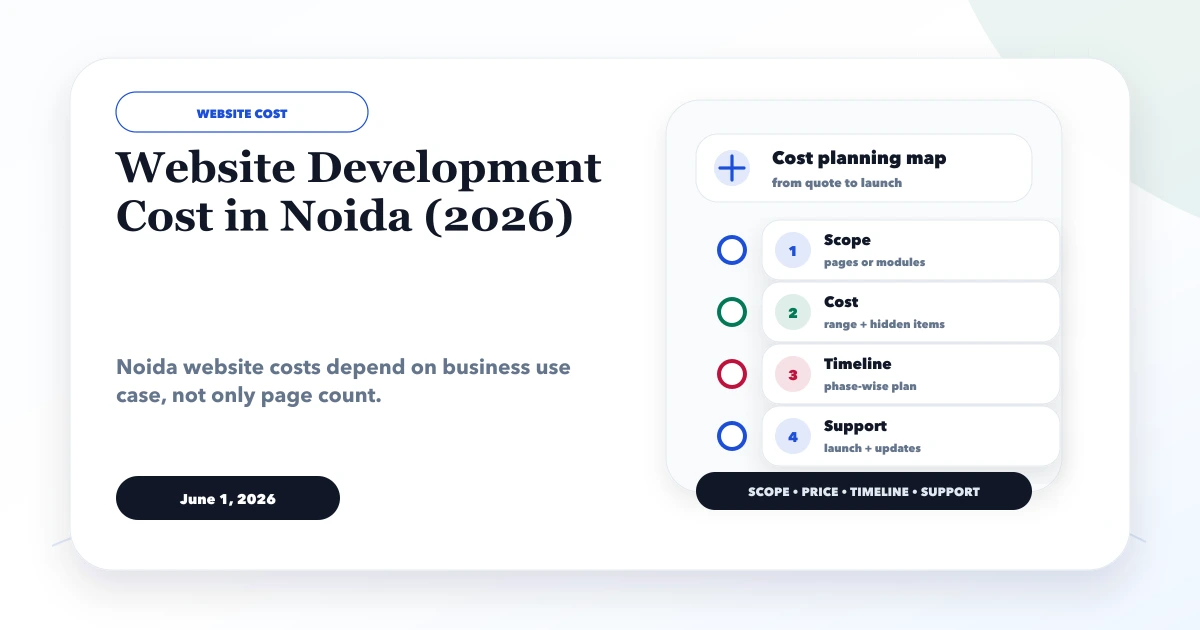
Explore the parent topic: Website Development Delhi NCR Hub →Website development cost in Noida cannot be estimated responsibly from page count alone. The total includes discovery, content, proof, design, development, forms, integrations, migration, testing, infrastructure, ownership, and ongoing maintenance. Two five-page websites can have very different effort and risk.
This guide provides a total-cost-of-ownership model rather than a promotional starting price. Use it to prepare a budget and normalize vendor quotes. Actual VASUYASHII pricing should come from a current written proposal.
Written by Tushar C. (Founder, VASUYASHII) using the current VASUYASHII scoping process. No fixed market rate, Noida office, lead result, or ranking is claimed.
Use:
Total first-year cost = discovery + content + design + development + integrations + migration + QA + launch + infrastructure + maintenance
Then calculate:
Three-year TCO = first-year project + renewals + maintenance + planned changes + migration/exit allowance
The formula does not require every item to be expensive. It requires every responsibility to be visible.
Discovery effort rises with:
A narrow business site may need a short brief. A multi-team portal needs workflow and security discovery.
| Content task | Cost driver |
|---|---|
| Interviews | Number of owners and services |
| Architecture | Distinct page intents |
| Writing | Research, expertise, length, review |
| Proof | Permissions, redaction, context |
| Images | Photography, processing, rights |
| Migration | Old pages, formatting, redirects |
| Translation | Language expertise and update process |
| Maintenance | Frequency and owner |
Content supplied by the client can reduce vendor effort only when it is approved, structured, accurate, and ready on time.
Design cost depends on unique templates, content complexity, responsive states, accessibility, interaction, and review rounds.
A reusable service template is different from ten bespoke landing pages. Animation adds design, development, performance, accessibility, and QA effort.
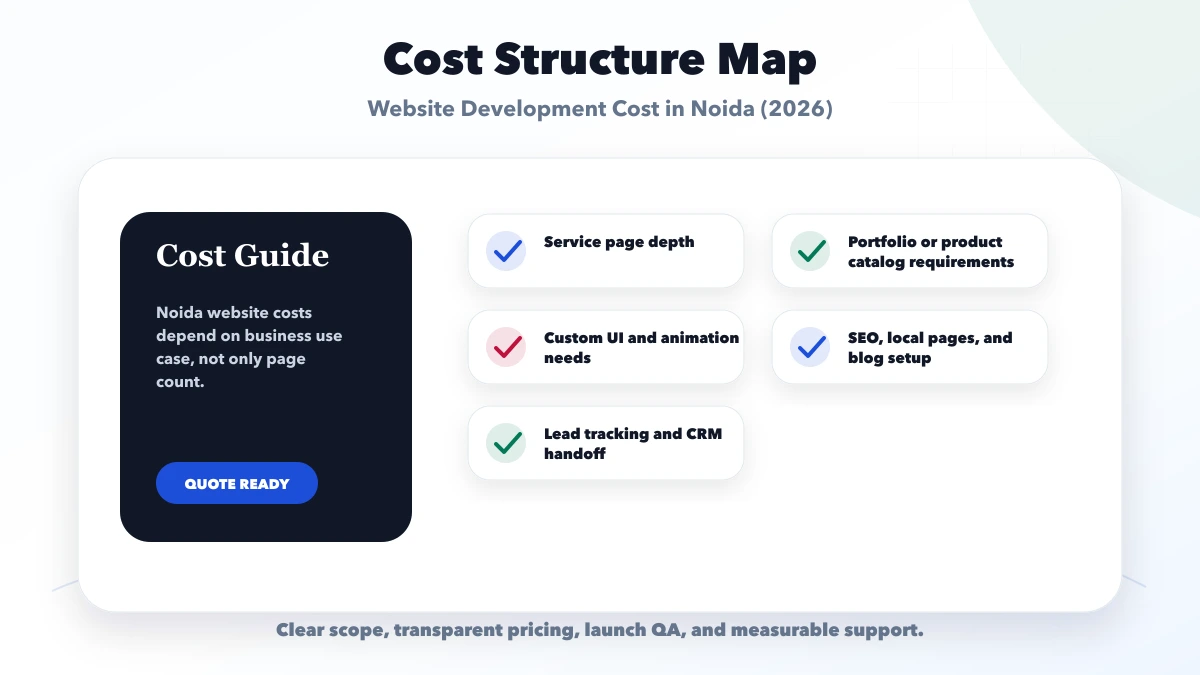
Typical public-site work includes:
Login, dashboards, booking, stock, payments, workflow, and role permissions are software features. Scope them as web application development, not ordinary pages.
A basic form may send to a monitored inbox. Cost rises with:
Measure successful lead generation without sending personal data to analytics. Use the GA4 lead tracking guide.
Each integration has setup and recurring risk.
| Integration | Questions affecting cost |
|---|---|
| CRM | Fields, assignment, duplicate, stage, failure |
| Provider, consent, template, trigger, opt-out | |
| Payment | Amount, tax, failure, refund, reconciliation |
| Booking | Capacity, confirmation, cancellation, reminders |
| Sender, deliverability, template, bounce | |
| Maps | Usage, consent, key, limits |
| External API | Authentication, quota, reliability, ownership |
Use integration services when these are production requirements.
An existing website adds:
Skipping redirects may damage existing links and search visibility. Migration should be priced explicitly.
QA should cover agreed browsers and devices, forms, calls, WhatsApp, navigation, keyboard use, contrast, images, final URLs, metadata, schema, sitemap, redirects, analytics, and ownership.
Complex workflows require role, calculation, integration, and failure tests. The website delivery checklist can form part of acceptance.
List:
Record renewal dates, owner, currency, usage limits, and cancellation/export terms.
Separate:
Content accuracy, forms, updates, backups, access, renewals, and monitoring.
New pages, research, conversion improvement, SEO, campaigns, and integrations.
Outage, compromised account, broken form, failed API, expired domain, or recovery.
A monthly plan should state included tasks, hours or response boundaries, exclusions, and approval for extra work.
Instead of universal price ranges, build scenarios:
| Scenario | Main cost components |
|---|---|
| New service website | Content, core templates, proof, form, analytics |
| Existing-site rebuild | Audit, migration, redirects, content cleanup |
| Lead website plus CRM | Form design, integration, failure handling |
| Catalogue | Product data, search, filters, admin, enquiry |
| Booking website | Availability, confirmation, reminders, policy |
| Portal | Auth, roles, data, workflow, security, support |
Request a quote against one scenario and a list of later options.
Tie payments to discovery, architecture, implemented pages, integration, QA, launch, and handover. Define how new requests affect amount and date.
Do not rely on “all features included” or “unlimited revisions.” The payment milestone plan provides a clearer sequence.
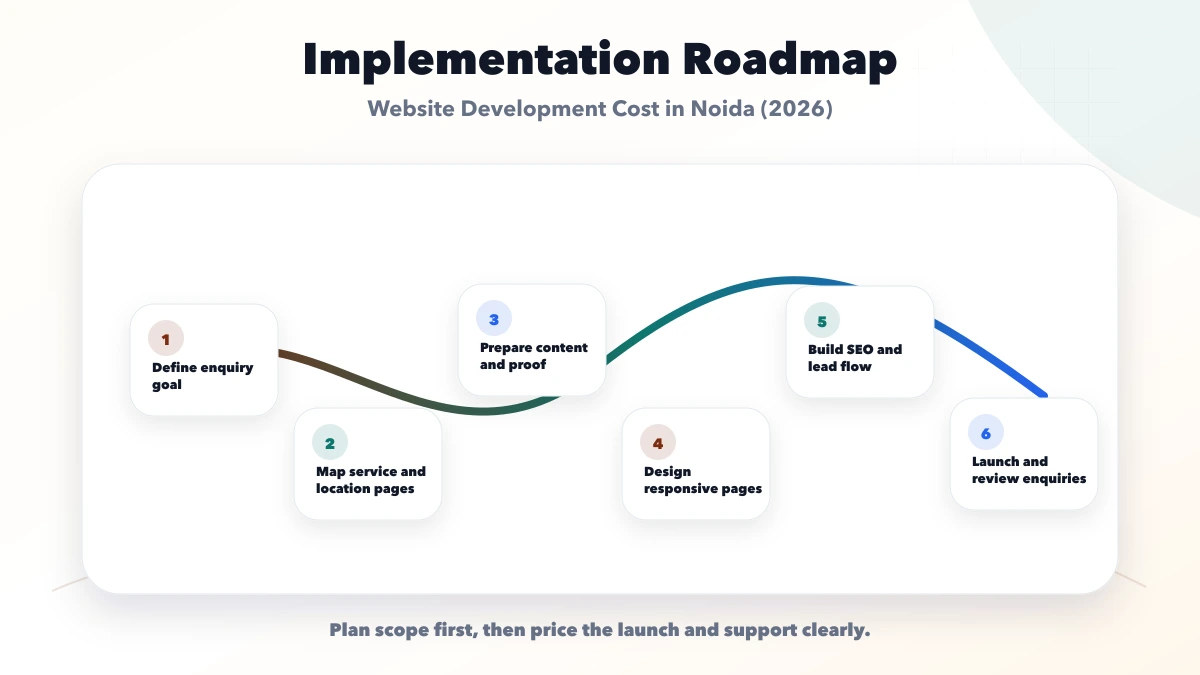
The business should own domain, hosting, source, content, analytics, form data, and production integration accounts. Confirm:
Low development cost can hide high dependency if exit is impossible.
VASUYASHII scopes website development, software, and integrations separately. A proposal should show first-year and recurring components, ownership, acceptance, and exclusions.
We do not guarantee rankings or leads. Share the requirement through contact for a current estimate.
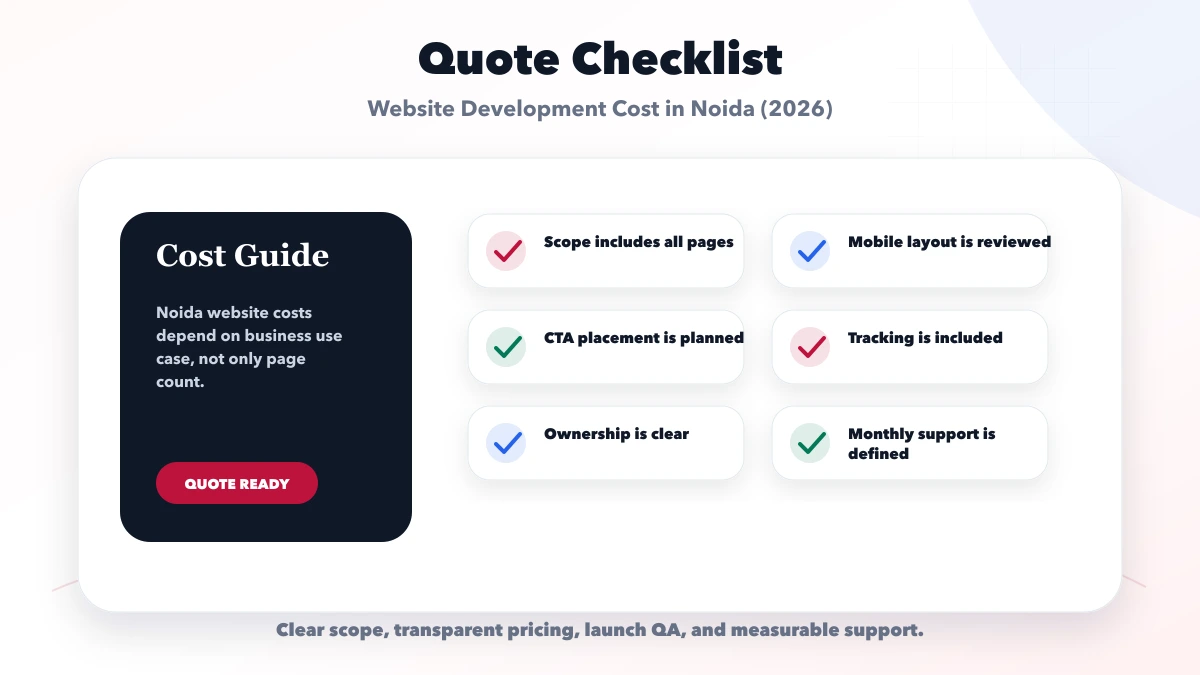
Content, unique design, forms, integrations, migration, proof, accessibility, QA, ownership, and support can differ substantially.
It may be bundled or separate. Confirm provider, limits, renewal, ownership, backups, and migration.
Technical launch basics should be explicit. Ongoing research, content, local work, authority, and optimization are separate continuing activities.
Base it on platform risk, update frequency, integrations, content changes, and response needs rather than a universal percentage.
No. A maintained CMS or existing product may meet the need. Choose custom work when workflow, integration, or control justifies it.
Undefined content, migration, integration, recurring services, or vendor lock-in can each become the largest cost. Make them visible before approval.
Place every vendor response into the same worksheet before comparing totals. Separate one-time work, recurring services, optional items, client responsibilities, and excluded risks. A lower quotation may simply move content, migration, testing, or maintenance back to the buyer.
| Cost line | Comparison question |
|---|---|
| Discovery and architecture | Is this included, limited, or assumed complete? |
| Copy and media preparation | Who writes, approves, compresses, and uploads assets? |
| Development and integrations | Which pages, states, systems, and failure cases are covered? |
| Migration | What volume, format, cleanup, and reconciliation are included? |
| Accounts and licences | Who owns each account and pays renewals? |
| QA and acceptance | Which devices, browsers, forms, redirects, and checks are tested? |
| Warranty and maintenance | What is a defect, what is a change, and how quickly is each handled? |
Ask each provider to mark assumptions directly. If one quote includes analytics setup and another only inserts a tag supplied by the client, those are different deliverables. The normalised sheet should make that difference visible.
Estimate twelve months of domain, hosting, email, premium tools, consent or security services, monitoring, content updates, maintenance, and expected improvement work. Include internal time required to supply content, review pages, and handle enquiries. This produces a more useful total cost of ownership.
Keep a contingency for confirmed scope changes, but do not treat contingency as permission for vague billing. Every change should state the reason, impact, price, and revised acceptance condition. At handover, reconcile the actual recurring commitments against the approved estimate so there are no surprise renewals.
Approve the project only when the business can name the owner of content, accounts, reviews, enquiries, and post-launch changes. Ask the provider to issue one final schedule showing payment milestones, acceptance evidence, recurring commitments, and excluded services. The approved budget should match that schedule, not an earlier sales message. Store it with account and handover records for future maintenance comparisons.
Confirm taxes and third-party renewal currencies separately before signing anything. The finance owner should retain the approved comparison sheet and review actual first-year spend against it after launch.
Estimate Noida website cost through total ownership, not a headline package. Define the first outcome, price every responsibility, protect accounts and portability, and reserve future budget for evidence-led improvement.
Related Articles
May 31, 2026
Select a Noida website partner for SaaS or product marketing with positioning, demo routes, proof, documentation, analytics, handover, and growth controls.
Read article
March 22, 2026
Website development company in Noida: low starting packages, mobile-first UX, SEO structure, web apps, and WhatsApp lead generation strategy in 2026.
Read article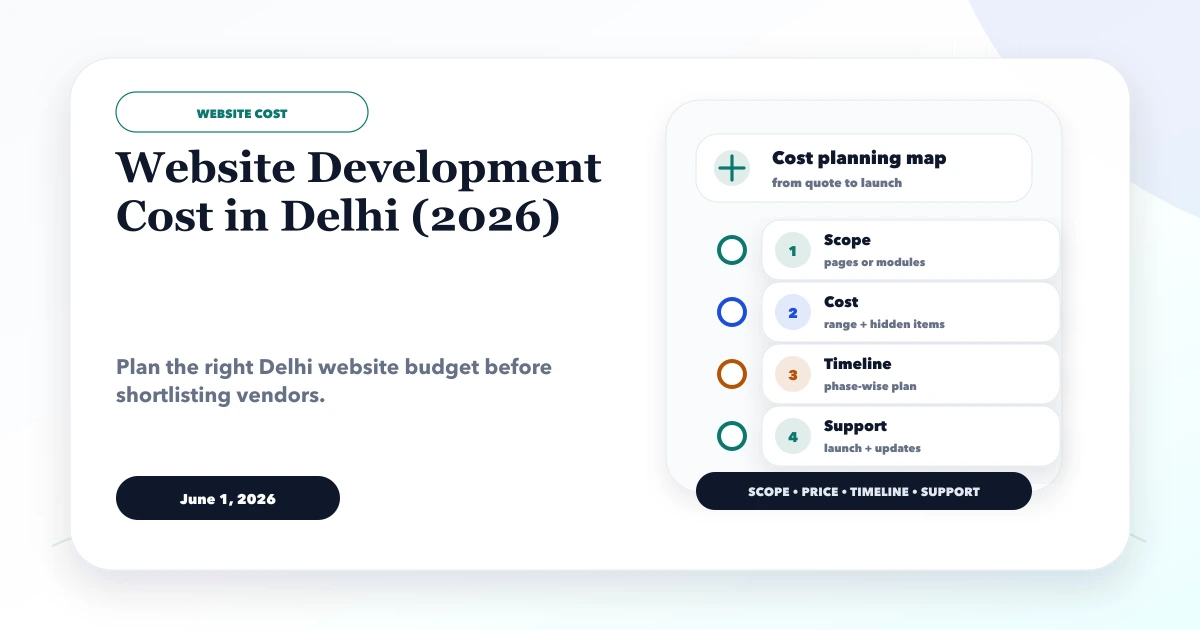
June 1, 2026
Website development cost in Delhi for 2026 with practical price ranges, inclusions, hidden costs, timelines, and quote checklist.
Read article
May 3, 2026
Plan a Noida field-operations mobile app with offline data capture, task assignment, photo evidence, syncing, permissions, rollout, and support.
Read article