
May 10, 2026
Software Project SRS Template for SMEs
A practical software SRS template for SMEs covering roles, workflows, data, business rules, integrations, acceptance criteria, migration, and change control.
Read articlePublished Updated
Plan website and software payments around approved scope, visible deliverables, acceptance checks, change control, handover, support and documented ownership.
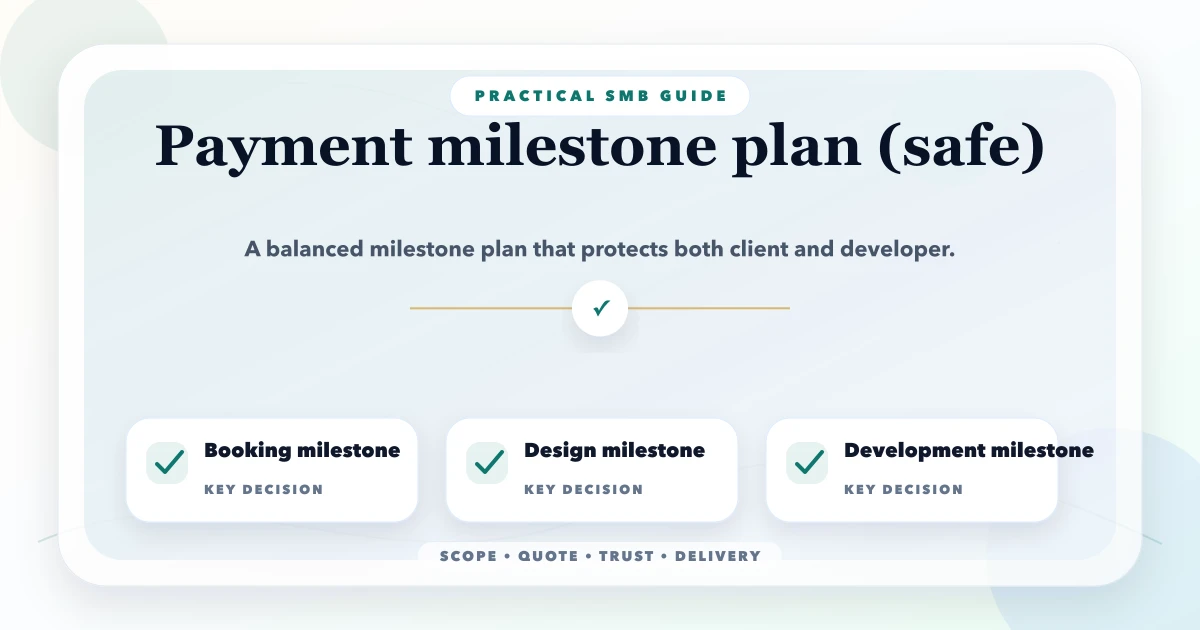
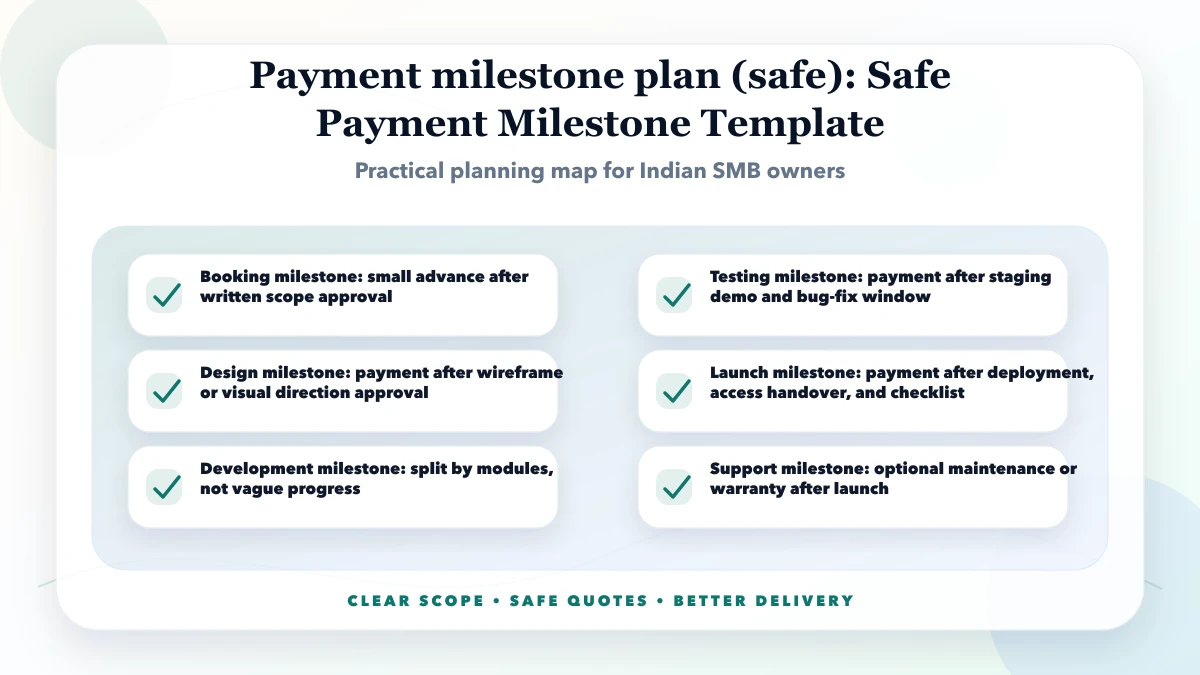
A payment milestone plan connects money to clear work stages, visible deliverables, acceptance checks and ownership.
It should protect both parties: the client should understand what is being approved, and the service provider should not fund the entire project while requirements continue changing.
This guide provides a practical commercial planning framework for Indian website and software projects. It is not legal, tax or financial advice. Important agreements should be reviewed by qualified professionals for the parties and jurisdiction involved.
Every milestone should state:
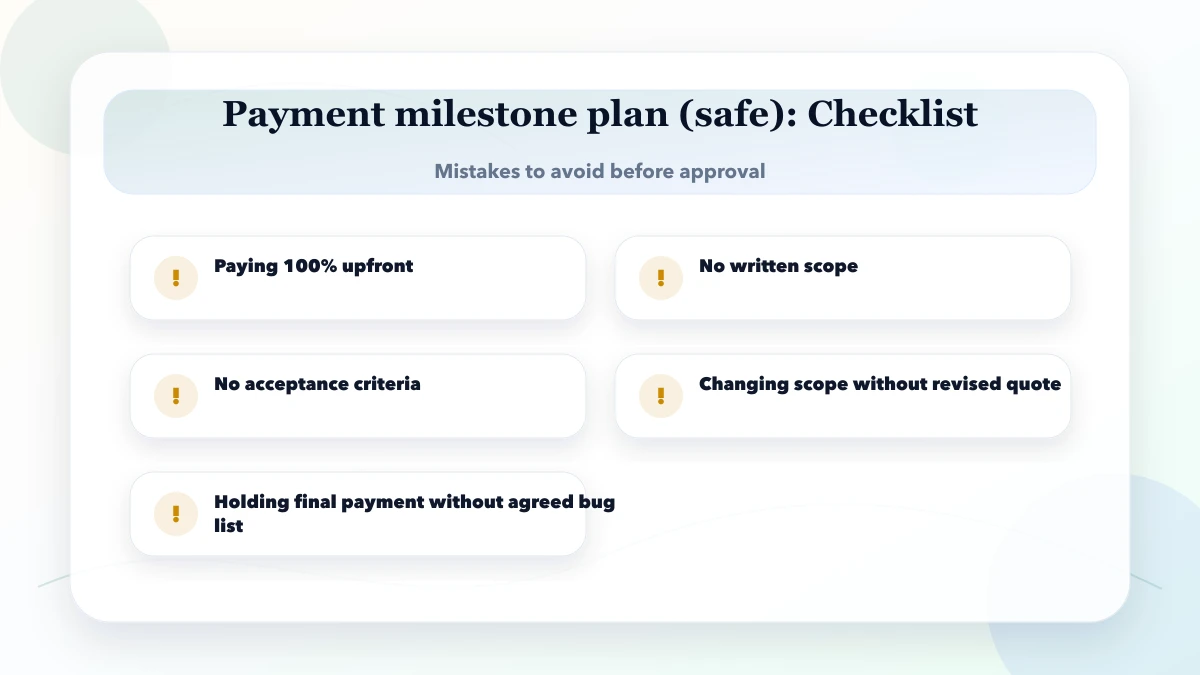
Avoid “50% now, 50% later” when “later” has no defined acceptance.
Payment planning cannot repair an unclear project.
The scope should define:
Use the website project agreement checklist before assigning amounts.
| Component | Example |
|---|---|
| Deliverable | Approved homepage design |
| Evidence | Shared prototype link |
| Acceptance | Correct sections, brand and responsive states |
| Client input | Logo, copy and consolidated feedback |
| Review window | Three working days |
| Payment | Agreed percentage or amount |
| Change path | New request added to change log |
| Next step | Build approved template |
The exact review period and payment terms must be agreed in writing.
| Stage | Visible output | Illustrative share |
|---|---|---|
| Booking and discovery | Signed scope, schedule and kickoff | 20% |
| UX/design approval | Approved key page designs | 25% |
| Development staging | Working responsive pages and forms | 30% |
| Acceptance and launch | Agreed fixes, deployment and access | 20% |
| Handover close | Documentation and final assets | 5% |
This is an example, not a universal recommendation. A very small website may use fewer stages. A long custom build may need monthly or sprint-based billing.
Software work needs stronger state and acceptance definitions.
| Stage | Output |
|---|---|
| Discovery | Workflow, roles, data model, risks and backlog |
| Foundation | Authentication, company scope, environments |
| Core workflow | One end-to-end accepted module |
| Secondary modules | Agreed modules and reports |
| Integration | Provider sandbox and failure handling |
| UAT | Test cases, defects and acceptance record |
| Production | Release, monitoring and rollback readiness |
| Handover | Accounts, documentation, training and support |
Do not defer all payment until production when months of approved work already exist.
An advance can reserve capacity and fund discovery or setup.
Document:
Avoid verbal assumptions about refundability.
Acceptance should be observable.
Weak:
Website should look premium.
Stronger:
For software:
Define:
Scattered WhatsApp messages create ambiguity. Use one shared record.
The delivered item does not meet approved scope or acceptance criteria.
The client asks for a new or changed requirement after approval.
For every change:
Many website delays are caused by missing:
Tie the timeline to client dependencies. Payment should not become disputed because an agreed input was not available.
Separate:
State who owns and renews each account.
The agreement should identify:
Client-owned core accounts usually reduce long-term access risk.
Launch checks:
Handover checks:
Use the website delivery checklist before final payment.
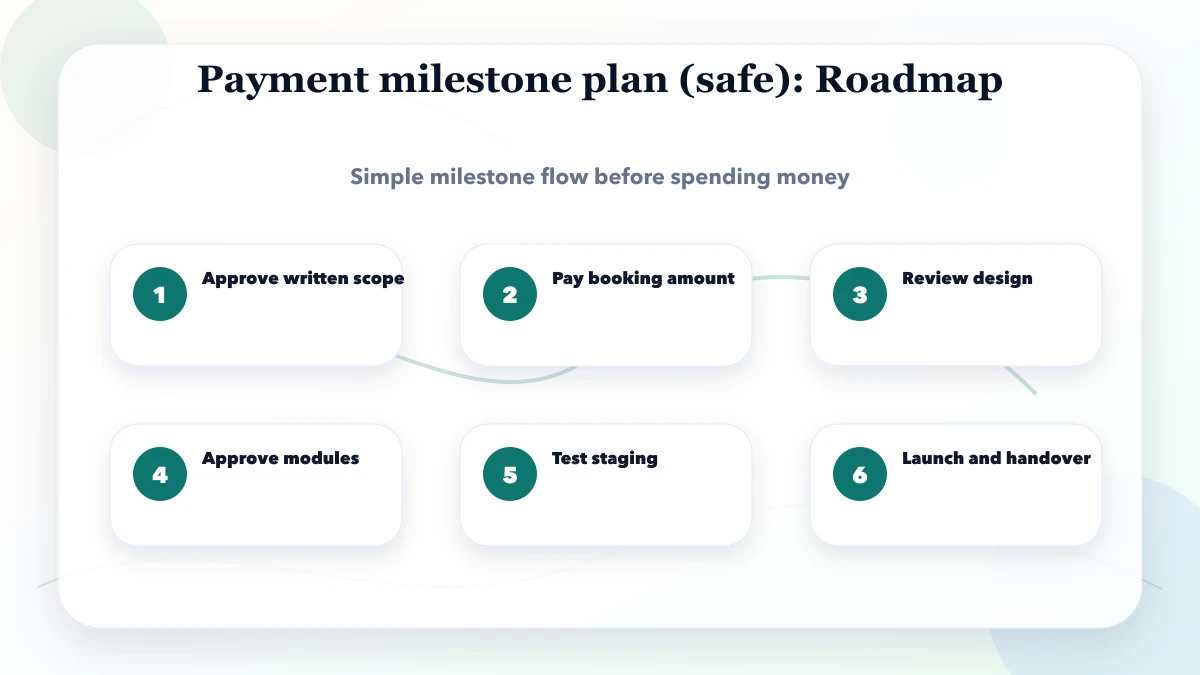
If a small final holdback is used, define:
An indefinite holdback creates risk. Final payment should not depend on subjective business results outside the agreed deliverables.
Clarify:
Maintenance is not unlimited development.
Keep:
Consult an accountant or tax professional for GST, TDS or other obligations applicable to the parties.
Useful when scope and acceptance are stable.
Useful when requirements will evolve. Use regular time reports, budget limits and review points.
Useful for continuous work with defined capacity and priority rules.
Useful when the project cannot be safely quoted before workflow and data analysis.
No model removes the need for transparency.
VASUYASHII scopes websites, web applications, software and integrations using deliverables, roles, dependencies and acceptance rather than a payment percentage alone.
The exact payment schedule depends on the project. Examples in this article are planning templates, not published standard terms or evidence that every project uses the same percentages.
Suppose a five-page business website has reached the staging milestone. “Website is 80% complete” is not useful acceptance evidence. A better record identifies the staging URL, approved page list, tested form destination, responsive widths, remaining content, known defects and the person authorised to approve.
The review can record:
| Item | Evidence | Decision |
|---|---|---|
| Five named pages | Staging URLs | Accepted or list missing sections |
| Contact form | Test submission received | Accepted after delivery confirmation |
| Mobile navigation | Checks at agreed widths | Defects recorded separately |
| Metadata | Rendered page source | Accepted after title and canonical review |
| Client content | Approved copy tracker | Pending items assigned to owner |
| Excluded requests | Change log | Quote separately or defer |
The milestone closes only when the agreed acceptance rule is satisfied. A new animation request should not block payment for an accepted form unless animation was already part of that milestone. Conversely, a form that displays success but does not deliver the enquiry is a defect, not a preference.
Store the approval with the relevant version or staging date. If a later deployment changes the accepted work, the team can identify what was approved and what introduced the regression. This simple record is useful for websites, dashboards and integrations because it connects payment to observable behaviour instead of memory.
There is no universal number. It depends on project size, discovery, capacity reservation, duration and risk. Define what the advance covers.
The agreement should define the sequence. Some projects release production after accepted staging and payment; others keep a small handover milestone.
Use agreed acceptance criteria and a defect log. Separate defects from new requirements.
Yes, through documented change control showing cost and timeline impact.
Generally avoid tying website-delivery payment to rankings the provider cannot fully control. Pay for agreed work and measurement setup.
Only when the scope states duration, tasks, response and exclusions.
The agreement should explain timeline movement and whether reserved capacity must be rescheduled.
For material projects, intellectual property, liability, privacy or cross-border work, qualified legal review is prudent.
For a scoped website, web app or business-software project, review VASUYASHII services or share the required workflow. A useful payment plan begins with accepted scope and visible outputs.
Related Articles
May 10, 2026
A practical software SRS template for SMEs covering roles, workflows, data, business rules, integrations, acceptance criteria, migration, and change control.
Read article
May 19, 2026
Prevent software scope creep with a practical change-control process, acceptance criteria, decision owners, impact estimates, and phased delivery rules.
Read article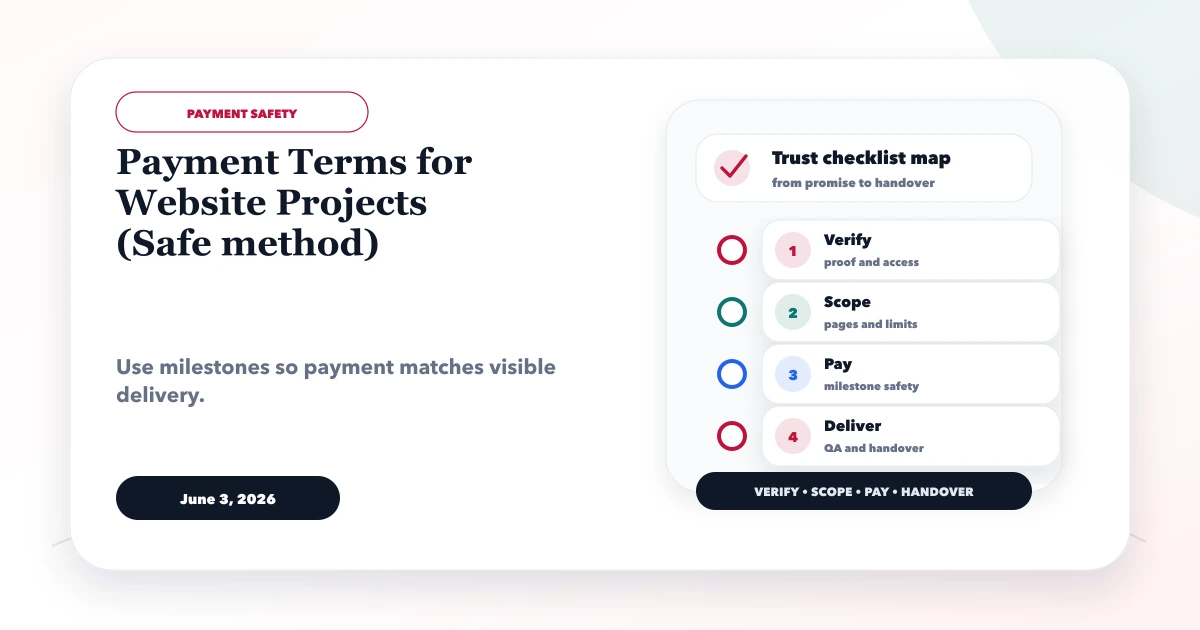
June 3, 2026
Use milestone-based website payment terms with acceptance, change control, staging proof, receipts, handover checks, support limits and dispute safeguards.
Read article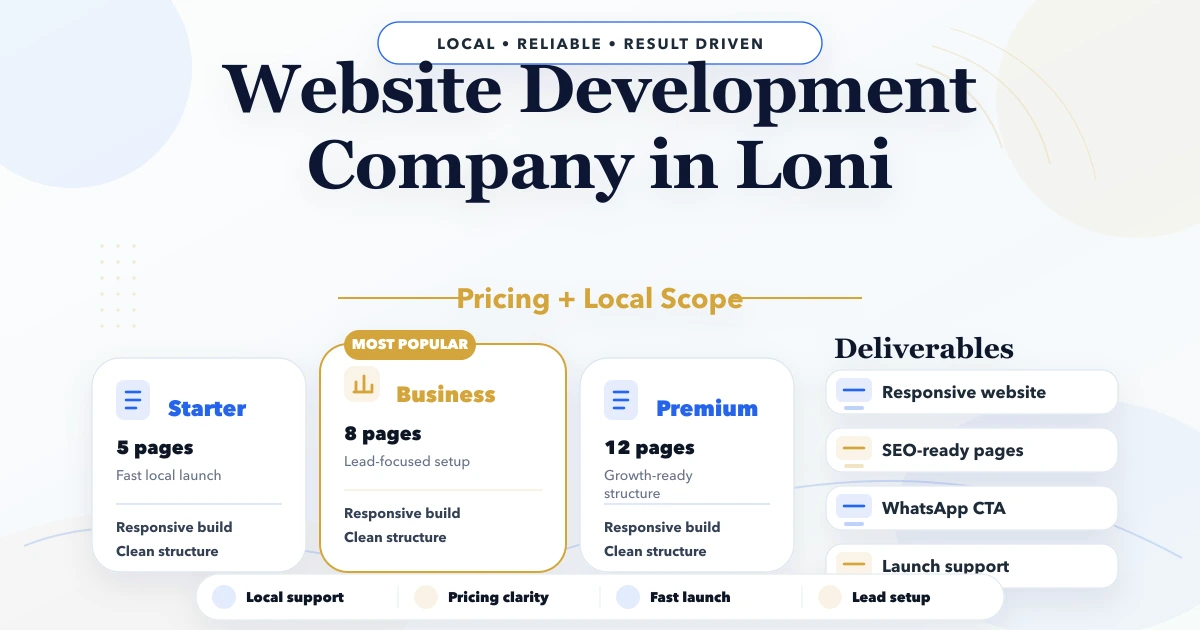
April 23, 2026
Plan a Loni quote-ready website with service packages, qualification fields, WhatsApp and form routing, follow-up metrics and ownership.
Read article