
May 21, 2026
How to Verify a Web Development Company
Verify a web development company through portfolio proof, domain ownership, contracts, payment milestones, source-code access, testing, and handover checks.
Read articlePublished Updated
NDA ownership clause: practical checklist, template, pricing, timeline, mistakes, FAQs, clear owner-safe guidance, and next steps for Indian SMBs today.
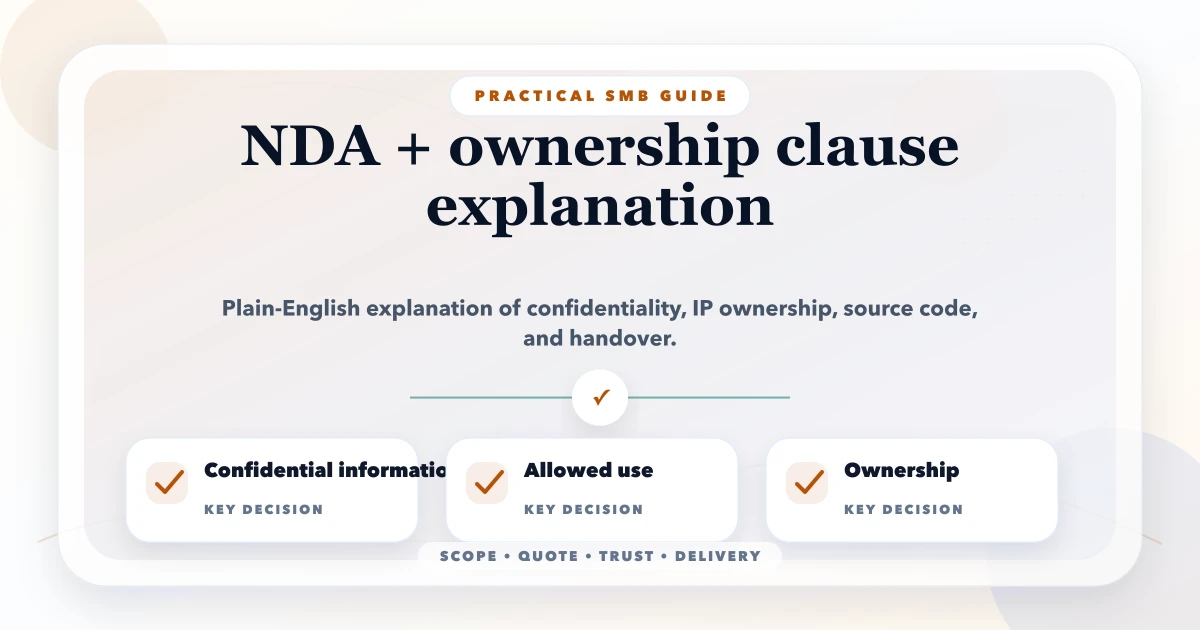
This guide on NDA ownership clause is for SMB owners, founders, and developers who want simple contract clarity before sharing ideas, business workflows, code, designs, or data. It is written for Indian SMB owners who want practical clarity before they pay, approve a proposal, or start development. It explains what to include, what to ask, how pricing usually works in INR, what mistakes to avoid, and how to make the next conversation with a developer or SEO team more productive.
By Tushar C. (Founder, VASUYASHII). Reviewed by VASUYASHII Editorial for field experience, buyer clarity, SEO usefulness, and practical implementation relevance.
An NDA protects confidential information. An ownership clause clarifies who owns designs, source code, content, data, credentials, and deliverables after payment and handover.
These are separate contract problems. A signed NDA does not automatically transfer copyright or source-code ownership. An ownership clause does not by itself explain how confidential customer data may be accessed, retained, or deleted. Both should be reviewed with a qualified lawyer for the project, parties, and jurisdiction.
Ownership depends on the applicable law and the written agreement; payment alone should not be treated as a complete answer. The contract should separately address client-specific source code, reusable provider components, third-party libraries, design files, business data, domains, cloud accounts, documentation, and deployment access.
A practical ownership schedule can use three categories:
| Category | Typical contract question |
|---|---|
| client-specific deliverable | Is it assigned to the client, and when does transfer occur? |
| provider background IP | What operating licence does the client receive? |
| third-party or open-source component | Which external licence, renewal, or restriction continues? |
Data control and intellectual-property ownership are also different. A client should control its business data, exports, accounts, and access even when some software components remain licensed. Ask a qualified Indian lawyer to review the actual wording; this article explains handover questions, not enforceable legal conclusions.
Use two decision columns during contract review:
| Confidentiality decision | Ownership decision |
|---|---|
| What information is confidential? | What exact deliverables are created? |
| Who may receive and use it? | Who owns or licenses each deliverable? |
| What permitted project purpose applies? | When does a transfer or licence begin? |
| How long must protection continue? | What happens to pre-existing tools? |
| How is information returned or deleted? | Which third-party licences continue? |
This separation prevents a broad sentence such as "all information and work belong to the client" from hiding practical gaps.
A useful definition can cover non-public business plans, customer and vendor records, credentials, pricing, workflows, code, designs, documents, financial information, and data shared for the project. It should also identify information that is not confidential, subject to legal review, such as material already public, independently developed, lawfully received from another source, or required to be disclosed by law.
The agreement should state the permitted purpose, authorized recipients, minimum security duties, subcontractor responsibility, incident notification route, and return or deletion requirement. Confidentiality duration and survival after project completion should be written explicitly rather than assumed.
Do not share live production credentials merely because an NDA exists. Use least-privilege accounts, separate development data, access logs, and a revocation plan.
Create a schedule that identifies the treatment of each asset:
| Asset | Decision to write |
|---|---|
| Custom source code | Assignment or licence, repository, branches, and transfer timing |
| UI and design source | Included formats, editable files, fonts, and asset licences |
| Content | Client-supplied, provider-created, or licensed third-party material |
| Database and business data | Client control, export format, backups, and deletion |
| Domain and hosting | Account owner, billing owner, DNS access, and handover |
| API and SaaS accounts | Contracting party, recurring cost, keys, and exit path |
| Documentation | Setup, deployment, environment, user, and support documents |
| Analytics and search accounts | Property ownership and administrator access |
Avoid relying on the phrase "complete ownership" without this schedule. The operational question is whether the client can maintain, move, secure, and continue the system after the engagement.
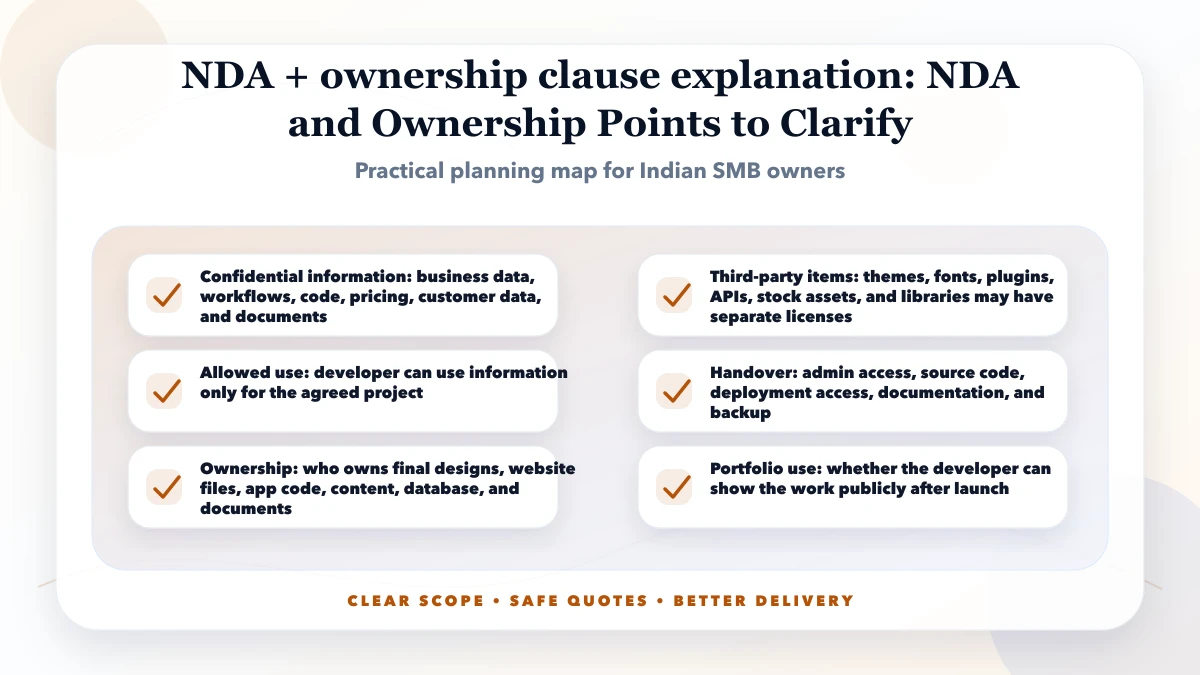
A provider may bring generic components, internal tooling, deployment scripts, design systems, or know-how developed before the project. These are often called background or pre-existing IP. The contract should distinguish them from client-specific deliverables and explain what licence the client receives when they are required to operate the final system.
Open-source libraries remain governed by their licences. Paid fonts, stock images, themes, plugins, APIs, and SaaS services also retain separate terms. A provider cannot transfer rights it does not own. Ask for a dependency or licence register that names the component, purpose, licence or subscription, account owner, renewal cost, and replacement risk.
Copyleft or source-disclosure obligations can be material in some software distributions. The development team and lawyer should review the actual dependency set instead of using a generic "all open source is free" assumption.
Ownership language should agree with commercial milestones. Common questions include:
Link each milestone to observable acceptance criteria and a review period. Payment disputes are harder to resolve when the deliverable, acceptance method, and transfer event are all vague.
Good execution produces more than a signed PDF. The project has named accounts, a controlled repository, written access owners, a dependency register, approved milestone records, and an exit checklist.
| Scope | Practical price range | Typical timeline |
|---|---|---|
| Basic NDA review with lawyer | Varies by lawyer | 1 to 3 days |
| Project agreement drafting | Varies by scope | 2 to 7 days |
| Development handover checklist | Included or ₹3,000 to ₹15,000 | 1 to 3 days |
These are planning examples, not legal fee quotes. Lawyer fees and project handover costs depend on complexity, jurisdiction, risk, negotiations, and the quality of existing records. Ask for a written quote from the relevant professional.
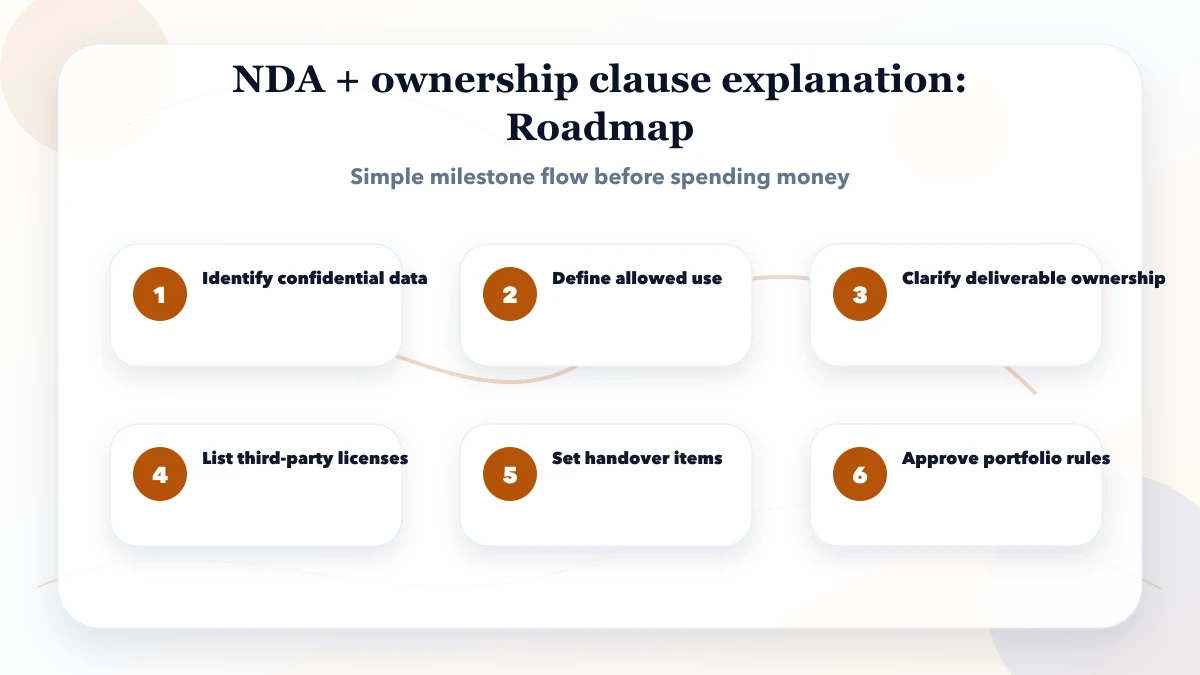
Decide whether the provider may display the client's name, logo, screenshots, results, testimonial, or anonymized case study. Approval can be conditional on launch, written consent, and removal of confidential data. A portfolio right should not imply permission to publish analytics or private workflows.
The agreement should also say whether subcontractors are allowed, what access they receive, and whether they sign equivalent confidentiality and ownership obligations. The primary provider should remain accountable for approved subcontracted work unless the agreement says otherwise.
Before final acceptance, verify:
Record the handover with a dated acceptance note. A zip file without setup instructions is not a complete operational transfer.
For legal background, see the official Copyright Act, 1957. This article is practical guidance, not legal advice.
VASUYASHII can help define software scope, repositories, access ownership, technical handover items, dependency records, and acceptance tests. VASUYASHII does not provide legal advice or guarantee that a sample clause is enforceable. The final NDA, intellectual-property terms, remedies, governing law, and dispute provisions must be reviewed by a qualified lawyer.
Before you approve the next step, check these points:
Pair this review with the software project handover checklist so contractual rights and operational access are verified together.
If you want to use this project planning guide immediately, start with a single shared document. Put the business goal at the top, then add the checklist points, current links or screenshots, and the decision deadline. This avoids scattered WhatsApp messages where important details get lost.
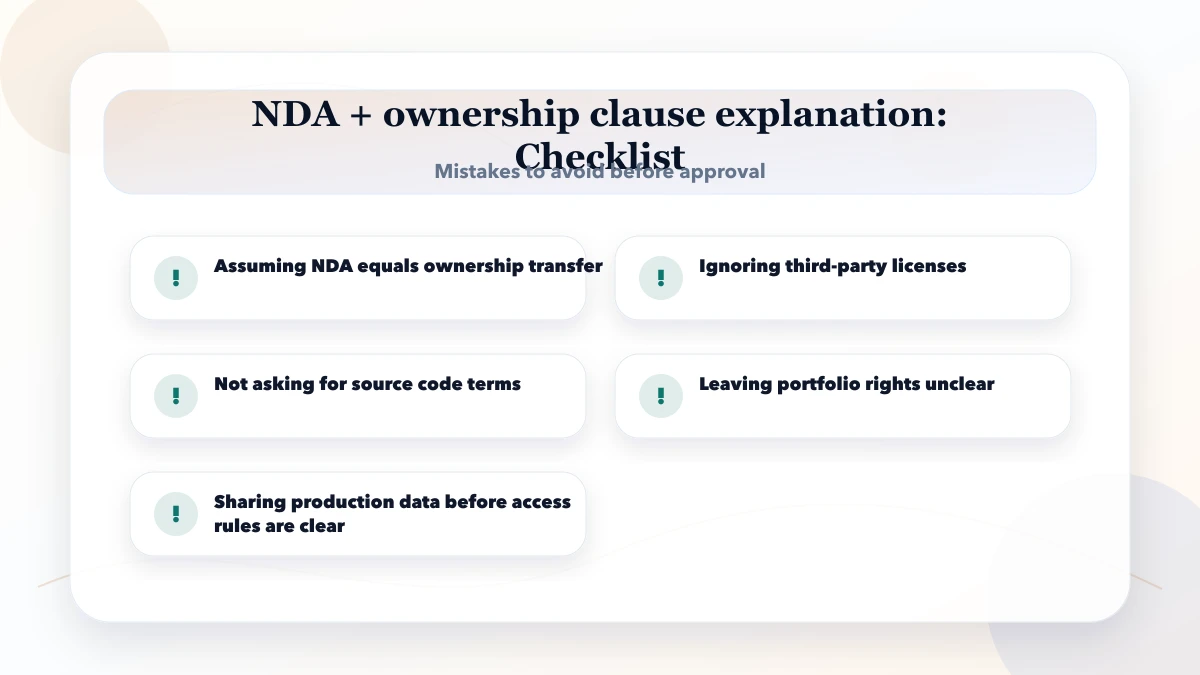
No. This is a practical explanation for project discussions. For enforceable legal terms, consult a qualified lawyer.
No. NDA and ownership are different. NDA covers confidentiality; ownership clauses cover deliverables and rights.
Yes. If source code handover matters, write exactly what will be handed over and when.
Open-source libraries remain under their own licenses. Your agreement should not pretend they become private property.
Reusable non-client-specific components can be allowed if the agreement clearly separates them from client-specific assets.
Decide in writing. Some clients allow public portfolio use, some allow anonymous case studies, and some restrict it.
Related Articles
May 21, 2026
Verify a web development company through portfolio proof, domain ownership, contracts, payment milestones, source-code access, testing, and handover checks.
Read article
March 23, 2026
Use this web-developer hiring checklist to assess scope, proof, ownership, accessibility, SEO, security, payments, testing, support and handover.
Read article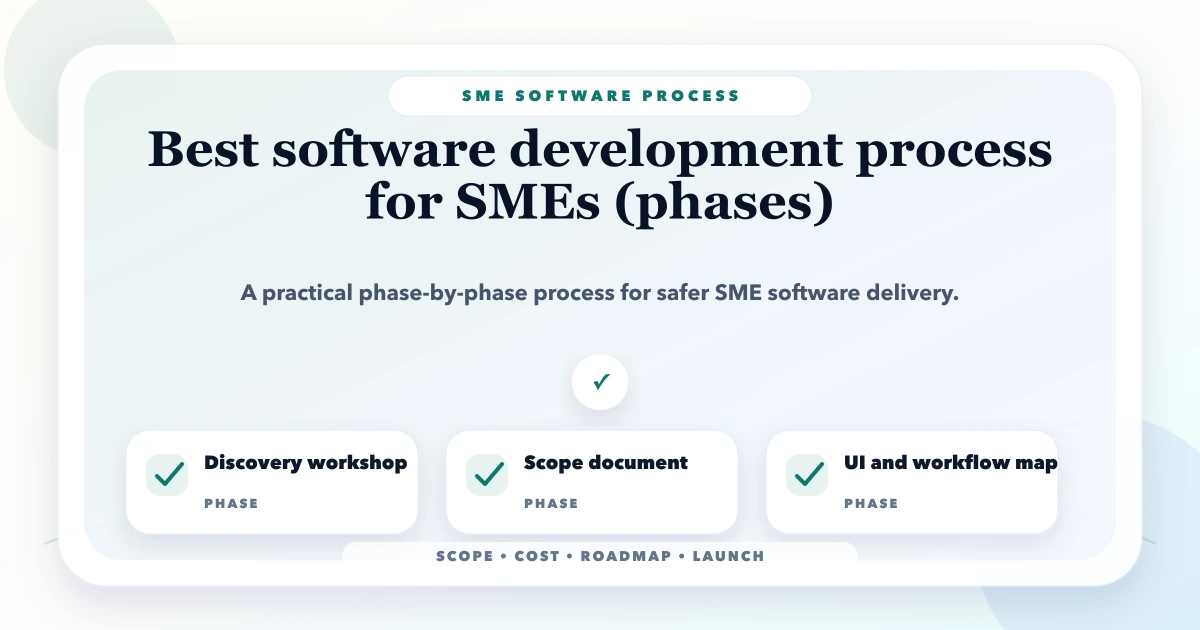
May 19, 2026
Follow an eight-phase software development process for SMEs covering discovery, scope, UX, build, testing, migration, training, launch, and support.
Read article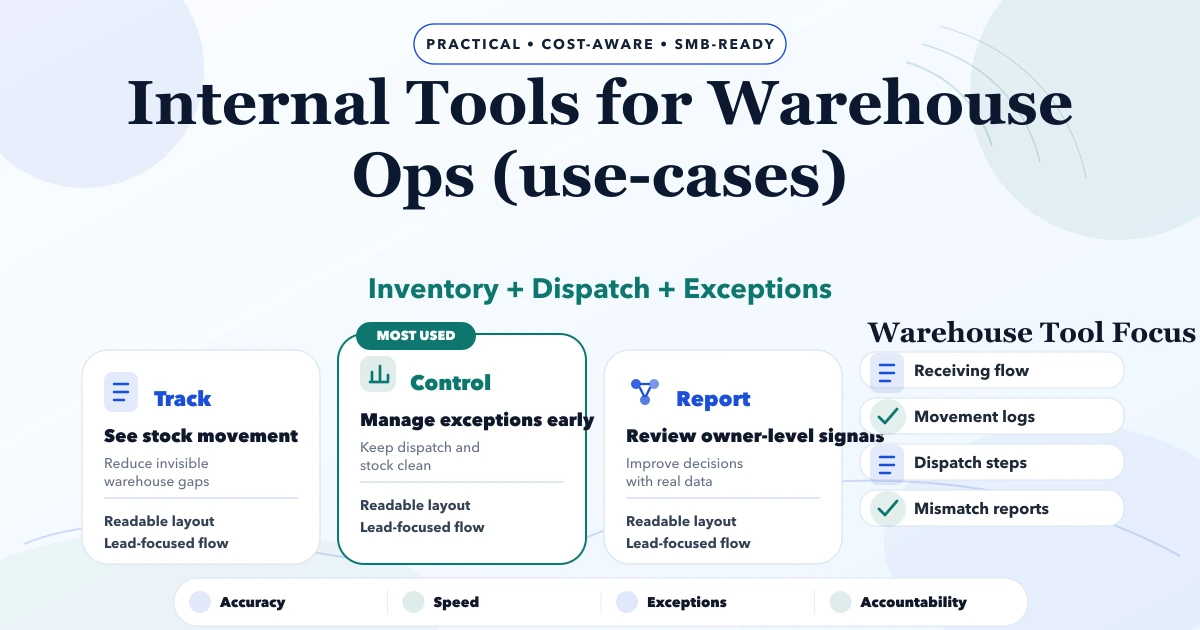
May 6, 2026
Internal Tools for Warehouse Ops (use-cases) guide for 2026 with practical pricing, rollout risks, implementation notes, and lead-focused decision points.
Read article