
June 1, 2026
Website Development Cost in Delhi (2026)
Website development cost in Delhi for 2026 with practical price ranges, inclusions, hidden costs, timelines, and quote checklist.
Read articlePublished Updated
Use a practical 2026 scorecard to compare Delhi website companies by discovery, content, proof, technical quality, ownership, support, and acceptance.
Service-area note: VASUYASHII is based in Delhi NCR and supports businesses remotely across India. A city-focused guide describes service and planning context; it does not claim a physical office in every location mentioned.
Explore the parent topic: Website Development Delhi NCR Hub →The best website development company in Delhi is not a universal winner. A small service website, a multilingual institution, a product catalogue, and a customer portal require different capabilities. The useful question is which provider can understand your business, define the correct scope, prove relevant competence, protect ownership, and deliver against testable acceptance criteria.
This guide provides a weighted selection process. VASUYASHII is one possible provider and should be evaluated using the same standard. The article does not claim an award, rank, local office, or guaranteed outcome.
Written by Tushar C. (Founder, VASUYASHII) using the current VASUYASHII proposal and delivery process. Scores should be based on evidence supplied during procurement, not marketing language alone.
Use a 100-point comparison.
| Area | Weight | Evidence to review |
|---|---|---|
| Business discovery | 15 | Questions, problem framing, exclusions |
| Content and information architecture | 15 | Page purpose, copy responsibility, evidence plan |
| Relevant delivery evidence | 15 | Explainable work, process, attributable proof |
| Technical implementation | 15 | Responsive, performance, accessibility, forms, SEO basics |
| Ownership and handover | 15 | Domain, hosting, source, analytics, data |
| Quality and acceptance | 10 | Test cases, review stages, production checks |
| Support and maintenance | 10 | Response boundary, updates, incident ownership |
| Commercial clarity | 5 | Milestones, recurring fees, change control |
Set a minimum score in critical areas. A vendor should not win because a low price offsets zero ownership or security clarity.
Comparisons fail when every vendor receives a different conversation. Prepare:
Use the website development brief to create a common input.
A capable provider should ask:
Be cautious when the first response is a fixed package before the provider understands the requirement.
Open relevant work and ask what the vendor actually delivered. A screenshot is not proof of strategy, code, SEO, or results.
Look for attributable, specific feedback. Do not accept copied testimonials as independent verification.
Ask the vendor to explain a page journey, form handling, performance decision, or handover. The explanation should connect technology to the project.
Reject guaranteed rankings, unexplained traffic numbers, invented client logos, or awards without a source.
The genuine developer verification guide provides deeper checks.
A website is a content system. Confirm:
| Question | Strong answer |
|---|---|
| Who writes? | Named responsibility and interview process |
| Who verifies? | Business owner approves facts and claims |
| What is unique? | Page purpose and evidence differ |
| How are revisions handled? | Staged review and sign-off |
| Who updates later? | Editing and maintenance owner |
| What happens if content is late? | Timeline dependency is written |
A beautiful design with placeholder or repeated copy is not launch-ready.
The proposal should define:
Avoid accepting “SEO-friendly, secure, fast” without checks. The website delivery checklist can become part of acceptance.
The business should control root access.
Invite the vendor with the required role. Do not share root passwords casually.
Normalize:
Tie milestones to reviewable output. Use written change control when scope changes. The payment milestone plan explains a safer project sequence.
The answers reveal judgement better than a long feature list.
For a high-value project, commission a limited discovery, architecture, or difficult prototype. Define fee, output, rights, and end date. Evaluate:
Do not use an unpaid design contest as procurement.
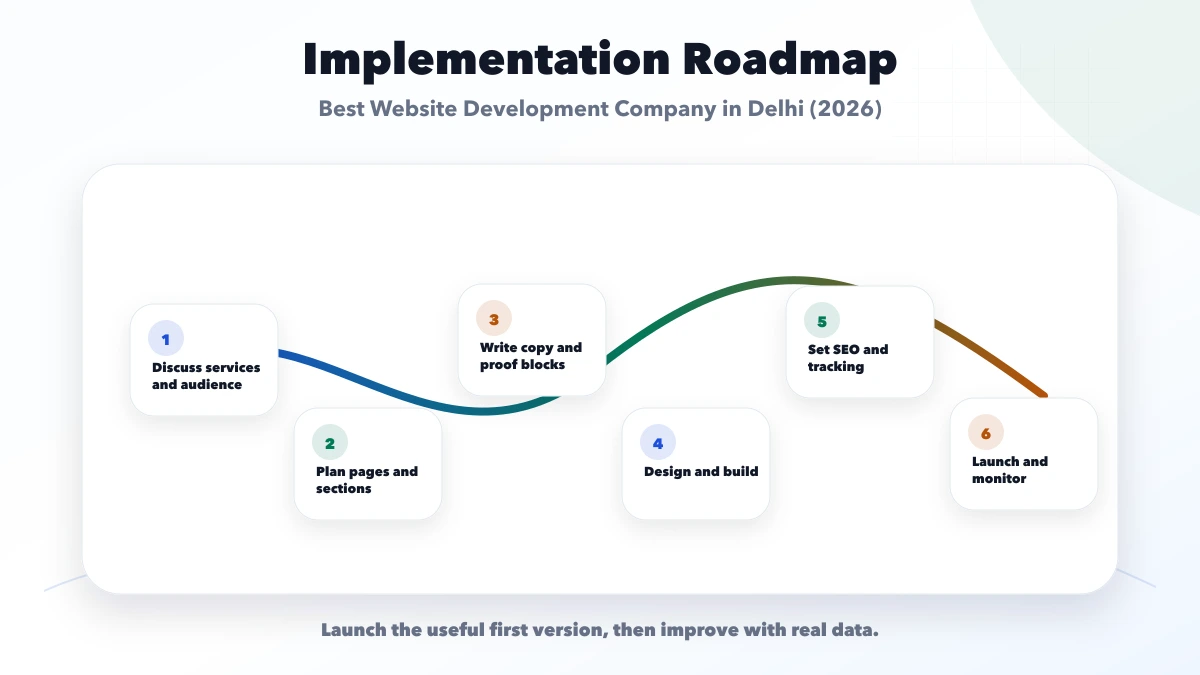
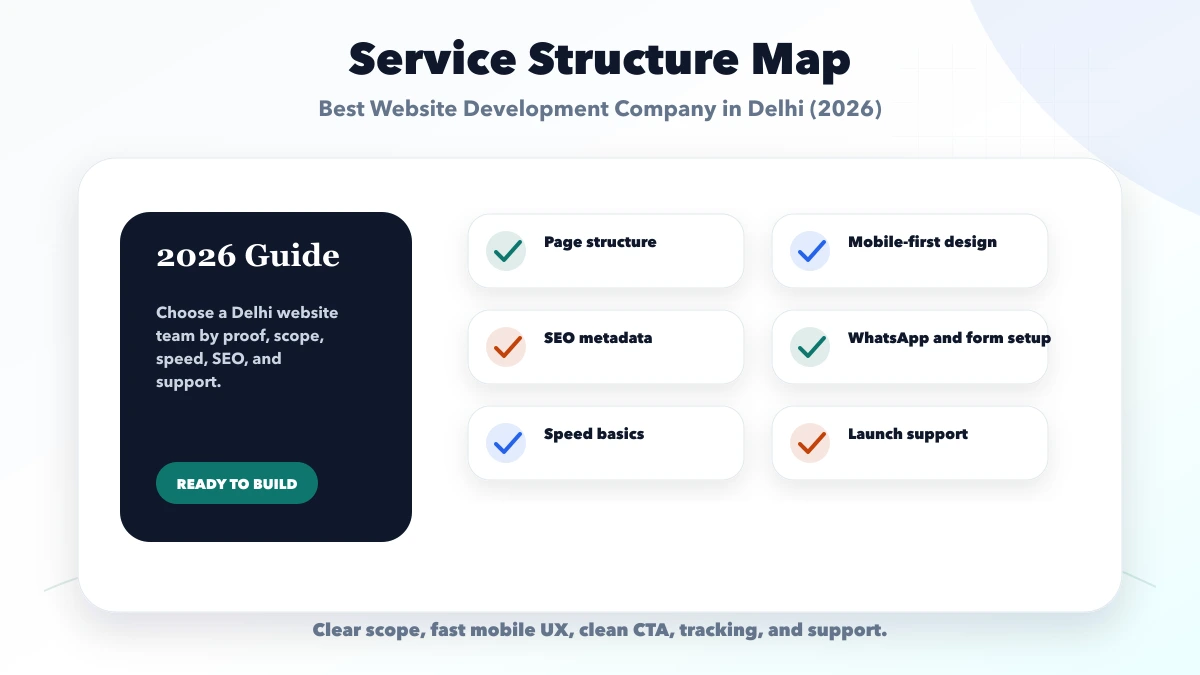
VASUYASHII offers Delhi NCR website development, web applications, software development, and integrations. Our proposal should identify page purpose, content, evidence, tracking, ownership, acceptance, and support.
We do not guarantee rankings, traffic, leads, or revenue. Use contact to request a written scope and apply this scorecard to it.
No. Review a smaller relevant sample deeply. The ability to explain decisions and ownership matters more than thumbnail count.
Only when physical presence is a real project requirement. Clear scope, communication, accountability, and evidence can support remote delivery.
Use milestones tied to discovery, approved architecture, implementation, QA, launch, and handover. Exact percentages depend on the project and agreement.
No responsible provider can guarantee an organic position. Technical quality and content can improve eligibility, but competition, authority, demand, and external signals also matter.
Maintenance responsibilities must be defined. They may be included for a period or contracted separately, but forms, updates, renewals, backups, and content still need owners.
Long enough to issue a common brief, verify evidence, clarify risk, and approve scope. Rushing procurement often creates more delay during delivery.
When two providers score similarly, a small paid exercise can reveal how each team works without asking for speculative free design. Give both providers the same narrow problem: for example, map the enquiry journey for one service, review an existing analytics problem, or prototype one critical mobile interaction. The deliverable should be useful even if the main contract is not awarded.
Evaluate the exercise on:
Do not use unpaid competitive work as a substitute for procurement. A short paid diagnostic respects the provider's time and gives the business evidence about communication, reasoning, and handover.
If references are offered, ask questions related to the proposed scope: Was the launch accepted against a checklist? Who owned content? Were account credentials transferred? How were changes priced? Did support follow the written process? A reference cannot prove every capability, but it can verify delivery behaviour.
The contract should then convert the selection scorecard into commitments. Attach the approved brief, page or module list, content responsibilities, review rounds, third-party costs, acceptance tests, launch conditions, ownership transfer, warranty boundary, and support terms. If a scored capability does not appear in the scope, it should not influence the final decision.
Keep the completed scorecard, evidence links, reference notes, paid exercise, and final exclusions with the signed proposal. Record why the chosen provider won and which risks remain with the buyer. This prevents the decision from being reduced later to price or personal preference and gives the project team a clear basis for acceptance.
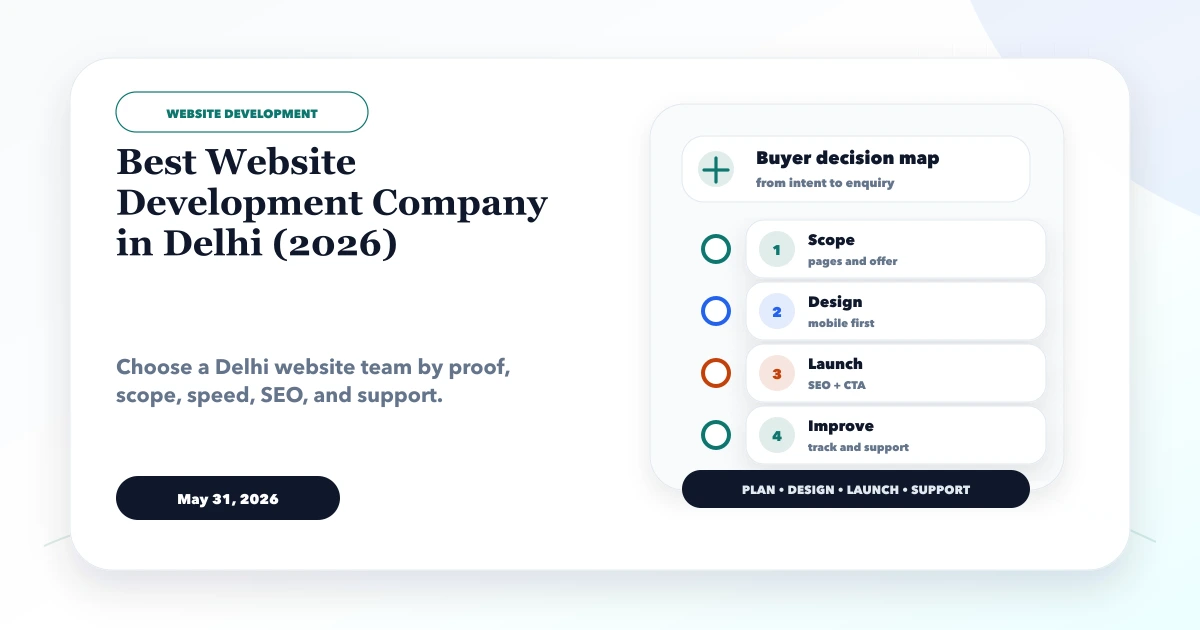
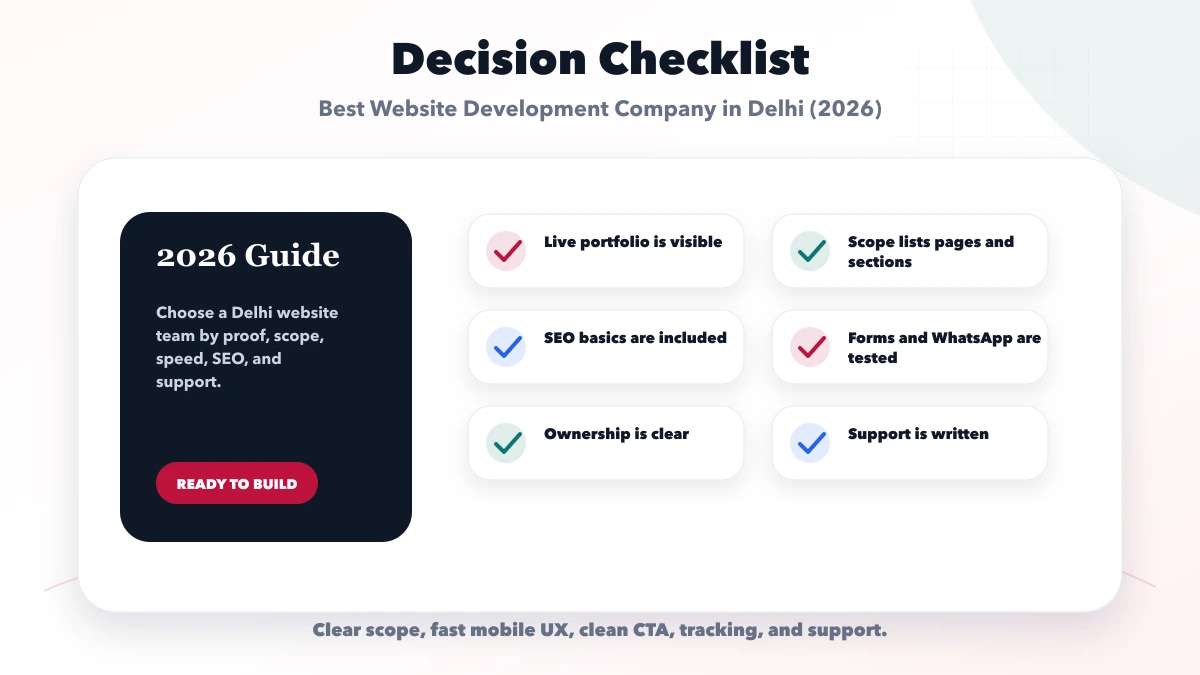
Select a Delhi website company through an evidence-based scorecard. Strong discovery, content architecture, technical acceptance, ownership, and support are better indicators than awards, location claims, or the lowest total.
Related Articles
June 1, 2026
Website development cost in Delhi for 2026 with practical price ranges, inclusions, hidden costs, timelines, and quote checklist.
Read article
March 22, 2026
Website development company in Delhi: low starting packages, SEO-ready structure, mobile-first UX, proof system, and WhatsApp lead generation strategy in 2026.
Read article
May 30, 2026
Plan a Delhi web app to replace spreadsheet workflows with controlled records, approvals, calculations, migration, integrations, reporting, and ownership.
Read article
June 6, 2026
Use this Noida Sector 63 website developer due-diligence guide to verify scope, technical quality, security, ownership, acceptance, and support.
Read article