
March 23, 2026
Questions to Ask Before Hiring a Web Developer: Checklist
Use this web-developer hiring checklist to assess scope, proof, ownership, accessibility, SEO, security, payments, testing, support and handover.
Read articlePublished Updated
Use this Noida Sector 63 website developer due-diligence guide to verify scope, technical quality, security, ownership, acceptance, and support.
Service-area note: VASUYASHII is based in Delhi NCR and supports businesses remotely across India. A city-focused guide describes service and planning context; it does not claim a physical office in every location mentioned.
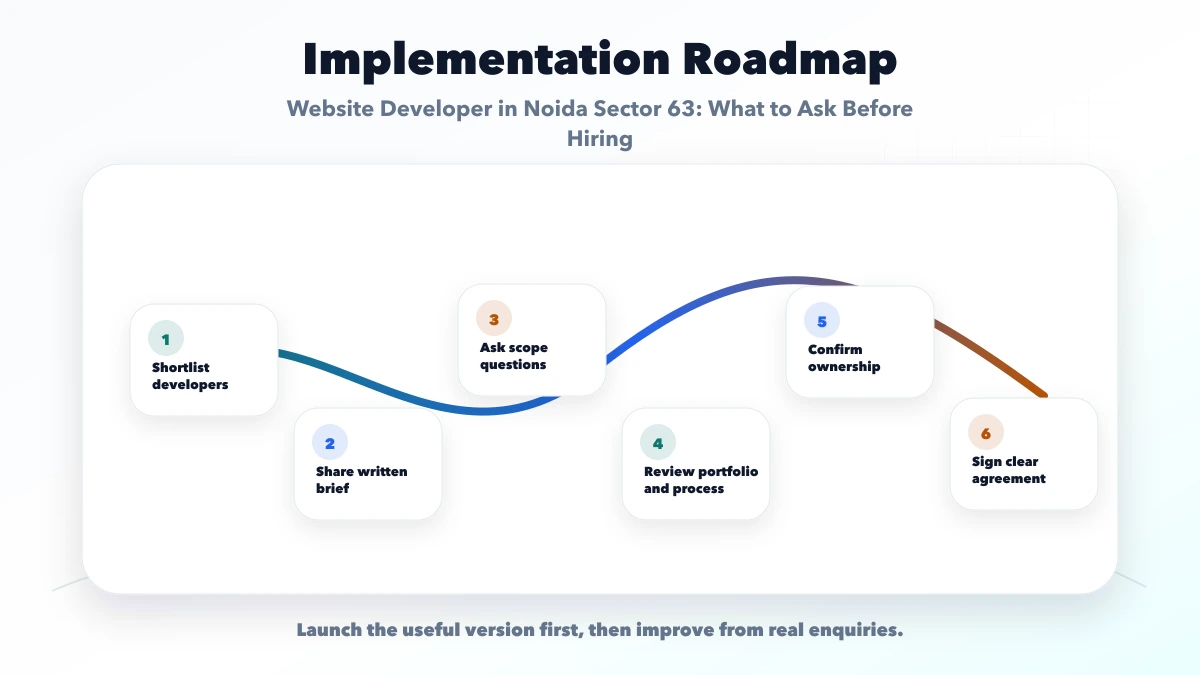
Explore the parent topic: Website Development Delhi NCR Hub →When hiring a website developer in Noida Sector 63, a polished proposal and a list of technologies are not enough. A buyer needs to verify what will be built, who owns each account, how quality will be accepted, what evidence supports the portfolio, and what happens when the vendor relationship ends.
This guide is designed for companies, agencies, institutes, exporters, service teams, and B2B firms purchasing a website on behalf of an organization. It provides a practical due-diligence process without assuming that a large team, nearby office, or low price automatically means lower risk.
Written by Tushar C. (Founder, VASUYASHII) based on the current VASUYASHII proposal, delivery, and handover process. This article does not claim a VASUYASHII office or customer result in Noida Sector 63.
Before scheduling a detailed call, request:
Reject guaranteed rankings, unverifiable customer logos, unclear “unlimited” commitments, or proposals that require the vendor to own the domain permanently.
A screenshot proves only that an image exists. Ask:
The fake portfolio detection guide includes reverse-image, archive, attribution, and implementation checks.
Do not demand confidential customer data. A responsible vendor can explain process and boundaries without disclosing private information.
| Area | Scope statement | Acceptance evidence |
|---|---|---|
| Pages | Named routes and purpose | Final URLs open with approved content |
| Responsive UI | Supported breakpoints/devices | Test results on agreed viewports |
| Forms | Fields, validation, destination | Valid submission received and logged safely |
| Analytics | Named events and properties | Debug or realtime evidence |
| SEO basics | Metadata, canonical, sitemap, redirects | Source/rendered check |
| Performance | Image and loading approach | Agreed lab/field review |
| Accessibility | Keyboard, labels, contrast boundary | Manual and automated checks |
| Security | Form validation, access, updates | Configuration and ownership review |
| Handover | Accounts, source, documentation | Business administrator access |
“SEO-friendly,” “mobile responsive,” and “secure” are too broad unless the proposal defines what will be checked.
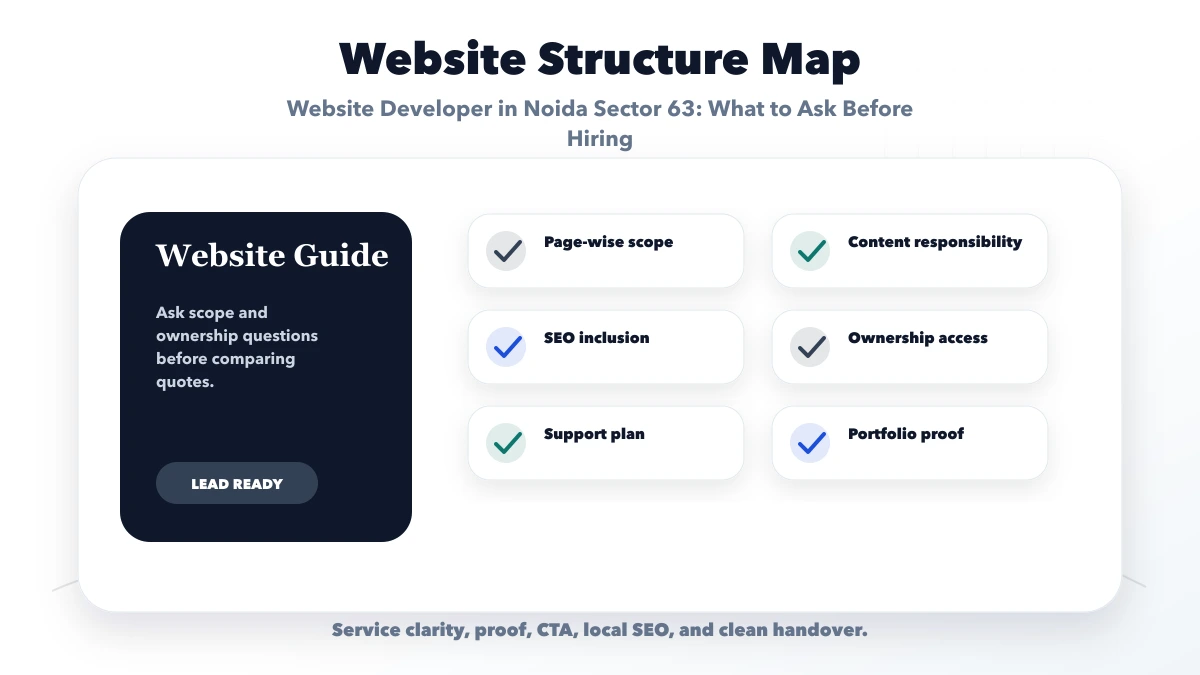
Ask:
A website can be technically complete and commercially weak because the content responsibility was never assigned. Use a written website development brief before comparing quotes.
The vendor should explain technology in relation to operating needs.
Which content must staff update? Does the team need a CMS, product admin, or only occasional developer changes?
Which external systems are required? Who owns API accounts, limits, credentials, failure monitoring, and costs?
Where will the website run? Who pays, renews, deploys, backs up, and responds to incidents?
Can another qualified developer maintain the project? Are source, data exports, and configuration available?
What is a defect, content change, feature request, and emergency? Each category needs a response boundary.
Technology names without these answers do not reduce vendor risk.
For a normal lead website, confirm:
For login, payments, health, education, financial, or employee data, perform a deeper review. See the business website security checklist and scope specialist requirements when applicable.
| Asset | Question | Safe outcome |
|---|---|---|
| Domain | Whose registrar account? | Business-owned with MFA |
| DNS | Who can change records? | Business admin plus limited vendor access |
| Hosting | Can the project be transferred? | Documented ownership and billing |
| Source | Where is the repository? | Business can access and export |
| Analytics | Who is administrator? | Business property ownership |
| Forms/CRM | Where do leads go? | Business-monitored destination |
| Images/fonts | Are rights clear? | Licensed or business-supplied |
| Integrations | Who owns API account? | Business owns production account |
Ownership should be operational before final payment, not a future promise.
Tie payment to reviewable outputs rather than dates alone.
Do not use this as a legal template. The agreement should reflect the project and applicable law. The safe website payment terms guide explains milestone risks.
Reviews can support due diligence but should not replace it. Look for:
If a reference call is offered, respect confidentiality and ask about scope clarity, communication, ownership, and issue resolution rather than requesting private metrics.
VASUYASHII provides website development in Delhi NCR, web applications, software development, and integrations. Our proposal should be evaluated using the same due-diligence checks in this article.
We do not guarantee rankings, lead volume, or sales outcomes. We also do not claim a Sector 63 office on this page. Use contact to request a written scope.
For a higher-value engagement, use a paid, limited discovery or prototype before committing to the entire build. The trial should have a real output, such as an approved page architecture, one difficult journey prototype, a migration assessment, or a technical integration note.
Evaluate:
A trial should not become unpaid speculative design or expose confidential production data. Define its fee, output, rights, and end date. A strong result can reduce uncertainty; a weak result allows the buyer to stop before a larger dependency is created.
Before signing, ask the business sponsor, content owner, technical reviewer, and finance approver to sign off on the same scope. Record unresolved assumptions. This prevents a late stakeholder from introducing a portal, payment system, or content migration after the budget and date were agreed.
Store that approval with the final proposal so later change requests can be assessed against the same baseline.
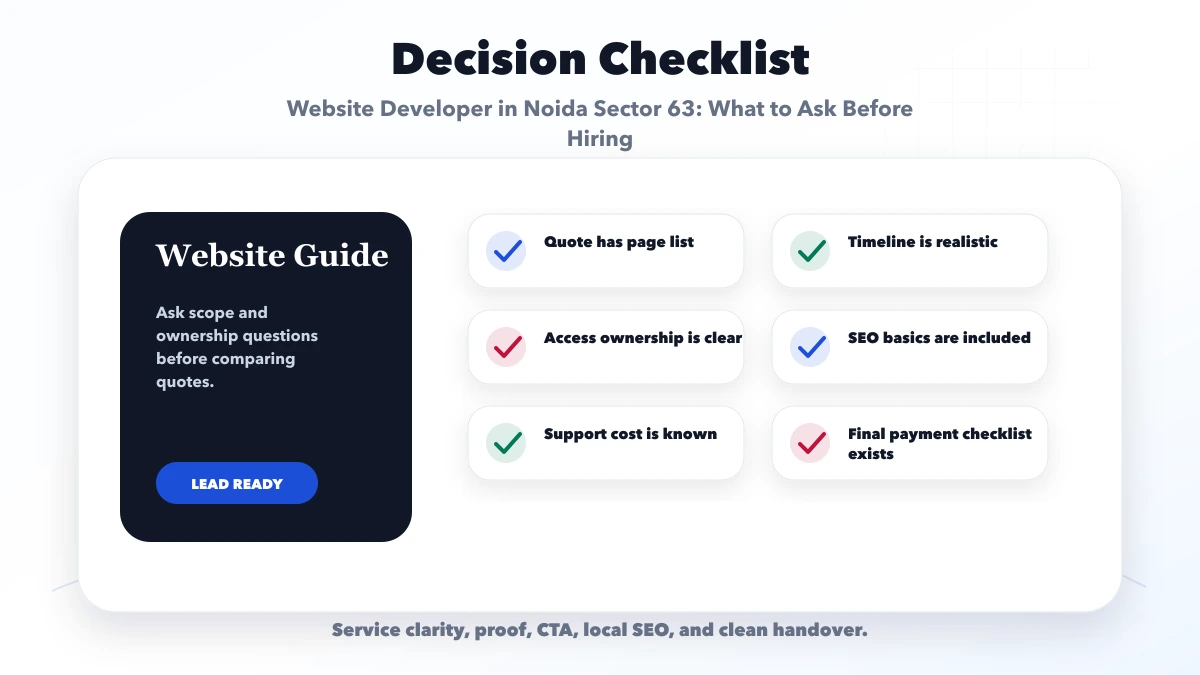
Choose the lowest evaluated risk for the required outcome, not simply the lowest number. Missing content, ownership, QA, or support can make a cheap quote expensive later.
No. Clear communication, evidence, scope, access, and accountability matter more. If physical meetings are required, include them explicitly in the proposal.
Inspect a small relevant sample deeply. One example the vendor can explain is more useful than dozens of unverified thumbnails.
The ownership or licence must be explicit. For custom work, business repository access is a strong default. Third-party themes and services may have separate licences.
Understand export, migration, data access, ongoing fees, termination, and vendor dependency before signing.
According to the written milestone after agreed production acceptance and handover evidence. Do not rely on an informal promise that access will arrive later.
Hire a Noida Sector 63 website developer through a documented procurement process. Verify work, normalize proposals, define acceptance, protect accounts, and connect payment to evidence. This is more reliable than selecting by design style, office distance, or technology vocabulary alone.
Related Articles
March 23, 2026
Use this web-developer hiring checklist to assess scope, proof, ownership, accessibility, SEO, security, payments, testing, support and handover.
Read article
June 6, 2026
Plan a Nehru Nagar Ghaziabad business website with verified identity, consistent local information, lead continuity, ownership, backups, and handover.
Read article
March 30, 2026
Plan a Modinagar trade or service website with phased scope, quote inputs, product-service routes, timeline controls, proof, handover, and lead ownership.
Read article
May 31, 2026
Use a practical 2026 scorecard to compare Delhi website companies by discovery, content, proof, technical quality, ownership, support, and acceptance.
Read article