
June 3, 2026
Website Project Agreement Template: Scope & Timeline
Use this website project agreement template to define deliverables, exclusions, timeline, revisions, payments, ownership, acceptance, support and termination.
Read articlePublished Updated
Use milestone-based website payment terms with acceptance, change control, staging proof, receipts, handover checks, support limits and dispute safeguards.
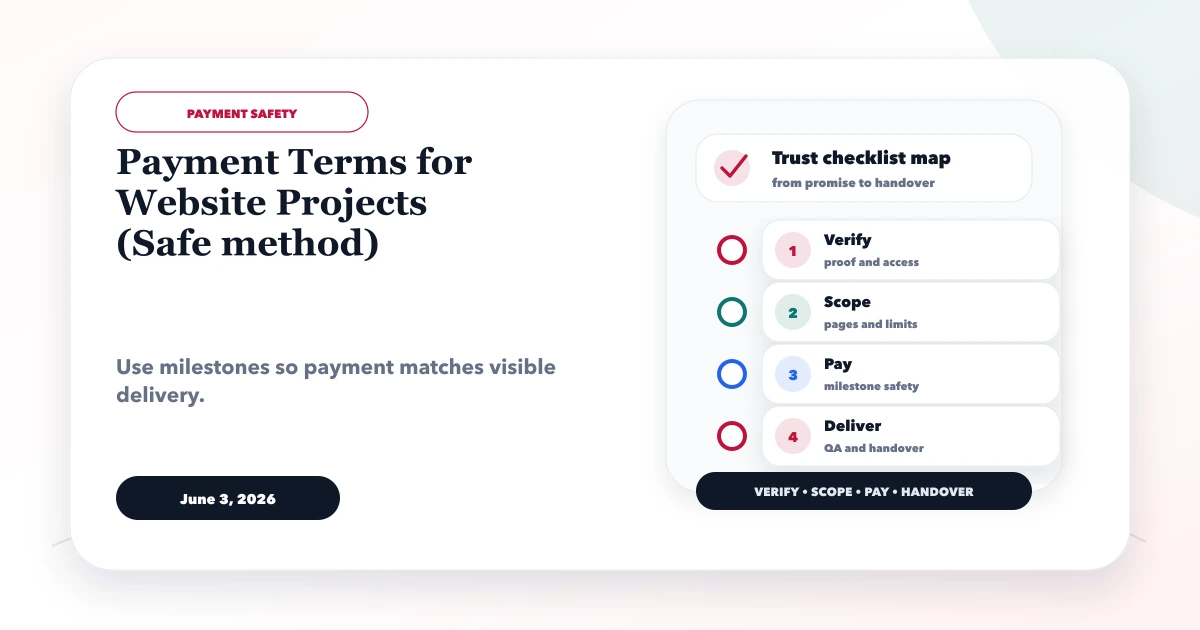
Website payment terms should connect money to visible progress and written acceptance. They should protect a client from paying for an undefined result and protect a developer from completing weeks of approved work without payment.
There is no universal “safe percentage.” A five-page business website, a custom ecommerce build, and a login-based portal carry different design, content, integration, and deployment risks. The safer method is to define deliverables, approval evidence, payment dates, change rules, ownership, and handover before development starts.
This guide is practical commercial planning, not legal advice. Have the final agreement and tax treatment reviewed by qualified professionals for your business and jurisdiction.
A balanced structure normally includes:
Do not use milestone names such as “design complete” unless the agreement says what the client can inspect and how approval is recorded.
Use the safe payment milestone plan to turn these principles into reviewable website and software delivery stages.
| Milestone | Reviewable evidence | Approval question |
|---|---|---|
| Project start | Signed scope, page list, responsibilities, schedule | Is the delivery boundary understood? |
| Structure | Sitemap, content checklist, wireframe or section plan | Are pages and user paths correct? |
| Design | Approved desktop/mobile direction for named templates | Is the visual system accepted? |
| Staging build | Working pages and agreed features on a test URL | Does the accepted scope function? |
| Launch readiness | QA list, content, analytics, SEO basics, access plan | Is the site safe to publish? |
| Handover | Credentials, source/export, documentation, support start | Can the owner operate the delivered website? |
Evidence reduces opinion-based disputes. A screenshot cannot prove that forms submit, mobile layouts work, analytics fire, or the owner has the accounts.
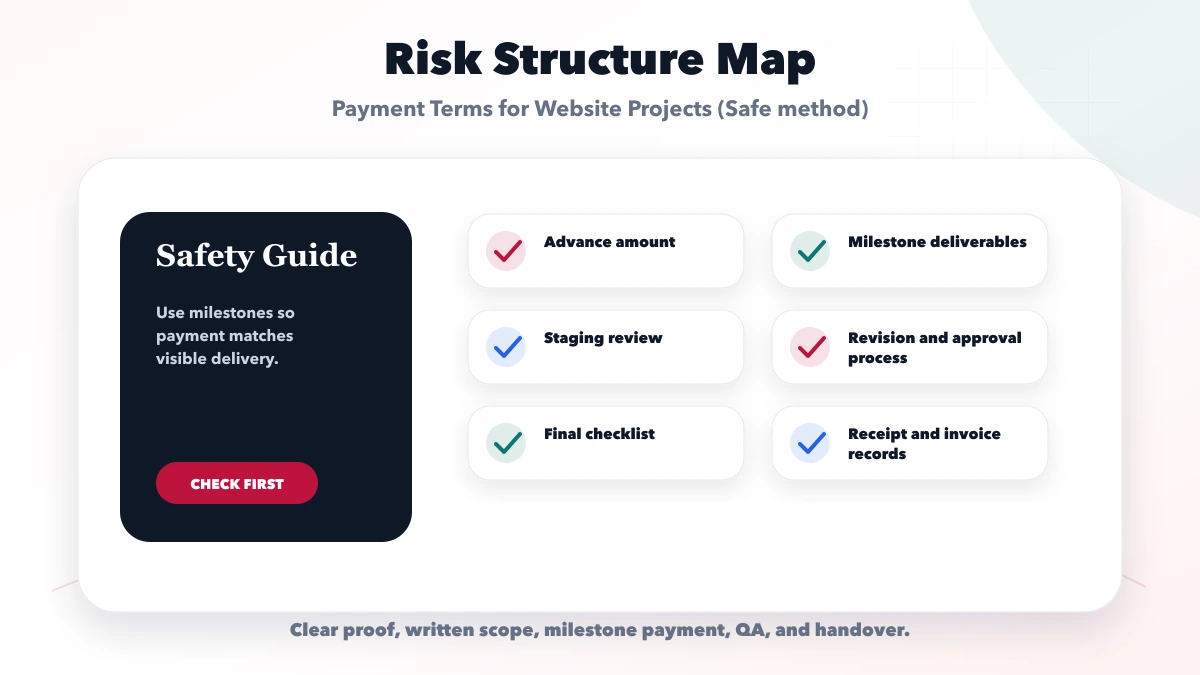
An advance reserves delivery capacity and funds project setup. Before paying it, the client should have:
The developer should not begin from a verbal feature list and expect the advance to absorb unlimited discovery. If requirements are not ready, use a paid discovery phase with a clear output such as a requirement document, sitemap, and estimate.
For a short marketing site, milestones can be:
Keep payment events few enough to administer but specific enough to prove progress.
Separate template creation from content population. Otherwise a developer may finish the build while launch waits for 60 missing articles, images, team profiles, or product records.
Possible milestones:
Payments, CRM, WhatsApp, booking, or external APIs introduce provider access and failure paths. Use a milestone for the integration proof and another for production hardening.
Use feature or workflow slices, not page percentages:
This type of work belongs in a web application scope, even if the public marketing site is part of the same project.
Examples help discussion, but they are not recommendations for every contract.
Small fixed website example
Longer custom build example
The percentage matters less than the definition. A “90% complete” project is meaningless if login, mobile QA, production data, and ownership are excluded.
The agreement should state:
A client should consolidate feedback. A developer should maintain a list showing accepted, pending, rejected, and out-of-scope items.
Scope changes are normal. Uncontrolled changes are the problem.
A change request should record:
Do not hide a significant new workflow inside a revision round. “Change the heading colour” and “add reseller login with pricing permissions” are not the same type of change.
Payment and schedule terms should account for missing:
Define whether the project pauses, moves to the next available slot, or incurs remobilisation after a long delay. This protects the developer's schedule without blaming the client for a clearly documented dependency.
State who pays and owns:
Where possible, business-critical accounts should be created in the client's name. A developer can receive limited access rather than owning the account permanently.
“Pay everything before launch” and “pay only after launch” can both create unfair risk.
A balanced process can:
Do not keep a live domain, source code, or essential credentials hostage outside written terms. Do not expect a developer to transfer all licensed assets or unpaid custom work before the agreed payment.
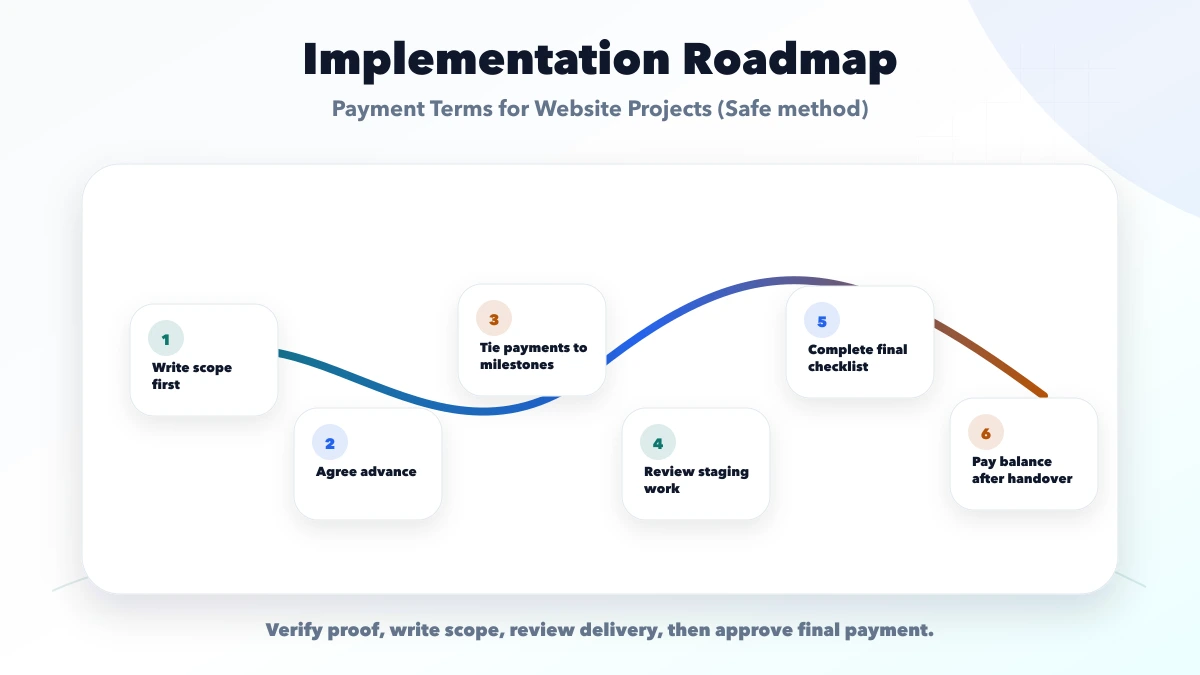
Before closing the final milestone, confirm:
Use the detailed website delivery checklist before final payment for final acceptance.
Define three different concepts:
A 30-day defect period does not automatically include new pages, rewritten copy, changed business rules, plugin subscriptions, or third-party provider changes.
The agreement should explain:
Do not wait for a dispute to decide these rules.
VASUYASHII scopes websites and software in phases with explicit deliverables. Public product and service pages distinguish current scope from roadmap or separately quoted modules. The same rule should exist commercially: a milestone should only charge for work that is named, reviewable, and accepted.
This article does not publish a mandatory VASUYASHII payment percentage. The actual structure depends on project duration, discovery, third-party cost, custom development risk, and client readiness.
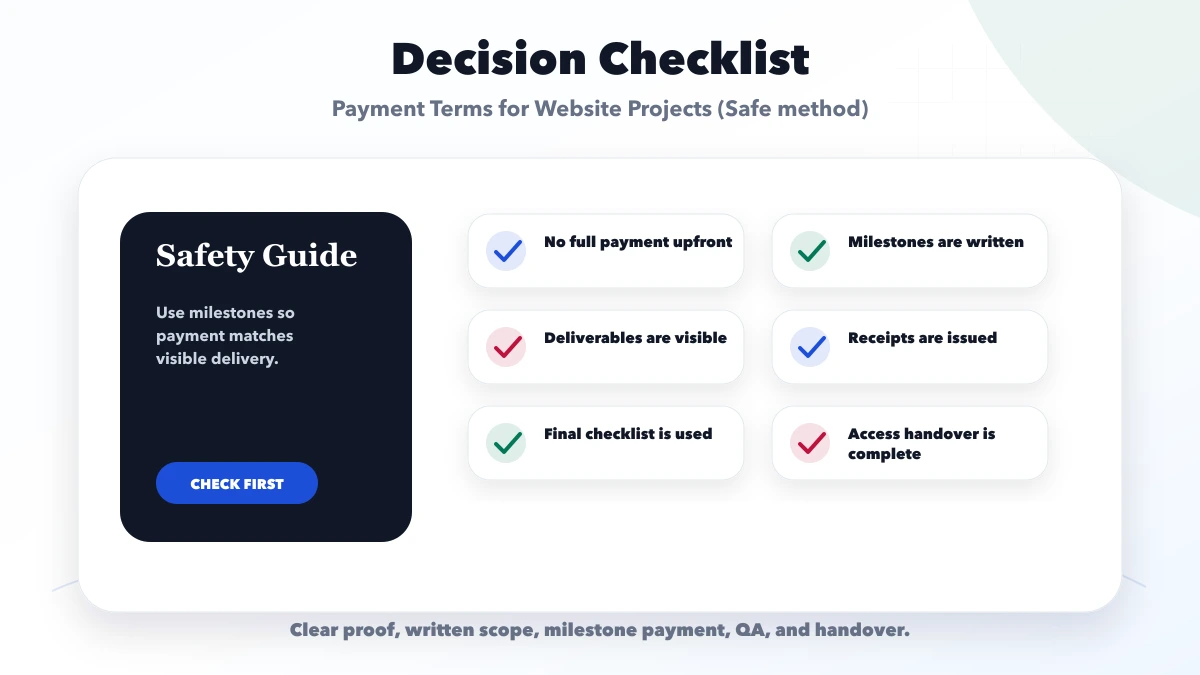
The risk is undefined delivery, not merely the percentage.
The developer funds the project and can be blocked by missing client content or access. Use evidence-based progress payments.
New workflows need change control.
Organic rankings are not fully controlled by the developer. Accept technical and content deliverables, not guaranteed positions.
A finished site without business-owned domain, hosting, analytics, and repository access creates avoidable dependency.
There is no universal number. Evaluate vendor evidence, project duration, discovery effort, reserved capacity, written scope, and the value delivered at each later milestone.
Tie payment to staging acceptance, launch readiness, production work, and handover. The exact order should be written and balanced.
Use a dependency schedule and pause/remobilisation rule. Do not leave the effect of a long delay undefined.
That depends on the agreement and applicable law. Record approvals clearly and obtain professional review for legal reliance.
They can be, but state cost, renewal owner, account owner, and what happens when the engagement ends.
Acceptance should compare delivery with the approved scope. New preferences can become change requests rather than defects.
Safe payment terms turn progress into evidence. Define what is being bought, what closes each milestone, who owns delays, how changes are approved, and what the client receives at handover.
For a website or software scope with milestone-level acceptance, contact VASUYASHII.
Related Articles
June 3, 2026
Use this website project agreement template to define deliverables, exclusions, timeline, revisions, payments, ownership, acceptance, support and termination.
Read article
June 3, 2026
Website delivery checklist before final payment with pages, forms, SEO, speed, mobile, access handover, backups, and launch QA.
Read article
June 3, 2026
How to check if a web developer is genuine in 2026 with portfolio checks, references, scope, payment safety, and red flags.
Read article
May 10, 2026
Plan website and software payments around approved scope, visible deliverables, acceptance checks, change control, handover, support and documented ownership.
Read article