
May 21, 2026
How to Verify a Web Development Company’s Portfolio (2026)
verify web development company portfolio: practical 2026 guide with checklist, pricing, timeline, risks, tools, FAQs, and Indian business tips today safely.
Read articlePublished Updated
How to check if a web developer is genuine in 2026 with portfolio checks, references, scope, payment safety, and red flags.
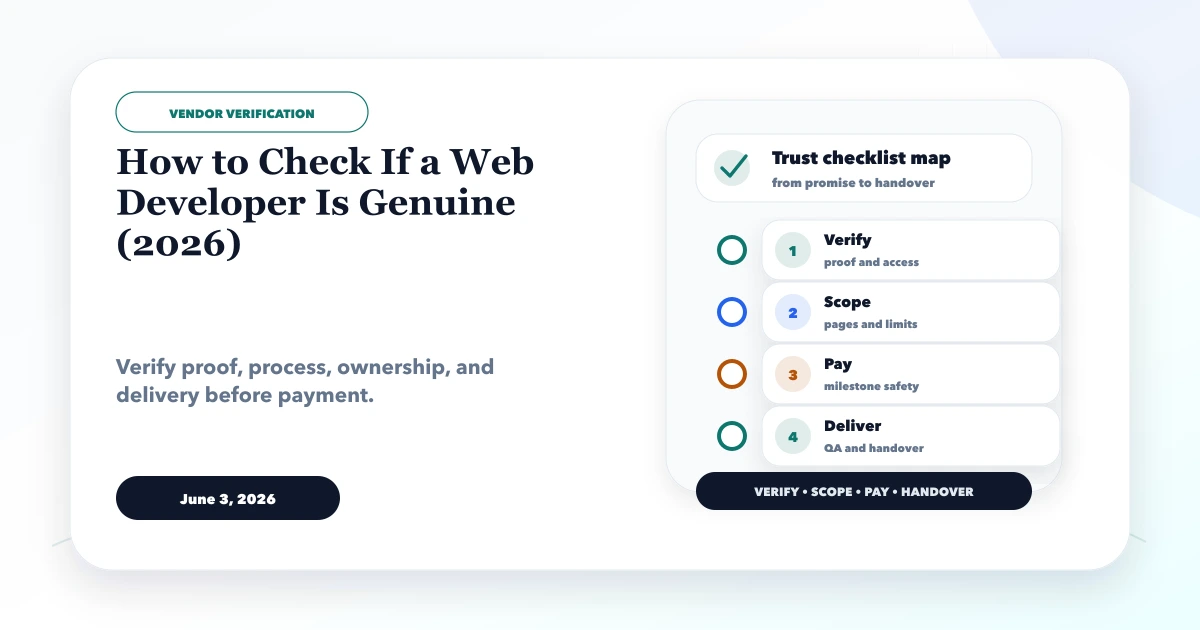
This guide explains how to check if a web developer is genuine without treating a polished portfolio, social profile, or low quote as sufficient proof. Verification should cover identity, current work, technical understanding, written scope, payment trail, account ownership, and the exact handover expected at launch.
The purpose is not to eliminate all project risk. It is to replace vague trust with checks that a serious freelancer or agency can answer professionally.
By Tushar C. (Founder, VASUYASHII). Reviewed by VASUYASHII Editorial for practical website development, vendor verification, project scope, payment safety, launch QA, security, maintenance, and technical SEO.
A genuine web developer should have verifiable work, clear scope, realistic timeline, written payment terms, source-code or access handover clarity, and a support plan. Do not judge only by screenshots or low pricing.
A retailer receives three quotes for a website. One vendor shares attractive screenshots but no live URLs. Another has live work but cannot explain which parts they delivered. The third provides a smaller portfolio, walks through the mobile flow, names the hosting and maintenance boundaries, and turns requirements into a written milestone plan.
The third vendor has offered stronger verification even before showing the most visually dramatic design. The buyer should still check identity, references, ownership, and commercial terms before payment.
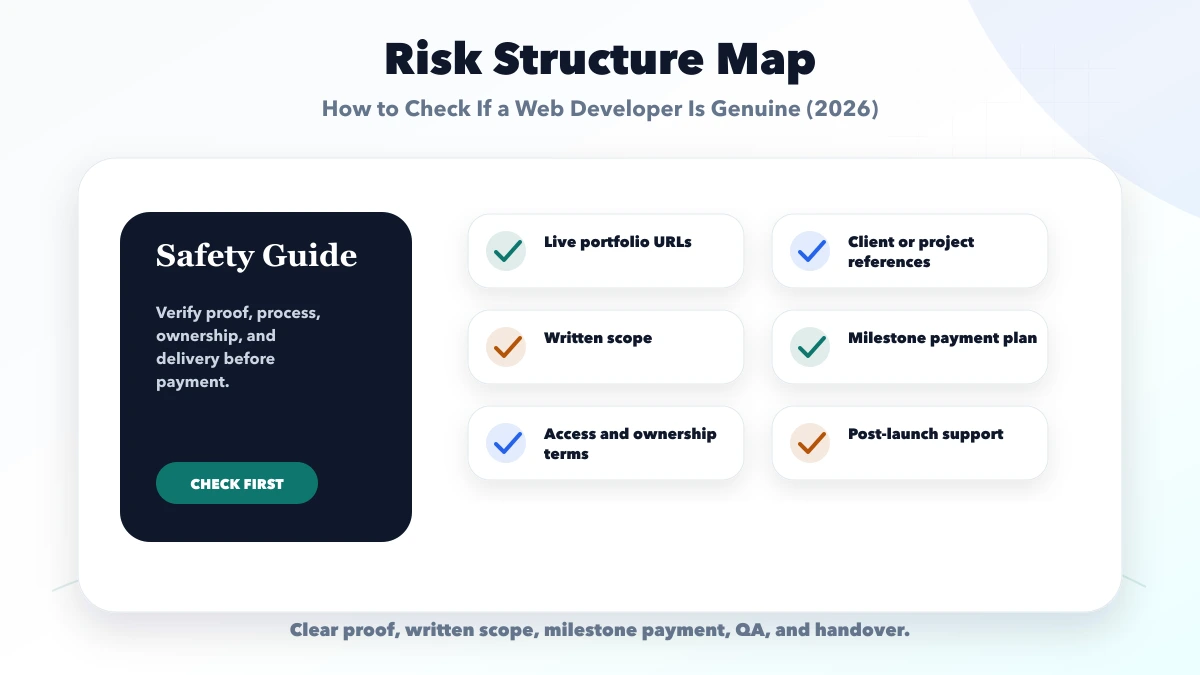
Each check should be specific enough to verify. Vague statements like "SEO included", "premium design", or "full support" should be converted into page names, fields, features, timelines, access details, or support limits.
| Area | What to verify | Safe action |
|---|---|---|
| Portfolio | Live links, case context, matching screenshots | Ask for proof before advance |
| Scope | Pages, features, revisions, timeline | Keep it written |
| Payment | Milestones, receipts, final holdback | Avoid full upfront payment |
A safe workflow does not mean slow delivery. It means the project has enough clarity that both sides can move quickly without guessing.
Ask for the legal or billing name, business email, phone, invoice details, and the person responsible for delivery. Confirm that payment instructions match the written proposal or invoice. A different bank beneficiary, last-minute account change, or pressure to pay outside the agreed method should be independently verified.
Check the vendor's own domain and current contact details. ICANN Lookup may show registration information where it is not privacy-protected, but hidden registration details do not automatically mean fraud. Use domain history only as one signal alongside real conversations, work evidence, and written terms.
For two relevant projects, ask the developer to explain:
Open the live site on mobile, submit only safe test data with permission, inspect contact routes, and compare the claimed delivery with the visible result. A template is not automatically bad, but it should not be represented as fully custom work.
If a project is confidential, ask for an anonymized walkthrough, a client reference with permission, or process artifacts that demonstrate the work without exposing private access.
You do not need to conduct a programming interview. Ask scenario questions:
A trustworthy answer names trade-offs and unknowns. Be cautious when every question receives a guaranteed outcome with no dependency or limitation.
| Area | Write into scope |
|---|---|
| Pages | Exact routes or page types and content responsibility |
| Features | Forms, WhatsApp, booking, payment, dashboard, integrations, and acceptance behavior |
| Design | Template/custom boundary, responsive breakpoints, revision rounds, assets |
| SEO | Metadata, sitemap, redirects, schema, analytics, Search Console, content responsibility |
| Ownership | Domain, hosting, repository/source, accounts, licenses, credentials |
| Launch | Staging review, migration, DNS, backup, testing, approval |
| Support | Included period, response channel, exclusions, ongoing cost |
Connect payments to observable milestones such as approved scope, accepted design direction, working staging flow, and verified handover. Keep receipts and change approvals. Avoid paying the entire amount upfront when no independently reviewable deliverable exists.
Log in to the accounts the business is supposed to own. Confirm the domain, DNS, hosting, CMS/admin, repository or source archive, analytics, forms, third-party accounts, backups, license list, and renewal dates. Run a real form test and check the receiving workflow. Record what happens if the developer is unavailable.
The final payment checkpoint should reflect the written acceptance criteria, not surprise features introduced at the end.
One warning does not always prove fraud. Risk becomes higher when several appear together: copied work, no written scope, guaranteed rankings, pressure for full payment, payment to an unrelated identity, refusal to discuss ownership, unrealistic deadlines, and no support boundary.
Pause and verify rather than accusing the vendor publicly. Preserve messages, proposals, receipts, and delivery evidence if a dispute develops.
Score each shortlisted vendor from zero to two on five areas: identity, relevant evidence, scope clarity, ownership/handover, and support. Zero means missing, one means partly explained, and two means written or verifiable. The total is a comparison aid, not a guarantee.
Discuss every zero before selecting the lowest quote. A vendor may reasonably lack public client names because of confidentiality, but should offer another form of evidence. Likewise, a new freelancer may have limited commercial work yet provide strong process, transparent limitations, and a safe first milestone.
Record the decision and unresolved risks. If the project involves payments, health information, sensitive customer data, regulated claims, or a complex migration, request specialist review beyond this general website checklist.
Use this roadmap to keep risk controlled. For larger websites, add written approvals at each stage: scope, design, staging, launch, and final handover.
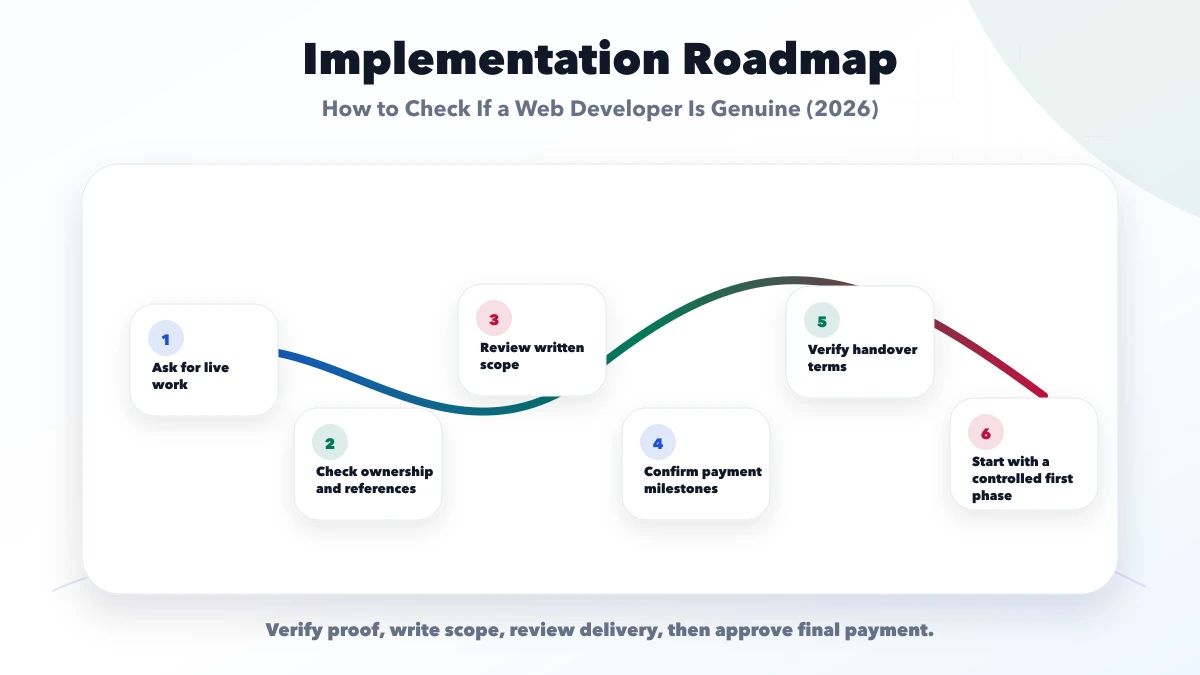
This checklist protects the project from avoidable disputes. It also gives the client a clear reason to approve, pause, or ask for clarification.
VASUYASHII would first map the business goal, scope, pages, proof, timeline, access needs, lead flow, SEO basics, and support expectations. Then we would create a phase-wise plan with clear deliverables.
Useful links: web application services, software development, integrations, services, and contact.
Avoid approving work only because it looks good in one screenshot. Real delivery includes working forms, mobile layout, SEO basics, access handover, tracking, support, and clear ownership.
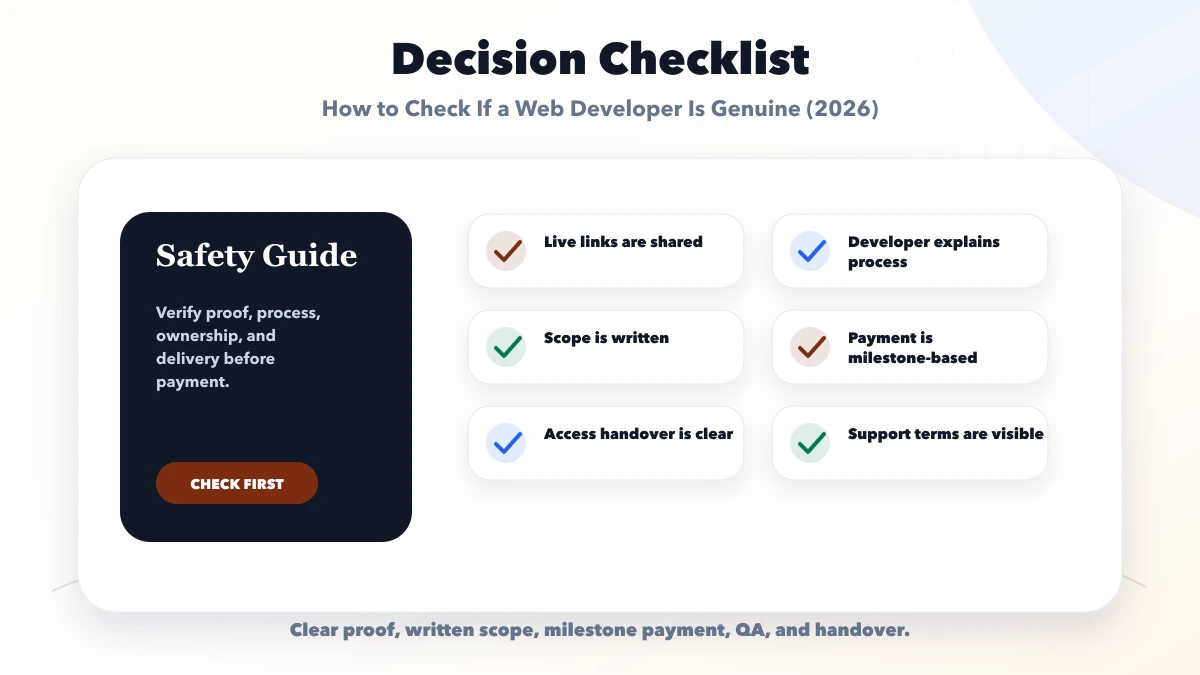
Check live projects, references, written scope, realistic timelines, payment milestones, and ownership handover terms.
It can be. Low pricing is not always fake, but it often means limited scope, template work, weak support, or hidden charges.
Yes, if the website is custom-built. For CMS sites, ask for admin, hosting, domain, and plugin access details.
Use a small advance tied to a written scope and milestone plan instead of paying the full amount upfront.
Yes. We can review scope, timeline, deliverables, and risk before you start.
If you want a practical plan for how to check if a web developer is genuine, VASUYASHII can help with scope, design, development, SEO setup, integrations, tracking, launch, and maintenance.
Related Articles
May 21, 2026
verify web development company portfolio: practical 2026 guide with checklist, pricing, timeline, risks, tools, FAQs, and Indian business tips today safely.
Read article
May 9, 2026
web developer near me Delhi NCR: pricing, checklist, FAQs, trust signals, and practical SEO steps for Indian SMB owners.
Read article
May 31, 2026
Compare Delhi NCR web app developers using discovery, architecture, security, ownership, delivery evidence, support and a weighted vendor scorecard.
Read article
June 3, 2026
Use milestone-based website payment terms with acceptance, change control, staging proof, receipts, handover checks, support limits and dispute safeguards.
Read article