
June 3, 2026
How to Detect a Fake Developer Portfolio
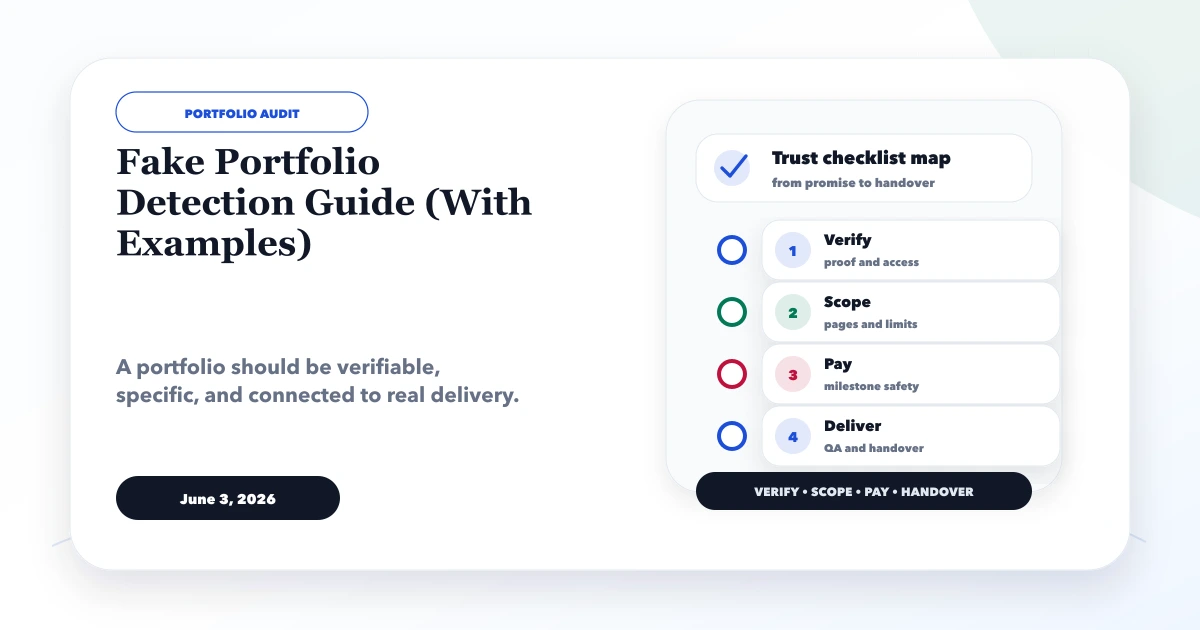
Detect a fake developer portfolio using live URL checks, role evidence, screenshot matching, copied case-study searches, references, and paid trial work.
Read articlePublished Updated
Verify a web development company through portfolio proof, domain ownership, contracts, payment milestones, source-code access, testing, and handover checks.
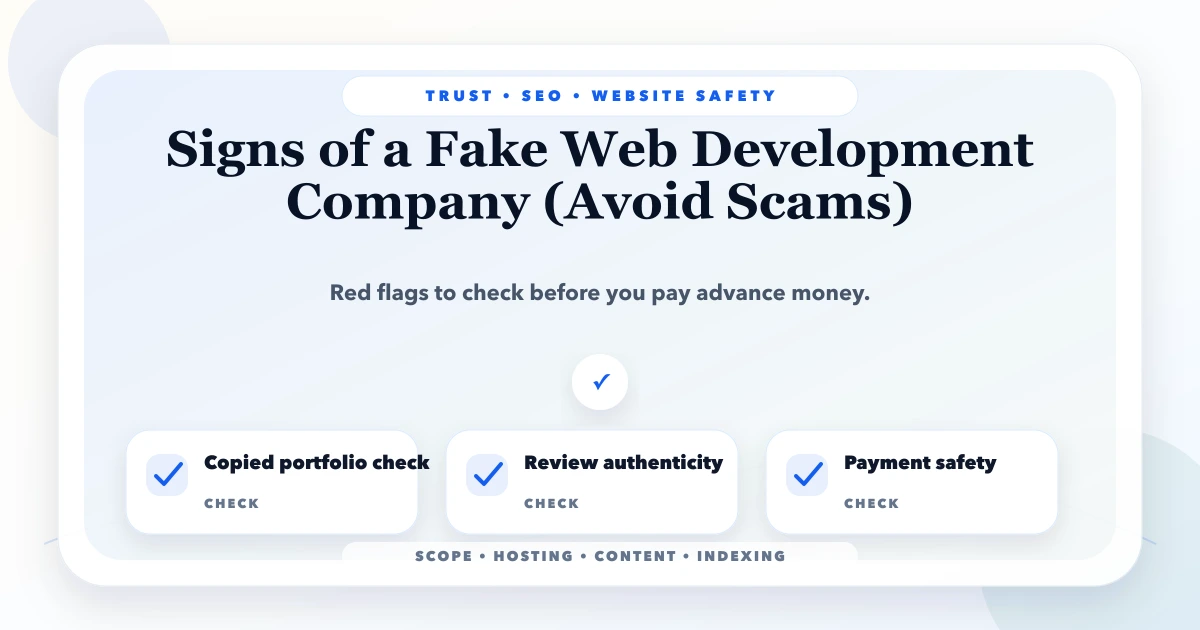
A genuine web development company should be able to explain what it will build, who will own each account, how progress will be demonstrated, and what the client receives at handover. A polished sales call or low quote is not proof. Verification comes from matching claims to public work, written scope, controlled access, staged payments, and a reproducible delivery process.
This guide is not a legal finding that any provider is fraudulent. It is a practical buyer checklist for reducing project, access, and payment risk before signing.
Ask for the legal or trade name used on the proposal and invoice, the business email domain, operating contact, and billing details. These should be reasonably consistent across the website, proposal, payment account, and communication.
Inconsistency is a reason to ask questions, not automatic proof of fraud. A freelancer may operate under a personal legal name and a studio brand. The important point is that the relationship is disclosed and the party responsible for delivery is identifiable.
Basic checks include:
A screenshot proves that an image exists. It does not prove who designed, developed, owned, or maintained the website. Select two or three relevant portfolio claims and ask:
Do not demand private client credentials or confidential source code. A responsible provider should protect previous clients. They can still explain the scope, constraints, and their contribution accurately.
The fake portfolio detection guide provides a deeper claim-verification process.
Industry demos are useful for evaluating design quality and feature understanding, but they are not completed client projects. A trustworthy site labels demos clearly. VASUYASHII, for example, presents demo websites as samples rather than customer claims.
Ask the provider to classify every example as client work, internal product, concept demo, template adaptation, or team member's prior work. That simple label prevents many misleading comparisons.
The safest default is that the client controls business-critical accounts:
| Account | Recommended owner | Provider access |
|---|---|---|
| Domain registrar | Client/business | Delegated technical access if needed |
| Hosting/deployment | Client or documented shared setup | Project role, not sole hidden owner |
| Analytics/Search Console | Client | Invited user access |
| Business email | Client | Limited configuration support |
| Payment gateway | Client legal entity | Developer/testing access only |
| Source repository | Client organisation or agreed transfer | Team access during delivery |
| Third-party APIs | Client-owned production account | Restricted keys and environments |
If the provider registers everything under its own identity, the client may struggle to move later. Record ownership and recovery email before launch. Never share passwords in ordinary chat; use invited roles, password managers, or provider-approved secure methods.
A usable scope states pages, features, integrations, content responsibility, responsive expectations, browser/device support, forms, analytics, SEO basics, deployment, exclusions, and handover. It also defines what "complete" means.
Weak scope:
Professional five-page website with unlimited features and SEO.
Testable scope:
Home, About, three service pages, Contact, mobile navigation, validated enquiry form, WhatsApp link, analytics events, metadata, sitemap, final deployment, and administrator handover. Copywriting, paid tools, multilingual content, and monthly SEO are excluded unless added.
Use the website project agreement guide and business website planning checklist before approving the quote.
Avoid paying the entire project before any verifiable work. Also avoid expecting a provider to complete a custom project with no deposit. A balanced structure may connect payment to discovery approval, working staging delivery, final acceptance, and handover.
Each milestone should specify:
The safe website payment terms guide explains milestone design. Have a qualified legal or financial professional review important contracts; a blog cannot determine the right terms for every business.
Risk increases when a provider:
One issue may have an innocent explanation. Look for patterns, ask for clarification, and document the answer.
Use a real acceptance checklist:
The detailed website delivery checklist is appropriate for final acceptance.
Ask before signing:
There are valid hosted-service models where source is not transferred. The problem is not the model; it is discovering it only after payment.
Score each item 0 absent, 1 partial, or 2 clear:
| Area | Evidence |
|---|---|
| Identity | Contracting and payment party disclosed |
| Portfolio | Contribution and project type verified |
| Scope | Deliverables, exclusions, acceptance written |
| Ownership | Domain, hosting, analytics, source defined |
| Payments | Milestones tied to evidence |
| Security | Access uses roles and safe credential handling |
| Delivery | Staging, QA, and review process shown |
| Handover | Accounts, code, documentation, support listed |
A low score does not prove fraud. It means the buyer should pause, request evidence, narrow the first milestone, or seek another professional opinion.
VASUYASHII would scope a project around written deliverables, a working review environment, client-controlled business accounts, and explicit handover. Our project checklist records who owns the domain, hosting, analytics property, repository, production credentials, backups, and content before development begins. Each milestone also needs a visible output and acceptance rule, such as an approved page set, a tested workflow, or a documented handover package.
This process does not prove that every disagreement is fraud, and it does not guarantee every future project outcome. It gives both sides evidence when scope, payment, access, or delivery is questioned. Review website services, web application services, or contact us with the current requirement.
Keep dated copies of approvals, invoices, access transfers, and accepted milestone evidence.
No. A new provider may be capable and honest. Reduce risk through a smaller first milestone, direct evidence, clear ownership, written acceptance, and staged payments rather than relying only on review count.
No. Price may reflect a template, limited scope, junior team, or temporary offer. Compare exclusions, ownership, recurring cost, content, testing, and support before deciding.
Look for specific, attributable, permitted context. Do not harass named people. Ask the provider whether a reference is available and respect confidentiality.
Normally the business should control its domain registrar and recovery details. The provider can receive delegated technical access when required.
Confirm whether the proposal is a hosted service, licensed product, or custom development. Source transfer is not universal, but the commercial model and exit process must be disclosed before signing.
Pause further payment, preserve agreements and communication, secure business accounts, contact the relevant bank/platform where appropriate, and seek qualified legal or law-enforcement guidance for your jurisdiction.
Verify one portfolio claim, mark account ownership, and convert the quote into milestone acceptance criteria before paying. For a transparent scope review, contact VASUYASHII.
Related Articles
June 3, 2026
Detect a fake developer portfolio using live URL checks, role evidence, screenshot matching, copied case-study searches, references, and paid trial work.
Read article
May 10, 2026
NDA ownership clause: practical checklist, template, pricing, timeline, mistakes, FAQs, clear owner-safe guidance, and next steps for Indian SMBs today.
Read article
May 22, 2026
Compare workflow automation with hiring staff using workload, exception rate, service risk, costs, controls, payback, and a practical Indian SME decision model.
Read article
June 6, 2026
Website development for shops in Ghaziabad with pages, product catalog, WhatsApp leads, local SEO, cost ranges, and checklist.
Read article