
June 6, 2026
Govindpuram Business Website: What to Build First
Plan the first useful Govindpuram business website with a phased page scope, proof, contact flow, ownership, launch criteria, and practical upgrades.
Read articlePublished Updated
Use this website planning checklist to define goals, pages, content, ownership, SEO, integrations, acceptance tests, and handover before hiring.
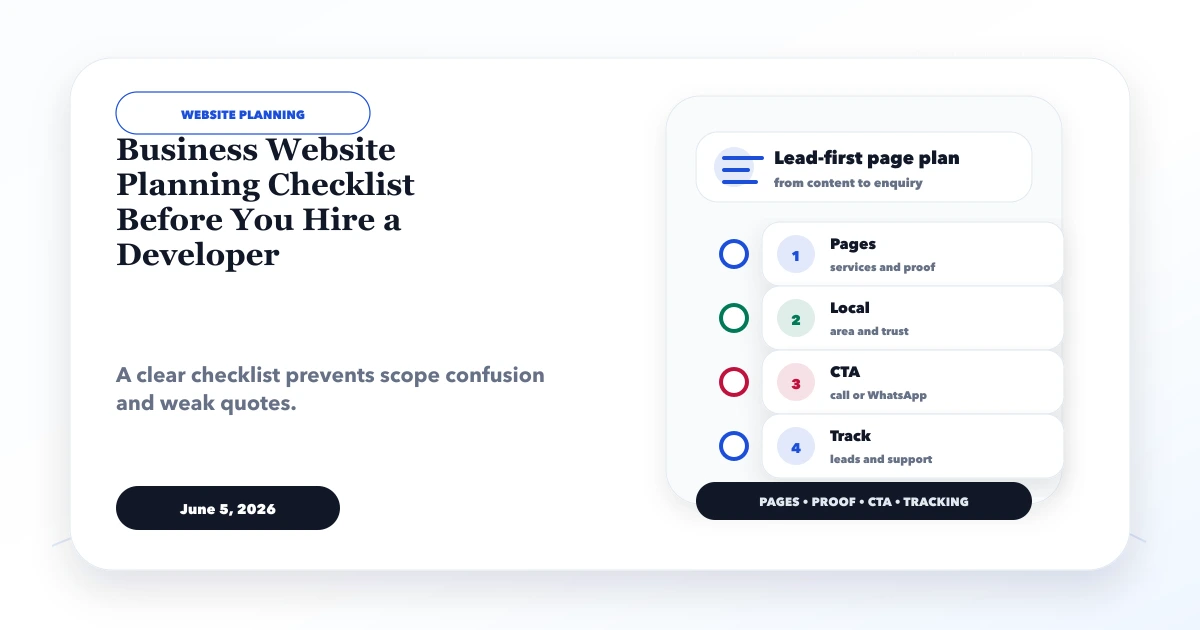
The best time to reduce website cost and delay is before design starts. A business that sends only a logo and asks for a "modern website" leaves the developer to guess the audience, page hierarchy, proof, lead flow, integrations, ownership, and acceptance standard. Those guesses later become revisions.
This business website planning checklist helps an Indian small business prepare a usable brief before hiring a developer. It covers goals, pages, content, brand assets, SEO, conversion, security, analytics, integrations, commercial scope, acceptance testing, and handover.
By Tushar C. (Founder, VASUYASHII). The checklist is a project-scoping tool. Hosting, legal, tax, privacy, accessibility, and industry requirements should be reviewed for the business's actual context.
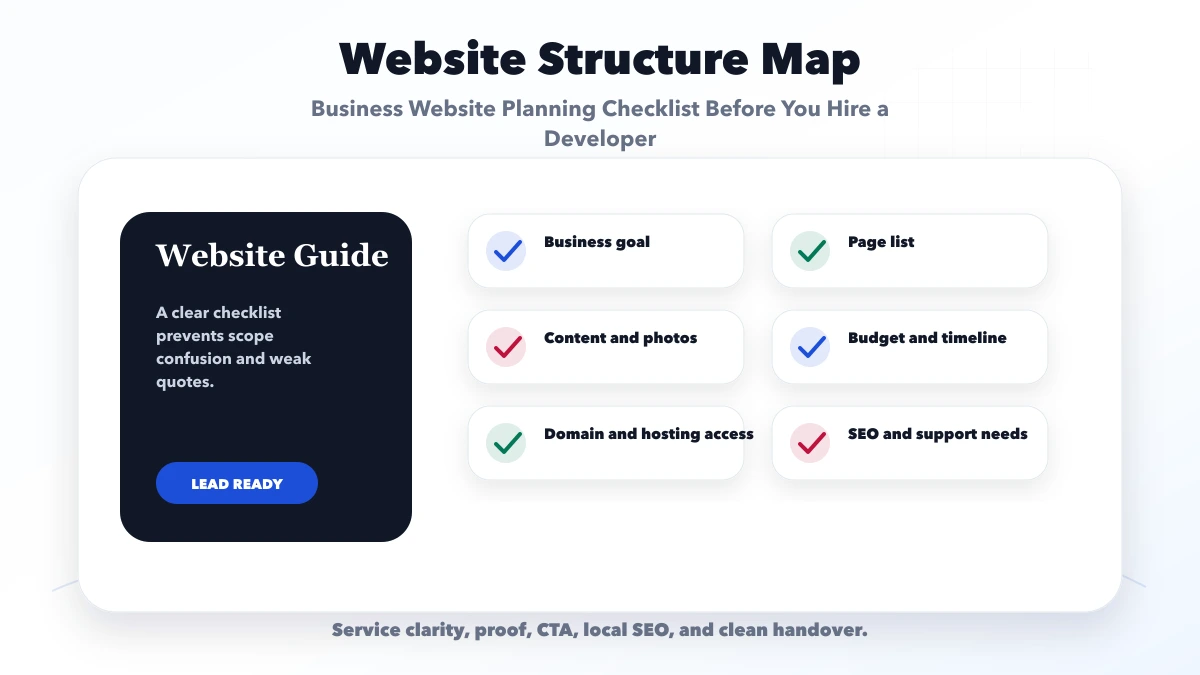
Before requesting quotes, prepare these ten decisions:
A clear two-page brief is more useful than a fifty-page document nobody maintains.
Choose one primary outcome for the first version:
Write the outcome as a measurable journey. "Get leads" is vague. "A Delhi NCR manufacturer should understand our product categories and submit an RFQ with quantity, specification, and delivery city" gives the developer a testable flow.
List secondary outcomes, but do not let them compete with the primary action in the hero.
Document customer type, geography, decision role, device, language, urgency, common questions, objections, and evidence needed. A local patient, wholesale buyer, startup founder, and school parent should not receive the same page structure.
Useful inputs include:
Do not invent personas based only on age and job title. Focus on the decision and information need.
| Page | Purpose | Content owner | Primary CTA |
|---|---|---|---|
| Home | Route visitors to the right offer | Founder/marketing | Main enquiry or demo |
| About | Establish accountable trust | Founder | View work/contact |
| Service/product | Explain scope and fit | Service owner | Request quote/demo |
| Projects/case studies | Show verifiable delivery | Project owner | Discuss similar need |
| Blog/resources | Answer support questions | Editorial owner | Visit relevant service |
| Contact | Capture and route enquiries | Sales/operations | Submit/call/WhatsApp |
| Privacy/terms | Explain policies | Business/legal reviewer | Contact for questions |
Add a page only when it serves a distinct visitor decision and has enough original content. Avoid creating many thin city or keyword pages before the core service architecture is strong.
For every page, gather:
Separate proof from claims. A screenshot, project page, public demo, process document, verified review, or named credential can support a statement. Do not publish fabricated metrics, client logos without permission, stock photos as team members, or fictional demos as client outcomes.
Content delivery should appear in the project timeline. "Client will provide content" needs dates, format, reviewer, revision limit, and a fallback if content is late.
Provide vector/high-resolution logo files, colour references, font licences, approved photographs, product images, icon preferences, and brand examples. State who owns or has permission to use every asset.
Define whether the developer will source stock imagery, generate visuals, photograph the business, or only use supplied assets. Record licence and removal responsibilities.
Ask for responsive image formats and fixed dimensions. Large unoptimised assets can damage mobile performance even when the design looks correct.
The business should own or control:
Use named business accounts and password management. Avoid leaving the domain or analytics permanently under a freelancer's personal account. Define who can add/revoke access after handover.
SEO is not a metadata task added at launch. Plan:
If an old site exists, export its URLs and traffic before changing structure. A redesign that drops valuable URLs without redirects can lose existing visibility.
Review SEO-friendly website architecture and internal linking planning before approving the sitemap.
Choose one primary CTA per page. Define form fields, WhatsApp context, phone hours, spam controls, consent, notification recipients, owner, response target, status values, and confirmation wording.
The developer should know what happens after submission. Does the lead enter email, CRM, Google Sheets, or an admin dashboard? Who handles duplicates? What happens when notification delivery fails?
Use privacy-safe events such as form start, valid generate_lead, WhatsApp click, phone click, demo open, and key page CTA. Do not send personal data or form content into GA4.
A marketing website displays public information and captures leads. Login, roles, dashboards, inventory, payment reconciliation, customer portals, or workflow automation are application features.
If the project includes these, document:
Use web application services to scope those workflows separately instead of hiding them under "one website."
The quotation or agreement should state:
Avoid choosing only by the lowest total. Compare scope line by line. A low quote may exclude copy, mobile QA, SEO migration, forms, analytics, or post-launch support.
Consider a fictional electrical supplier requesting a new website. The first request says "six pages with modern design." Discovery reveals three product categories, dealer and project buyers, downloadable specifications, RFQ fields, Delhi NCR delivery coverage, and an existing domain with indexed pages.
A proper brief changes the quote: the site needs category architecture, controlled product data, RFQ routing, legacy redirects, asset preparation, and a named catalog owner. Those decisions avoid redesigning the structure after visual approval.
Success means qualified RFQs, accurate catalog information, preserved search URLs, and a maintainable handover. The scenario is illustrative.
Test behavior, not only screenshots:
Use a written issue list and severity. Define which issues block launch and which are post-launch improvements.
Request:
Credentials should be transferred through a secure method, not pasted into general documents or chat history.
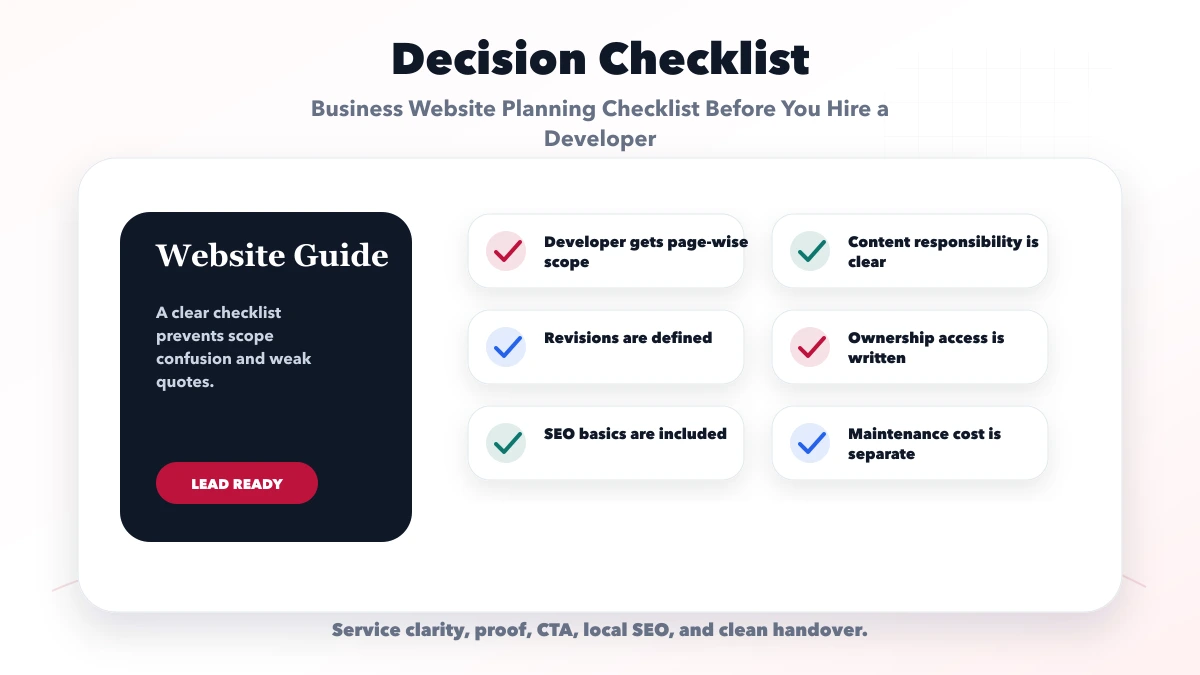
Detailed enough to define goal, audience, pages, content ownership, lead flow, integrations, acceptance, and handover. Avoid unnecessary technical prescriptions unless they are real constraints.
The developer or copywriter can help, but the business must provide accurate service facts, proof, policies, and a final reviewer. State content scope in the quote.
The business should control core accounts and grant appropriate access. Avoid permanent dependency on a developer's personal account.
Not necessarily. Confirm URL planning, metadata, content, migration, canonical, sitemap, schema, internal linking, analytics, and GSC deliverables explicitly.
Follow the written milestone terms. Before final acceptance, complete agreed tests, account/source handover, known-issue review, and launch responsibilities.
Yes. VASUYASHII can help define website or software scope, page architecture, lead flow, integrations, acceptance checks, and phased implementation.
Before requesting quotes, decide how many pages the business website needs, collect the source material through the website content checklist, define the navigation path to enquiries, and confirm the global details required in the business website footer.
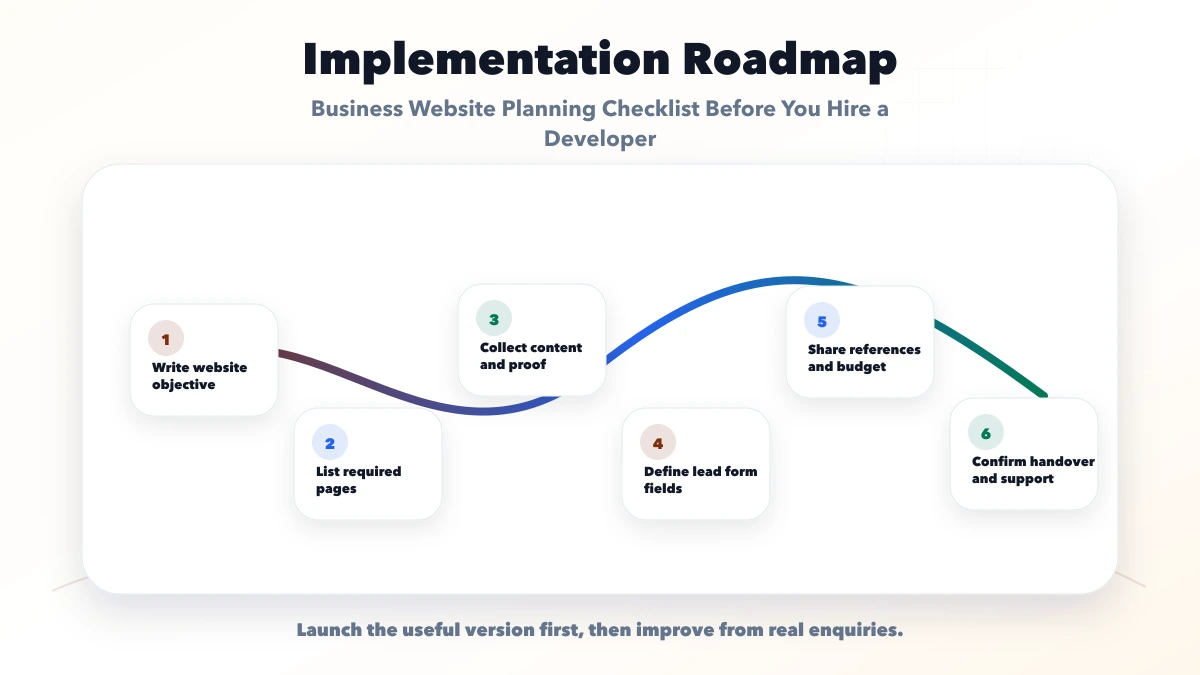
Complete the ten planning decisions before comparing quotes. A strong brief makes price, timeline, and quality easier to evaluate and gives both sides a shared definition of done. Use the website development trends buyer guide to separate durable requirements from optional technology trends.
Review website development services, software development services, services, or contact VASUYASHII for a scoped discussion.
Use why a business still needs a website in 2026 to confirm the owned assets, buyer journey, and measurement purpose before converting this checklist into a build request.
Related Articles
June 6, 2026
Plan the first useful Govindpuram business website with a phased page scope, proof, contact flow, ownership, launch criteria, and practical upgrades.
Read article
March 23, 2026
Use this web-developer hiring checklist to assess scope, proof, ownership, accessibility, SEO, security, payments, testing, support and handover.
Read article
May 10, 2026
Evaluate SEO proposals using deliverables, access control, baseline data, reporting, link transparency and red flags before approving payment or long contracts.
Read article
June 3, 2026
Use this monthly website maintenance checklist, plan example and report template for backups, updates, forms, security, SEO, analytics and ownership.
Read article