
June 5, 2026
Business Website Planning Checklist for 2026
Use this website planning checklist to define goals, pages, content, ownership, SEO, integrations, acceptance tests, and handover before hiring.
Read articlePublished Updated
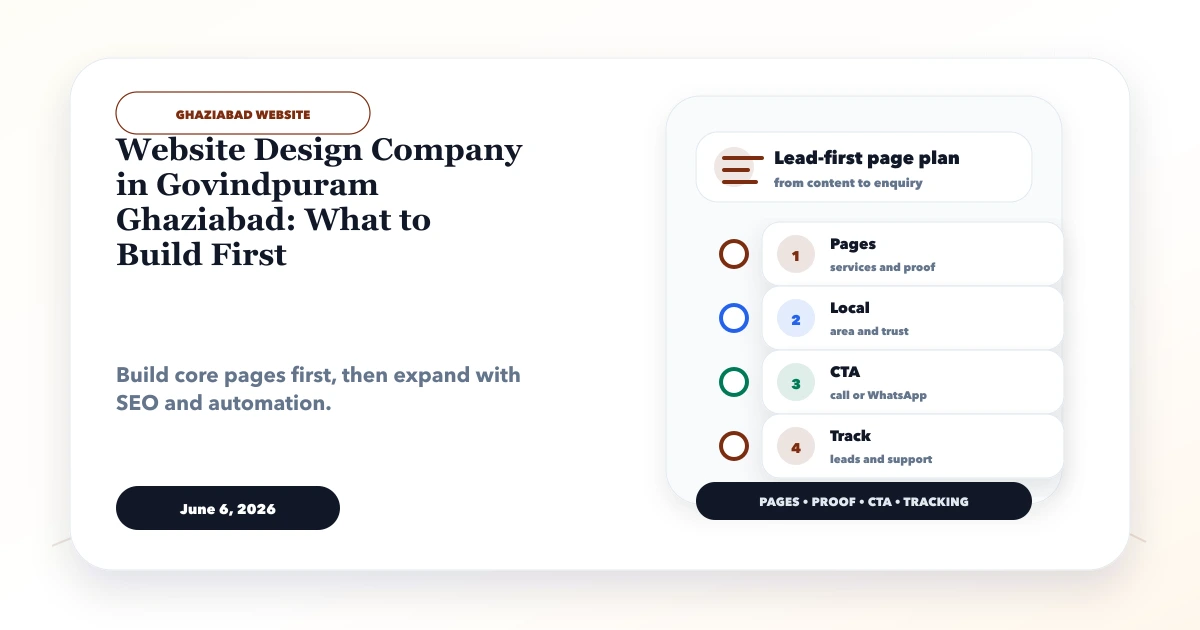
Plan the first useful Govindpuram business website with a phased page scope, proof, contact flow, ownership, launch criteria, and practical upgrades.
Service-area note: VASUYASHII is based in Delhi NCR and supports businesses remotely across India. A city-focused guide describes service and planning context; it does not claim a physical office in every location mentioned.
Explore the parent topic: Website Development Delhi NCR Hub →A business comparing a website design company in Govindpuram Ghaziabad may receive proposals containing many pages, effects, and features before anyone defines the first commercial job of the website. For a clinic, tutor, shop, consultant, home-service provider, or growing local company, the safer approach is to launch the smallest complete version and expand from real customer questions.
This guide explains how to choose that first version. It separates essential trust and enquiry work from later SEO, catalogue, booking, and automation upgrades.
Written by Tushar C. (Founder, VASUYASHII) using the current VASUYASHII scoping and acceptance process. The recommendations are planning guidance, not a claim of a Govindpuram office, local client, lead count, or ranking outcome.
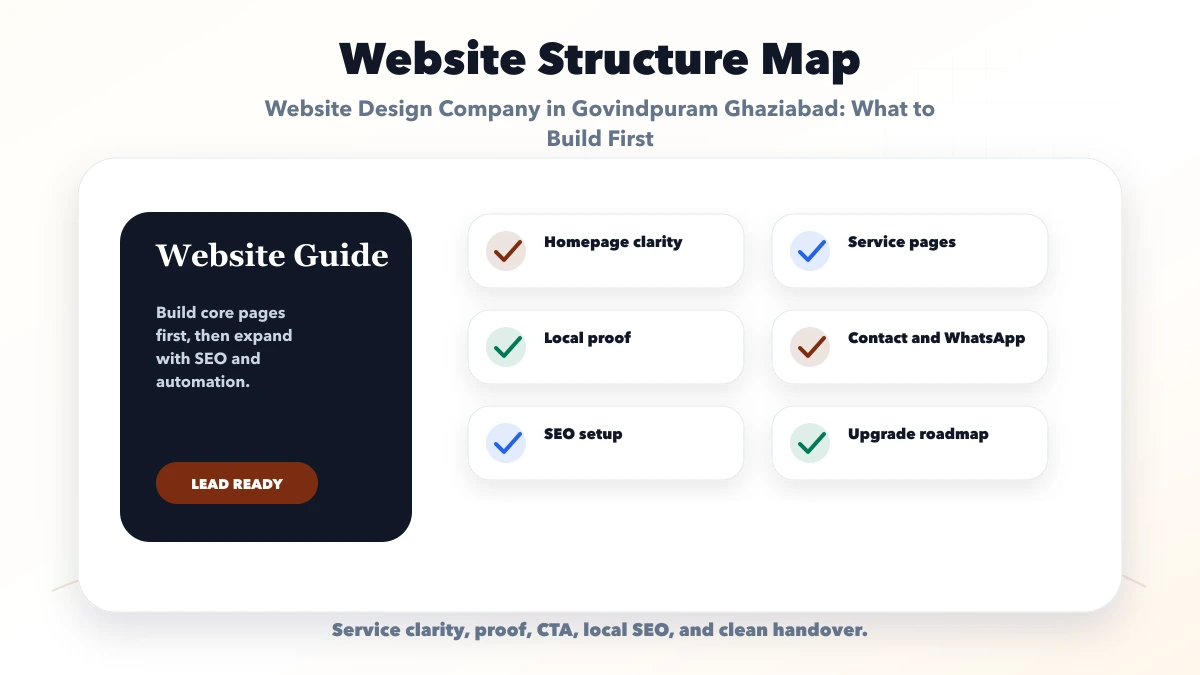
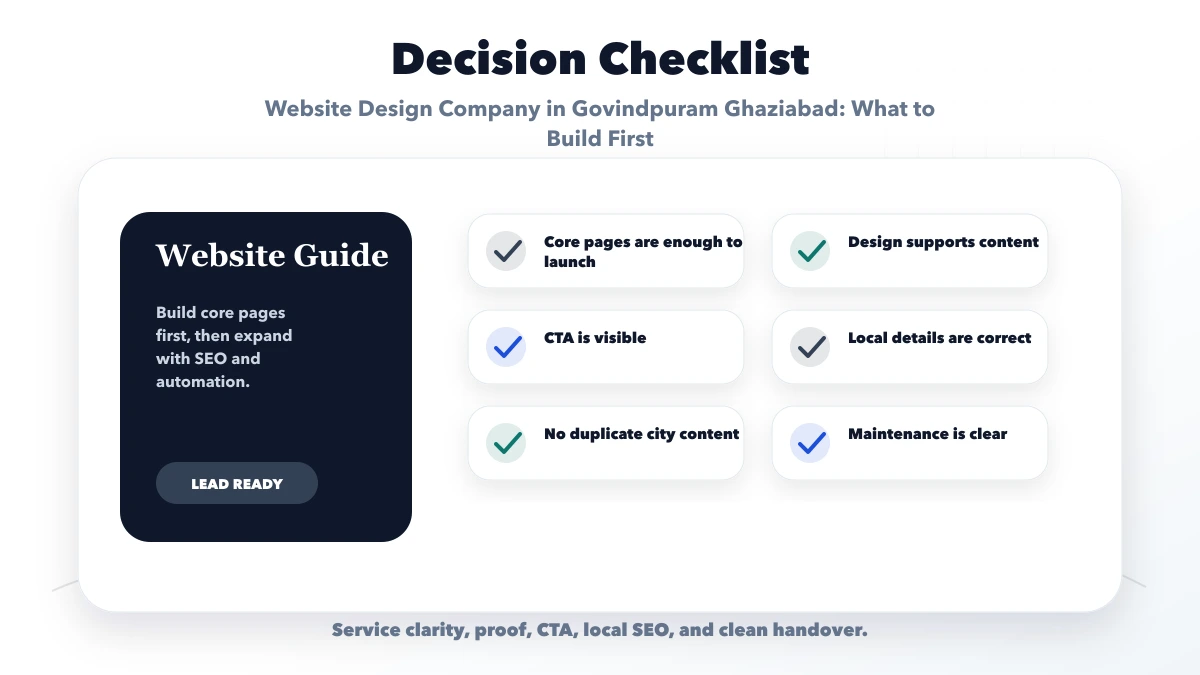
Build these foundations first:
Add blogs, large galleries, online payments, booking, customer login, or CRM automation only after their process and owner are clear.
Choose one primary outcome for release one.
| Outcome | Website must help the visitor do | Evidence of success |
|---|---|---|
| Build trust | Verify business and understand offer | Relevant page viewed, direct enquiry |
| Generate appointments | Choose service and request a slot | Qualified appointment request |
| Request quotations | Share requirement with context | Complete, relevant quote enquiry |
| Visit a location | Confirm service and access | Directions or relevant call |
| Browse products | Find category and product reference | Product-qualified enquiry |
Do not ask the first release to solve all outcomes equally. A clear priority improves copy, navigation, CTA, and measurement.
Name the service, customer, operating model, and next action. Link to deeper information instead of repeating every paragraph.
Explain the problem, suitability, process, deliverables, exclusions, evidence, cost method, and next step. If several services differ materially, create separate pages gradually.
Show responsible people, real business context, verifiable credentials, permitted work examples, and how delivery happens.
Offer the channel the team actually monitors. State hours or expected response process accurately. Ask only the first-step information.
Add privacy and other policies appropriate to the data, service, and jurisdiction. Do not copy a policy without confirming it matches the business.
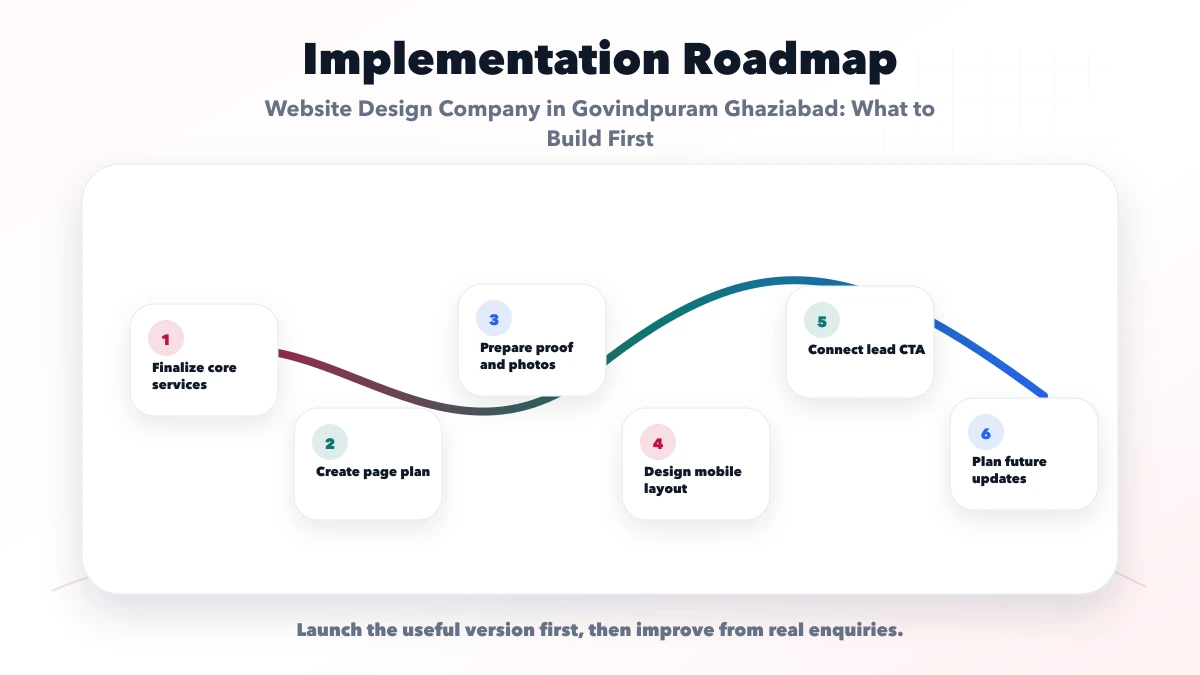
Prepare a compact launch folder:
Missing content should be visible in the project plan. Placeholder text must not quietly become production copy.
Launch the core pages, mobile navigation, genuine proof, form or WhatsApp, metadata, analytics, and ownership. This version must be complete enough to share confidently.
Add focused pages for services that receive meaningful demand. Use questions from enquiries and Search Console rather than copying competitors.
Publish useful guides, improve internal links, and maintain genuine local information. Do not produce many swapped-city pages.
Add booking, quotation, product catalogue, payment, CRM, or customer login only when the operating process is documented.
Review lead quality, search queries, page paths, and staff feedback. Improve weak stages instead of redesigning the entire site without evidence.
| Feature request | Build now when | Delay when |
|---|---|---|
| Blog | A person owns useful topics and review | It will contain generic bulk content |
| Online booking | Availability and confirmation rules exist | Staff still manage an informal diary |
| Payment | Price, refund, tax, and reconciliation are clear | Payment ownership is undefined |
| Product catalogue | Product data is structured and maintainable | Photos, codes, and categories are inconsistent |
| Customer login | Users need protected records or actions | It is added only to look advanced |
| CRM integration | Lead stages and owners are defined | Team follow-up is undocumented |
| Multi-language | Translation and updates have an owner | Machine text will remain unreviewed |
This decision prevents the common pattern where features launch but cannot be maintained.
If the business has a genuine customer-facing location, publish the approved address, hours, appointment or walk-in policy, and useful access guidance. Keep the same information on verified profiles.
If the business only serves customers in Govindpuram from another location, state the service-area model. Do not use a fictional address or imply a branch. The service-area page strategy explains when a local page has enough unique value.
Cost depends on:
A five-page website with carefully written services, real proof, tracking, and handover may require more work than a fifteen-page template populated with repeated text. Ask for a component-wise scope.
The business should control:
The developer can receive role-based access. Root ownership should not depend on a personal account outside the business.
Define a small measurement plan:
| Event | Why it matters | Quality check |
|---|---|---|
| Service page view | Shows interest path | Correct page category |
| Phone/WhatsApp click | Indicates contact intent | No personal data in parameter |
| Form start | Shows engagement | Not counted as a lead |
| Successful submission | Indicates generated lead | Server or success-state validated |
| Directions click | Useful for visit-led business | Real location only |
Use the lead tracking guide. Review whether enquiries are relevant, not only how many clicks occurred.
VASUYASHII can build business websites, web applications, custom software, and integrations. We separate the first website release from later software phases so the proposal remains testable.
For Delhi NCR website development, scope should name pages, content responsibility, CTA, proof, analytics, ownership, acceptance, and support. Share the actual requirement through contact.
Do not set phase two only by a calendar date. Agree on an evidence trigger, such as repeated questions about one service, a meaningful number of qualified catalogue enquiries, staff difficulty routing leads, or verified demand for a new page.
Write the trigger during phase one and record the data source. This keeps the first launch focused while giving the owner a clear path to expand. It also prevents a temporary idea from becoming permanent website complexity.
It can be enough for a narrow offer, but separate pages are better when services have different buyer questions, evidence, or search intent. Do not force complexity into one long page only to reduce count.
Only when it can publish useful, reviewed content consistently. Complete service and trust pages first, then answer real customer and search questions.
Yes. Plan the data and integration boundary early, but launch booking after availability, confirmation, cancellation, and staff ownership are defined.
Enough to explain real availability, service model, and useful local differences. Repeating a city name does not create local value.
Final URLs, responsive layouts, forms, calls, WhatsApp, analytics, metadata, access transfer, backups, and every written acceptance item.
Use enquiry questions, lead quality, staff workload, and search data. Build the next phase only when it solves an observed problem.
Build the first Govindpuram website as a complete trust-and-contact system, not an incomplete version of a large feature list. Preserve ownership, measure real actions, and expand only when customer questions or operations justify the next phase.
This guide owns the what-to-build-first decision for a new business website. It helps a Govindpuram business choose the first complete release before discussing visual style or optional features. The main website development services in Ghaziabad page covers provider evaluation, packages, evidence, and the complete service process; the affordable Ghaziabad website guide covers phased budget decisions.
No local office, customer, or outcome should be inferred from this guide. Use it only where the business genuinely serves or operates in Govindpuram. Send the approved first-release goal and available content through the business website enquiry form.
Related Articles
June 5, 2026
Use this website planning checklist to define goals, pages, content, ownership, SEO, integrations, acceptance tests, and handover before hiring.
Read article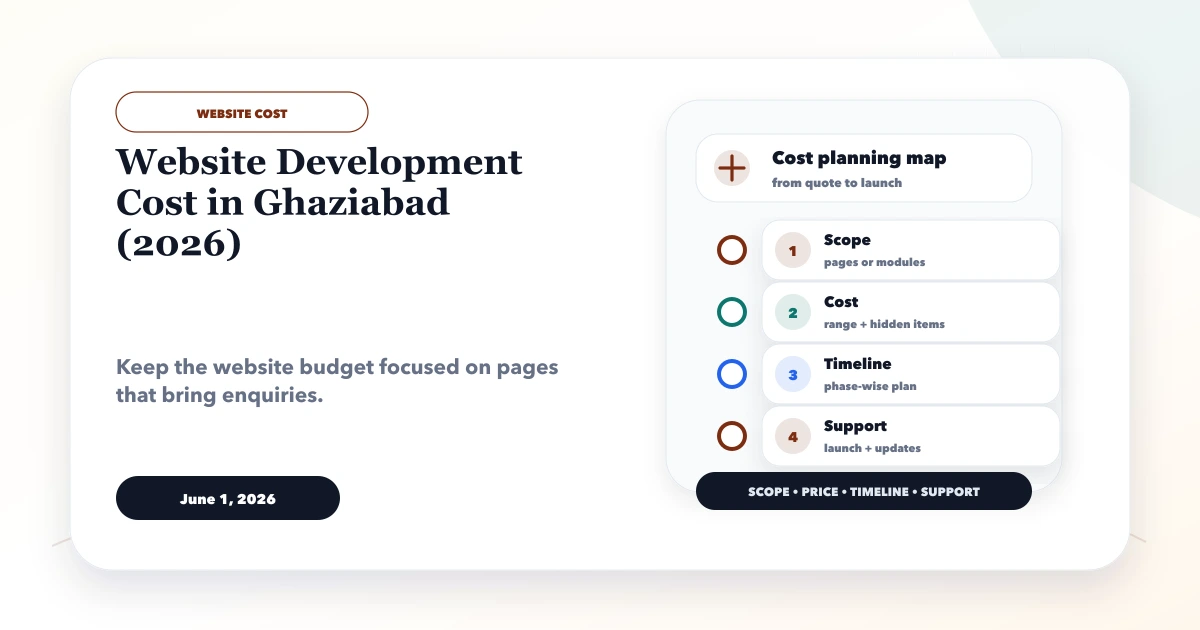
June 1, 2026
Compare website development cost in Ghaziabad for new builds, redesigns, migration, SEO foundations, maintenance, and phased business launches.
Read article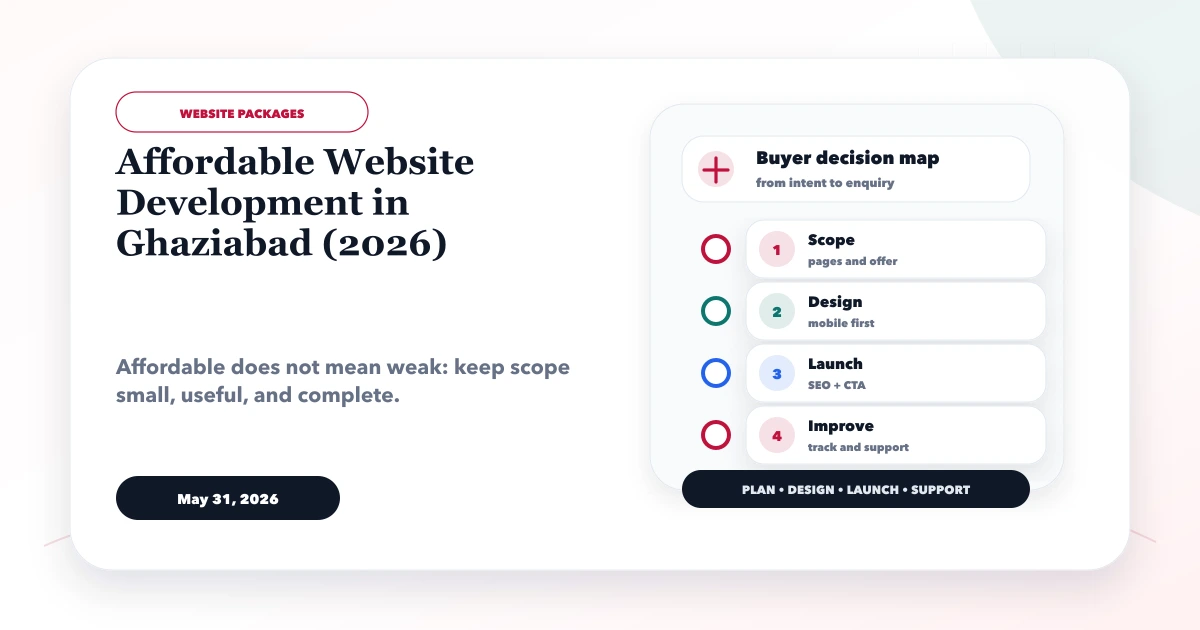
May 31, 2026
Affordable website development in Ghaziabad guide for 2026 with low-budget packages, what to include, pricing, SEO basics, and red flags.
Read article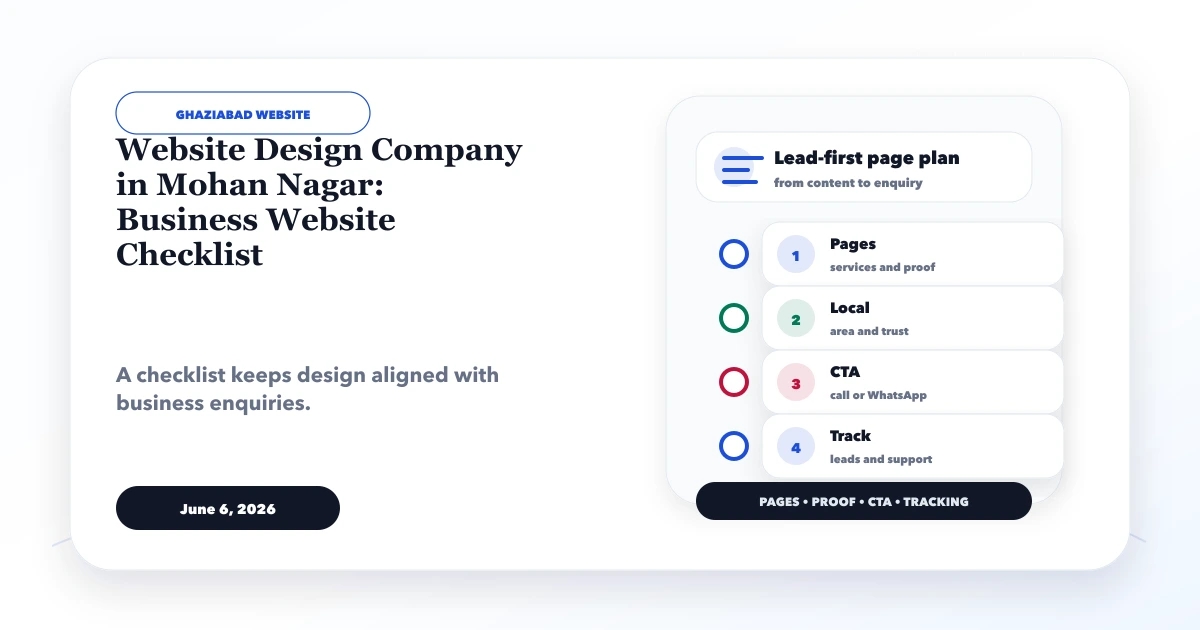
June 6, 2026
Plan a Mohan Nagar business website for calls, visits, directions, service availability, trust, WhatsApp enquiries, and accurate local information.
Read article