
April 23, 2026
Website Development in Loni: Quote-Ready Lead Plan
Plan a Loni quote-ready website with service packages, qualification fields, WhatsApp and form routing, follow-up metrics and ownership.
Read articlePublished Updated
Plan a Crossings Republik local-service website with trust evidence, appointment requests, review governance, mobile UX and lead ownership.
Service-area note: VASUYASHII is based in Delhi NCR and supports businesses remotely across India. A city-focused guide describes service and planning context; it does not claim a physical office in every location mentioned.
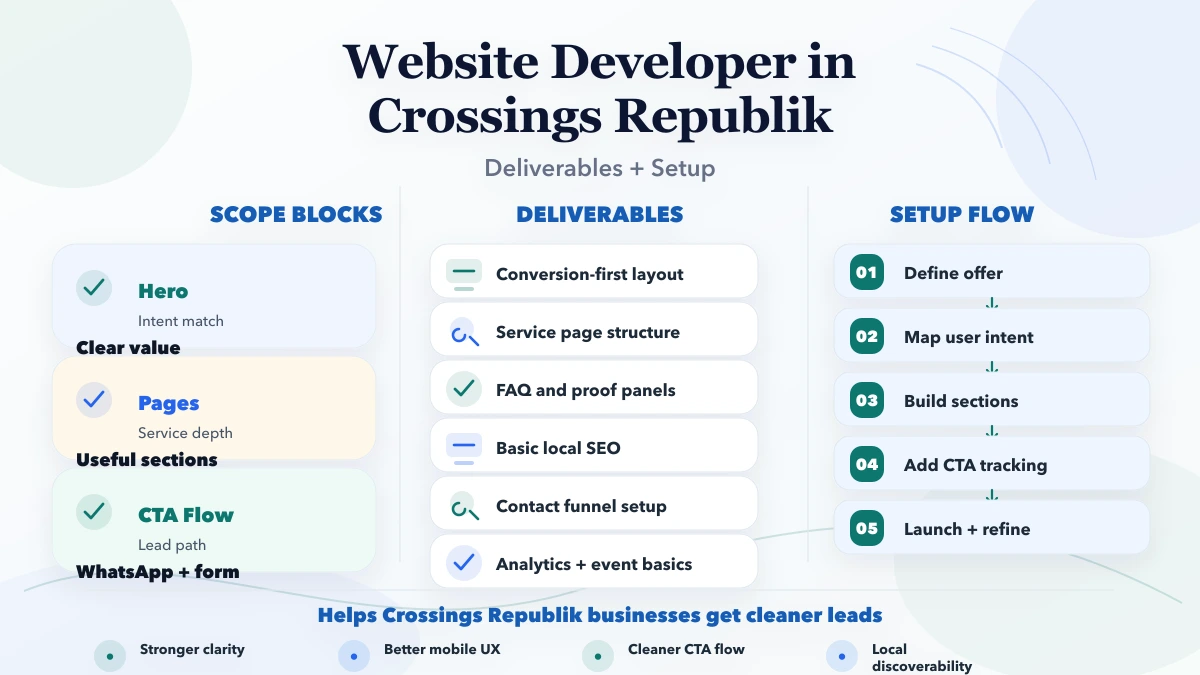
Explore the parent topic: Website Development Delhi NCR Hub →A resident-facing service website must answer four questions quickly: Is this the right service, is the provider genuine, can it serve my location, and what happens after I contact it? Decorative design cannot replace those answers.
This guide uses Crossings Republik as the context for a trust-first local-service website. It does not claim that VASUYASHII has an office, customer or measured lead result there. Local details and evidence must be supplied and approved by the actual business.
| Trust layer | Visitor needs |
|---|---|
| Identity | real business name and responsible contact |
| Relevance | service matches the current need |
| Coverage | location and availability are honest |
| Competence | qualifications, process or work supports the claim |
| Safety | privacy, payments and policies are understandable |
| Reliability | response and support expectations are clear |
Place each proof near the related decision. A large review carousel cannot repair unclear service details.
State service category, area model and primary action. Give visitors a clear route to important services.
Explain fit, preparation, options, price factors, process, common questions and next step.
Show genuine identity, approved experience and qualifications. Avoid anonymous claims.
Use original work, process evidence, labelled samples and verifiable reviews.
Collect the minimum fields needed to confirm service and timing.
Publish privacy, cancellation, refund or warranty terms relevant to the service.
The about-page trust template helps separate identity evidence from promotional copy.
Reviews should be genuine and collected without incentives tied to sentiment.
Use the safe review collection guide for an ethical process.
For each public proof item, record:
This makes it possible to remove an outdated qualification, old team photo or withdrawn testimonial everywhere it appears. Label demos and illustrative scenarios clearly. A proof register also prevents the same generic review from being repeated across unrelated service pages.
Trust is affected by what happens when the service goes wrong. Publish the correct support channel and explain the information needed to investigate. Internally, separate a complaint from a new sales lead.
Assign acknowledgement, investigation and escalation owners. Protect personal details, retain evidence appropriately and avoid discussing a customer's case publicly without permission. If a review raises a real issue, respond with the process rather than revealing private facts.
A visible recovery route does not promise that every dispute will be resolved in the customer's favour. It shows that the business has an accountable method.
If the website requests a deposit, show the business identity, amount, purpose, confirmation state and relevant cancellation/refund terms before redirecting to the payment provider. Verify payment on the server or through the provider's trusted status, not only through a success screen.
Do not ask customers to send card or banking credentials through a form or WhatsApp message. Record failed and duplicate payment states, and provide a human support route.
After payment, send a receipt or acknowledgement from a business-controlled system and connect it to the appointment or service request. If confirmation is delayed, show a pending state rather than asking the customer to pay again. Staff should be able to search by a safe reference and escalate mismatches without requesting sensitive credentials.
Test refund and cancellation communication with safe sample data before enabling real payments for customers.
Keep the test evidence with the payment-provider and support handover notes.
Review those notes after every provider change.
For service businesses, “appointment” may mean:
The page should explain whether the submitted time is requested or confirmed. Collect service, preferred date, area and contact preference only when necessary. Give the user a reference or confirmation message.
If live slots are not reliable, use request-and-confirm instead of showing false availability.
On a phone:
Avoid auto-opening chat, full-screen popups and moving controls that make reading difficult.
Use factual wording:
Do not imply a branch through an embedded map or local keyword. A clear service-area statement protects the customer and reduces poor-fit enquiries.
Prioritise:
Record owner, consent, source and permitted use. Compress files without making evidence impossible to inspect.
Document:
| Step | Owner |
|---|---|
| New request check | named staff member |
| Coverage confirmation | service coordinator |
| Appointment confirmation | schedule owner |
| Payment/deposit | authorised commercial owner |
| Complaint/support | escalation owner |
| Analytics review | privacy-aware manager |
If a lead changes channel from form to WhatsApp, preserve one case record where practical.
Website events:
Business outcomes:
Do not publish conversion metrics without a defined period, source and sample.
The website should not create pages for every nearby society or landmark unless each page has distinct visitor value and approved operations.
These ranges are planning references, not fixed VASUYASHII quotations or verified Crossings Republik prices.
| Scope | Typical inclusion | Illustrative band |
|---|---|---|
| Trust-first service site | 5-7 pages, proof, appointment request, contact routes | Rs. 35,000-Rs. 85,000 |
| Booking and lead website | service variants, schedule/request flow, reminders, analytics | Rs. 85,000-Rs. 2,00,000 |
| Customer service platform | accounts, bookings, payments, records and reports | discovery-based |
Original photography, copywriting, multiple staff, calendar/payment integration, migration and maintenance change cost.
Ask the developer to show:
Use the fake portfolio detection guide to verify screenshots and claimed work.
Current VASUYASHII public evidence includes service pages, labelled industry demos, a working contact route and the live Business Suite. The owned website uses responsive layouts, final-www canonicals, structured data and ongoing build/link/content checks.
Review demo websites, website services and contact. These current assets do not prove a Crossings Republik office, resident-service project, review score or conversion result.
Show a representative, genuine set where permission and platform rules allow. Do not fabricate, rewrite or selectively misrepresent feedback.
Not always. A request-and-confirm flow may suit businesses with variable staff or service eligibility.
It can provide identity, evidence and policies, but visitors should still verify important claims independently.
No. Use the location where it helps coverage and visitor relevance. Repetition does not create quality.
No. The website is one part of demand, trust, offer, visibility and response operations.
Assign an authorised business editor who can verify source, permission and accuracy before publication.
Collect approved identity, coverage, proof and appointment rules. Then test the complete mobile enquiry with safe data before launch. Contact VASUYASHII for a trust-first service website scope.
This guide owns the trust, review governance, payment confidence, and appointment-request intent for service businesses. The main Ghaziabad website development service remains the commercial parent for packages, verified customer feedback, implementation evidence, and the complete delivery process. The Indirapuram booking guide covers booking states and availability in greater detail.
Do not manufacture local testimonials or imply a Crossings Republik office. Proof needs permission, a traceable source, and an accurate description of what was delivered. Use the business website enquiry form to share the actual service, coverage, appointment, and proof rules.
Related Articles
April 23, 2026
Plan a Loni quote-ready website with service packages, qualification fields, WhatsApp and form routing, follow-up metrics and ownership.
Read article
April 22, 2026
Plan a Kaushambi professional website with appointment requests, office directions, visitor routing, service qualification, accessibility, and analytics.
Read article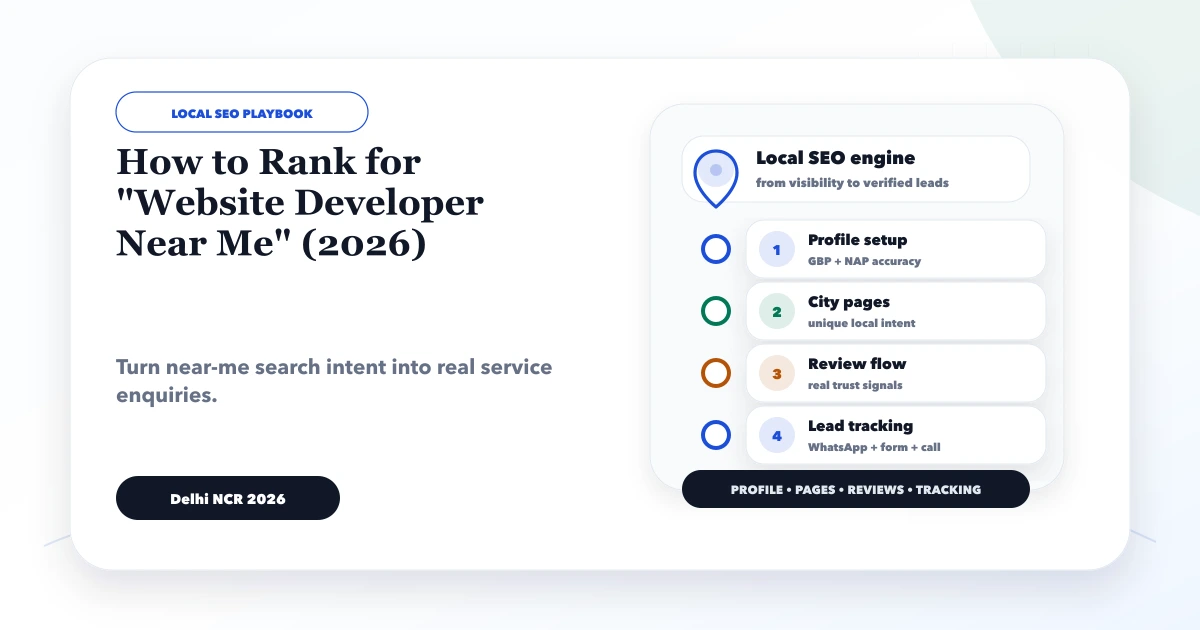
May 29, 2026
A safe near-me SEO framework for website developers using eligibility, relevance, verified business data, service evidence, reviews, links, and measurement.
Read article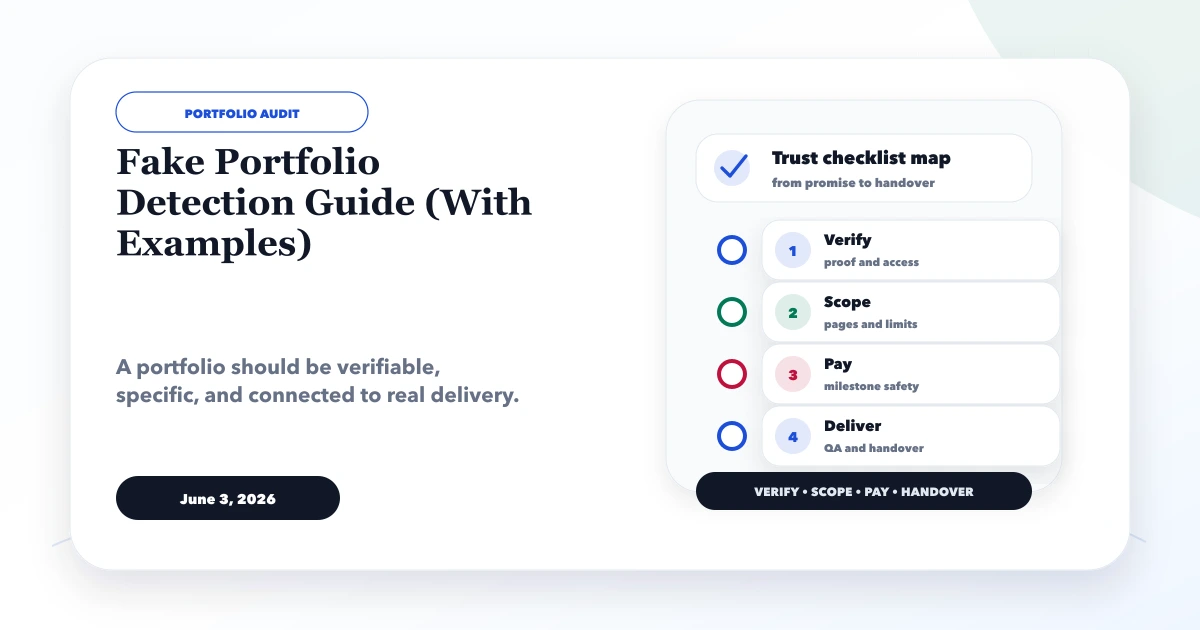
June 3, 2026
Detect a fake developer portfolio using live URL checks, role evidence, screenshot matching, copied case-study searches, references, and paid trial work.
Read article