
May 29, 2026
How to Avoid Local SEO Spam and Profile Suspensions
Avoid local SEO spam with accurate Business Profile details, genuine locations, useful city pages, honest reviews, clean citations and a recovery checklist.
Read articlePublished Updated
Safe ways to get real Google reviews: timing, WhatsApp request flow, review link, staff scripts, response process, and spam practices to avoid.
This guide explains how to get real reviews for Google ranking for Indian service businesses, especially web development and software companies targeting Delhi NCR searches. It is written for owners who want real enquiries, not vanity rankings.
By Tushar C. (Founder, VASUYASHII). Reviewed by VASUYASHII Editorial for practical website development, local SEO, Search Console, service-page planning, and conversion tracking experience.
Get real Google reviews by asking actual customers after successful delivery, making the review link easy, training staff to ask politely, responding to every review, and never buying, scripting, gating, or bulk-posting fake reviews.
Reviews help a buyer judge whether a business keeps its promises, communicates clearly, and resolves problems. They can also contribute to local prominence, but they are not a shortcut around an incomplete Google Business Profile, inconsistent contact details, weak service pages, or poor delivery.
The safest objective is therefore not "get more five-star reviews." It is to build a repeatable feedback system that asks every eligible customer at a genuine service milestone, records the request, and learns from the response. A business that treats reviews as operating feedback is less likely to create suspicious bursts, duplicate wording, or pressure that damages trust.
Before creating a review campaign, confirm that the business is eligible for a Google Business Profile and that the profile represents a real customer-facing business. Use the correct business name, category, phone number, website, service area, and opening hours. Do not create extra profiles for keywords, departments that do not independently serve customers, or locations where the business has no legitimate presence.
For a service-area business, configure the profile according to how customers are actually served. The website should show the same core name and contact details. This foundation matters because genuine reviews cannot rescue a misleading profile.
Google requires reviews to reflect a genuine experience. Its Maps policy prohibits fake engagement, incentives, review manipulation, and content posted from multiple accounts to influence ratings. The practical rules are:
| Safe practice | Risky practice |
|---|---|
| Ask a real customer after delivery | Buy reviews from a vendor or group |
| Invite honest feedback without prescribing a rating | Offer a discount only for a positive review |
| Send the same neutral request opportunity to eligible customers | Ask only customers who privately promise five stars |
| Let the customer use their own words | Give everyone a keyword-heavy script to paste |
| Keep one request and one polite reminder | Repeatedly pressure the customer |
| Respond to criticism with a service-recovery step | Threaten, argue, or reveal customer information |
Read the current Google Maps user-contributed content policy before launching a campaign. Policies can change, so the live policy is more reliable than an old marketing checklist.
For a web development company, the best review moment is after launch, after a support issue is solved, or after the client gets their first real leads. Asking too early creates weak reviews. Asking too late reduces response rate.
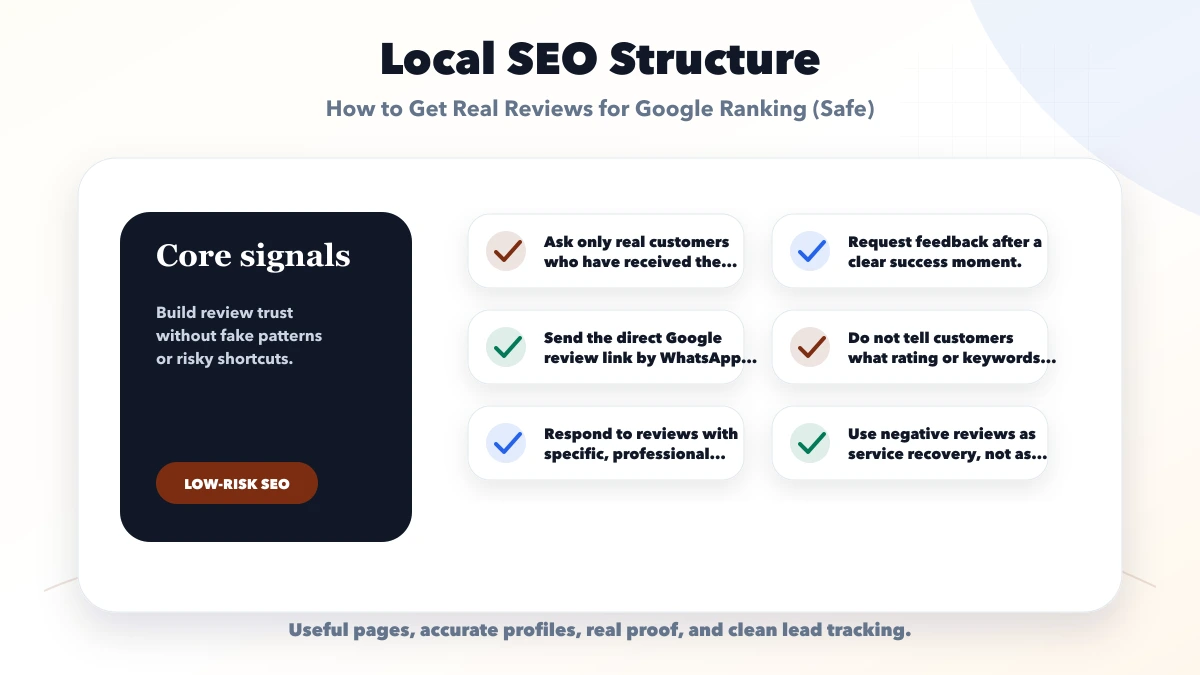
The request should follow a completed, observable milestone. A web development client might be asked after the website is live and the handover checklist is signed. A repair business can ask after the repaired item is returned and tested. A consultant can ask after the agreed workshop or report is delivered. A retailer can ask after a completed purchase, not before the customer has used the product.
Use a small trigger matrix:
| Business type | Suitable moment | Internal proof |
|---|---|---|
| Website or software project | Launch and accepted handover | Acceptance message or closed milestone |
| Local repair service | Item returned and tested | Closed job card |
| Training institute | Batch or module completion | Attendance and completion record |
| B2B supplier | Order delivered without open issue | Delivery confirmation |
| Ongoing support plan | Material issue resolved | Closed support ticket |
If a complaint is still open, solve it first. Do not use the review request as a way to end the support conversation.
A review request should make honesty and choice clear. Replace the placeholders with the real customer and business details.
WhatsApp after delivery
Hi [Name], thank you for working with [Business]. The agreed [service/milestone] is now complete. If you would like to share your genuine experience, here is our Google review link: [link]. Your honest feedback helps us improve. There is no obligation.
Email after issue resolution
Subject: Feedback on your completed support request Hello [Name], we have marked support request [reference] as resolved. If the result is working as expected, you may share an honest review here: [link]. If anything is still pending, please reply so we can fix it first.
Do not add suggested stars, prepared praise, or a list of SEO keywords. The review is the customer's account, not marketing copy written by the business.
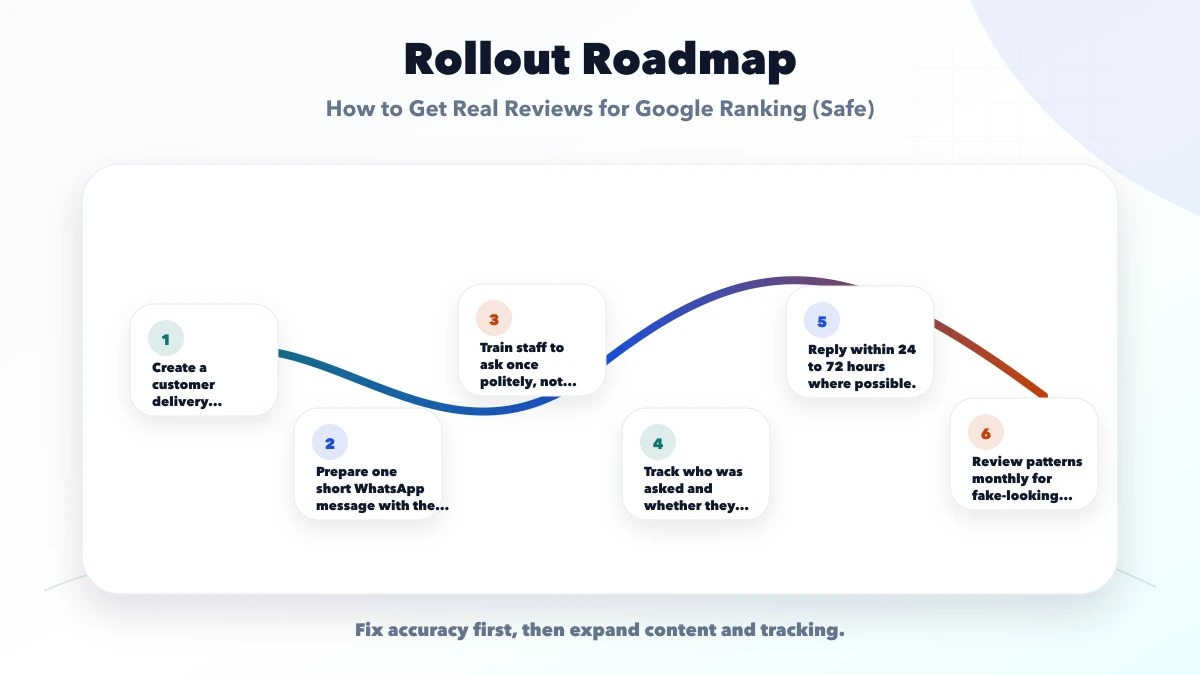
A basic sheet or CRM activity log is enough. Record the customer reference, completed milestone, request date, channel, reminder date, and whether a service issue remains open. Do not store the customer's Google account or ask for a screenshot as a condition.
The register prevents three common problems: multiple team members messaging the same customer, asking before delivery, and sending reminders for months. Limit access because it contains customer relationship data.
Suggested operating rule:
Reply to reviews as if the response will remain public permanently. Thank the reviewer, acknowledge the relevant service in general terms, and avoid quoting phone numbers, order values, medical details, addresses, credentials, or private project information.
For a critical review, use a calm sequence: acknowledge the concern, state that the team wants to investigate, invite the reviewer to a private channel, and record the corrective action internally. Do not claim a reviewer is fake unless there is clear evidence and an appropriate platform reporting route.
Track request coverage, response time, complaint resolution, and recurring themes. A steady flow of detailed, varied reviews is more credible than a sudden numerical jump.
| Monthly measure | What it reveals |
|---|---|
| Eligible completed customers | Size of the fair request pool |
| Customers asked | Whether the process is consistent |
| Open issues before asking | Quality-control failures |
| Public response time | Reputation-management discipline |
| Repeated complaint theme | Delivery process needing correction |
| Calls or enquiries mentioning reviews | Commercial influence without claiming causation |
Do not promise that a certain number of reviews will produce a ranking position. Local results also depend on relevance, distance, prominence, competition, profile quality, website quality, and Google's systems.
VASUYASHII can help a business design the website, CRM fields, reminder workflow, and event tracking around an ethical review-request process. This article does not claim a guaranteed review count or ranking outcome. Final profile eligibility, customer consent, platform policy compliance, and service delivery remain the business owner's responsibility.
Useful next links: web application services, software development, integrations, services, and contact.
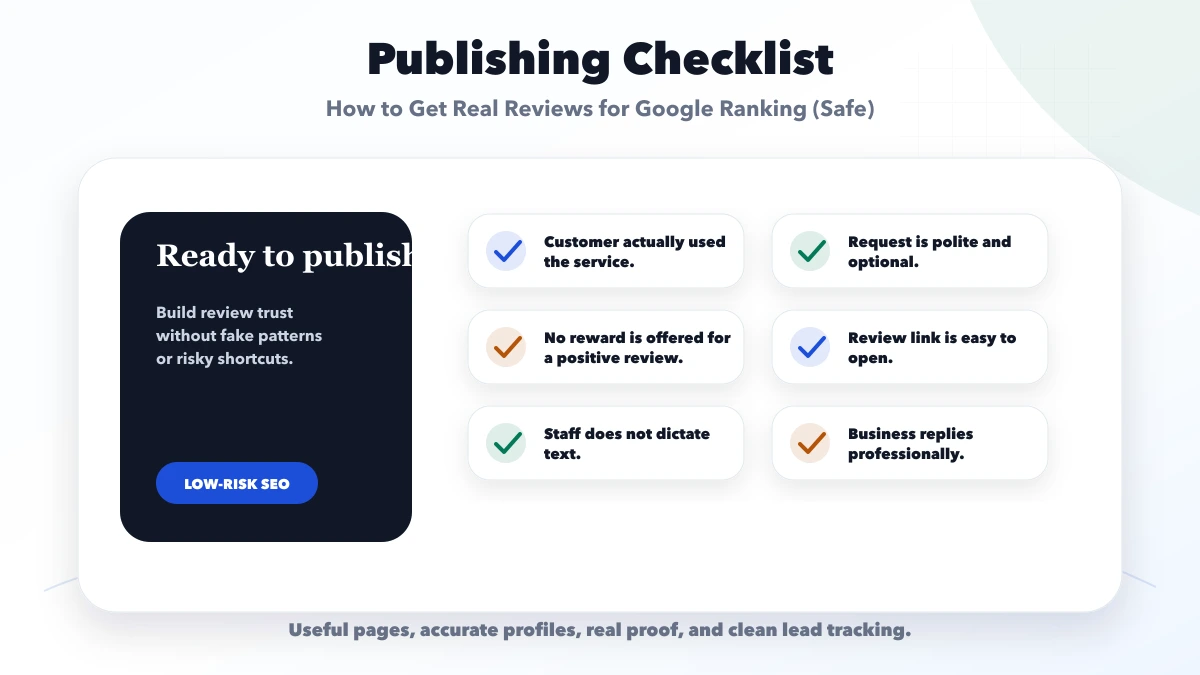
Reviews can support prominence and trust, especially for local visibility, but they work best with accurate profile and website relevance.
Avoid incentives tied to reviews. It creates policy and trust risk.
No. Let customers write naturally. Keyword-stuffed reviews look forced.
Acknowledge the issue, stay professional, explain the next step, and avoid public arguments.
Ask steadily after real customer milestones. A natural review flow is safer than bulk bursts.
Related Articles
May 29, 2026
Avoid local SEO spam with accurate Business Profile details, genuine locations, useful city pages, honest reviews, clean citations and a recovery checklist.
Read article
May 29, 2026
Set up an eligible service-company Google Business Profile with accurate ownership, category, service area, contact details, verification, and review practices.
Read article
May 9, 2026
reviews and trust signals that impact rankings: pricing, checklist, FAQs, trust signals, and practical SEO steps for Indian SMB owners.
Read article
May 29, 2026
Create a reliable name, address and phone source of truth, audit local listings, handle service-area businesses, manage changes and prevent citation drift.
Read article