
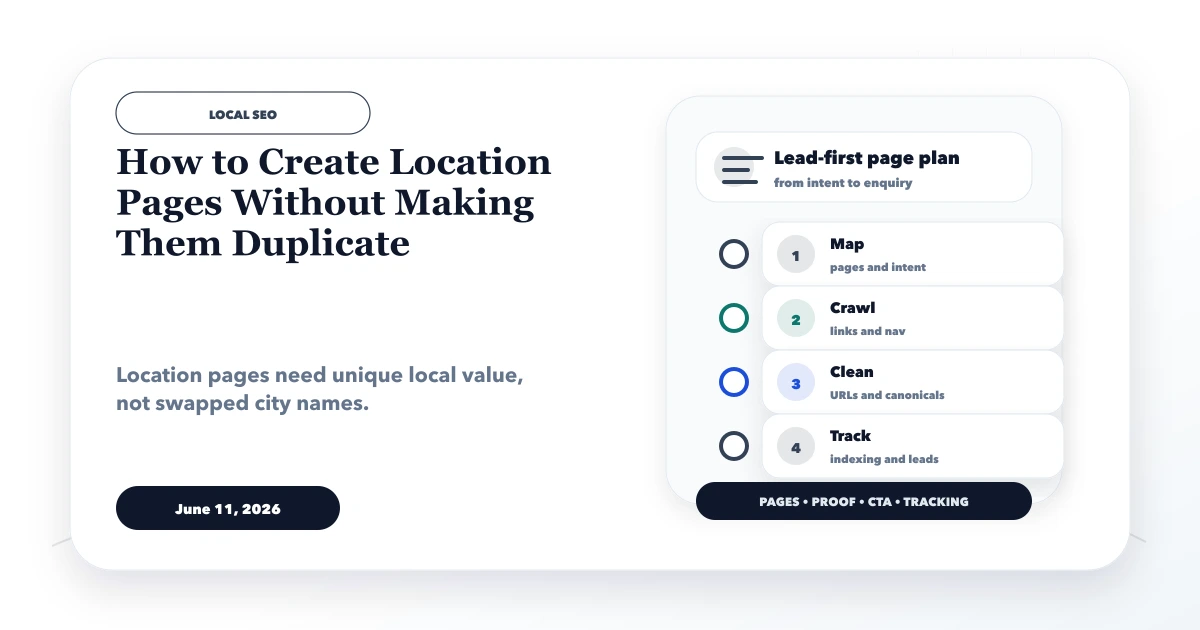
June 11, 2026
How to Create Location Pages Without Making Them Duplicate
How to create location pages without duplicate content using unique local intent, services, proof, FAQs, internal links, and canonical checklist.
Read articlePublished Updated
How to create service plus city pages without spam: avoid doorway abuse, build real local value, and structure pages safely in 2026.
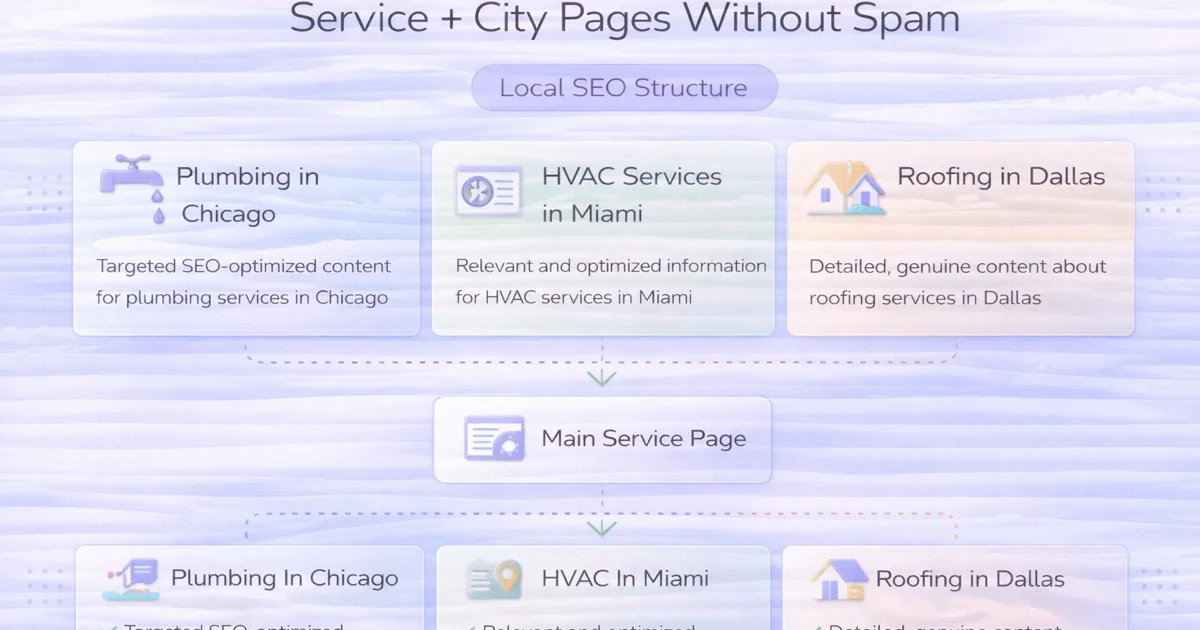
Service plus city pages are one of the most misused SEO assets on small business websites. The idea sounds simple: make a page for each service and city combination. The problem starts when those pages become near-duplicates with only the city name changed. That is where quality falls and doorway-page risk begins.
Google's spam policies are clear that pages created mainly to rank for similar queries and funnel users into the same destination can become doorway abuse. That means businesses need a better standard for local landing pages: each page should offer real local value, real context, and a clear place in the site structure.
This guide explains how to build city pages safely, when not to build them, and what structure makes them useful instead of spammy.
Service plus city pages are usually safe when they:
They become risky when they:
The goal is not to create more pages. It is to create pages that deserve to exist.
If the service explanation, trust sections, FAQs, and CTA flow are basically identical and only the city changes, quality is weak.
A city page should show why the page exists for that city:
If dozens of pages just push users into one generic service page or the same contact flow without meaningful local value, that is exactly the type of pattern Google warns against.
Related reading:
Here is a stronger model for local city pages.
Explain the service in the context of the city, not with generic filler.
Add:
Do not treat the page as only a location page. It should still be a good service page.
Local users often have different objections, turnaround questions, or trust questions.
Link logically between:
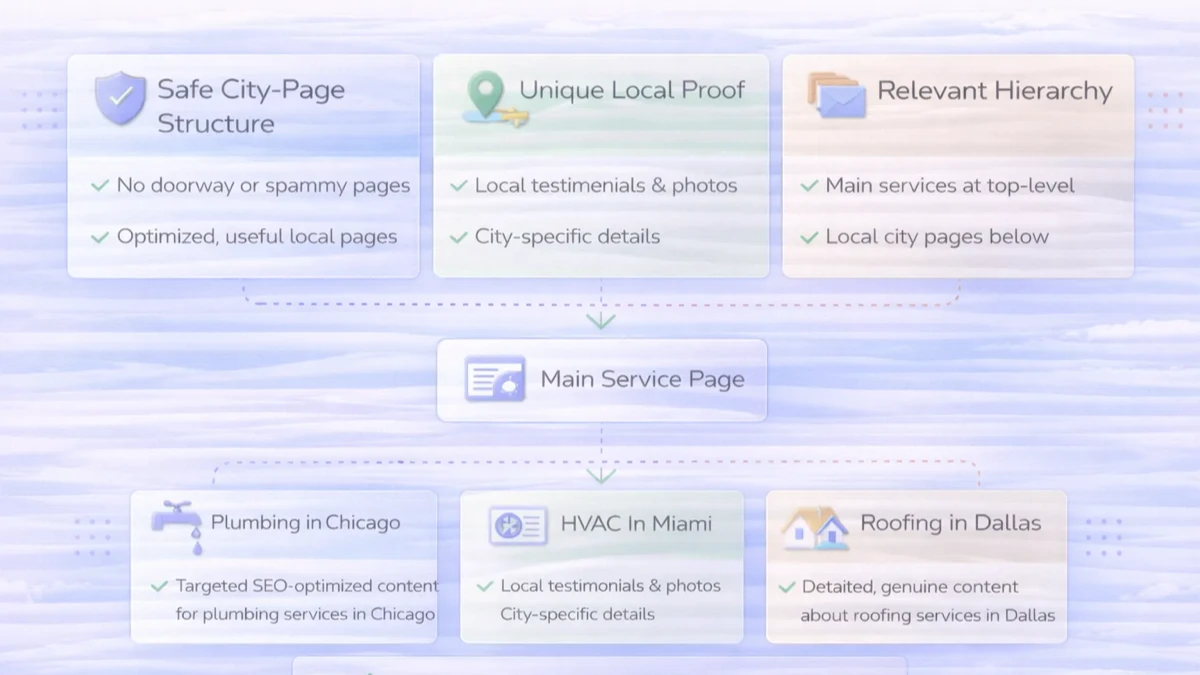
Do not create city pages when:
A stronger site with fewer high-quality city pages usually performs better than a bloated site with dozens of thin pages.
Typical pricing for good service plus city page creation:
₹2,500 to ₹6,000 per page₹6,000 to ₹15,000 per page₹20,000 to ₹80,000+Typical timeline:
1 to 2 days per page: strong single-page work1 to 3 weeks: structured cluster rolloutMain cost drivers:
A service city page should exist only when the business can serve that location and provide useful local context. The page should not be a copied doorway page.
Before publishing, check:
For software and website service pages, city content should connect to web application services, software development, services, and contact.
Do not copy these pages as templates. Use them to see how the primary decision can change while the service category remains website development:
| Decision type | Example |
|---|---|
| Buying and proposal comparison | Janakpuri buyer guide |
| Safe redesign migration | Vaishali rebuild plan |
| Honest regional coverage | East Delhi service-area plan |
| Scheduling and booking states | Indirapuram booking guide |
| Language and mobile contact | Shahdara lead plan |
| Product catalogue and RFQ | Baghpat B2B plan |
| Small-business phasing | Gulaothi phased plan |
| Quotation qualification | Loni quote-ready plan |
| Industrial capability and documents | Sahibabad industrial guide |
| Reviews, proof and appointment trust | Crossings Republik trust plan |
The correct comparison is not whether the place names differ. It is whether the user problem, operating evidence, page structure and next action justify separate URLs.
| Page purpose | Example |
|---|---|
| Premium-service vendor evaluation | South Delhi buyer guide |
| Office visitor and department routing | Connaught Place office guide |
| Retail catalogue operating model | Karol Bagh catalogue guide |
| Education and service enquiry qualification | Laxmi Nagar enquiry guide |
| Business identity and recovery | Nehru Nagar continuity guide |
| Smallest complete first release | Govindpuram phased plan |
| Website vendor procurement | Noida Sector 63 due-diligence guide |
| B2B account and CRM handoff | Noida Sector 62 lead-system guide |
| Capability-based package upgrade | Wave City package guide |
| Quote and maintenance normalization | Kavi Nagar quote checklist |
These are editorial examples, not a recommendation to publish ten new locality pages. A page still needs truthful coverage, a useful parent, evidence and measurable demand.
| Primary question | Reviewed page |
|---|---|
| How should a multi-service team route enquiries? | Rohini website plan |
| How should a professional firm collect a first enquiry safely? | RDC Raj Nagar consultation plan |
| How are roles and operational records controlled? | Noida role-based web app |
| How are stock and field exceptions handled? | Ghaziabad field workflow |
| What makes a dealer RFQ actionable? | Meerut dealer enquiry guide |
| How should providers be compared? | Delhi website company scorecard |
| How can a spreadsheet workflow be retired safely? | Delhi spreadsheet-to-app plan |
| What belongs in total website ownership cost? | Noida TCO guide |
| How should product and dispatch requests be qualified? | Hapur supplier website |
| How are SaaS claims, demos and releases governed? | Noida product-marketing website |
These pages are retained for different planning questions. A location label alone remains insufficient; each URL still needs real coverage, maintenance and measurable usefulness.
| Operational test | Reviewed page |
|---|---|
| Can society-area service coverage be stated honestly? | Raj Nagar Extension |
| Can one trade/service route launch before optional modules? | Modinagar |
| Can two language versions stay operationally aligned? | Lucknow |
| Can seasonal catalogue and dealer content remain current? | Karnal |
| Can programme facts and admissions be safely governed? | Dehradun |
| Can package labels become comparable acceptance criteria? | Ghaziabad |
| Can public programme content remain accessible and authoritative? | Bhopal |
| Can technical evidence produce a useful RFQ? | Chennai |
| Can hiring and buyer journeys remain separate and trustworthy? | Pune |
| Can a startup website test one product assumption honestly? | Bangalore |
These are distinct content responsibilities, not a blueprint for generating more city pages. Keep each URL only while it has truthful coverage, maintenance ownership and independent value.
| Primary decision | Reviewed page |
|---|---|
| Should an existing site be repaired, redesigned or rebuilt? | Ghaziabad cost guide |
| How can established URLs survive a redesign? | Meerut migration guide |
| How should calls, visits and directions be prioritised? | Mohan Nagar website checklist |
| How should repair and maintenance requests be qualified? | Hapur service website |
| How should an ERP implementation partner be evaluated? | ERP developer guide |
| What makes an offline field app reliable? | Noida mobile app guide |
| What belongs in a contractor inspection request? | Roorkee contractor guide |
| When is an appointment requested rather than confirmed? | Kaushambi appointment guide |
| How can near-me visibility grow without spam? | Near-me ranking guide |
| Should a business configure SaaS, integrate or build CRM? | CRM decision guide |
This mixed review group shows that local modifiers and “near me” searches can still lead to different buyer decisions. The pages must remain truthful and independently useful; internal links do not justify retaining weak URLs forever.
| Primary question | Reviewed page |
|---|---|
| Can a home-service provider communicate serviceability and visit rules? | Dwarka |
| Can branch details and lead routes stay centrally governed? | Indore |
| Can an export buyer submit a technically useful RFQ? | Kolkata |
| Can seasonal content expire without breaking evergreen pages? | Haridwar |
| Can a professional firm control profiles, authorship, and intake privacy? | Chandigarh |
| Can an AMC provider separate site audits from existing-customer support? | Faridabad |
| Can made-to-order variants, samples, and wholesale enquiries stay clear? | Jaipur |
| Can customer accounts expose only authorised records and documents? | Delhi NCR mobile app |
| Can regulated product facts and buyer routes stay owned and current? | Sonipat |
| Can textile specifications, colours, samples, and MOQ be represented accurately? | Panipat |
Each page now owns a separate content or workflow responsibility. That differentiation must still be supported by genuine service relevance and ongoing maintenance.
| Page question | Supporting guide |
|---|---|
| Can several business functions approve one website without endless revision? | Gurgaon |
| Can a limited budget preserve ownership, measurement, and expansion? | Affordable Ghaziabad |
| Can a buyer accept a package through observable handover tests? | Noida |
| Can seasonal visitor information remain accurate and reversible? | Mathura |
| Can industrial RFQs and support requests reach different owners? | Manesar |
| Can product, dealer, sample, and custom-request records stay controlled? | Aligarh |
| Can visitor pages separate evergreen facts from changing availability? | Agra |
| Can a software buyer define workflow, data, permissions, and rollout before coding? | Delhi NCR software |
| Can a local shop choose catalogue or ecommerce from real operations? | Ghaziabad shops |
| Can a redesign preserve useful URLs, tracking, and rollback safety? | Redesign guide |
Use these as intent examples, not as a reason to publish unsupported city variants. Every retained page still needs truthful service coverage and an owner who can maintain it.
If you are planning city pages, do not ask how many you can publish. Ask how many you can make genuinely useful. That is the metric that protects quality and long-term rankings.
No. They become risky when they are thin, repetitive, or funnel-only.
Real local context, unique content, useful service detail, and clear site hierarchy.
You should not. That weakens credibility and local relevance.
Start with the cities where you have real service coverage and proof.
No. That is exactly the pattern that creates weak local pages.
Yes, where it helps hierarchy and user navigation.
Yes, if the pages mainly exist to rank for many similar queries without real value.
Each city page should justify its existence on its own, not just by the keyword variation.
If you want city pages that help SEO without doorway risk, start with real service coverage, unique local proof, and a clear content model before scaling the cluster.
Related Articles
June 11, 2026
How to create location pages without duplicate content using unique local intent, services, proof, FAQs, internal links, and canonical checklist.
Read article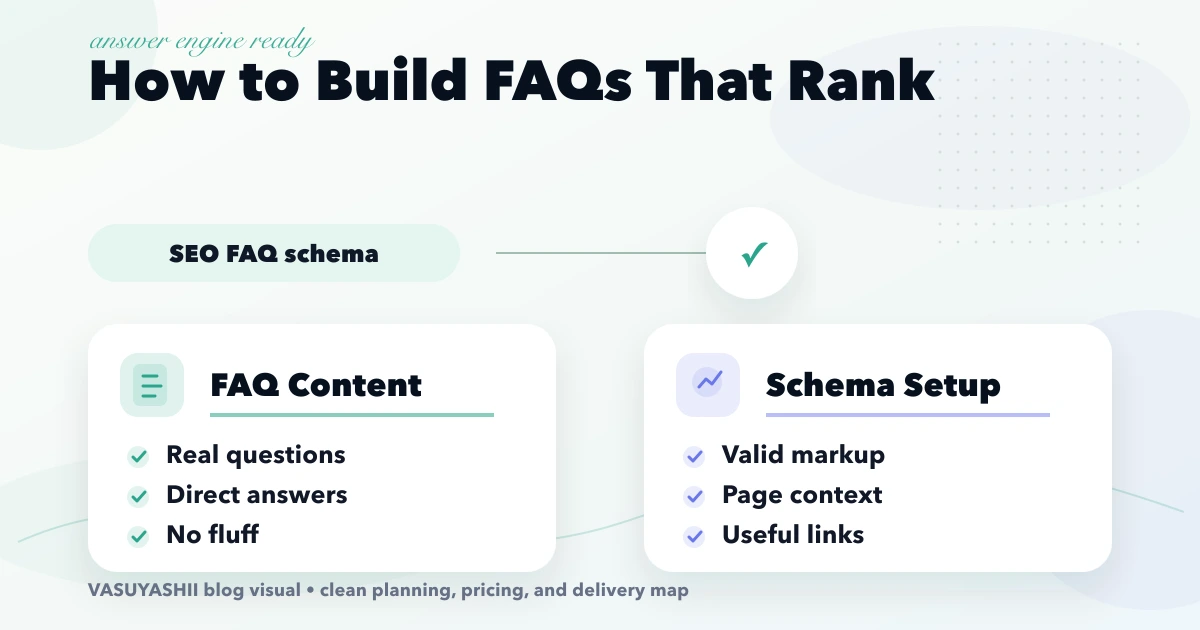
April 18, 2026
Build useful SEO FAQs from buyer questions, direct answers, internal links and review data. Understand the 2026 status of Google FAQ rich results and schema.
Read article
April 8, 2026
Build useful local SEO landing pages with service-area evidence, unique buyer information, conversion paths, internal links and doorway-spam safeguards.
Read article
May 10, 2026
Evaluate SEO proposals using deliverables, access control, baseline data, reporting, link transparency and red flags before approving payment or long contracts.
Read article