
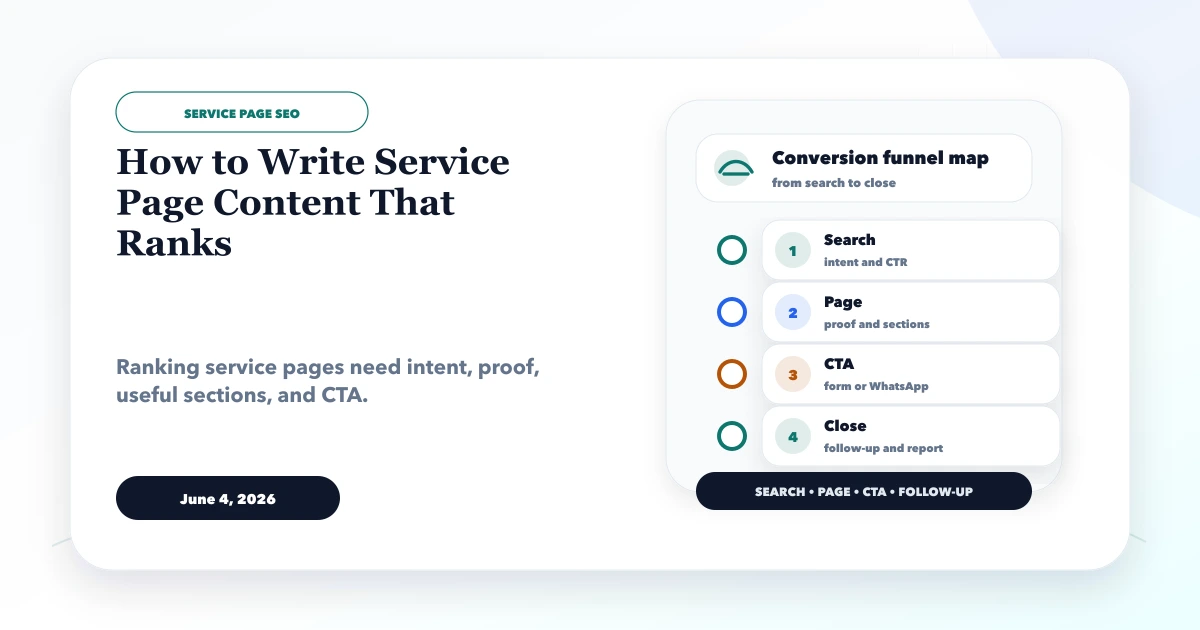
June 4, 2026
How to Write Service Page Content That Ranks
How to write service page content that ranks with search intent, headings, proof, FAQs, internal links, CTA, and content checklist.
Read articlePublished
How to write a service page that ranks: SEO and conversion structure, page sections, proof blocks, internal links, and mistakes to avoid.
Many service pages fail because they try to do only one job. Some pages are written for search engines but feel generic and unconvincing to buyers. Others sound polished but are too weak on keyword structure, page depth, and internal links to rank well.
A strong service page must do both jobs at the same time. It should help Google understand relevance while also helping the visitor trust the company and take action. That balance is where most businesses struggle.
This guide explains how to write a service page that ranks and converts, including structure, sections, proof blocks, internal linking, CTA placement, and the mistakes that usually keep service pages weak.
A service page that ranks well usually has:
The mistake is trying to rank with a short brochure page. In 2026, many service keywords need more clarity, proof, and page depth than that.
It must answer three questions clearly:
If even one of these is weak, the page may attract traffic but fail to convert, or convert well but never rank strongly.
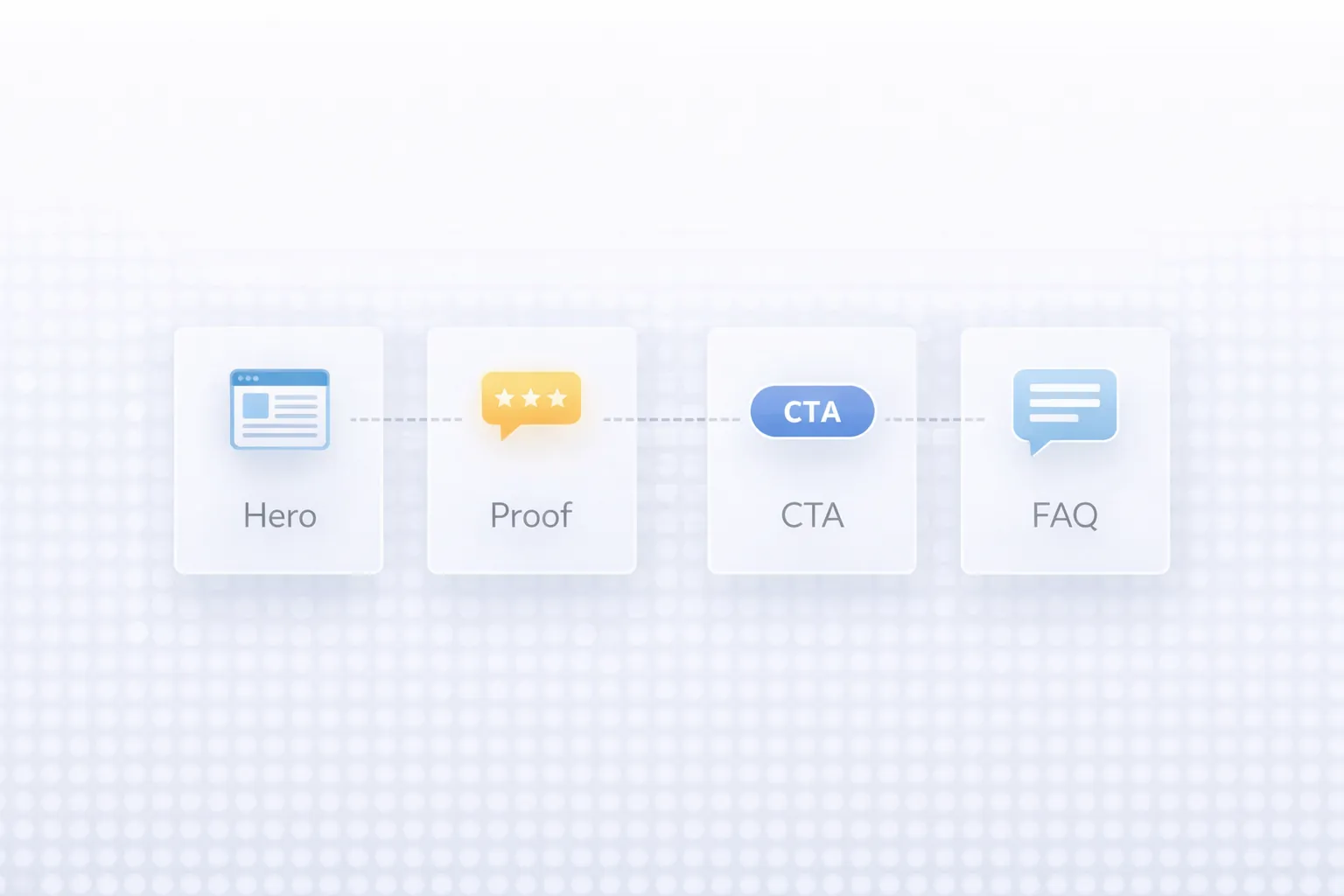
The best service pages usually follow a practical sequence.
The hero should say what the service is, who it is for, and what action the user should take next. Avoid vague branding-only opening sections.
Explain the pain points the service solves. This helps both relevance and conversion.
List deliverables, modules, steps, or service scope clearly. Buyers want to know what they are actually getting.
Explain how the work happens. This reduces friction and improves trust.
Use portfolio examples, case studies, testimonials, metrics, or screenshots where possible.
Even if you do not publish exact rates, give some direction. It improves lead quality.
FAQ helps cover objections and long-tail relevance naturally.
Finish with a clear next step that matches visitor intent.
Good SEO writing is structured clarity, not keyword stuffing.
Use the main keyword in:
Link to related blogs, portfolio, contact, and relevant service pages. This improves both user flow and crawl structure.
Service pages should not be thin. Google often favors pages that explain scope, process, fit, and trust signals more clearly.
One service page should target one core intent. If the page tries to rank for five unrelated services, it gets weaker.
Related reading:
Ranking is not enough. A service page should also move the user toward action.
The CTA should match the buying stage. For high-intent services, WhatsApp, call, or contact form works better than vague "learn more."
Do not hide your proof at the very bottom. Place trust elements where the user is likely deciding.
Specific beats generic. "Custom CRM for lead follow-up, reminders, and owner reports" is stronger than "innovative business solutions."
Packages, ranges, or "starting from" guidance often improves lead quality because the user understands the service level better.
These mistakes make service pages weak fast:
If you hire a team to write or redesign a service page properly, the cost depends on research depth and page quality expectations.
₹5,000 to ₹12,000₹12,000 to ₹30,000₹30,000 to ₹75,000+If the page also needs design, development, tracking, and speed improvements, cost rises beyond copywriting alone.
The best service pages are supported by a good publishing stack.
One strong service page can often be built faster than people expect if the inputs are ready.
A high-quality page depends more on clarity than on excessive production time.
If your service pages get traffic but not leads, or leads but no rankings, the issue is often page structure and proof placement rather than traffic alone.
If you outsource this work, pricing usually depends on:
The biggest hidden cost is when no one can provide real proof, process details, or service clarity, so the writer is forced to stay generic.
There is no universal count, but most high-value services need more than a thin brochure paragraph to rank and convert well.
Usually yes, if the business wants clearer relevance and conversion for that service.
Not in the old spammy sense. Clear intent, structure, and useful depth matter more.
Not always exact numbers, but some commercial guidance usually improves lead quality.
Both. A page that ranks without converting wastes traffic. A page that converts but never ranks stays invisible.
Yes, if they answer real buyer objections and support search intent naturally. Use the useful SEO FAQ workflow for 2026 to source questions from sales, support, and Search Console without promising discontinued Google FAQ rich results.
Publishing generic service pages that look professional but say very little.
Yes. Supporting blogs strengthen internal linking and topical authority around the service.
If you want pages that look professional and rank with intent, the next step is to improve structure, proof, CTA flow, and internal linking together.
Related Articles
June 4, 2026
How to write service page content that ranks with search intent, headings, proof, FAQs, internal links, CTA, and content checklist.
Read article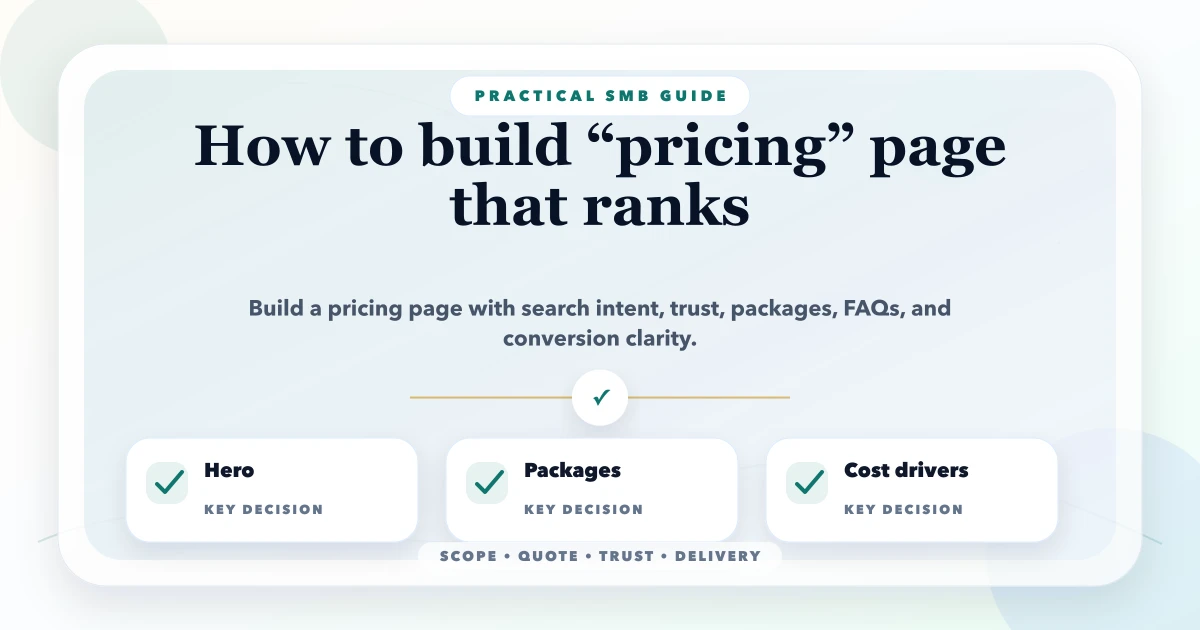
May 10, 2026
Build an SEO-friendly pricing page with clear packages or cost drivers, inclusions, exclusions, comparisons, FAQs, internal links, and qualified CTAs.
Read article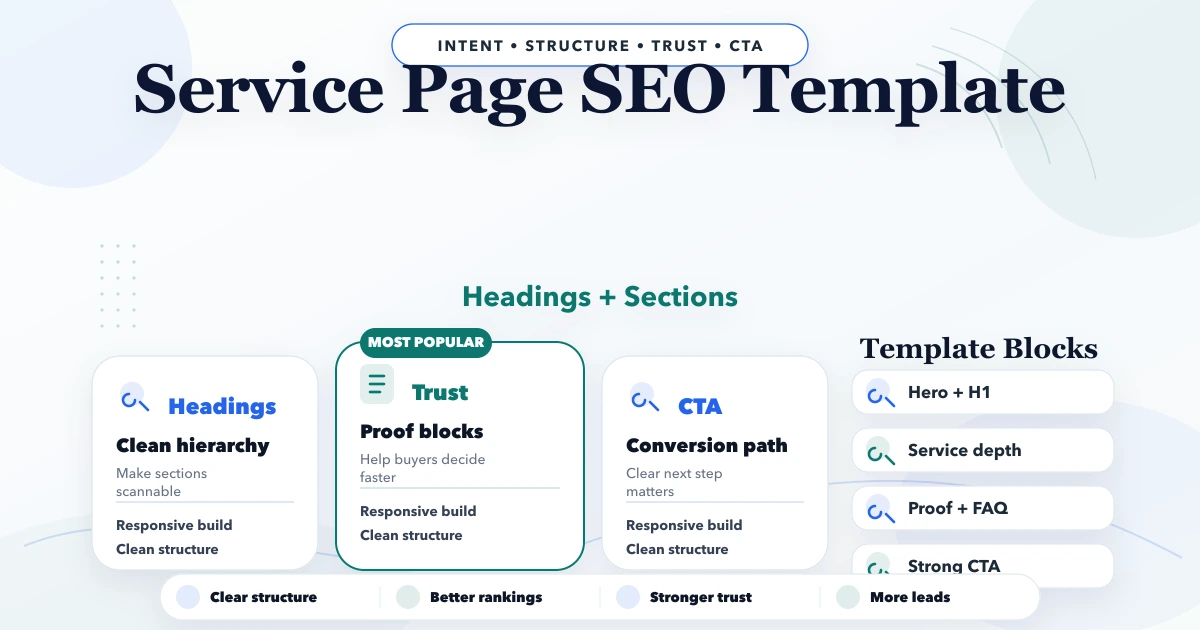
April 22, 2026
Use this service page SEO template to structure intent, headings, proof, process, pricing context, FAQs, internal links, and conversion-focused CTAs.
Read article
March 24, 2026
SEO setup cost for a new website in 2026 with one-time vs monthly pricing, technical SEO, on-page scope, extras, and plan selection.
Read article