
May 18, 2026
Product Photography vs UI: What to Fix First
Diagnose whether ecommerce conversion needs better product photography, product-page UI, offer clarity, trust, performance, or checkout before investing.
Read articlePublished Updated
Website conversion optimization guide for 2026 with CRO principles, CTA flow, trust signals, forms, WhatsApp, speed, UX, analytics, and action plan.
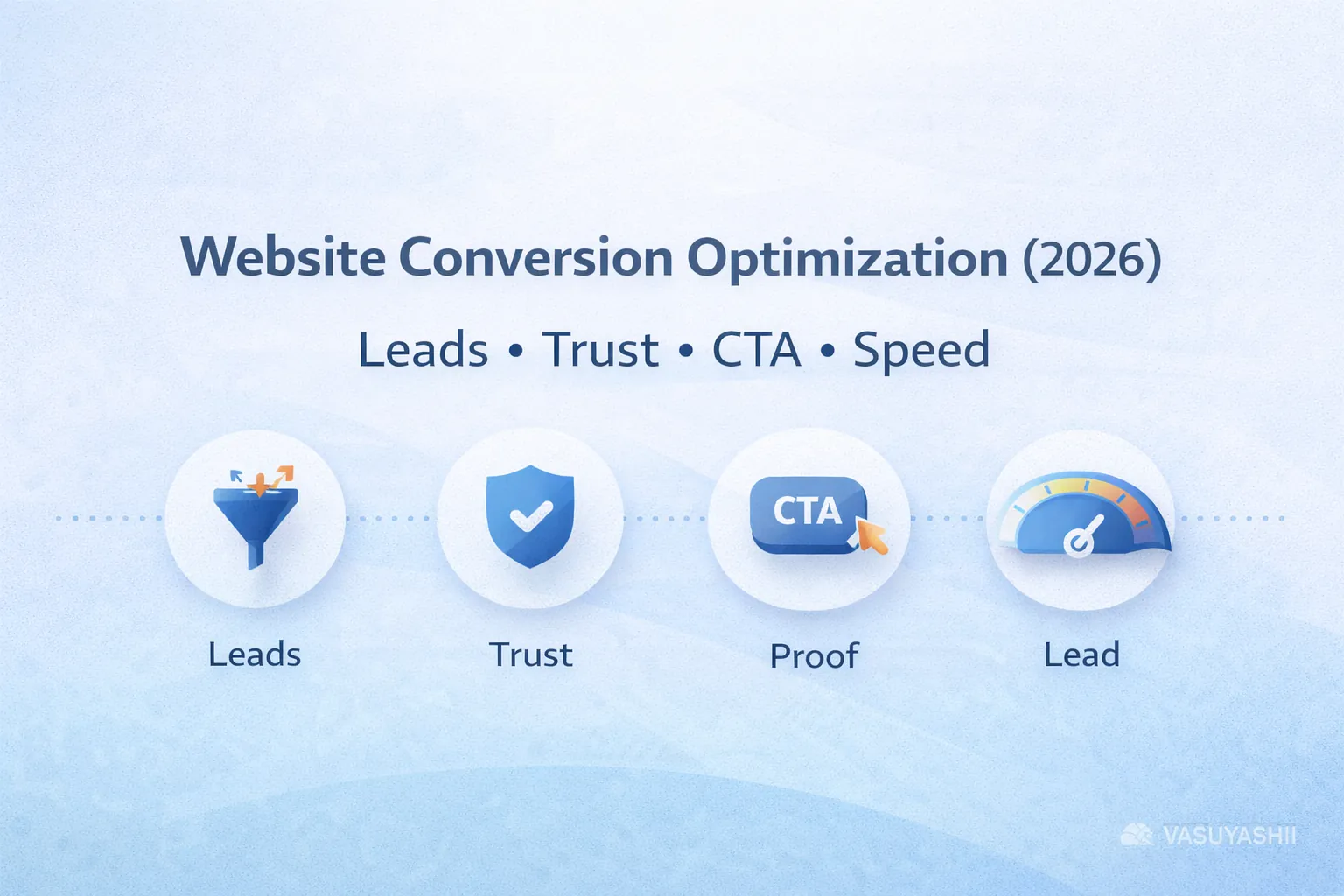
Traffic alone doesn’t grow a business. Conversions do. In 2026, many businesses publish blogs, run ads, and get visitors—but still struggle to generate leads because their website is not designed to convert.
Website conversion optimization (CRO) means improving your website so that more visitors take the action you want:
A conversion-rate change matters only when the underlying events and lead quality are measured consistently. For example, 1,000 visits at a 1% valid-lead rate produce 10 leads; the same traffic at 2% produces 20. That is a mathematical example, not a promise. Traffic intent, service fit, response time, and duplicate or spam enquiries can change the commercial result.
This guide is a complete CRO system: mindset, structure, CTAs, trust signals, forms, speed, analytics, and a step-by-step plan you can apply to your business website.
A “conversion” is any action that supports your business goal. Common conversions:
Before optimizing anything, define your primary conversion.
If you run ads, improving conversion reduces your cost per lead dramatically.
Most websites look similar. CRO helps you win trust faster.
On mobile, users decide fast. If your site feels unclear or slow, they leave.
If you build conversion-focused websites and web applications, explore: Web Applications Services
A visitor doesn’t convert instantly. They go through micro-steps:
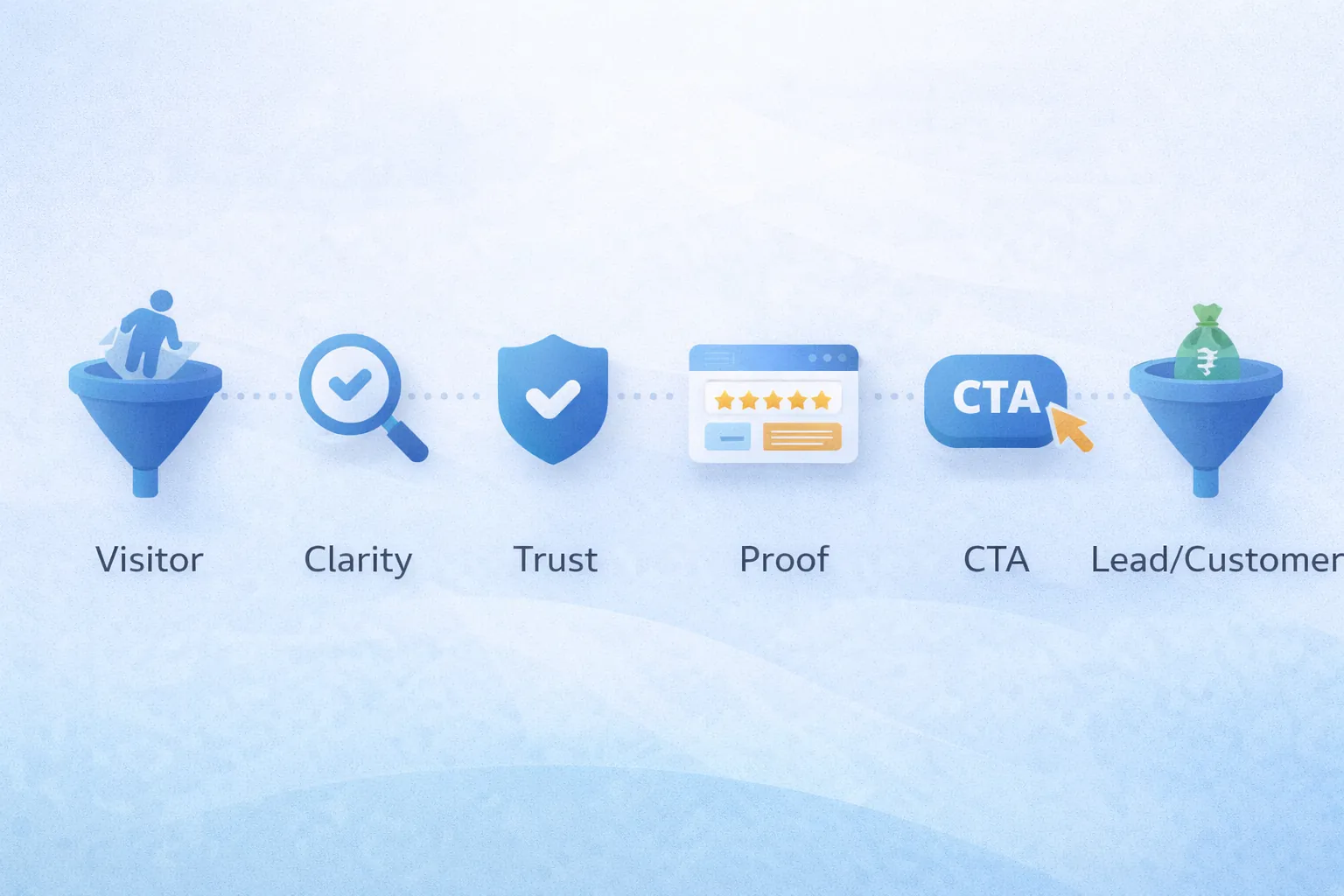
Typical funnel: 1) Visitor lands on page 2) Understands offer 3) Feels trust 4) Sees proof 5) CTA becomes obvious 6) Takes action (WhatsApp/form/call)
CRO is about reducing friction at each step.
Most websites fail because visitors don’t understand the offer.
Bad headline: “We provide innovative solutions.”
Good headline: “We build fast, SEO-ready websites and web applications that generate leads.”
Clarity increases conversion more than fancy design.
Many websites have CTAs, but they are:
Example WhatsApp CTA: 👉 WhatsApp: Chat on WhatsApp
People don’t trust claims. They trust proof.
You can show demos like:
Portfolio:
A relevant proof section near a decision CTA can reduce uncertainty. Test its effect instead of assuming every visitor responds the same way.
Conversion friction includes:
Mobile conversion rules:
If mobile UX is weak, your conversion rate drops—even with good content.
People scan. They don’t read.
Example bullets:
Many forms are too long. Fix this:
If WhatsApp is your main channel, keep form as secondary.
Slow websites feel untrustworthy. Speed improves:
Quick speed improvements:
For deeper speed steps: Website Speed Optimization Guide
Internal linking isn’t only for SEO. It helps conversions by guiding users.
Every blog should link to:
Example:
This creates a smooth journey from content → service → lead.
To optimize conversions, you must track:
Even basic tracking helps you compare pages, CTA types, and valid enquiries.
On the current VASUYASHII website, the useful event vocabulary separates intent instead of treating every click as a lead:
| Event | What it records | Should it count as a lead? |
|---|---|---|
contact_click | A visitor opened a contact route | No, it is an intent signal |
whatsapp_click | A visitor opened WhatsApp | Not until the enquiry is qualified |
phone_click | A visitor tapped a phone link | Not automatically |
demo_open | A visitor opened a demo | No, it is product or portfolio interest |
generate_lead | A valid contact form was submitted | Yes, when validation succeeds |
This is implementation evidence, not a published claim that the website achieved a particular conversion uplift. The next measurement layer is to connect each event with page path, CTA location, service context, and campaign source without sending personal data to analytics. The sales team can then compare analytics counts with genuine conversations.
For a privacy-conscious setup, never send names, phone numbers, email addresses, or message contents as GA4 event parameters. Keep customer details inside the enquiry system and use analytics only for non-identifying journey data. If event setup or CRM routing is missing, review integrations and automation before interpreting conversion numbers.
Keep it short, proof-based.
People trust structured process.
FAQs remove objections without calls.
Filters low-intent traffic.
Conversion increases significantly for India.
This plan gives real improvement quickly.
If you want to increase leads without increasing traffic, we can optimize your website structure, UI/UX, proof system, and conversion flow.
👉 WhatsApp: Chat on WhatsApp 👉 Services: Web Applications Services 👉 Projects: View our services 👉 Contact: Contact page
Website conversion optimization should start with the pages that already get visitors. For service businesses, the main conversion is usually WhatsApp click, phone call, form lead, booking, or demo request.
Audit these first:
For better measurement, combine CRO with integrations, web application services, and contact.
Conversion work should not turn one page into an isolated landing page. The homepage, service pages, proof, related guides, and contact route need to support the same buyer decision. Start with the Website Development Delhi NCR hub as the parent route, then use contextual links to move visitors toward the most relevant service instead of sending every user directly to a generic form.
A practical sequence is:
Judge outcomes by qualified conversations, not raw button clicks. A high WhatsApp-click rate can still be weak if visitors lack pricing context, service fit, or proof. Record what prospects ask, which page they entered from, and whether the enquiry matched the service. Use those objections to improve copy and internal links, then contact VASUYASHII when the route needs a structured conversion audit.
Use the bounce-rate UX, speed, and intent guide to separate weak conversion paths from measurement or traffic-intent problems before redesigning a page.
It depends on industry, but improving even by 0.5–1% can create big lead growth.
There is no universal winner. WhatsApp can reduce interaction friction, while forms collect structured requirements. Track both and compare qualified leads, response time, and closure quality.
Slow interaction can create friction, especially on mobile. Measure loading and responsiveness alongside lead events so speed work is connected to a real user journey.
Optional. “Starting from” pricing can filter low-quality leads and improve conversion quality.
Start with clarity, CTA placement, and proof—these give the biggest gains.
Related Articles
May 18, 2026
Diagnose whether ecommerce conversion needs better product photography, product-page UI, offer clarity, trust, performance, or checkout before investing.
Read article
March 21, 2026
Business website redesign guide for 2026 with SEO migration, speed, UX, trust signals, conversion upgrades, tracking, and launch checklist.
Read article
March 21, 2026
Common website development mistakes in 2026 that hurt SEO and leads, including slow speed, weak UX, bad forms, duplicate content, and no tracking.
Read article
March 17, 2026
Use this mobile-friendly website design guide to improve responsive layouts, navigation, forms, speed, accessibility, SEO, and lead conversion in 2026.
Read article