
June 2, 2026
How to Add WhatsApp CTA Properly (SEO + UX)
How to add WhatsApp CTA properly for SEO and UX with button placement, message text, tracking, mobile behavior, and mistakes.
Read articlePublished Updated
Place WhatsApp CTA buttons across hero, proof, pricing, FAQ and mobile layouts, then track clicks separately from sent, qualified and confirmed leads.
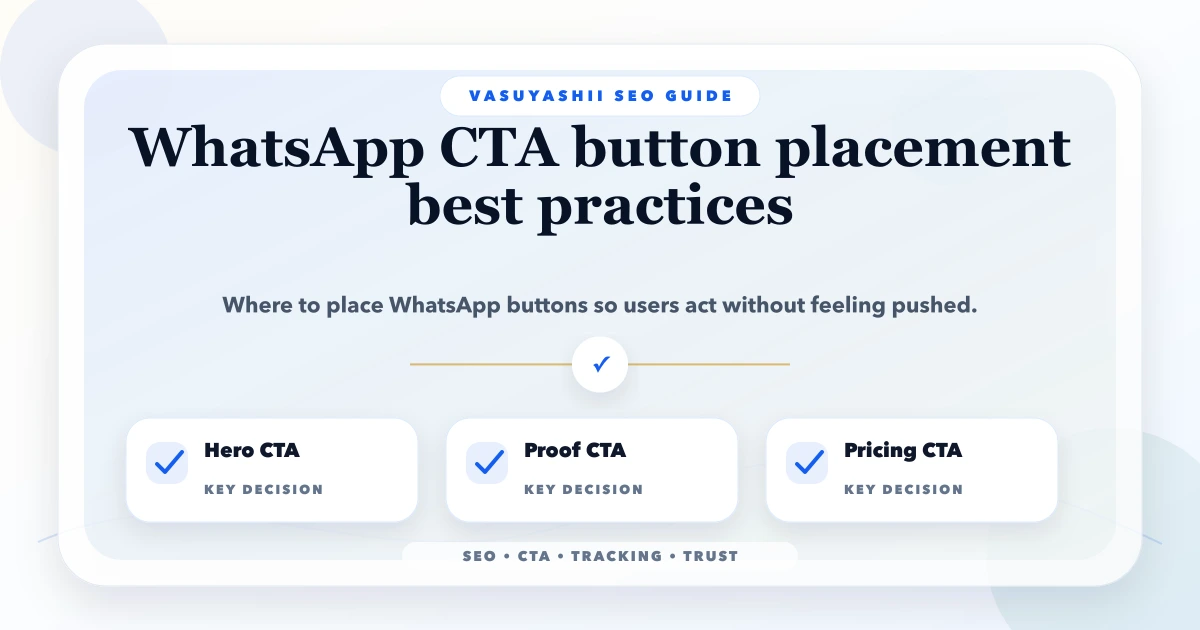
The best WhatsApp CTA button placement is not “everywhere.” Use the hero for visitors who already understand the offer, repeat the action after proof or pricing, place a contextual CTA after objections, and use a mobile sticky button only when it does not cover navigation, forms, consent controls, or content.
The goal is to place WhatsApp at moments where the visitor has enough context to start a useful conversation, then preserve the page and placement source for follow-up.
By Tushar C. (Founder, VASUYASHII). Reviewed by VASUYASHII Editorial for field experience, SEO usefulness, buyer clarity, and implementation practicality.
Serving Delhi NCR and nearby business markets: Ghaziabad, Noida, Delhi, Gurugram, Faridabad, Meerut, Hapur, and remote clients across India.
Good WhatsApp CTA button placement means one CTA in the hero, one after trust proof, one near pricing or packages, one after FAQs, and a sticky mobile CTA that does not cover content.
Use one simple rule: the CTA should follow the information needed for that decision. A quote CTA follows scope and pricing context; a demo CTA follows product evidence; a support CTA follows the relevant help information.
The current VASUYASHII website uses separate privacy-safe analytics events for direct WhatsApp clicks, contact-page clicks, and valid lead-form submissions. Form values such as name, phone, email, and message are not sent inside analytics events. This distinction matters because a button click and a completed requirement are different stages of the funnel.
The implementation also shows why CTA placement cannot be reviewed by screenshots alone:
This is the evidence standard to use on another website: first define the user action, then place the CTA, then verify that the event appears in analytics. Do not claim that a sticky button or a particular label “converts better” until the site has enough qualified lead data to support that conclusion.
| Placement | Visitor context | Event to record | Quality check |
|---|---|---|---|
| Hero | Offer understood quickly | whatsapp_click with placement label | Did the chat mention the correct service? |
| After proof | Visitor reviewed projects or screenshots | whatsapp_click with proof context | Did proof reduce basic trust questions? |
| Pricing section | Visitor is evaluating budget | Quote or WhatsApp click | Was the enquiry within the stated scope? |
| Contact page | Visitor wants a direct conversation | Contact or WhatsApp click | Was a complete requirement captured? |
| Lead form | Visitor submitted valid fields | generate_lead | Did the sales team receive useful details? |
The above-the-fold design guide explains how the first CTA fits into the hero. The WhatsApp lead tracking guide covers attribution after the click.
For a 14- to 30-day test, keep the offer, traffic source, form, sales ownership, and follow-up process stable. Change only one placement or label. Give every button a placement value such as hero, proof, pricing, faq, or mobile_sticky.
Measure the funnel in separate stages:
Meta describes click-to-message experiences as a route into a conversation, not proof that the conversation became a lead. Review the current Meta click-to-message guidance when paid campaigns are involved. For analytics, use Google's recommended event guidance and keep a raw whatsapp_click separate from generate_lead or later lead stages.
Do not send message text, phone numbers, names, emails, or form contents to analytics. Use non-personal parameters such as page path, CTA placement, service category, and campaign source.
Map every existing WhatsApp button before editing the page. Record its label, section, prefilled message, destination number, tracking event, mobile behavior, and the team responsible for replying.
For an Indian SMB, WhatsApp reduces contact friction but can also create unstructured chats. Prefill the service or page name, ask only for the minimum useful detail, and give the sales team a consistent way to record source and qualification.
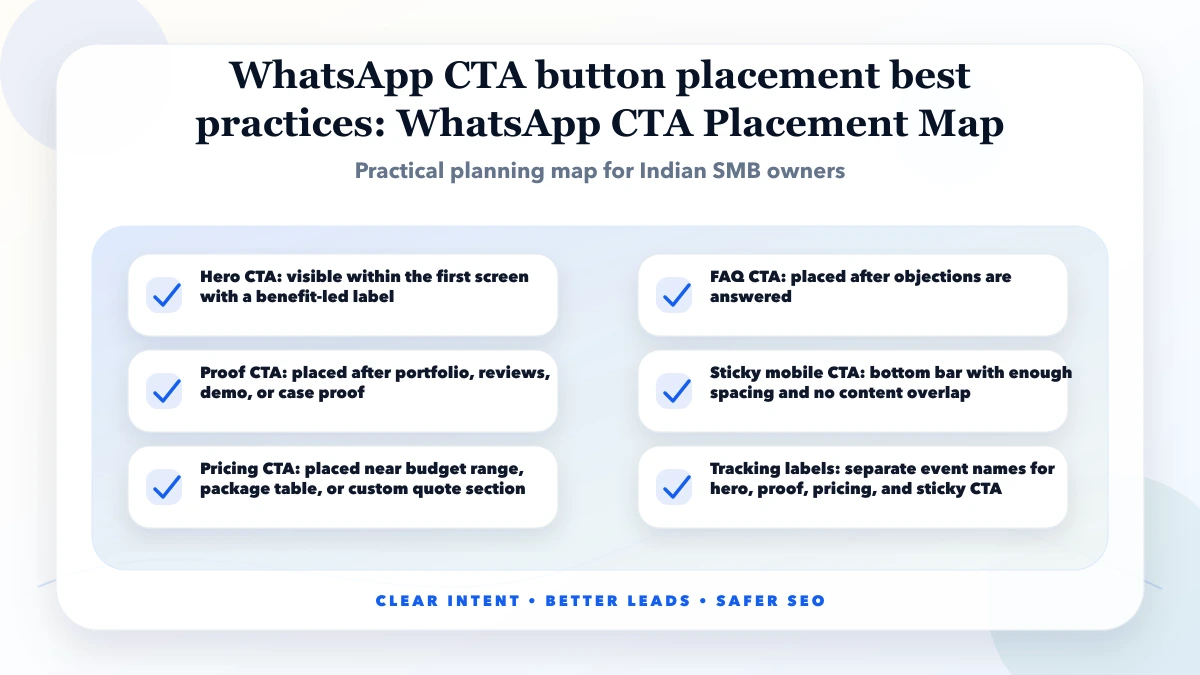
Placement should match intent. An educational article uses a soft CTA after the answer. A service page uses a direct CTA after scope or proof. A pricing page can ask for requirements needed to confirm a quote.
A useful prefilled message names the service and asks the visitor to add business type, required outcome, and timeline. Avoid inserting long sales copy into the message; the visitor should be able to review and send it comfortably.
Operations determine whether the CTA creates value. Define response ownership, business hours, backup contact, qualification fields, and where the final lead status is recorded. A click without follow-up ownership is not a lead system.
| Scope | Practical price range | Typical timeline |
|---|---|---|
| CTA placement audit | ₹3,000 to ₹10,000 | 1 to 2 days |
| CTA redesign + tracking | ₹10,000 to ₹30,000 | 2 to 5 days |
| Full conversion page refresh | ₹30,000 to ₹90,000 | 1 to 3 weeks |
These are planning ranges, not fixed quotes. Cost depends on the number of templates, responsive sticky behavior, analytics labels, consent requirements, CRM or lead-sheet capture, message routing, and QA across devices.
The roadmap should produce a CTA inventory, approved labels, message templates, responsive placement rules, analytics events, test evidence, and a lead-quality review date.
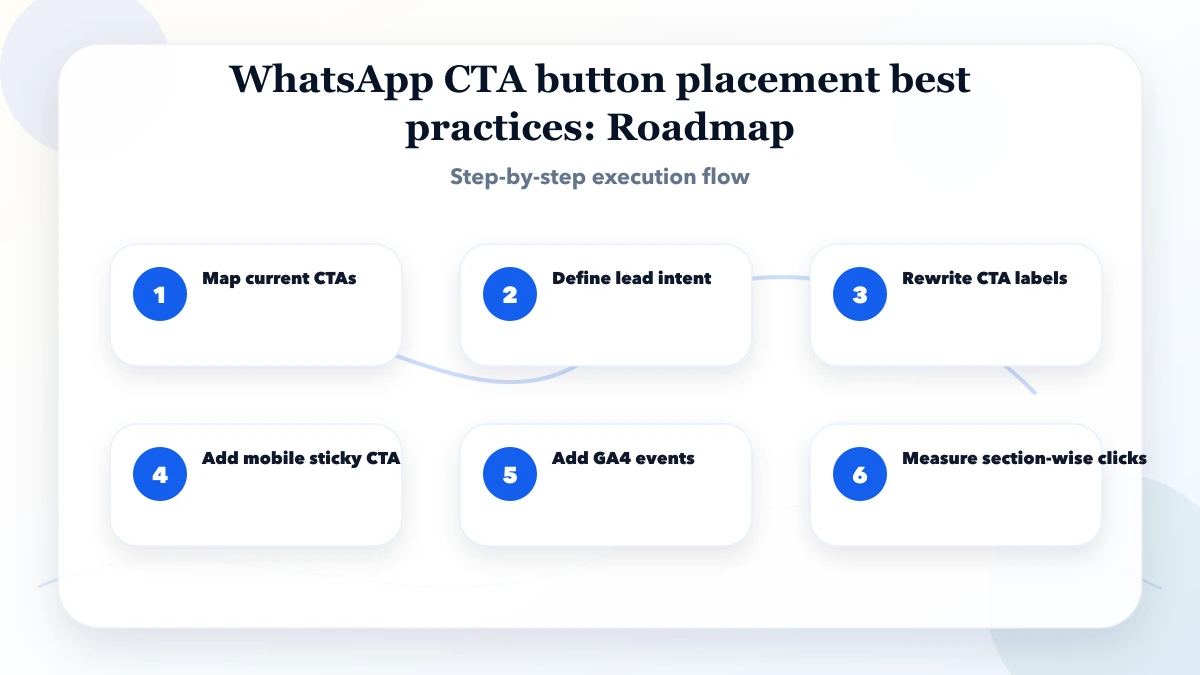
A small service business can begin with a correctly encoded WhatsApp URL, a structured contact form, placement-specific GA4 events, and a lead sheet. Add CRM routing only when ownership and follow-up volume justify it.
The best WhatsApp CTA position changes with visitor intent:
Track the click with page path, CTA label, placement, and campaign source. A WhatsApp click is not automatically a qualified lead, so connect it to enquiry status and outcome where possible. The WhatsApp funnel guide explains the follow-up path, while the lead tracking guide covers attribution. Review the landing page service when the full conversion path needs redesign, or the integrations and automation service when WhatsApp must connect to a CRM, payment, report, or internal workflow.
Review each placement by clicks, messages actually sent where measurable, qualification rate, response time, proposal creation, and closed work. Keep SEO impressions and position separate from conversion outcomes so ranking changes do not hide weak lead quality.
The biggest measurement mistake is calling every WhatsApp click a qualified lead. A user may open the app and never send, ask an unrelated question, or contact without enough scope. Keep click, sent conversation, qualified requirement, proposal, and customer as separate funnel stages.
Start with one page that already receives relevant traffic. Give each CTA position a distinct placement label, verify events in analytics, and review conversations with the sales owner before copying the pattern elsewhere.
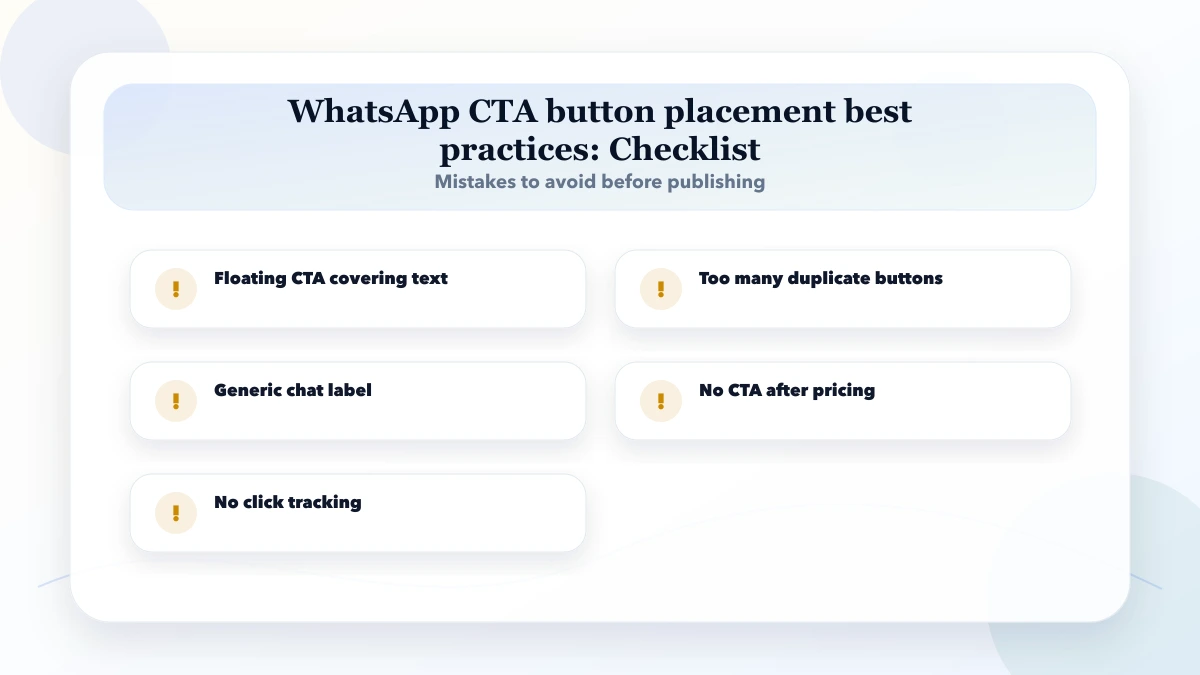
Start with one priority page instead of changing the whole website at once. Pick a page that already gets impressions, enquiries, or sales calls. Improve the headline, proof, CTA placement, and tracking first. Then compare the next 14 to 30 days with the previous period.
For WhatsApp-heavy sales, compare hero, proof, pricing, FAQ, sticky, and contact-page placements. A lower-volume CTA after pricing may create better-scoped conversations than a high-volume floating button.
For a service-area business, include location only when it affects delivery, response, visit availability, or proof. Do not use the WhatsApp CTA as a reason to repeat a city list across every section.
On mobile, yes for many service pages. Keep it slim, clear, and away from important content.
Usually a side or header CTA is enough. Desktop users may also prefer form or call options.
Use intent-led labels like Get website quote on WhatsApp, Book consultation, or Ask for package details.
Yes. Repetition without context can look spammy. Place CTAs after useful decision sections.
For desktop, opening WhatsApp Web in a new tab is usually safer. Mobile deep links should open the app.
Use separate GA4 event labels or URL parameters for hero, sticky, pricing, and FAQ CTA buttons.
VASUYASHII can audit CTA placement, implement privacy-safe events, connect the contact flow, and define a lead-quality review without promising a conversion rate before evidence exists.
Related Articles
June 2, 2026
How to add WhatsApp CTA properly for SEO and UX with button placement, message text, tracking, mobile behavior, and mistakes.
Read article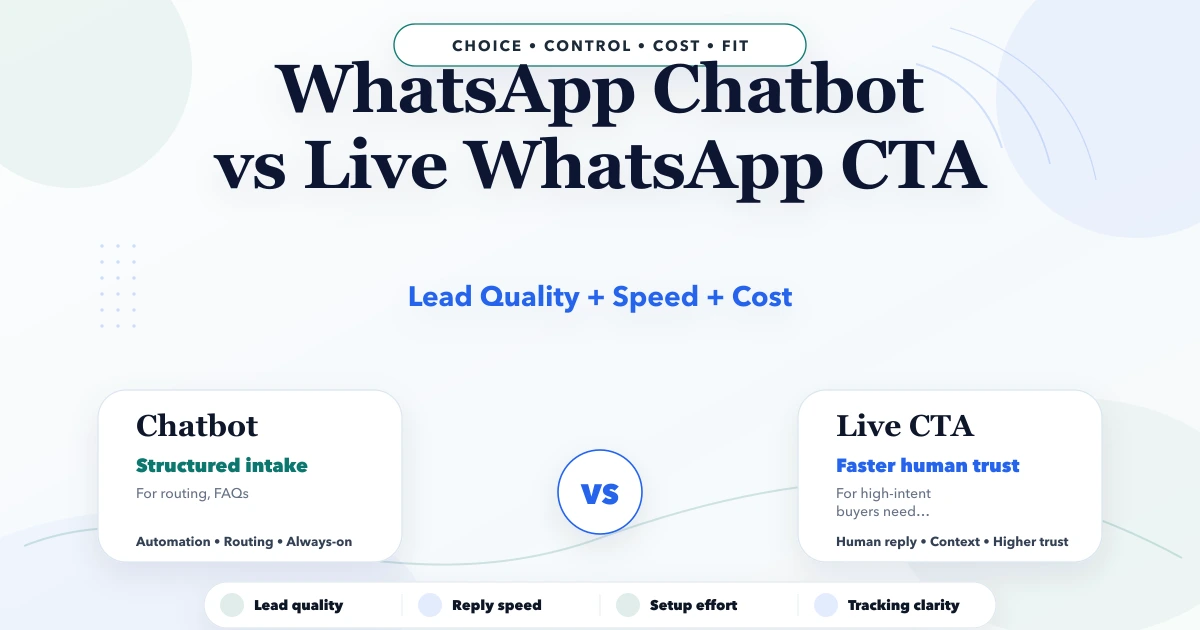
May 2, 2026
WhatsApp chatbot vs live WhatsApp CTA: lead quality, response speed, setup cost, tracking, and best use cases for Indian businesses in 2026.
Read article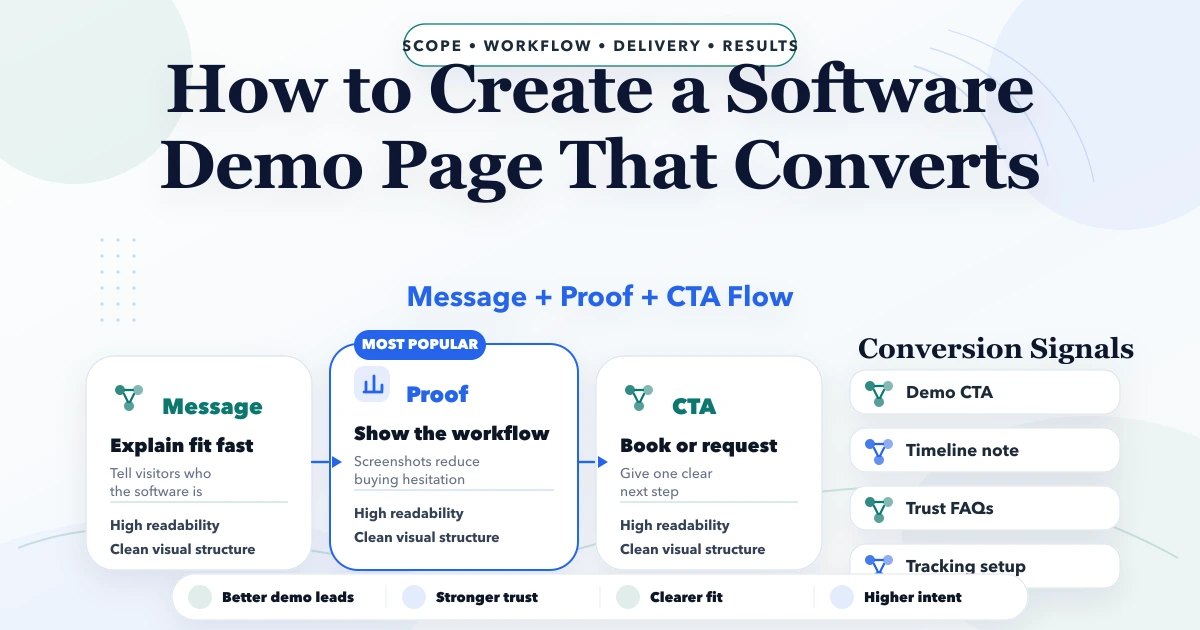
April 26, 2026
Software demo page that converts: page structure, pricing, proof blocks, CTA flow, tech stack, and launch checklist for better leads.
Read article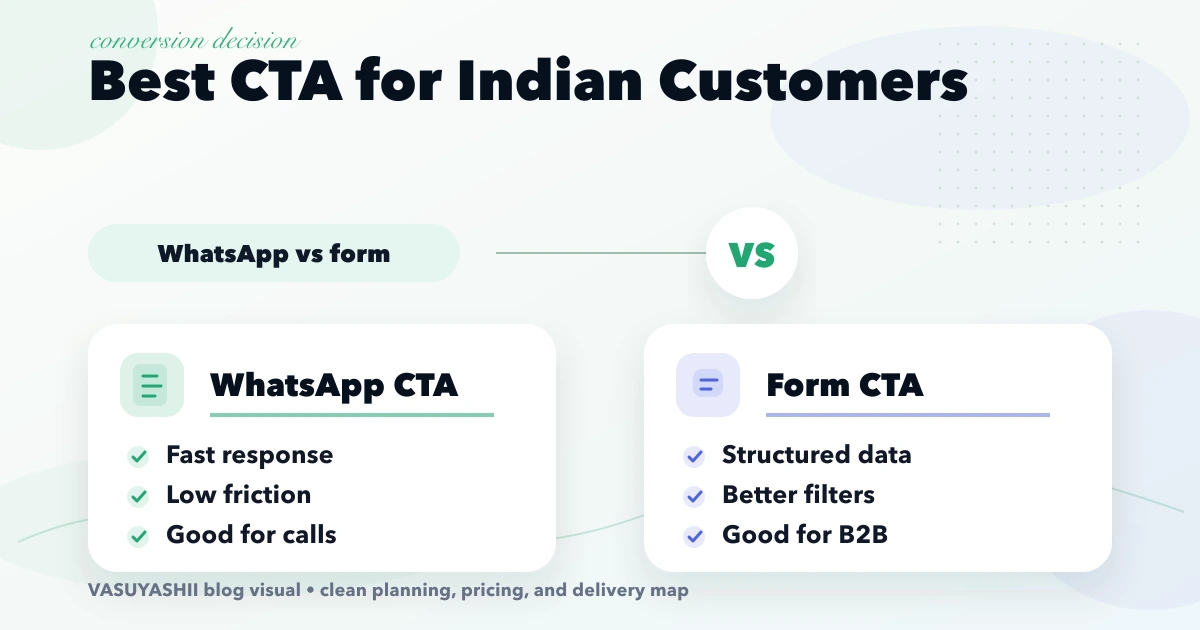
April 18, 2026
Choose between WhatsApp, forms, and calls using buyer intent, requirement complexity, response ownership, consent, mobile UX, tracking, and lead quality.
Read article