
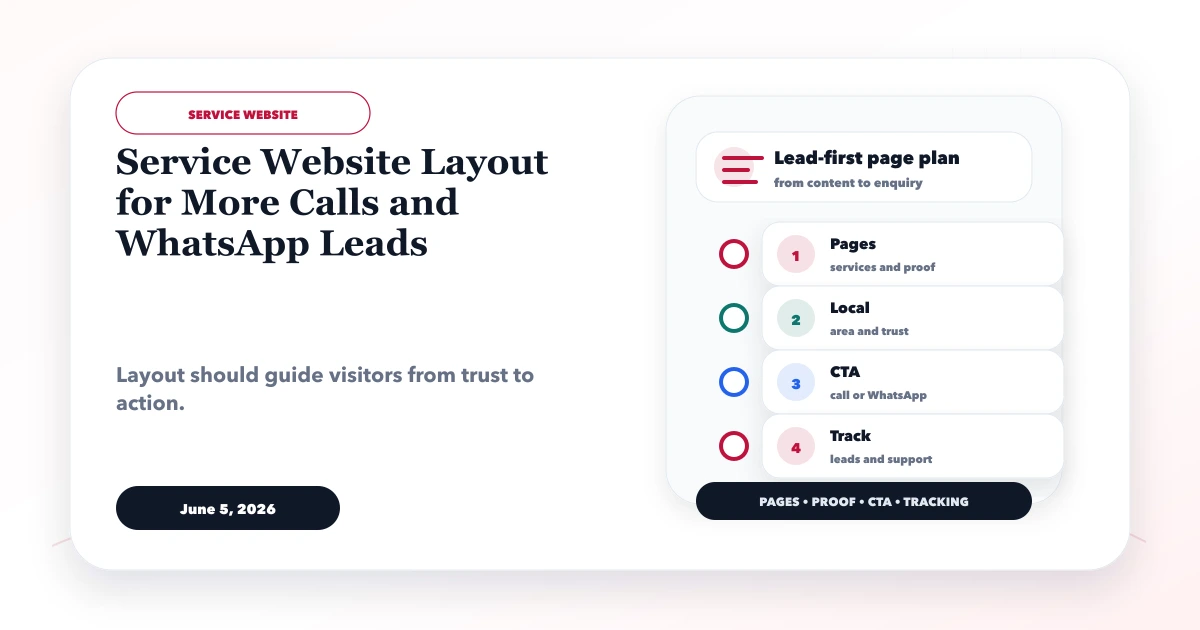
June 5, 2026
Service Website Layout for Calls and WhatsApp Leads
Plan a service website layout with clear offer, local fit, proof, process, pricing context, mobile call and WhatsApp CTAs, forms and conversion tracking.
Read articlePublished Updated
Connect SEO and WhatsApp lead generation with focused service pages, useful content, local proof, tracked conversations and a practical 90-day plan.
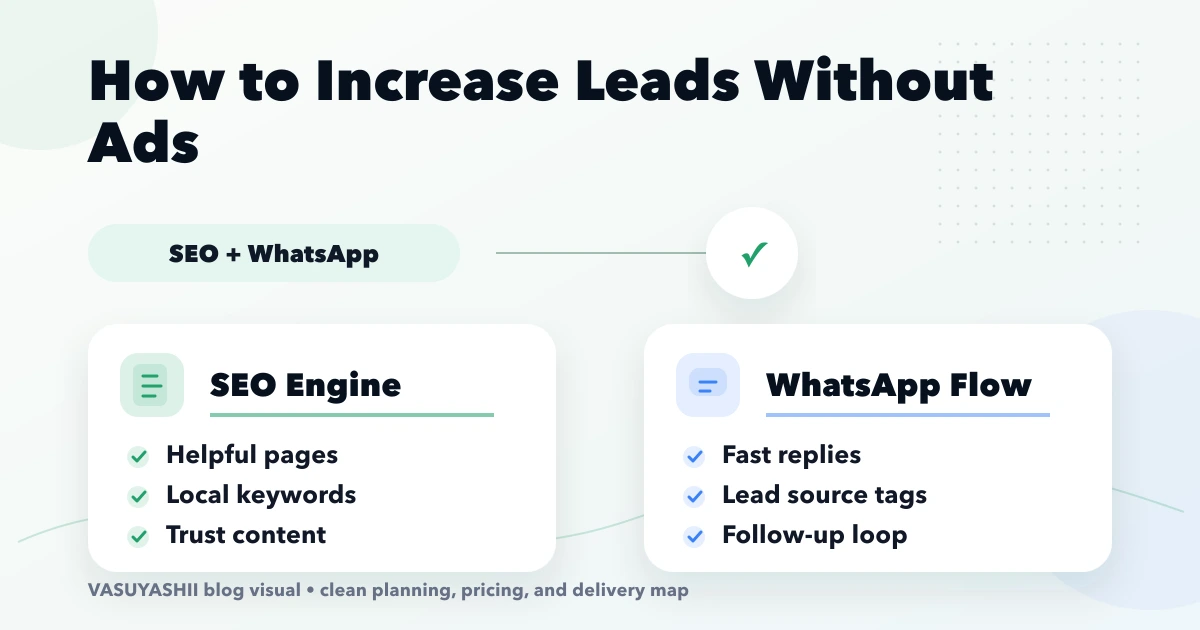
SEO and WhatsApp perform different jobs in an organic lead system. SEO helps the right page appear for a relevant search; the page answers the buyer's question and establishes trust; WhatsApp provides a low-friction route into a qualified conversation.
Getting leads without ads is therefore not a matter of publishing more posts and adding a floating WhatsApp icon. A dependable system connects four things: a search query with buying intent, a page that answers that query, proof that reduces risk, and a contact journey that records what the visitor needs.
For an Indian service business, the first goal is not maximum traffic. It is a small number of relevant enquiries that the team can answer quickly and attribute to the right page. That changes what should be built, measured, and improved.
A WhatsApp button does not make a page rank higher by itself. Its role begins after discovery: it helps a visitor move from reading to a conversation without losing the service or page context. SEO and WhatsApp work together when each stage has a separate responsibility.
| Stage | Primary job | Practical implementation |
|---|---|---|
| SEO | Match a relevant search with the correct page | One primary URL per intent, descriptive title, useful answer and internal links |
| Landing page | Help the visitor evaluate the offer | Scope, process, cost factors, proof, limitations and FAQs |
| WhatsApp CTA | Preserve context at the moment of contact | Clear label and a prefilled message containing the service or page topic |
| Sales follow-up | Qualify and progress the enquiry | Named owner, response target, status and next action |
| Measurement | Show which pages create useful conversations | Page-level Search Console data, CTA events and qualified-lead records |
Do not replace crawlable service information with a WhatsApp-only journey. Google and prospective buyers still need a useful page they can read before contacting the business.
| Layer | Question it must answer | Useful measurement |
|---|---|---|
| Demand | What is a potential buyer searching for? | Relevant impressions and query position |
| Landing page | Does the page solve that exact decision? | Engaged visits and CTA reach |
| Trust | Why should the buyer believe this business? | Proof interactions and qualified replies |
| Contact | Is the next step easy and specific? | WhatsApp, form, or call events |
| Follow-up | Does somebody own the enquiry? | Response time and next action |
| Revenue | Was the enquiry commercially useful? | Qualified leads, proposals, wins |
If one layer is missing, the numbers can look active while sales remain unchanged. Rankings without a clear offer produce browsing. WhatsApp clicks without ownership produce abandoned conversations.
Record the last 28 or 90 days before changing the website:
Do not classify every WhatsApp message as a lead. A job application, vendor pitch, support request, and project enquiry have different value. Use a simple lead-status sheet or CRM with source page, service, location, budget band, stage, owner, and next action.
A homepage cannot rank and convert for every service. Give each important offer one primary page with:
For example, a buyer comparing custom workflow software needs different information from somebody seeking a five-page business website. Route them to software development and website development for Delhi NCR businesses rather than forcing both through generic copy.
Google's SEO Starter Guide recommends content that is useful, well organised, and written for people. That is also the strongest conversion approach: answer the decision instead of repeating a keyword.
Use four practical intent groups:
| Search intent | Example | Best destination |
|---|---|---|
| Service | custom CRM development | Main service page |
| Cost | CRM development cost in India | Detailed cost guide |
| Comparison | custom CRM vs Zoho | Comparison article |
| Problem/use case | track sales follow-ups | Workflow or use-case article |
One primary URL should own each important intent. If three pages all target the same phrase, improve or differentiate them before publishing another. Supporting articles should link to the main service page and to the next logical question.
Local pages are useful only when they contain genuine local value. A Delhi NCR page can explain service availability, discovery process, remote/on-site coordination, relevant business types, delivery boundaries, and verifiable work. Replacing a city name inside identical paragraphs does not create a useful local resource.
Build trust with:
Avoid mass city pages, copied review text, hidden keywords, and irrelevant comment backlinks. Google's spam policies specifically cover scaled content and doorway abuse.
The best support article answers a question that delays a purchase. Useful formats include:
Every article should have a distinct job. A guide about payment terms should not repeat an agreement template. A restaurant QR-menu guide should not copy a general appointment-system article. Connect related content through descriptive links rather than a large unrelated list.
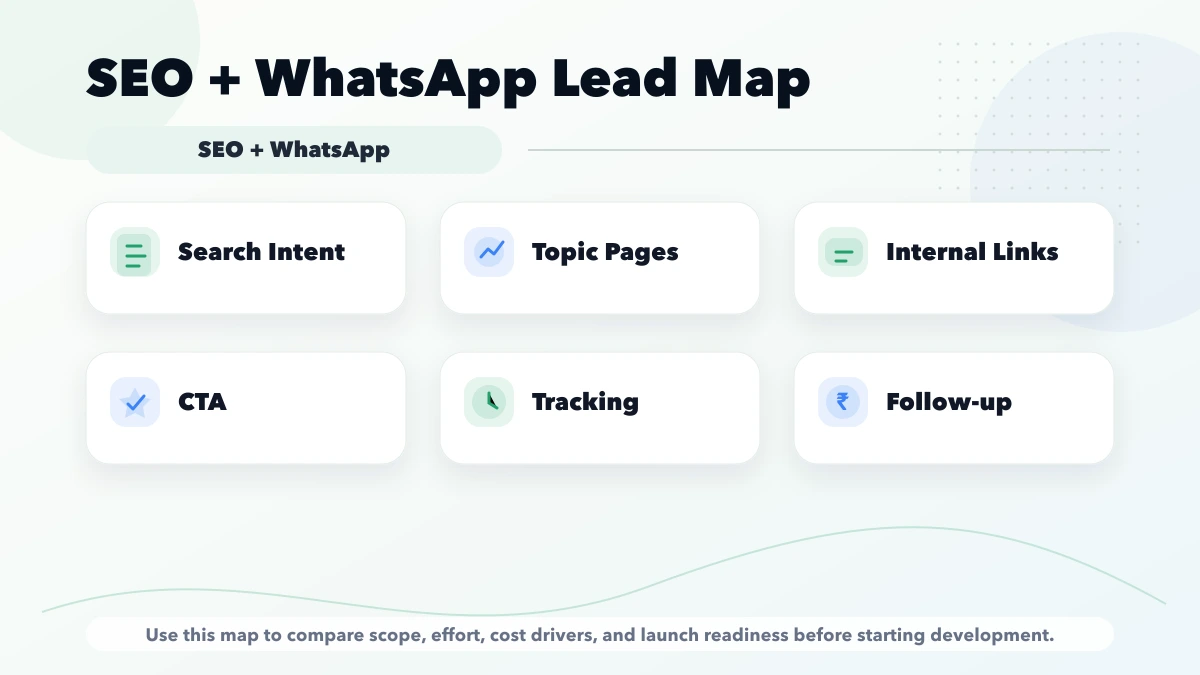
A good WhatsApp CTA tells the visitor what happens next. Use page-specific text such as:
Hi VASUYASHII, I am reviewing a custom CRM for a 12-person sales team. Please help me scope the first version.
This is more useful than “Hi” because it preserves source and intent. Pass only non-sensitive context in a link. Never place passwords, private customer data, or confidential requirements inside a URL.
A visitor initiating a conversation does not grant permission for unlimited promotional messaging. Use the conversation to answer the request, record consent where needed, and stop automated follow-ups when the person opts out.
For the implementation pattern, use the WhatsApp lead tracking guide and integrations and automation service.
At minimum, capture:
contact_click;whatsapp_click;form_start;generate_lead after valid submission;demo_open where demos support the sale;Do not fire generate_lead when a form button is merely clicked. It should represent a valid accepted submission. Test events in GA4 DebugView, mark the qualified conversion event as a key event, and compare it with actual enquiries.
The complete conversion tracking guide explains the attribution layer. Keep personally identifiable information such as phone numbers and email addresses out of analytics event parameters.
SEO can compound, but no ethical team can guarantee a ranking or lead number by a fixed date. The plan controls execution quality; competition, authority, demand, and crawling affect the outcome.
Consider a Noida-based B2B supplier that offers a product catalogue, custom quotations, and repeat ordering. Publishing general marketing blogs may attract students or researchers. A better system would use:
The traffic may be lower, but the enquiry carries enough context for a useful response.
VASUYASHII's current website implementation includes final-www canonical URLs, an XML sitemap, service/topic hubs, GA4 events for contact, WhatsApp, demo, and lead actions, and contextual links between commercial pages and supporting articles. These are implementation facts, not a promise of ranking or lead volume.
The present content programme is also refreshing existing commercial and support pages before adding more city pages. This article follows that rule by focusing on one measurable system rather than another location variation.
Yes, when search demand, page intent, trust, conversion, and follow-up align. SEO visibility alone does not guarantee enquiries or sales.
Start with the homepage, contact flow, and strongest service pages. Publish support content after buyers can understand and act on the offer.
No. It needs contextual messaging, event tracking, response ownership, consent-aware follow-up, and a way to classify the lead.
Technical and conversion fixes can be deployed quickly, but search growth often requires repeated crawling, useful content, authority, and time. Use 90-day execution cycles without guaranteeing a result date.
Only when the business serves that area and can provide distinct local information. Otherwise, strengthen a regional page and avoid near-duplicate doorway content.
Qualified leads by landing page is more useful than raw traffic. Also track impressions, CTR, CTA events, response time, proposals, and wins to diagnose each layer.
Start with one commercial page and trace its complete path from query to qualified conversation. For a wider architecture review, use Local SEO for Web Development Companies or contact VASUYASHII with the page and service you want to improve.
Related Articles
June 5, 2026
Plan a service website layout with clear offer, local fit, proof, process, pricing context, mobile call and WhatsApp CTAs, forms and conversion tracking.
Read article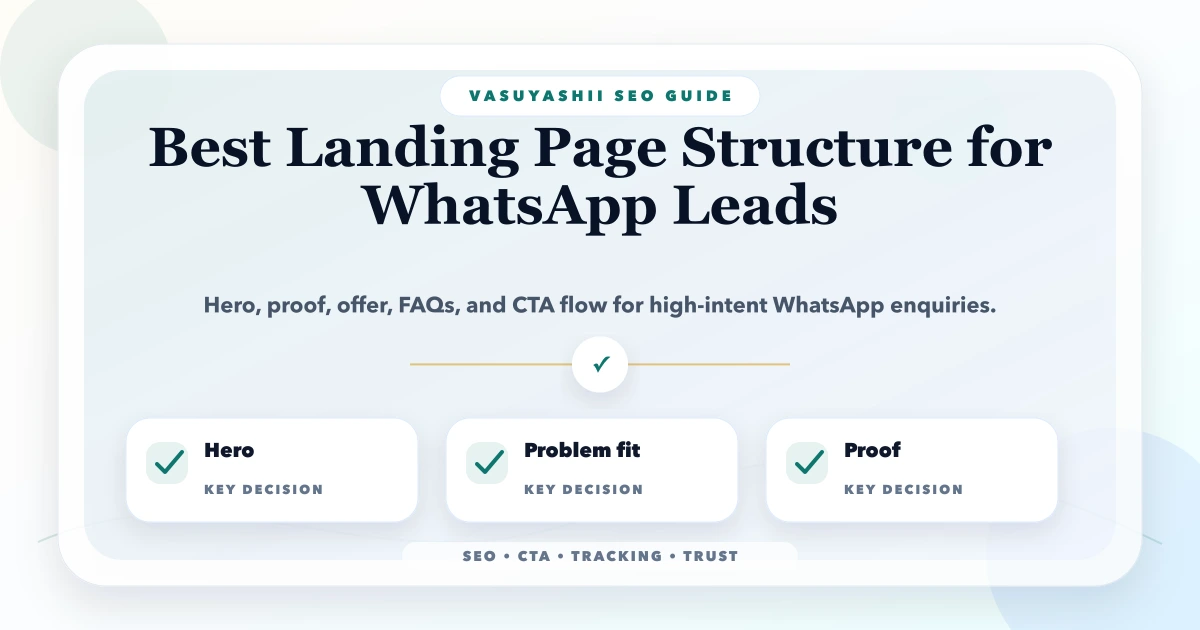
May 11, 2026
landing page structure for WhatsApp leads: practical 2026 guide with structure, pricing, checklist, mistakes, FAQs, tracking tips, and next steps for Indian.
Read article
May 20, 2026
Build a practical website-to-WhatsApp lead flow with contextual messages, qualification, ownership, tracking, privacy controls, and reliable follow-up.
Read article
May 25, 2026
Design CRM call tracking for ads, SEO, referrals, and direct leads with source capture, deduplication, consent, outcomes, offline conversion, and reporting.
Read article