
May 20, 2026
Local SEO for Service Businesses (Delhi NCR)
local SEO for service businesses Delhi NCR: practical 2026 guide with setup, pricing, checklist, roadmap, tracking, mistakes, FAQs, and Indian business tips.
Read articlePublished Updated
Avoid local SEO spam with accurate Business Profile details, genuine locations, useful city pages, honest reviews, clean citations and a recovery checklist.
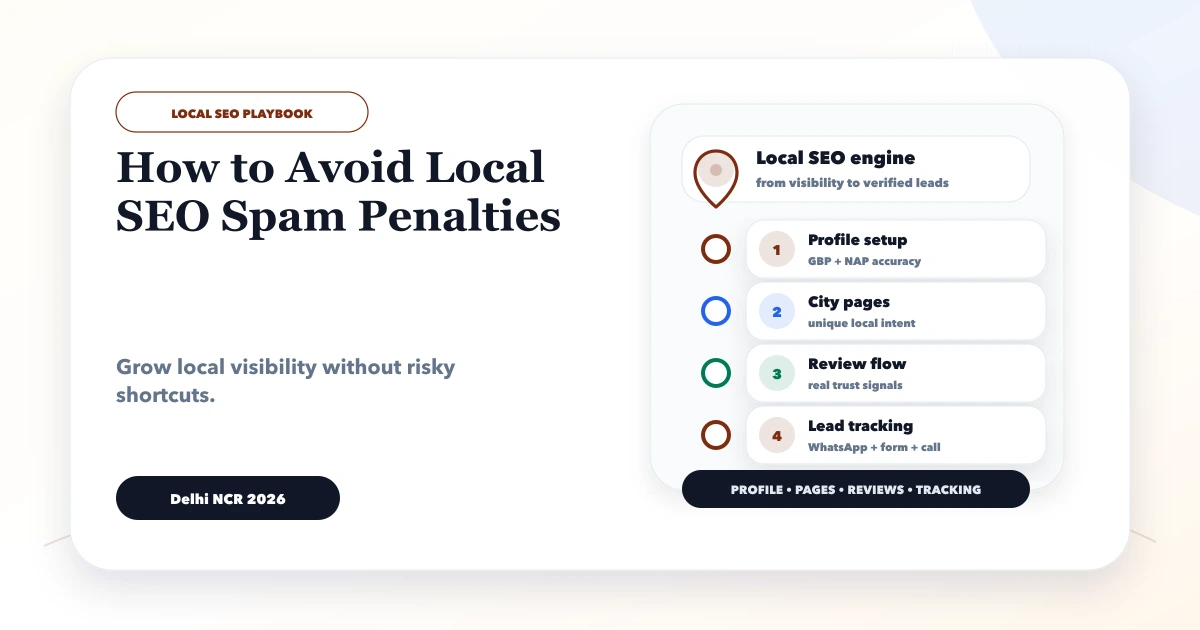
Local SEO becomes risky when a business tries to manufacture local relevance instead of documenting where and how it genuinely operates.
Common shortcuts include adding keywords to the Google Business Profile name, using a virtual address as a staffed office, creating duplicate profiles, buying reviews, or publishing dozens of city pages with only the place name changed. These tactics can create profile edits, suspensions, weak indexing or search-spam problems.
This guide separates Business Profile policy from website spam policy and gives Indian service businesses a practical prevention and recovery workflow.
Use real-world business information everywhere:
There is no safe “spam percentage.” If a claim exists only to influence rankings and cannot be supported operationally, remove or correct it.
Owners often call every visibility problem a “penalty,” but two different systems may be involved.
| Surface | Typical issue | Possible result |
|---|---|---|
| Google Business Profile | Ineligible address, stuffed name, duplicate profile, fake reviews | Edit rejection, verification request, suspension or content removal |
| Google Search | Doorway pages, scaled low-value content, hidden text, manipulative links | Weak indexing, ranking loss or manual action |
| Website trust | False office claims, unsupported proof, inconsistent contact details | Lower conversion and customer complaints |
Diagnose the affected surface before making changes. Repeatedly editing the profile will not fix duplicate city pages, and rewriting a city article will not fix an ineligible Business Profile address.
Google's Business Profile representation guidelines say the profile name should reflect the business's real-world name as used on signage, stationery and branding.
Do not change:
VASUYASHII
into:
VASUYASHII Best Website Development Company Delhi NCR
unless that full phrase is genuinely the recognized business name. Put services, locations, hours and categories in their intended fields.
A mailing address, P.O. box or rented virtual office does not automatically create a valid storefront. Google's current guidelines say a coworking office must meet conditions such as clear signage, customer access during business hours and staffing by the business.
For a business that travels to customers and does not receive customers at its address:
The service-area guidance also distinguishes storefront, service-area and hybrid businesses. Document the model before asking an agency to change the profile.
Choose the fewest categories needed to describe the core business accurately. Do not add unrelated categories because they have search volume.
The description should help customers understand:
Avoid:
Ask genuine customers for an independent account of their real experience. Do not:
A safe request can say:
Thank you for working with us. If you want to share an honest review, please describe the service you received and what was useful or could be improved.
Keep project and consent records. The safe review collection guide explains the operational process without manufacturing review language.
Google's search spam policies describe doorway abuse as pages created for similar queries that funnel visitors toward the same final destination without enough independent value.
A city page is not automatically spam. It becomes weak when only the city token changes.
Use the service-city page framework before publishing another location URL.
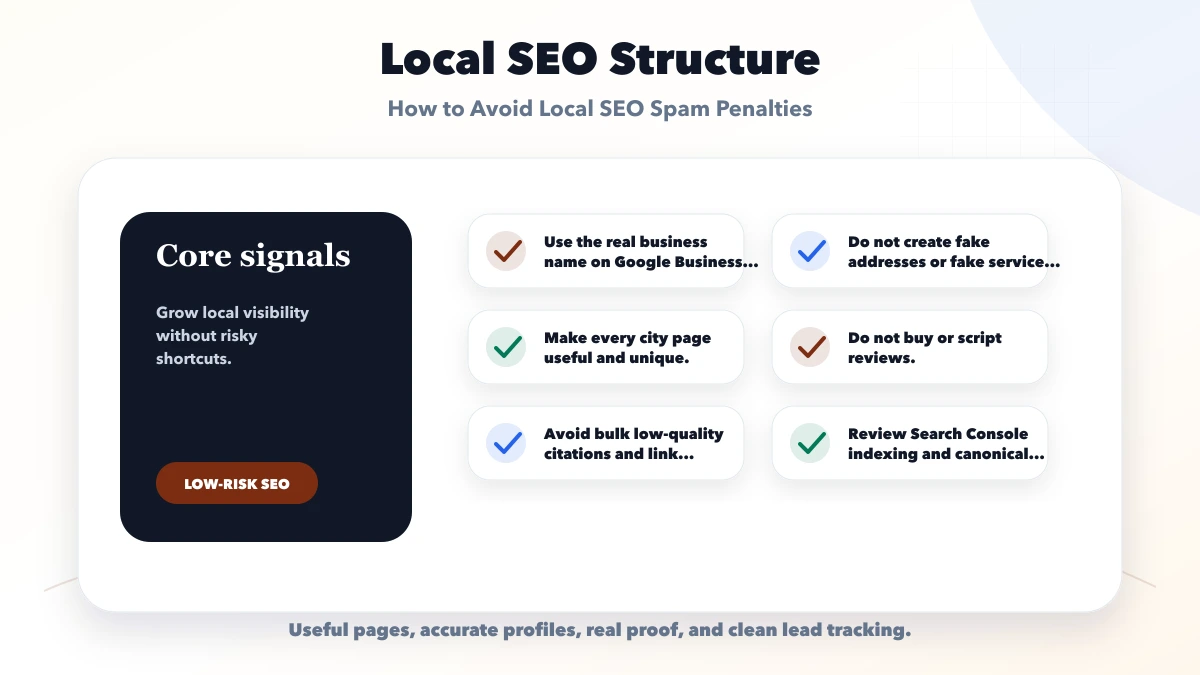
NAP means name, address and phone. Consistency does not mean forcing an address onto directories where the business is not eligible.
Maintain one controlled record for:
Audit important listings first. Correct high-visibility or industry-relevant sources before chasing hundreds of generic directories. The NAP consistency guide provides a practical source-of-truth sheet.
Local SEO safety also depends on the website.
Check:
Do not add multiple local business entities in structured data unless those entities exist and match visible page content.
Location pages should not form an isolated directory designed only for search engines.
A safe pattern is:
main service hub → selected genuine city page → relevant decision guide
The city page should link back to the parent service. Supporting guides can link to a city page only when the location context helps the reader.
For VASUYASHII, the Local SEO for Web Development Companies hub is the parent path. General local guidance should support the hub instead of making every article compete for the same commercial phrase.
Give an SEO vendor the minimum access needed. Maintain a change log for:
Ask who owns every account after the contract ends. The business should retain primary ownership of its domain, hosting, Search Console and Business Profile.
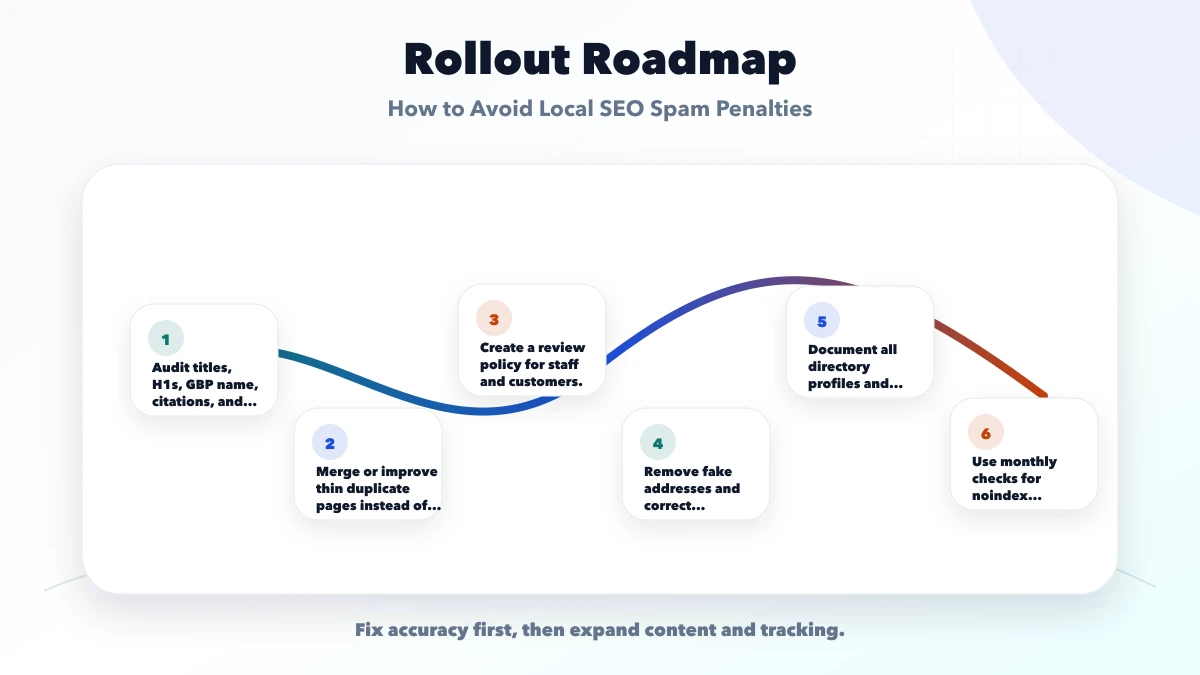
Document the legal/operating name, eligible location, service model, primary phone and genuine service areas.
Compare name, address, categories, hours, website and managers with current policy.
Group city URLs, compare substantive paragraphs, verify local claims, and inspect canonicals and internal links.
Remove internal scripts that pressure for positive sentiment. Correct high-value listings.
Pause new city or “near me” pages until existing pages have distinct purpose and evidence.
Record profile changes, Search Console coverage, manual actions, branded search visibility and genuine lead sources.
Do not create another profile to bypass a suspension.
Inspect duplication, usefulness, crawl paths, canonicals and page ownership. The absence of a manual action does not make scaled repeated pages valuable.
VASUYASHII can audit website content architecture, technical metadata, service-page structure and measurement. Business Profile eligibility, address evidence, customer reviews and local claims must come from the business owner.
No service should promise immunity from profile suspension or guaranteed local rankings. The safe objective is accurate representation, useful content and controlled implementation.
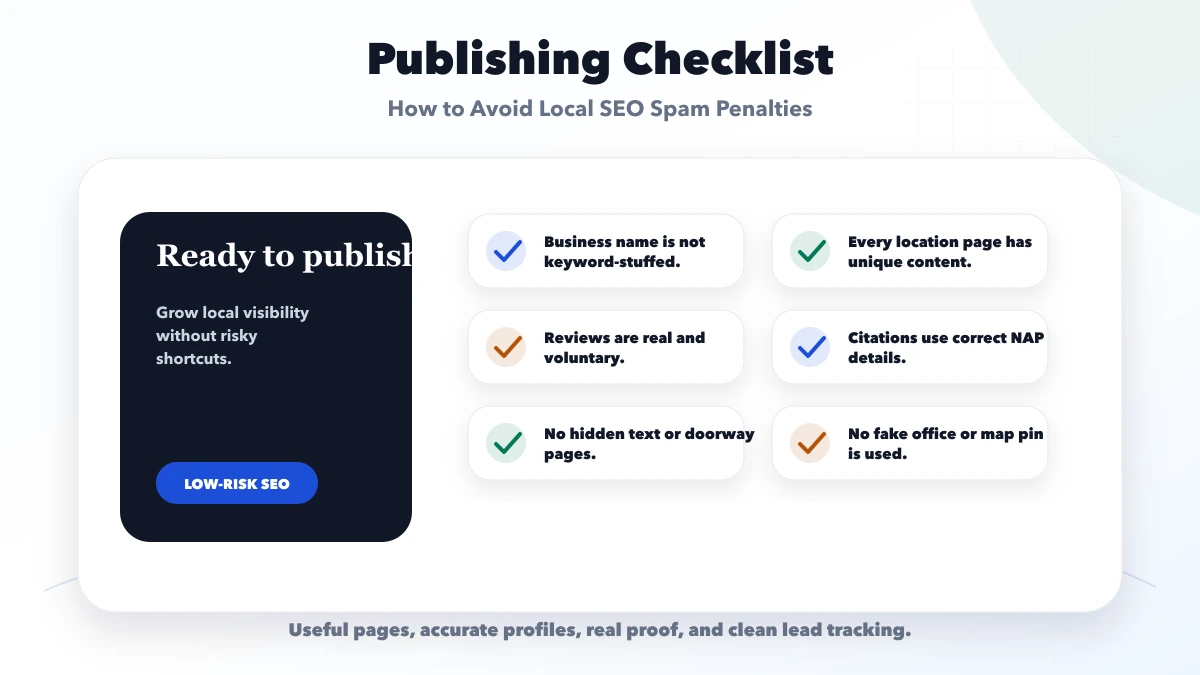
They may change visibility temporarily, but unnecessary information in the business name violates Google's representation guidelines and can create edit or suspension risk.
Not merely because mail can be received there. Review Google's current conditions for staffed offices, signage and customer access before using any coworking or shared address.
Yes, when they help users with genuine service and location information. Repeated pages made primarily to funnel similar queries are risky.
Only a person with a genuine customer experience should review it. Friendship alone is not evidence of a service experience.
No. Diagnose eligibility, correct the existing information and use the official process instead of creating duplicates.
No. Policy compliance is a baseline, not a ranking guarantee. Relevance, distance, prominence, competition and website quality also affect visibility.
Start with name, address eligibility, profile ownership, duplicate profiles and repeated city pages because these can create broad trust and policy problems.
Create one evidence sheet containing the official business name, profile URL, eligible address or service model, public phone, website, service areas and page inventory. Then run the local SEO content QA checklist before approving another local page.
For a website-focused review, contact VASUYASHII with the affected profile and final canonical URLs.
Related Articles
May 20, 2026
local SEO for service businesses Delhi NCR: practical 2026 guide with setup, pricing, checklist, roadmap, tracking, mistakes, FAQs, and Indian business tips.
Read article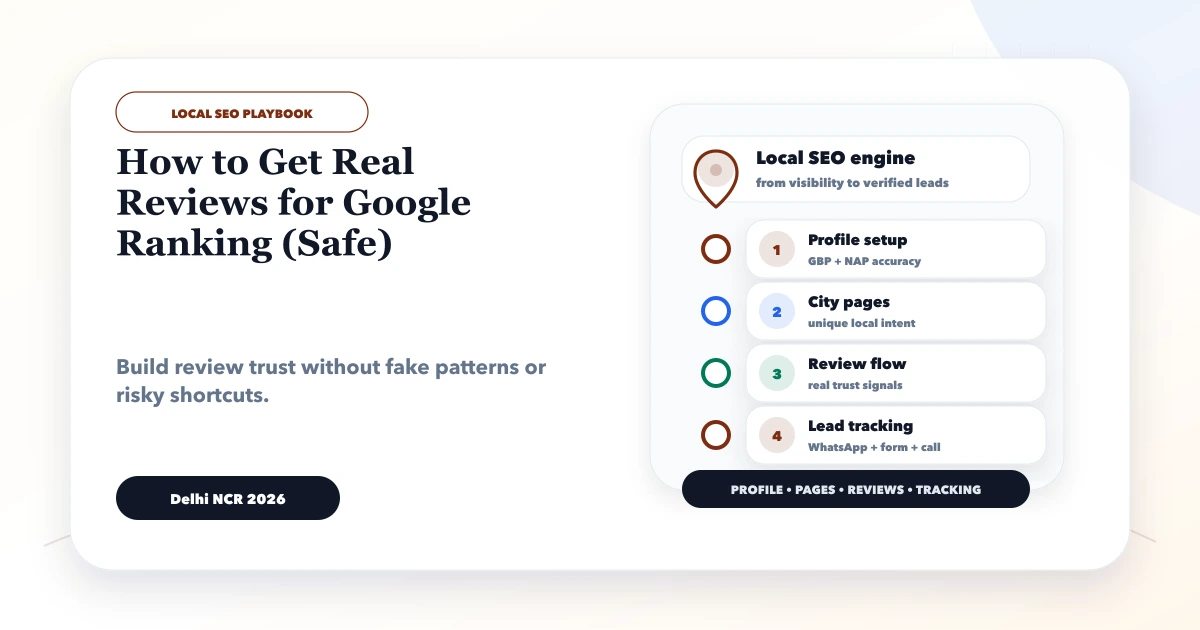
May 29, 2026
Safe ways to get real Google reviews: timing, WhatsApp request flow, review link, staff scripts, response process, and spam practices to avoid.
Read article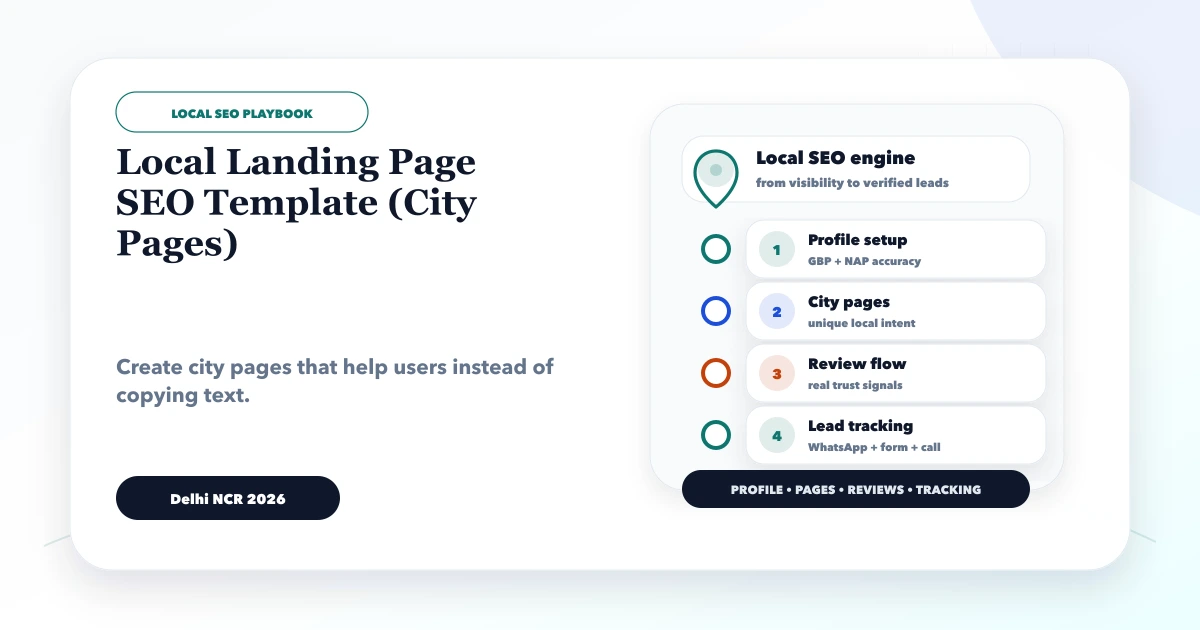
May 29, 2026
Local landing page SEO template for city pages: title, intro, service scope, local proof, pricing, FAQs, internal links, CTA, and spam checks.
Read article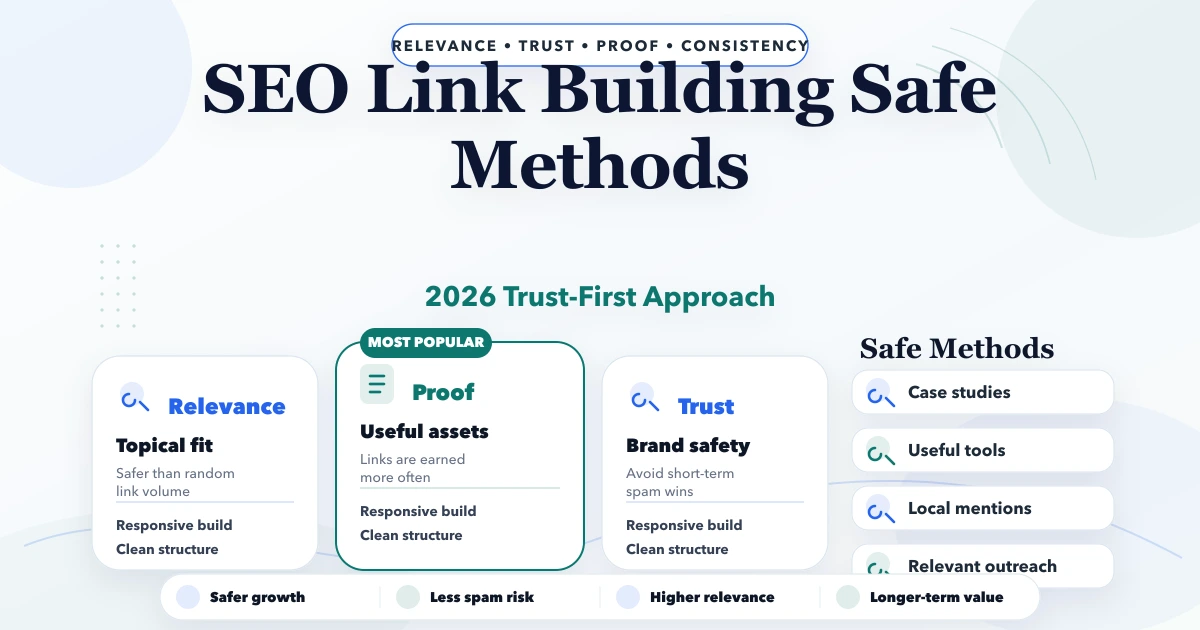
April 23, 2026
Build backlinks safely through original resources, expert contributions, partnerships, directories, digital PR, and outreach measured by referral value.
Read article