
May 2, 2026
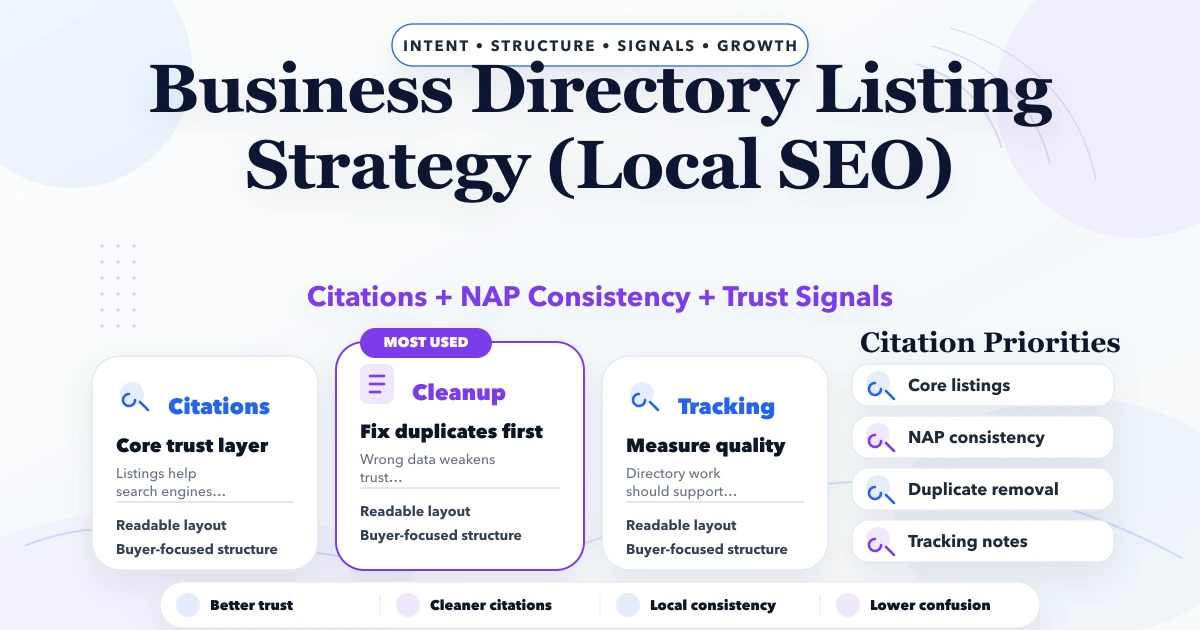
Business Directory Listing Strategy (Local SEO)
Business directory listing strategy for local SEO: citations, NAP consistency, duplicate cleanup, tracking, and rollout priorities for 2026.
Read articlePublished Updated
Create a reliable name, address and phone source of truth, audit local listings, handle service-area businesses, manage changes and prevent citation drift.
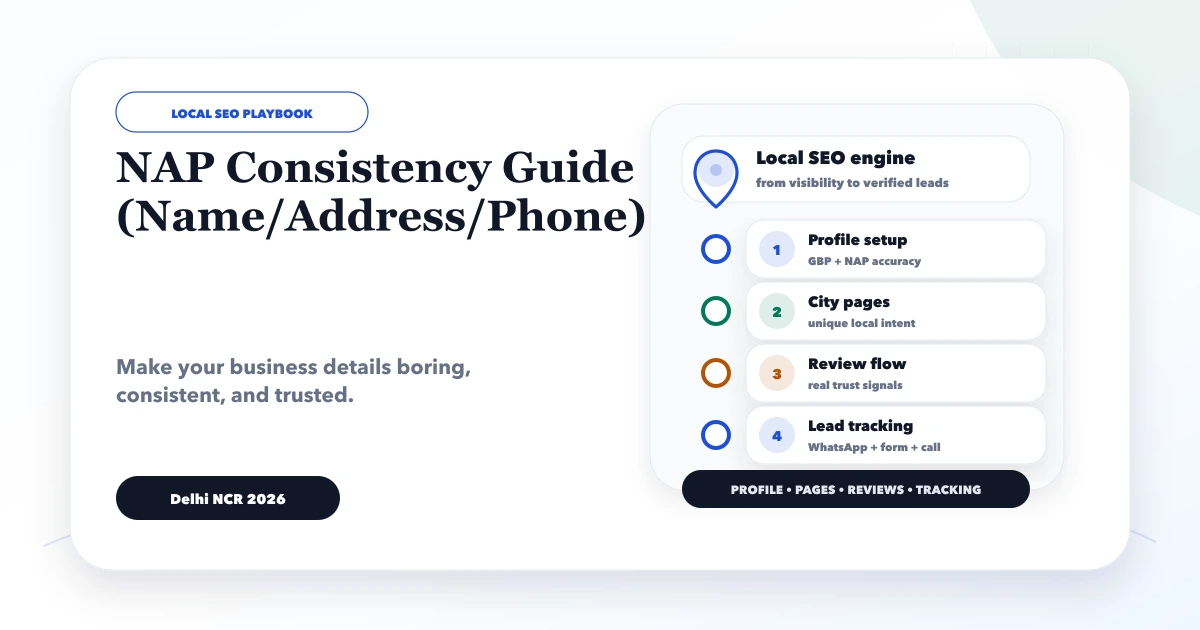
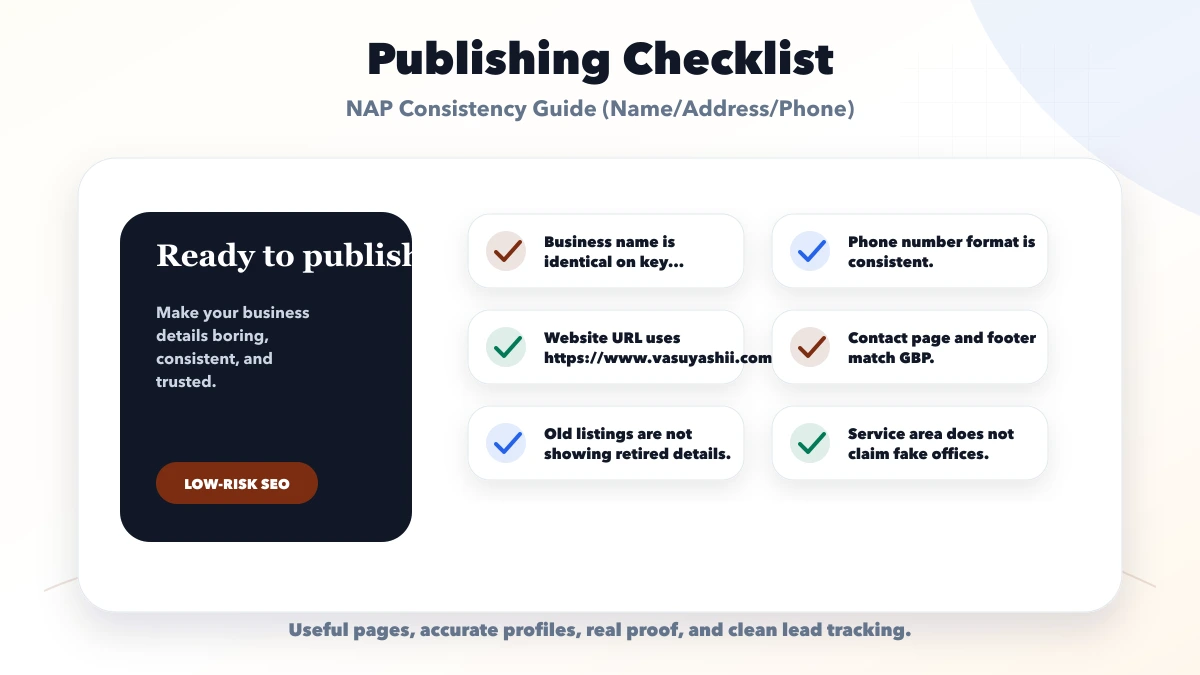
NAP means business name, address and phone number. Consistency means these facts represent the same real business across its website, eligible profiles, important directories and customer-facing documents.
The goal is not to repeat an identical keyword-formatted string everywhere. It is to prevent customers and platforms from encountering conflicting identity, location or contact information.
Treat NAP as business data governance. Define a source of truth, authorised variations, ownership and a change process before creating more listings.
Maintain a master record containing:
Use that record to audit priority platforms. Correct customer-impacting conflicts first, document legitimate formatting variations and stop creating listings that nobody will maintain.
| Field | What must remain consistent | Acceptable variation |
|---|---|---|
| Business name | Real-world public identity | Legal suffix where a platform requires it |
| Address | Same eligible physical location | Standard abbreviation or formatting |
| Phone | Number reaching that location/business | Formatted spaces and country code |
| Website | Final canonical business/location URL | Tracking parameters only when controlled |
| Hours | Actual customer availability | Platform display format |
| Category | Core business activity | Platform taxonomy differences |
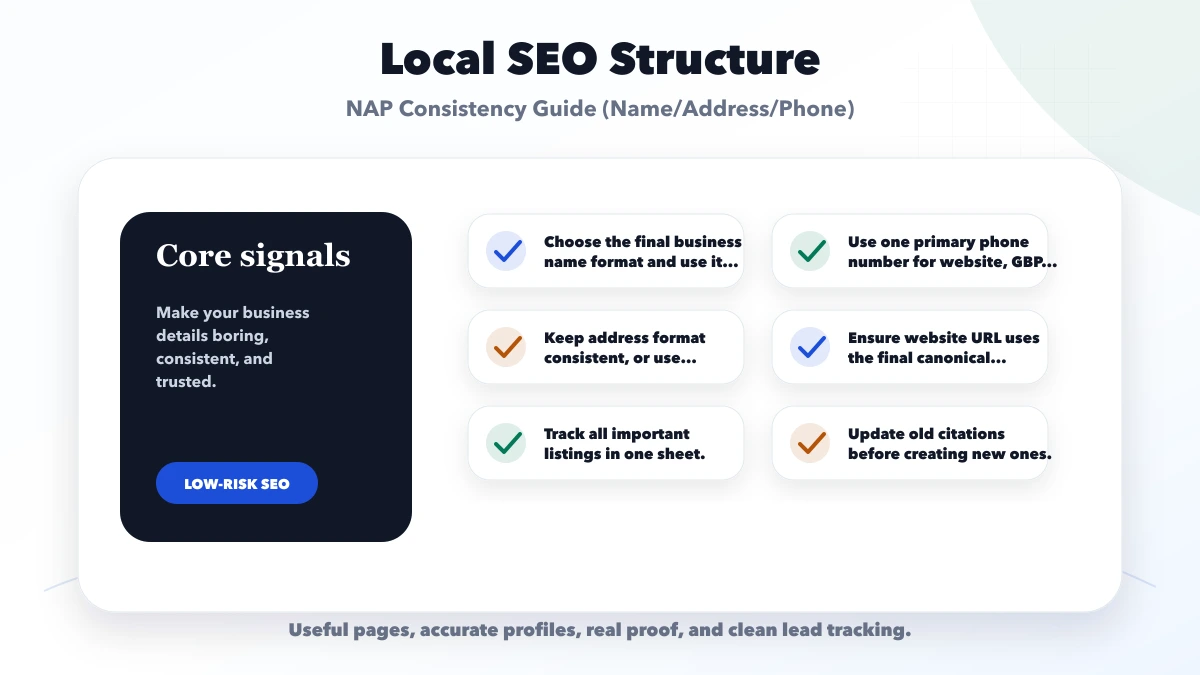
The difference between “Road” and “Rd.” is usually less serious than an old phone number or a profile pointing to a closed office.
Use a real location where the business is staffed and customers can visit during stated hours.
Use the real operating location according to platform rules and hide a residential address from customers when required. Define the genuine service area.
A staffed location may receive customers and also serve customers elsewhere.
Do not invent an address or profile to appear local. Google’s current Business Profile eligibility guidance states that online-only businesses and lead-generation agents are not eligible categories.
The website can still present accurate company identity and service coverage without implying a storefront.
Use a controlled sheet or internal record:
| Field | Example format | Owner |
|---|---|---|
| Public name | Approved brand name | Founder/operations |
| Legal entity | Registered entity | Finance/legal |
| Address type | Storefront/service area/hybrid | Operations |
| Address | Structured fields | Location owner |
| Phone | E.164 plus display format | Support/sales |
| Website | Final HTTPS URL | Web owner |
| Hours | Regular and special | Operations |
| Profile URLs | Verified listing links | Marketing |
| Last checked | ISO date | Assigned reviewer |
Protect the record from accidental edits. Keep a change log when phone, address or brand identity changes.
Audit in this order:
Do not spend equal time on every directory. A wrong phone number on the website is more urgent than a harmless abbreviation on an obscure listing.
Search for:
Use quoted searches for the name, phone and address components. Search results are a discovery aid, not a complete database.
| Difference | Severity | Action |
|---|---|---|
| Old disconnected phone | Critical | Correct priority sources immediately |
| Wrong location or pin | Critical | Follow platform correction process |
| Duplicate eligible profile | High | Resolve under platform rules |
| Old HTTP/non-canonical website | High | Update to final URL |
| Suite number missing | Medium | Correct if it affects visits |
Street versus St | Low | Document; correct during normal maintenance |
| Tracking parameter | Review | Keep only if intentional and measured |
This prevents the team from treating harmless typography as the same risk as customer misdirection.
The website should expose:
Do not add several hidden blocks of city names or phone variations. Use the local landing-page evidence guide before creating location URLs.
Structured data should mirror the visible page. For an eligible physical location, use the most specific supported LocalBusiness type and accurate address fields.
Google’s LocalBusiness structured-data documentation explains required and recommended properties. Markup can help Google understand the page but does not guarantee a rich result or local ranking.
Do not mark every service-area landing page as a separate location.
Phone changes create high customer risk.
Document:
If call tracking is used, ensure the business’s core number remains managed and the tracking setup does not create inconsistent public identity. Test calls from mobile devices.
Plan an address migration:
Do not create the new profile and abandon the old one without checking platform procedures.
Use the real rebrand consistently across signage, website and official material. Do not add service keywords to the profile name unless they are part of the recognised real-world name.
Google’s business representation guidelines require a name that reflects the business’s real-world identity and discourage unnecessary information.
Each location record should contain:
Use one reusable data structure, but keep location facts accurate. A shared call centre can be disclosed where appropriate; do not pretend it is a local direct number.
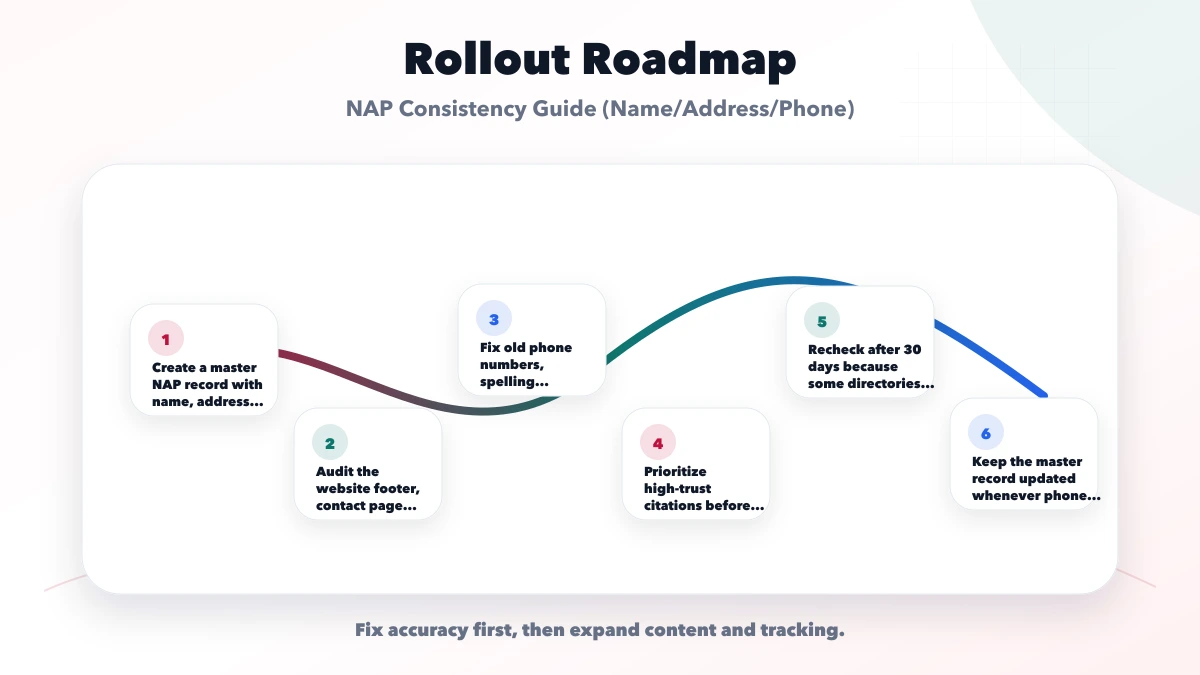
Stop adding directories while the source record is incomplete.
Record URL, platform, credentials, current data, authority and status.
Website, verified profile and customer-used platforms come first.
Use each platform’s merge, removal or support process.
Open the public record, test the phone and final URL, and record the date.
Review quarterly or after a business change. Assign ownership.
The Delhi NCR citation guide provides a platform-selection framework, not a mandate to submit everywhere.
Use columns:
Never place account passwords in the tracking sheet. Use a password manager and role-based access.
The current VASUYASHII website uses one final canonical domain and consistent public contact routes. The business should not claim physical locations or an eligible Google Business Profile until those facts are verified under platform rules.
This article is first-party process guidance, not evidence that VASUYASHII has storefronts across Delhi NCR or has completed a citation campaign for a client.
No. Focus on factual identity and customer clarity. Formatting variations are usually lower risk than wrong or outdated information.
Yes, and some platforms require it when customers are not served at that address. Follow current platform rules.
It can, but document routing and preserve the core business number. Test the setup and avoid uncontrolled inconsistencies.
Audit after any business change and periodically based on risk. High-volume multi-location businesses may need more frequent checks.
No. Accurate information supports trust and local understanding, but Google states local results mainly depend on relevance, distance and prominence.
Prioritise platforms customers and search systems use. Low-value directories may not justify recovery effort.
Create the master record and inventory the ten properties most likely to affect customers. Correct critical conflicts before submitting the business to additional directories.
Related Articles
May 2, 2026
Business directory listing strategy for local SEO: citations, NAP consistency, duplicate cleanup, tracking, and rollout priorities for 2026.
Read article
May 29, 2026
Set up an eligible service-company Google Business Profile with accurate ownership, category, service area, contact details, verification, and review practices.
Read article
May 29, 2026
Safe ways to get real Google reviews: timing, WhatsApp request flow, review link, staff scripts, response process, and spam practices to avoid.
Read article
May 20, 2026
Optimize an eligible web-service Google Business Profile with accurate categories, service areas, reviews, photos, landing pages, tracking, and monthly upkeep.
Read article