
April 22, 2026
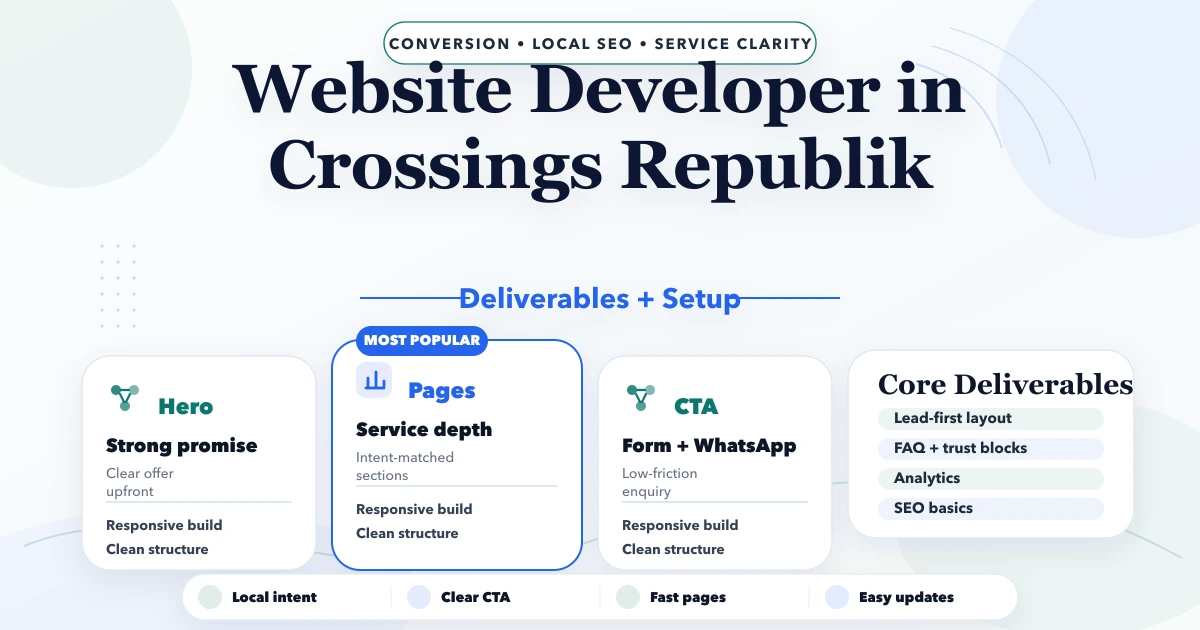
Website Developer in Crossings Republik: Trust Plan
Plan a Crossings Republik local-service website with trust evidence, appointment requests, review governance, mobile UX and lead ownership.
Read articlePublished Updated
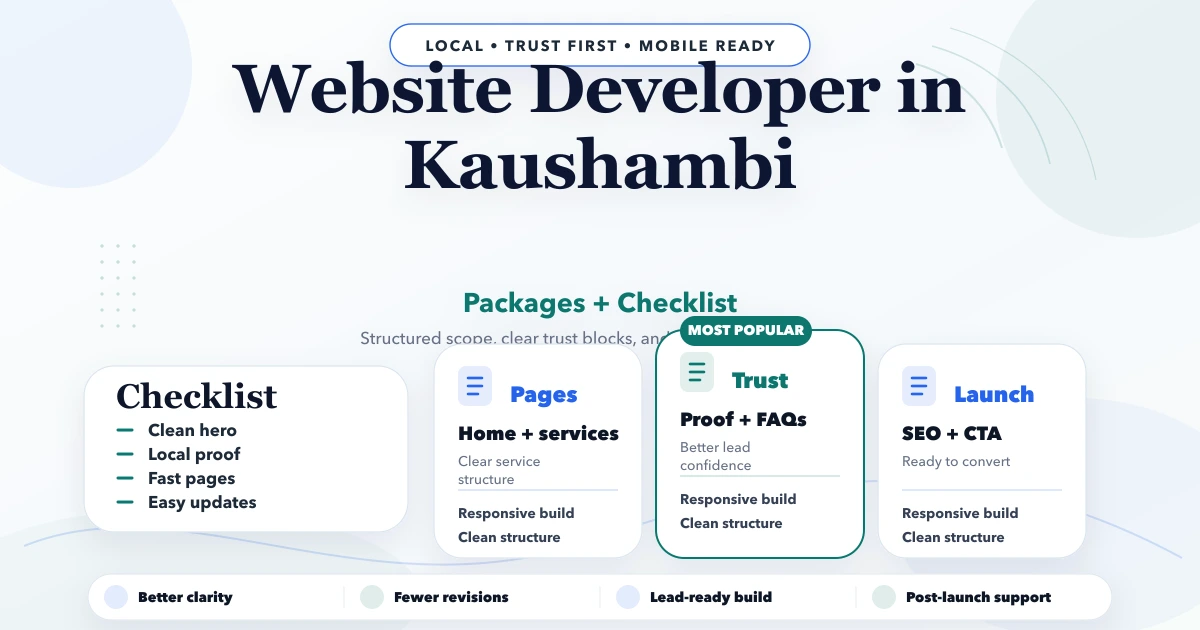
Plan a Kaushambi professional website with appointment requests, office directions, visitor routing, service qualification, accessibility, and analytics.
Service-area note: VASUYASHII is based in Delhi NCR and supports businesses remotely across India. A city-focused guide describes service and planning context; it does not claim a physical office in every location mentioned.
Explore the parent topic: Website Development Delhi NCR Hub →A website developer in Kaushambi may be asked to build for consultants, clinics, agencies, training providers, or other appointment-led offices. These websites need to help a visitor choose the right service, understand preparation requirements, request a suitable time, and reach the correct office or team.
This guide focuses on appointment requests and visitor routing. It is not a claim that every business needs automated booking, and it does not assume a VASUYASHII office in Kaushambi.
Use precise language:
The success message should repeat the state. A submitted request is not confirmed until the business accepts it.
Before asking for a date, help the visitor identify:
Clear service pages reduce misrouted appointments.
| Page | Purpose |
|---|---|
| Home | Explain expertise, audience, proof, and primary action |
| Service pages | Define scope, fit, exclusions, and preparation |
| Team/professional page | Verifiable credentials and role |
| Appointment/request page | Service, mode, time preference, contact |
| Office visit page | Genuine address, hours, directions, access notes |
| FAQs | Answer preparation, confirmation, rescheduling, and privacy |
| Contact | Alternate channels and response expectations |
If different teams or branches handle separate services, routing should be visible in both page content and form logic.
A useful office-visit section may include:
Do not publish a map pin or local address solely for rankings. Accurate service-area language is safer than a fabricated office.
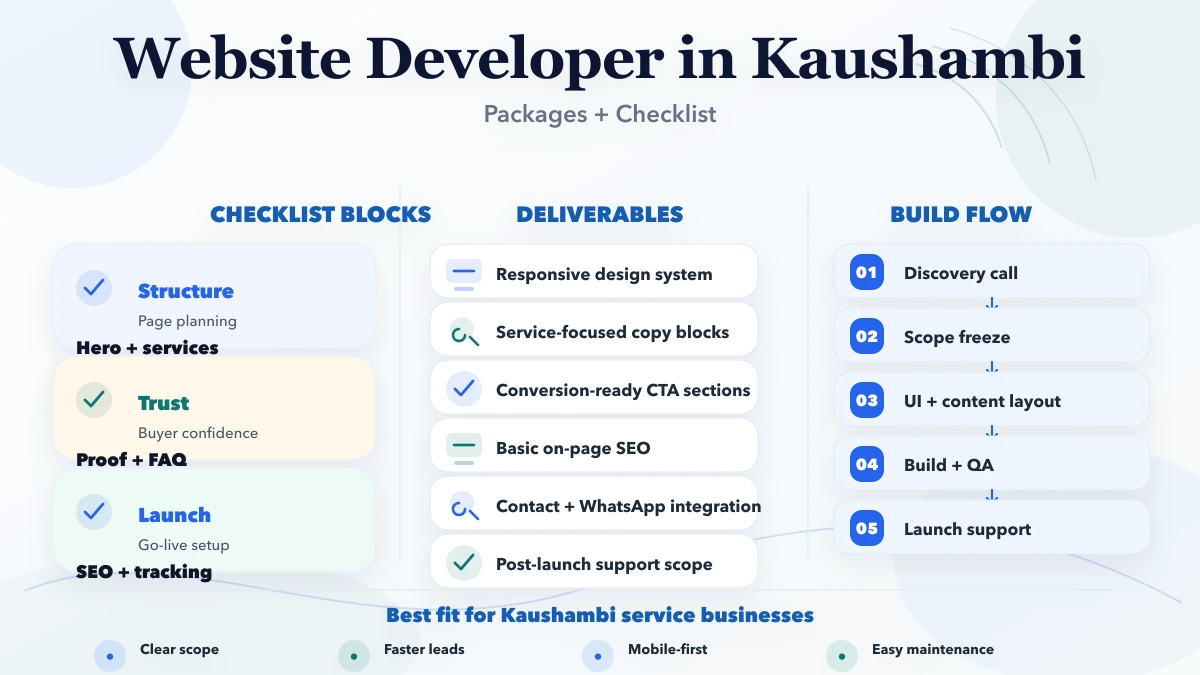
Start with:
Avoid collecting sensitive details in a general marketing form. A clinic, legal, financial, or other regulated service may need specialised privacy review and secure systems beyond a standard contact form.
Suppose a consultancy receives enquiries for three different services. Visitors use the same phone number, arrive without required documents, and assume a requested time is confirmed.
A focused website can:
This is primarily a content and routing problem. Custom scheduling becomes useful only when volume and availability rules justify it.
Use manual confirmation when:
Use live scheduling when:
For automated reminders or CRM routing, review integration services as a separate phase.
Publish:
Do not publish unsupported “best in Kaushambi” claims, copied reviews, fake awards, or client logos without approval.
Professional websites should support:
Physical access information should also be accurate. If accessibility is limited, honest instructions allow visitors to plan.
Use local context only where it helps the visitor:
Do not create near-identical pages for Kaushambi, Indirapuram, and every nearby locality unless operations differ. The location page duplication guide explains how to assess uniqueness.
Create a field-level data sheet before implementation:
| Data | Why collected | Who can access | Retention decision |
|---|---|---|---|
| Name | Identify the requester | Assigned team | Business-defined period |
| Phone/email | Confirm or clarify | Assigned team | Business-defined period |
| Service | Route the request | Relevant department | Reporting period |
| Preferred time | Schedule response | Scheduler | Until resolved plus policy |
| Free-text requirement | Initial qualification | Restricted team | Minimise and review |
The actual retention period depends on legal, contractual, and operational requirements; do not copy a generic duration without review. Delete test submissions and avoid keeping abandoned requests indefinitely.
Protect form access, use secure transmission, limit exports, and document who handles deletion or correction requests. If the service needs medical, legal, financial, identity, or other sensitive records, use a separately reviewed secure workflow rather than extending a marketing form.
Notification emails should contain only the information needed for routing. A secure admin view can be safer than distributing complete records across personal inboxes.
Appointment communication should define how a visitor can cancel or request a different time, who approves the change, and when the original slot is released. Do not expose a staff member's private calendar or send personal details in reminder URLs.
If no-shows create material cost, explain any deposit or cancellation policy before collecting payment. Keep the wording visible near the request action rather than revealing it only after submission.
Measure no-show and reschedule patterns using non-personal operational counts. If a service repeatedly needs clarification before confirmation, improve its page and form instead of sending more reminders. The goal is a better-qualified request, not simply a larger appointment total.
Cost changes with:
Ask the developer to separate the marketing website from operational scheduling. A conventional site can be delivered through website services, while complex role-based appointment operations may require a web application.
List who can request, what is collected, and when a request becomes confirmed.
Confirm address, hours, directions, access, preparation, and alternate channels.
Use realistic scenarios, invalid entries, mobile devices, and notification failures.
Confirm appointment-request, call, WhatsApp, and directions events without sending personal form data to analytics.
Check whether visitors choose the correct service and arrive prepared. Improve page content before adding more automation.
Current VASUYASHII service scope maps service qualification, request states, visit information, privacy boundary, and team routing before design. The about page provides verifiable company context, and contact is the correct place to discuss a real requirement. No local office or client outcome is implied by this guide.
Only if the connected calendar is accurate and staff follow it. Otherwise collect preferred times and confirm manually.
Yes for initial contact when monitored, but structured forms or scheduling may provide clearer data. Avoid requesting sensitive information in chat.
Confirm receipt, state that the appointment is pending or confirmed, explain the next response window, and provide a correction channel.
They help when qualifications, roles, and availability affect selection. Publish only approved and accurate information.
Yes after fees, refunds, cancellation, invoice, and confirmation rules are defined. Treat payment as a separate integration scope.
Track service-page journeys, completed request events, contact clicks, and directions actions. Never send names, phone numbers, or free-text requirements to analytics.
Write the exact state shown after a visitor submits an appointment request. Then prepare service, visit, and privacy details. Share that scope through contact to discuss the smallest reliable website or booking phase.
This page owns the professional-service appointment and visitor-routing intent. It explains request versus confirmation, suitable form fields, calendar ownership, rescheduling, accessibility, and privacy. The main website development services in Ghaziabad page covers the provider, package, evidence, and handover decision, while the Delhi NCR website development hub provides the regional parent. The RDC Raj Nagar professional-enquiry guide is the related reference for sensitive consultation intake.
VASUYASHII does not claim a Kaushambi office. Publish directions, availability, and practitioner information only when the business can verify and maintain them. Send the confirmed appointment model through the business website enquiry form.
Related Articles
April 22, 2026
Plan a Crossings Republik local-service website with trust evidence, appointment requests, review governance, mobile UX and lead ownership.
Read article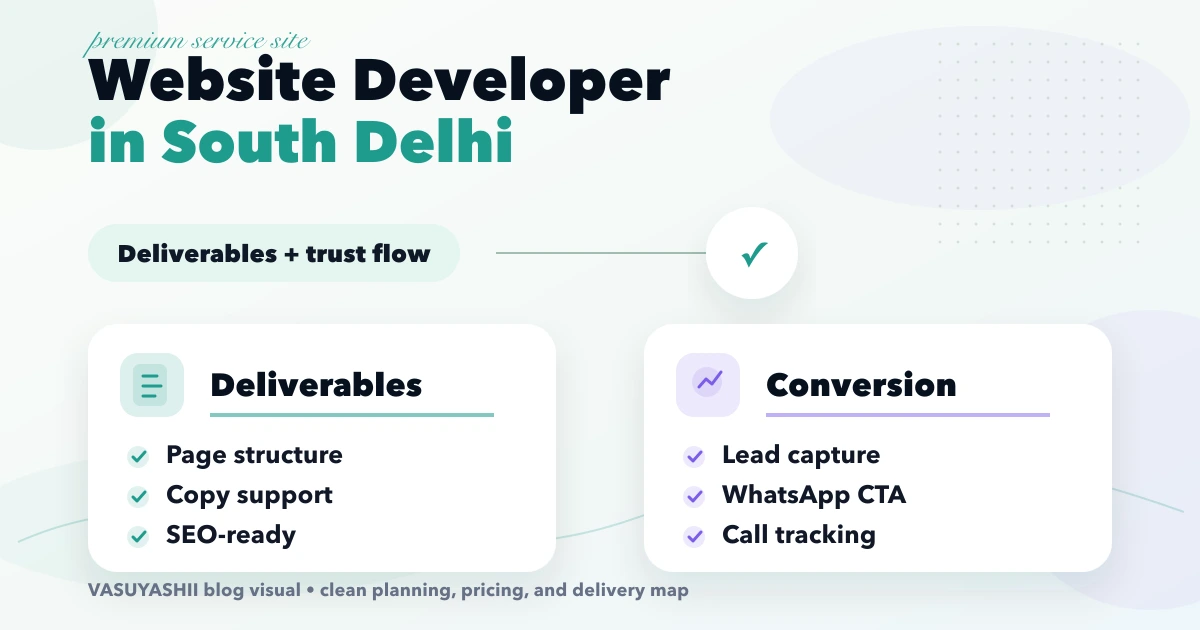
April 17, 2026
Evaluate a website developer in South Delhi with a practical guide to premium service pages, proof, ownership, lead tracking, scope, and handover.
Read article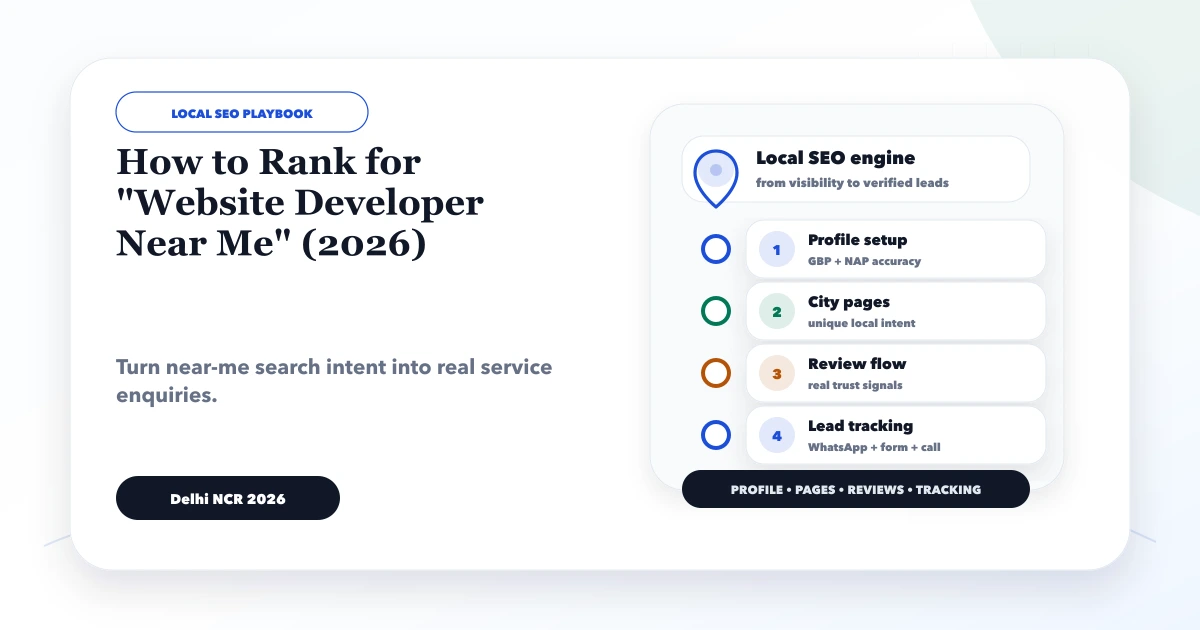
May 29, 2026
A safe near-me SEO framework for website developers using eligibility, relevance, verified business data, service evidence, reviews, links, and measurement.
Read article
May 26, 2026
Plan salon booking and staff scheduling with service duration, skills, resources, rosters, buffers, deposits, reminders, no-show controls, reports, and costs.
Read article