
April 17, 2026
Website Developer in East Delhi: Service-Area Plan
Plan an East Delhi service website with honest area coverage, mobile lead routes, page ownership, local SEO controls and developer checks.
Read articlePublished Updated
Evaluate a website developer in South Delhi with a practical guide to premium service pages, proof, ownership, lead tracking, scope, and handover.
Service-area note: VASUYASHII is based in Delhi NCR and supports businesses remotely across India. A city-focused guide describes service and planning context; it does not claim a physical office in every location mentioned.
Explore the parent topic: Website Development Delhi NCR Hub →Hiring a website developer in South Delhi is not mainly a design decision. It is a decision about how a professional service business will explain expertise, present evidence, qualify enquiries, and retain control of its digital assets. A polished homepage can still fail when the service pages are vague, testimonials cannot be verified, or every enquiry arrives without context.
This guide is for consultants, clinics, architects, legal and financial professionals, education providers, premium home-service brands, and other South Delhi businesses where trust matters before a visitor calls. It explains how to brief a developer, compare scope, review proof, and approve a launch without relying on unsupported claims.
Written by Tushar C. (Founder, VASUYASHII) and reviewed against the current VASUYASHII website-delivery process. VASUYASHII serves Delhi NCR remotely and on a project basis; this page does not claim a South Delhi office or local client result.
A strong South Delhi website brief should define five things before visual design starts:
The right developer should convert that brief into a useful information architecture, not simply place generic copy inside an attractive template.
Professional buyers often compare several providers in a short session. They are looking for answers, not decoration. A visitor may want to know whether a clinic handles a particular treatment, whether a consultant works with businesses of their size, or whether an architect has relevant project experience.
The website loses the enquiry when it creates any of these gaps:
These are content and operating problems. A new colour palette alone will not solve them.
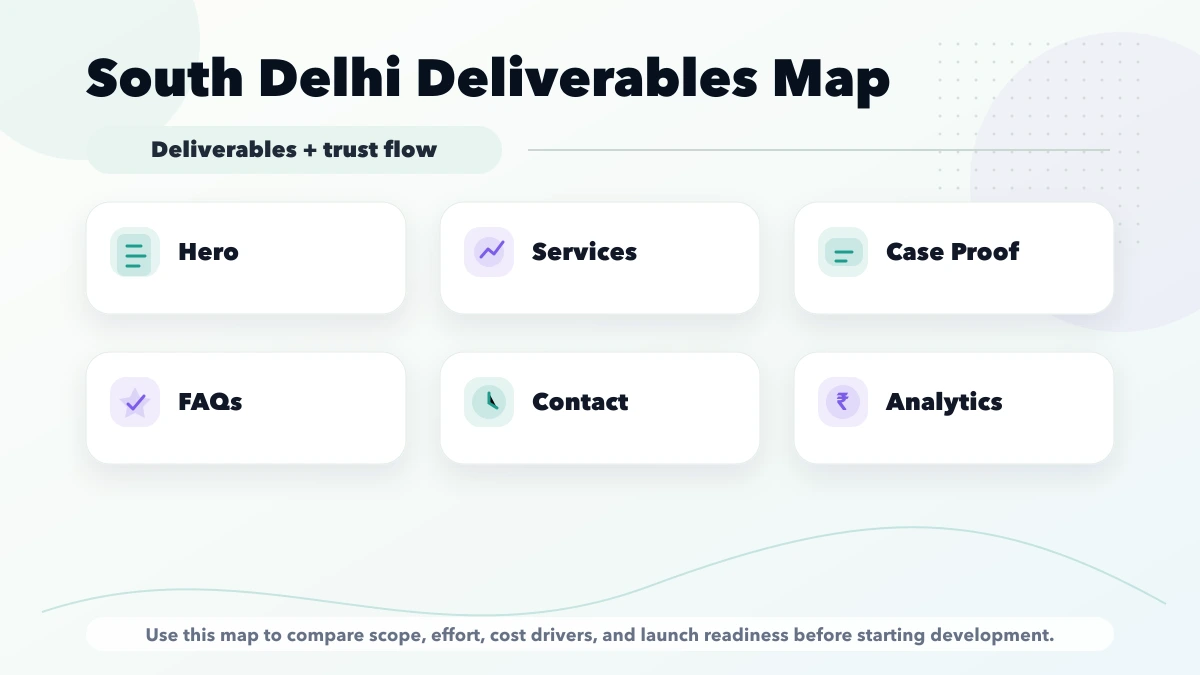
A professional-service website needs a visible chain from claim to evidence to action.
| Visitor question | Page element | Acceptable evidence |
|---|---|---|
| Do you handle my requirement? | Focused service page | Scope, exclusions, process, relevant example |
| Can I trust the people involved? | About or team section | Names, roles, credentials, real photographs |
| What happens after I enquire? | Process section | Steps, response channel, expected next action |
| Is this suitable for my budget? | Scope guidance | Package boundaries or factors that change cost |
| Can I verify your work? | Proof section | Live page, screenshot, document, or attributable review |
Do not publish a number, award, client logo, rating, or result merely because it looks persuasive. Keep only evidence the business can explain and substantiate. The broader website trust guide provides a useful review framework.
The page count should follow buyer questions rather than an arbitrary package label.
The homepage should identify the service category, intended customer, operating area, and next step. It should route visitors to detailed pages instead of trying to explain every offer in one long screen.
Create a separate page when a service has a distinct problem, process, proof set, or search intent. A legal practice, for example, should not place unrelated practice areas under one generic heading. A clinic should not combine every treatment into an unstructured list.
Show who is responsible for delivery, how the business works, and what evidence a prospect can inspect. Use the About page trust template to avoid biography-only copy.
Ask only the fields required for the first response. Service, location, preferred contact method, and a short requirement are usually more useful than a large questionnaire. The contact page conversion guide explains how to reduce friction.
Add the policies appropriate to the business and jurisdiction. At handover, verify access to the domain, hosting, analytics, Search Console, form destination, and source repository.
Too many equal CTAs make a professional website feel uncertain. Select a primary action based on how the business sells.
| Sales model | Primary CTA | Supporting CTA | Useful qualification |
|---|---|---|---|
| Consultation-led | Book or request a call | Service and preferred time | |
| Appointment-led | Request appointment | Call | Service, date, location |
| Project-led | Request a proposal | View work | Requirement, budget band, deadline |
| High-volume local | Call now | Area and service |
Track the action without collecting sensitive information in analytics. For implementation, use the SEO lead tracking guide and test every event on mobile.
A useful brief can fit on two or three pages. It should include:
The website development brief guide can be used before requesting quotes.
Do not compare only the total amount. Convert each proposal into the same scope table.
| Review area | What should be written | Warning sign |
|---|---|---|
| Pages | Named page list and templates | “Up to ten pages” without names |
| Content | Who writes, edits, and approves | Placeholder copy at launch |
| SEO | Metadata, crawlability, redirects, schema where valid | “Guaranteed ranking” |
| Conversion | Forms, CTA behaviour, event tracking | Buttons without tested destination |
| Performance | Image handling and mobile checks | Heavy effects on every section |
| Ownership | Domain, hosting, code, analytics access | Developer-controlled accounts |
| Support | Included period and response boundary | Undefined lifetime support |
If two quotes remain difficult to compare, ask both vendors to respond to the same acceptance checklist. The genuine developer verification guide covers portfolio and identity checks.
Confirm the business objective and the buyer questions. Record what will not be included in the first release.
Approve navigation, page purpose, CTA, and evidence before detailed visual work. This prevents important material from being forced into a layout later.
Write specific headings, choose evidence, and design mobile-first sections. Avoid animation that delays the first useful content.
Implement responsive pages, forms, analytics events, metadata, sitemap behaviour, and redirects. Use only the structured data supported by visible page content.
Test forms, calls, WhatsApp, keyboard navigation, mobile layouts, canonical URLs, and access ownership. Record credentials securely rather than placing passwords in chat or shared documents.
VASUYASHII can plan and build business websites, web applications, integrations, and lead measurement. The exact deliverables depend on the written proposal. Ranking positions, advertising performance, customer response time, and sales outcomes cannot be guaranteed because they also depend on competition, offer quality, reviews, media, follow-up, and ongoing marketing.
Review website development services for Delhi NCR, web application services, or contact VASUYASHII for a scoped discussion.
No. Mention a service area only when the business genuinely serves it and the information helps a buyer. Repeating locality names without unique value can create weak, overlapping pages.
No. The right platform depends on editing needs, integrations, performance requirements, team skills, and ownership. Evaluate the workflow before selecting technology.
Enough to answer distinct buyer questions. A focused firm may need a homepage, about page, several service pages, evidence, FAQs, contact, and necessary policies. Page count alone is not a quality measure.
Show prices, starting ranges, or cost factors when the business can maintain them accurately. If every project is custom, explain what changes the quote and what the discovery process covers.
No responsible developer can guarantee an organic position. A developer can implement crawlable architecture, metadata, performance improvements, internal links, and measurement; ranking also depends on demand, competition, authority, and content.
At minimum, domain and DNS control, hosting, source files or repository, CMS administration, analytics, Search Console, form destinations, third-party accounts, and a record of renewal responsibilities.
Select a South Delhi website developer by the clarity of the proposed buyer journey, evidence standard, delivery scope, and handover, not by a premium visual mock-up alone. A useful website makes expertise easier to verify, enquiries easier to qualify, and ownership easy to retain.
Related Articles
April 17, 2026
Plan an East Delhi service website with honest area coverage, mobile lead routes, page ownership, local SEO controls and developer checks.
Read article
June 6, 2026
Plan a Nehru Nagar Ghaziabad business website with verified identity, consistent local information, lead continuity, ownership, backups, and handover.
Read article
March 31, 2026
Plan a Chandigarh professional-services website with profile approvals, service ownership, enquiry routing, privacy boundaries, SEO, and content governance.
Read article
April 22, 2026
Plan a Kaushambi professional website with appointment requests, office directions, visitor routing, service qualification, accessibility, and analytics.
Read article