
June 2, 2026
Website for Small Business: Pages + Features (2026)
Website for small business guide for 2026 with must-have pages, features, lead flow, WhatsApp CTA, SEO basics, and checklist.
Read articlePublished Updated
Choose the right number of small business website pages using service intent, buyer questions, SEO value, content ownership, budget, and expansion plans.
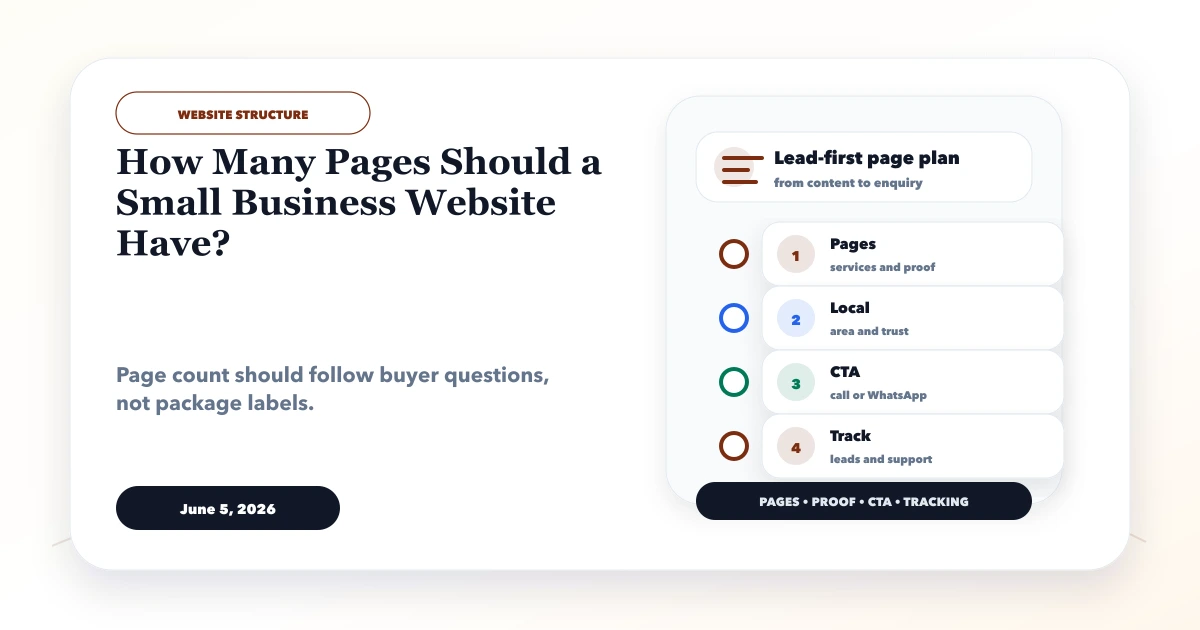
A small business website does not need a fixed number of pages. It needs enough focused pages to explain the offer, answer important buyer questions, show trustworthy evidence, and provide a clear contact path. Five useful pages can outperform twenty thin pages, while a business with several distinct services may lose enquiries if everything is compressed into one generic page.
The right page count follows the business model and content available. Decide which search intent or buyer task each page owns before deciding whether the website should have five, ten, or thirty pages.
These ranges are planning examples, not rules:
| Business stage | Typical public structure | Best fit |
|---|---|---|
| New single-offer business | 4-6 core pages | One audience, one main service, limited proof |
| Established service business | 7-15 pages | Several services, process, proof, FAQs, resources |
| Multi-service or multi-industry company | 15-30+ pages | Distinct buyer intents with maintainable content |
| Ecommerce, SaaS, school, clinic, or platform | Workflow-dependent | Categories, help, policies, portals, or programme pages |
Page count should increase only when a new page has a distinct job and enough accurate content to maintain.
Most small business websites need these foundations:
Depending on the business, Services overview, FAQ, Demos, Pricing, Support, Terms, Refunds, or Resources may also be essential.
The main decision is whether services deserve separate pages. Create a page when the service has a different buyer, problem, workflow, deliverable, proof requirement, or search intent.
For example, website development and web application development should not automatically share one page. A website buyer is evaluating public content, trust, lead capture, and search visibility. A web application buyer is evaluating login, roles, data, workflows, reports, security, and support. Combining both can make the page vague.
Separate pages are weaker when they merely repeat the same introduction and swap a keyword. In that case, use one stronger parent page with clearly labelled sections.
A focused local consultant or service provider may launch with:
This works when the services are closely related and one Services page can answer scope, exclusions, process, pricing context, proof, and FAQs without becoming confusing.
The risk is treating five pages as a package limit rather than a communication decision. If three services target different buyers, the package should adapt.
An established company with several offers might use:
The service overview helps visitors compare paths. Each child page then explains one problem deeply and links back to the parent. This structure also gives relevant articles a clear commercial destination.
Questions about the “four types of website structure” are more useful when connected to a real business decision:
Structure is not the same as page count. A five-page hierarchical site and a five-page funnel solve different tasks. Use the SEO-friendly website architecture guide before deciding URLs and navigation.
| Page count | Appropriate when | Main risk |
|---|---|---|
| 1 | One audience, one offer and one conversion action | Cannot explain multiple services or intents well |
| 5 | A focused business needs core trust and contact pages | Services may become compressed into generic copy |
| 10 | Several services need separate explanation and proof | Weak pages if content ownership is not ready |
| 20 | Distinct services, industries or resources have genuine demand | Cannibalisation and review workload |
| 50+ | Catalogue, locations, programmes or publishing are data-led | Thin templates, crawl noise and stale information |
The best number is the smallest set that completes important buyer journeys without forcing different intents onto one page. Compare the one-page versus multi-page guide and add pages only when their owner, evidence and CTA are known.
A one-page website can support a temporary campaign, event, very small validation offer, or single-purpose lead page. It becomes restrictive when the business needs multiple services, detailed proof, policy content, search landing pages, or regular expansion.
Choose one page when:
Choose multiple pages when visitors need to compare services, different search intents exist, or content owners must update sections independently.
Often need individual service pages, team/credentials, process, industries served, FAQs, resources, and contact. Claims must be evidence-safe and compliant with applicable professional rules.
May need practitioner/programme pages, appointments/admissions, policies, facilities, notices, contact, accessibility, and separate authenticated portal links. Do not expose private records through public pages.
Usually needs product overview, features or use cases, pricing, security/trust, documentation/support, login, contact/demo, policies, and status/help destinations.
Page count is driven by categories, products, search/filter states, cart/checkout, shipping, returns, privacy, terms, contact, and account flows. Not every filter should become an indexable page.
Needs service clarity, genuine coverage area, current proof, process, contact, and useful FAQs. Avoid mass city pages without local evidence.
Use this decision test:
If most answers are no, keep the service in a shared page until genuine detail exists.
Adding ten city pages does not make the business a ten-city authority. A location page should be useful because the business genuinely serves that area and can explain coverage, logistics, local process, proof, or contact context.
Do not count near-identical city pages as website depth. They create maintenance and cannibalisation risk. Start with a real service-area explanation and add location pages only when demand and evidence justify them.
Articles answer supporting questions and build topical depth. They should link readers to a relevant service or product page. A blog about admin dashboard cost cannot replace a service page that explains the actual development offer, process, boundaries, and contact route.
Plan the commercial architecture first, then use articles to answer cost, comparison, implementation, security, and decision questions around it.
Before creating a page, search the existing website for the same intent. Assign one primary URL to each commercial topic. Differentiate supporting pages by audience or decision rather than minor keyword variations.
A page inventory should track:
| Field | Why it matters |
|---|---|
| URL and proposed title | Prevents duplicate destinations |
| Primary visitor intent | Defines the page job |
| Parent page | Maintains hierarchy |
| Evidence/content owner | Prevents stale claims |
| Primary CTA | Connects content to action |
| Status and last review | Supports maintenance |
Additional pages increase more than writing volume. Each page needs content discovery, design states, responsive QA, metadata, links, image decisions, accessibility checks, analytics, stakeholder review, and maintenance ownership.
Template reuse can reduce implementation time, but content must remain specific. A quote should separate reusable layout work from unique content, proof, forms, integrations, and migration.
Do not buy a twenty-page package when the business can only approve five useful pages. Launch a coherent core and add evidence-backed pages later.
A website becomes unreliable when nobody owns prices, staff profiles, service scope, locations, notices, or policies. For each page, name a person responsible for approval and review frequency.
Time-sensitive pages need dates and expiry rules. Evergreen service pages still need review after offer, team, provider, process, legal, or pricing changes.
Every important page should be reachable through a logical path. Use the website navigation guide for global structure and contextual links for specific relationships.
A simple hierarchy is:
Home -> Services overview -> Focused service -> Relevant guide -> Contact
Breadcrumbs and the business website footer support recovery, but they do not replace links inside useful copy.
Our implementation workshop starts with business offers, buyer groups, repeated sales questions, current evidence, and required actions. We write a one-sentence job for every proposed page and reject pages that only duplicate another URL.
The deliverable is a page inventory with parent, owner, proof, CTA, and acceptance status. This is evidence of our planning process, not a promise that adding pages will create rankings or leads without demand, quality, authority, and follow-up.
It can be enough for one focused offer when the pages answer buyer questions and provide trustworthy contact paths. Multiple distinct services usually benefit from dedicated pages.
No useful page-count target exists. Publish pages that satisfy distinct user intent and can be maintained. Thin or duplicate pages can create index and quality problems.
Only when the service has distinct buyer needs, workflow, content, and evidence. Closely related offers can share a strong page.
Yes. A focused core launch followed by evidence-led expansion is often safer than publishing many weak pages at once. Preserve URL and hierarchy planning.
They are real pages requiring accurate content and implementation, even if they are not primary marketing destinations. Clarify this in the scope.
Use sales questions, search data, support issues, offer changes, and missing buyer information. Add the page only when it has a clear job, owner, and internal-link path.
Not by page count alone. Larger sites help only when each indexable page answers a distinct demand, has accurate content, receives internal links and stays maintained. A smaller coherent site is safer than a large set of near-duplicate pages.
Create a spreadsheet of current and proposed pages. Give each one a visitor question, owner, proof source, parent, and CTA. Remove rows that duplicate another page. Contact VASUYASHII for a focused website architecture plan.
Related Articles
June 2, 2026
Website for small business guide for 2026 with must-have pages, features, lead flow, WhatsApp CTA, SEO basics, and checklist.
Read article
May 20, 2026
Plan a service-business homepage that clarifies the offer, earns trust, routes visitors, proves capability, answers objections, and tracks qualified leads.
Read article
June 5, 2026
Plan a small business website around service pages, trust proof, WhatsApp and form leads, local SEO, tracking, cost, and launch priorities.
Read article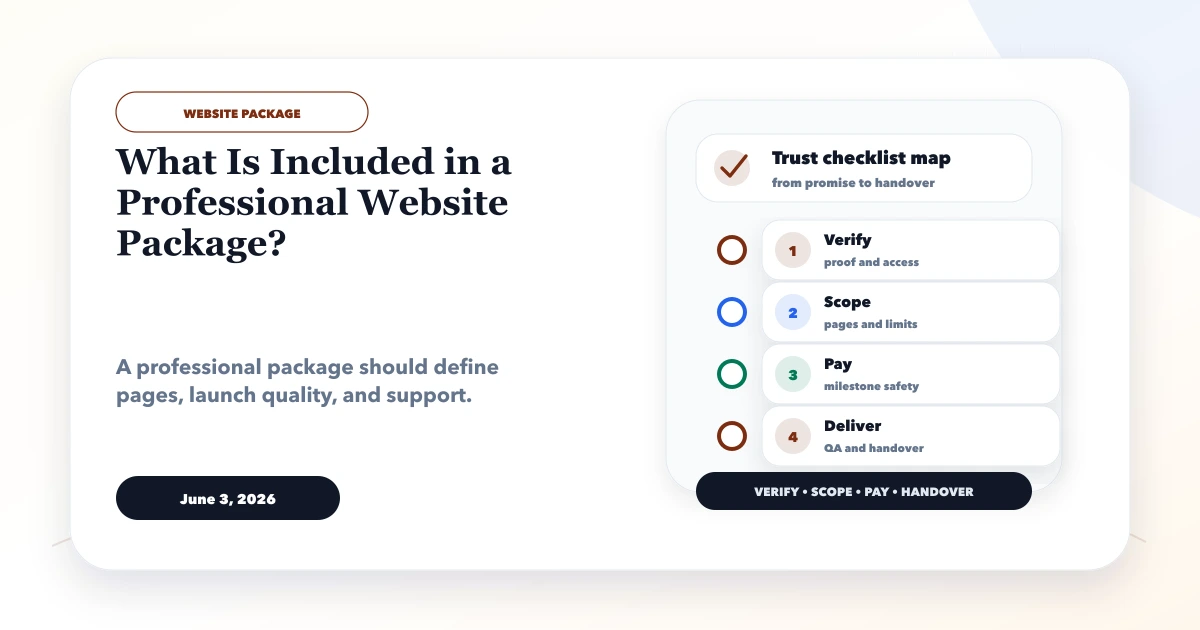
June 3, 2026
Understand professional website package inclusions across discovery, pages, content, UX, development, SEO, lead tracking, launch, ownership, and support.
Read article