
May 11, 2026
Service Page vs Landing Page: Which Ranks Better?
Compare service pages and landing pages for SEO, paid campaigns, conversions, indexing, content reuse, tracking, canonicals, and a practical hybrid strategy.
Read articlePublished Updated
Compare one-page and multi-page websites for leads, SEO, content depth, local services, cost, maintenance and growth. Use the decision matrix before building.
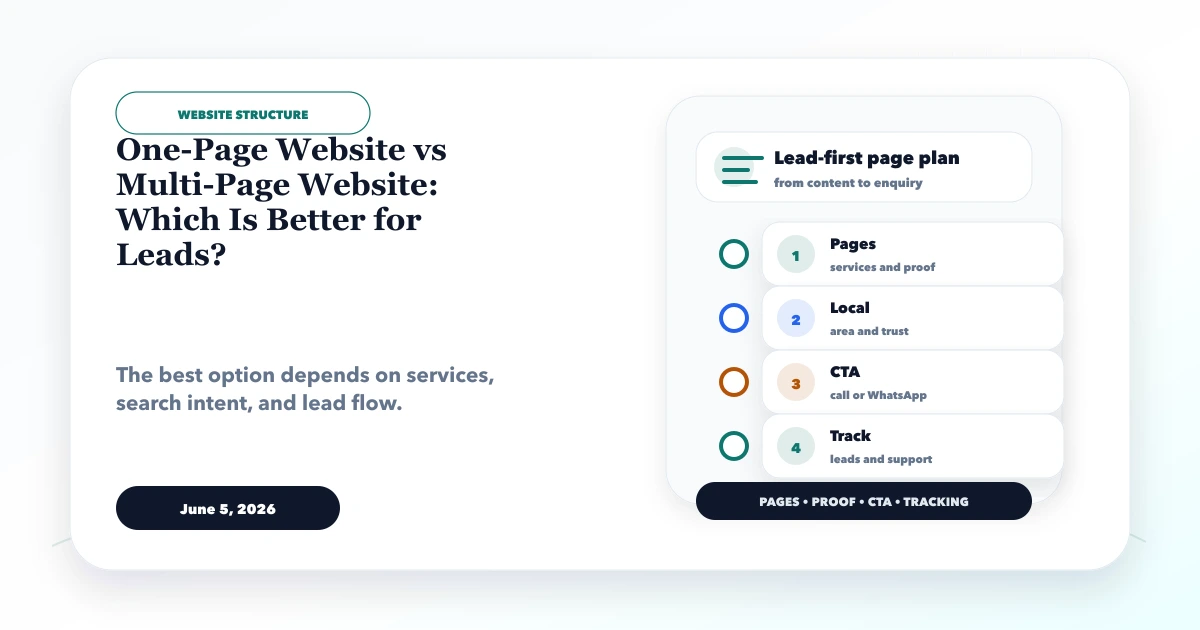
A one-page website places the main business information on one URL, usually with navigation that jumps to sections. A multi-page website assigns important services, proof, contact information, and supporting content to separate URLs. Neither structure creates leads automatically.
The right choice depends on how many buyer questions must be answered, how different the services are, whether organic search matters, how frequently content changes, and what the business can maintain accurately.
Choose a one-page website when the offer is narrow, the audience is clear, the information is limited, and traffic comes mainly from referrals, direct outreach, or one focused campaign. Choose a multi-page website when services have different intent, search visibility matters, proof needs depth, or the business expects to add locations, resources, products, or campaigns.
| Decision factor | One-page fit | Multi-page fit |
|---|---|---|
| Number of core services | One or closely related | Several distinct services |
| Search intent | One focused topic | Multiple commercial/informational topics |
| Proof | Compact summary | Separate case studies or portfolios |
| Local coverage | One clear area | Multiple genuine areas with unique value |
| Content growth | Limited | Ongoing resources or blog |
| Campaign use | Strong | Often needs focused landing pages too |
| Maintenance capacity | Very small | Defined content ownership |
| Analytics | One long journey | Performance by page and intent |
A useful one-page business site still needs a complete decision journey:
It is not simply a hero, three icons, and a WhatsApp button. Long navigation labels should scroll to stable section IDs, work with keyboard navigation, and avoid hiding headings under a sticky header.
All content can support one action. This is useful for a single consultant, event, early-stage service, or campaign with one audience.
There are fewer page templates and less navigation to plan. Cost can be lower when content is ready and functionality is simple.
The page can move from problem to proof to action without asking the visitor to choose among several routes.
A focused page can closely match one advertisement, QR campaign, referral offer, or launch message.
These benefits disappear when unrelated services are stacked into a very long page.
One URL may try to rank for website design, ecommerce, mobile apps, SEO, software, and five cities. Search engines and users receive no clear primary purpose.
A sales team cannot easily send a dedicated URL for one service explanation or case study. Section anchors help navigation but do not replace independent pages for distinct topics.
Every addition expands the same document. Large media, scripts, accordions, and animations can make the page slow or difficult to scan.
Several projects, industries, or processes may need dedicated context. Small cards can become vague.
Page-level reporting cannot show which service URL attracted or converted a visitor. Section events can help, but implementation and interpretation are more complex.
A visitor searching for inventory software can land on a page designed for that need rather than a generic “our solutions” section.
Each service can explain audience, problems, scope, process, proof, FAQs, and next steps without overwhelming unrelated visitors.
Service pages, guides, and related proof can form a useful topic path. The visitor can move from education to evaluation to contact.
Sales, WhatsApp, email, and partners can share the exact relevant page.
Traffic, search queries, CTA activity, and lead quality can be compared by page and intent.
Use the small-business website page guide to decide which pages are actually necessary.
A multi-page site needs more planning and maintenance. Weak implementations create:
More URLs are not automatically more search visibility. Each indexable page should have a useful, distinct purpose.
For organic search, separate pages are useful when they satisfy separate intents. Examples:
Do not create separate pages only by swapping the city or keyword. If the offer, proof, FAQs, and process are identical, the pages may compete or be treated as low value.
The SEO-friendly website architecture guide explains hierarchy, crawlable navigation, and internal linking.
One-page sites reduce navigation choices, but they can also force every visitor through the same sequence. Multi-page sites allow intent-specific journeys but require clear cross-page CTAs.
Ask:
The answer often leads to a hybrid structure: a multi-page business website plus focused landing pages for campaigns.
This may be sufficient when referrals are the main source and the offer is stable.
Separate services and practitioner details support trust and search intent.
Compressing technical capabilities into one page can limit qualification.
Each service should be genuinely differentiated, not generated from one template.
A one-page website can cost less because it needs fewer templates and less content. It is not necessarily cheap if it includes original visual direction, copywriting, animation, custom forms, integrations, or campaign testing.
A multi-page site costs more when each page receives proper planning, content, assets, internal links, metadata, and QA. Ask for page types and functionality rather than a headline page count. The five-page business website cost guide provides a broader quote framework.
Starting small is reasonable if future expansion is planned.
Do not copy a section into a new page and leave the same full text on both URLs.
One long page can become exhausting on mobile. Add clear section navigation only when it remains usable, keep headings descriptive, avoid excessive sticky controls, and prevent heavy media from loading at once.
Multi-page sites need a compact menu and clear breadcrumbs or contextual links. A user landing on a deep service page should understand the brand and next action without visiting the homepage first.
A freelance compliance consultant serving Delhi NCR has one defined audit service and receives leads through referrals. A focused one-page site with credentials, process, scope, FAQs, and booking may be adequate.
A hardware distributor serves dealers, contractors, and retail buyers and wants product categories, brand information, RFQ, delivery areas, and recruitment. A multi-page structure is easier to navigate, share, and extend.
These are illustrative scenarios, not reported client outcomes.
VASUYASHII chooses the smallest structure that can represent the real buyer journeys without creating thin pages. We map services, audiences, traffic sources, proof, CTAs, and future content before recommending one page or multiple pages.
Our website development service can deliver either structure. If the requirement includes login, dashboards, roles, or operational data, it should be scoped through web application development, not hidden inside a website package.
No. It can rank for a focused intent when the content is useful and technically accessible. Its limitation is serving several distinct topics through one URL.
No. Extra pages can confuse visitors when the offer is simple or the content is weak. Structure should match buyer decisions, not a page-count target.
Yes, but it then becomes a multi-route site in practice. That can be a sensible growth path: focused main page plus useful articles and utility pages.
Create a separate page when the audience, problem, scope, proof, or search intent is meaningfully different and you can maintain the page.
Yes. Campaign landing pages can serve focused traffic while the main website provides broader trust, navigation, and organic content.
Expand when users need deeper information, new services attract different searches, sales teams need shareable URLs, or analytics shows distinct journeys that deserve dedicated pages.
List your services, audiences, proof, and lead channels on one sheet. If the rows differ materially, plan a multi-page structure. If they describe one offer to one audience, begin with a focused page and a documented expansion path. Contact VASUYASHII for a page-architecture review.
Related Articles
May 11, 2026
Compare service pages and landing pages for SEO, paid campaigns, conversions, indexing, content reuse, tracking, canonicals, and a practical hybrid strategy.
Read article
March 23, 2026
Freelance developer vs agency—what’s better for your business in 2026? Compare cost, quality, timeline, SEO, support, risks, and the safest hiring strategy.
Read article
March 24, 2026
SEO setup cost for a new website in 2026 with one-time vs monthly pricing, technical SEO, on-page scope, extras, and plan selection.
Read article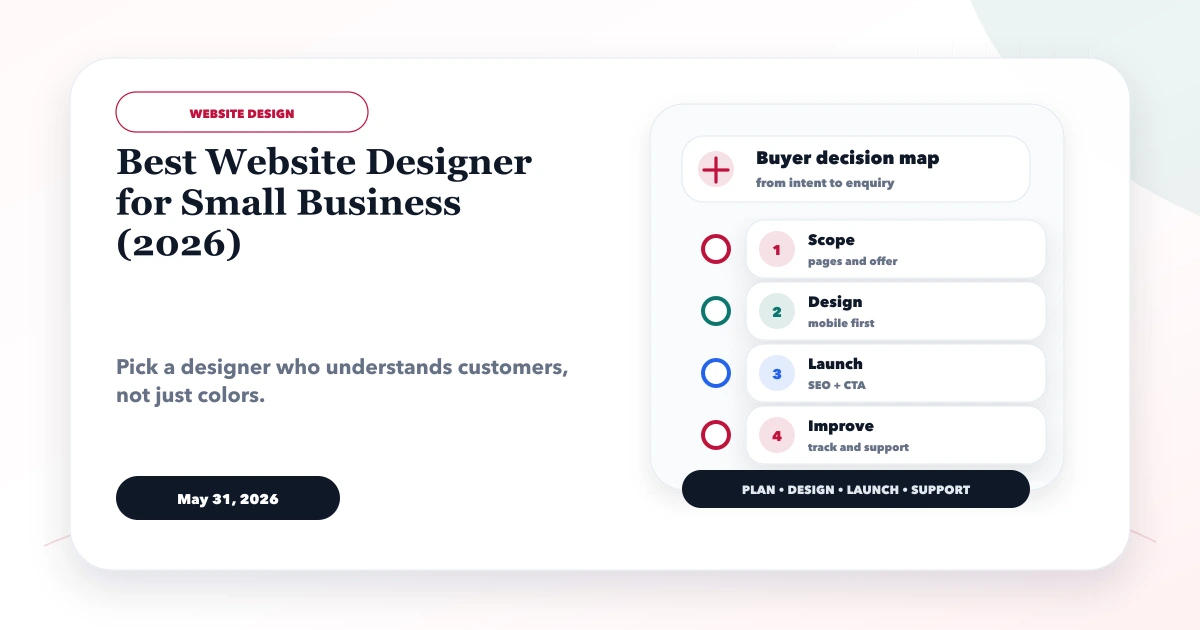
May 31, 2026
Choose the right small-business website designer using scope, lead flow, mobile UX, SEO foundations, ownership, proof, pricing clarity, and handover checks.
Read article