
March 24, 2026
Landing Page Cost in India: Scope and Pricing
Compare landing page cost in India by scope, copy, design, development, forms, WhatsApp, analytics, integrations, QA, ownership, and hidden exclusions.
Read articlePublished Updated
Compare service pages and landing pages for SEO, paid campaigns, conversions, indexing, content reuse, tracking, canonicals, and a practical hybrid strategy.
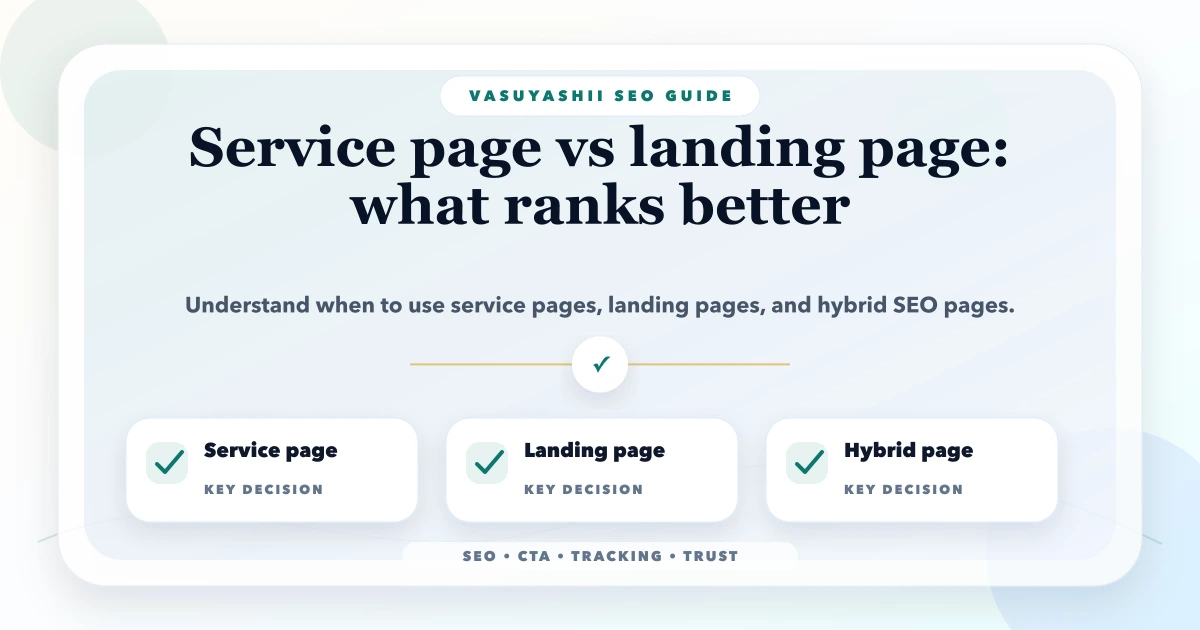
A service page usually has the stronger SEO role because it belongs to the permanent site architecture, answers broad buyer questions, receives internal links, and can build authority over time. A campaign landing page is usually stronger when one audience, offer, source, and conversion action need a focused experience.
The correct decision is not "which page type is always better?" It is whether a page is intended to become a durable search resource or a controlled campaign destination. This guide compares purpose, indexing, content, navigation, tracking, duplication, canonicals, and a practical hybrid model for service businesses.
By Tushar C. (Founder, VASUYASHII). Editorial review covers search intent, information architecture, campaign isolation, content duplication, conversion measurement, and implementation decisions.
Use an indexable service page for a stable service people search for, such as custom software development or web application development. Use a focused landing page for a defined campaign, such as a webinar, limited offer, specific ad group, downloadable checklist, or referral partnership.
Do not publish many near-identical landing pages and expect each to rank. If a campaign page does not provide unique long-term search value, keep it out of the index and point organic users to the main service page. If both pages deserve indexing, they must serve clearly different intents and contain independent value.
| Dimension | Service page | Campaign landing page |
|---|---|---|
| Primary purpose | Explain and sell a durable service | Convert one campaign audience |
| Typical discovery | Organic search, navigation, internal links | Ads, email, social, referral, QR |
| Lifespan | Long-term | Campaign or offer period |
| Navigation | Usually full site navigation | Often reduced but not deceptive |
| Content breadth | Problem, scope, process, proof, FAQs, related resources | Message match, offer, proof, objections, action |
| Indexing | Usually indexable | Depends on unique search value |
| Measurement | Qualified enquiries and organic visibility | Campaign conversion and lead quality |
| Update trigger | Service, proof, pricing or buyer questions change | Offer, audience, creative or campaign changes |
The same visual component can appear on both. Page type is defined by intent and architecture, not by whether the page has a hero and form.
A software company offers custom CRM development. Its main service page explains suitable use cases, modules, process, integration boundaries, cost drivers, proof, and FAQs. It ranks for broad service-intent searches and is linked from navigation, related blogs, and the custom software hub.
The company then runs a campaign for "CRM audit for distributors." The landing page speaks to distributor sales and collection problems, offers a defined audit, includes a relevant checklist, and sends the lead into a campaign-specific follow-up.
These pages are not duplicates:
If the campaign page only copies the service page and changes the headline, it adds little search value and creates measurement and canonical confusion.
A service page is a better organic-search candidate when:
The page should answer the decision, not repeat the keyword. Review the service page SEO template for a detailed section map.
A campaign landing page is appropriate when:
Examples include a demo registration, consultation for one industry, event follow-up, product waitlist, downloadable calculator, or partner referral offer.
Focused does not mean misleading. Keep company identity, offer conditions, privacy information, and essential trust visible.
Ask five questions:
If most answers are no, the campaign page probably should not compete in organic search. Use noindex when the page should be accessible to users but excluded from search results. Do not block a noindexed page in robots.txt before search engines can see the directive.
If the page is temporary and has no ongoing use, remove it after the campaign with an appropriate response or redirect based on whether a genuine replacement exists. Do not redirect every expired offer to the homepage.
A canonical is a hint about the preferred version of substantially duplicate content. It is not a tool for making a weak landing page rank through another page's authority.
Use a self-canonical when an indexable page is the preferred version of its own distinct content. Canonicalise a near-duplicate campaign page to the main page only when they are genuinely equivalent and you accept that the campaign URL may not be indexed separately.
Common mistakes include:
For a technical review, use the duplicate canonical guide.
A strong service page can include:
A focused landing page can include:
Do not remove important information merely to shorten a page. Conversion clarity is not the same as minimal word count.
Permanent service pages should be discoverable from the site's service hierarchy. Topic hubs and relevant articles should link to them using descriptive anchor text. The service page should link to related solutions, examples, process, and contact.
Campaign pages may use reduced navigation, but users still need identity, privacy, and a safe exit. If the page is indexable, it should not become an orphan accessible only through ads.
A practical structure is:
The internal linking plan explains how to build this graph without stuffing links.
A visitor who clicked an ad about inventory software for garment shops should not land on a general software company page. The headline, proof, scope, and CTA should continue the promise made by the source.
For organic visitors, message match means the title and opening answer the query accurately. A service page ranking for web application development should not open with unrelated company history.
Use one primary action, but support real buyer preferences. A service page can offer a project form and WhatsApp. A high-commitment landing page may offer a diagnostic call. Label the action honestly: "Request an assessment" is different from "Get an instant quote."
Form fields should support routing and qualification, not collect everything sales may eventually need. A service enquiry may ask name, company, contact, requirement, current process, and preferred follow-up. A campaign form may already know the offer and ask fewer questions.
Record:
Do not count contact_click, whatsapp_click, or form-start as a lead. Count a valid submission or meaningful conversation, then connect it to business outcome. For event design, see the lead tracking guide.
For campaign landing pages, A/B testing can compare headline, proof order, offer framing, CTA copy, or form length. Split traffic consistently, define one primary metric, and preserve the original experience for a test duration sufficient to avoid random conclusions.
For an established service page, avoid frequent URL, canonical, heading, and complete-content swaps merely to run short tests. Test components or offers while preserving the page's core intent and crawlable content.
If variants have separate URLs, manage indexing and canonicals deliberately. Do not leave expired test URLs discoverable in internal links or sitemap.
Both page types need fast rendering, stable layout, readable text, accessible forms, and clear touch targets. Landing pages often become slower because every campaign adds tracking scripts, video, chat widgets, and experiments. Service pages can become heavy with carousels and decorative animation.
Prioritise the text and action required for the decision. Delay nonessential third-party code, reserve media dimensions, compress images, and test on a mid-range phone under throttled network conditions.
A main service page often costs more to research initially because it needs durable architecture, proof, internal links, and broader buyer answers. A campaign page can be faster when it reuses a stable design system and has a clear offer.
Cost rises with:
Do not create dozens of pages without a naming, ownership, expiry, indexing, and reporting process.
Choose a service page when:
Choose a landing page when:
This lets organic authority accumulate on stable pages while campaigns remain flexible.
VASUYASHII uses permanent service pages and topic hubs for durable service discovery, while focused forms or landing experiences can support specific campaigns. We can help decide page type, content, analytics, form routing, canonical and index controls, and ongoing maintenance.
Review website development services, web application services, or contact VASUYASHII with the target query, traffic source, offer, existing page, and conversion definition.
Yes, if it is crawlable, indexable, useful, unique, supported by the site, and matches search intent. Being called a landing page does not prevent ranking; thin campaign duplication makes it a weak candidate.
It can when the page matches the ad and conversion goal. A dedicated landing page is better when the audience, offer, proof, or follow-up is materially different.
Only if they are intended for indexing as valuable canonical pages. Temporary, duplicate, or noindexed campaign URLs should stay out of the sitemap.
Not automatically. The page should be as long as needed to explain the offer, establish trust, answer important objections, and support the action without repetition.
They can mention the same topic, but two indexable pages should serve distinct intents. Otherwise they may compete, confuse internal linking, and split signals.
Link to the durable page that best completes the reader's task. Usually this is the main service page, not a temporary campaign URL.
Build service pages to become durable buyer resources. Build landing pages to convert defined campaigns. Decide indexing, canonical, internal links, measurement, and expiry before launch so the two page types support rather than compete with each other.
Related Articles
March 24, 2026
Compare landing page cost in India by scope, copy, design, development, forms, WhatsApp, analytics, integrations, QA, ownership, and hidden exclusions.
Read article
April 22, 2026
Build an SEO pricing page with clear scope, ranges, cost drivers, comparison tables, FAQs, schema boundaries, internal links, and conversion tracking.
Read article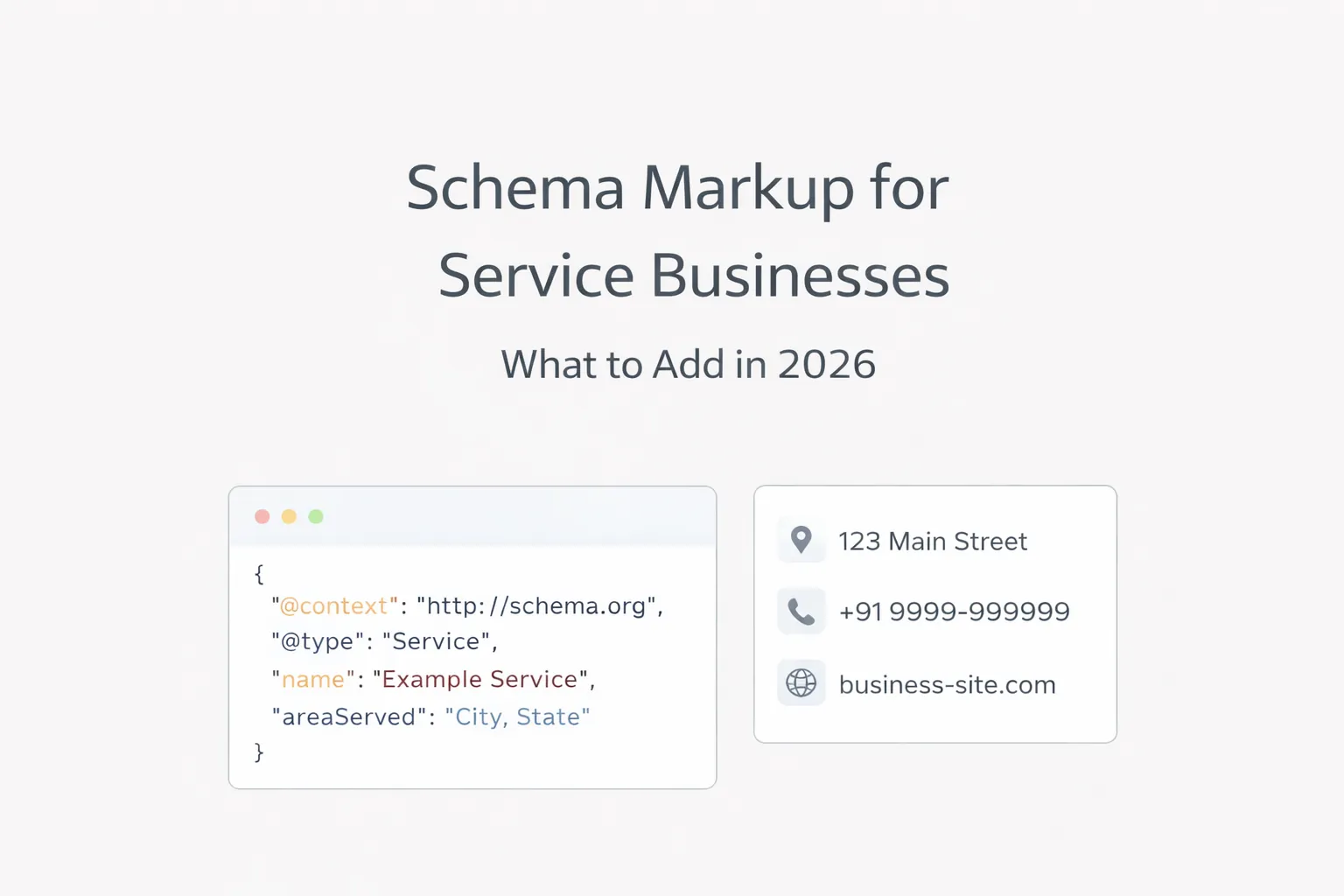
March 30, 2026
Choose valid schema for service websites using Organization, LocalBusiness, Service, Breadcrumb, Article and page-specific structured data without spam.
Read article
June 5, 2026
Compare one-page and multi-page websites for leads, SEO, content depth, local services, cost, maintenance and growth. Use the decision matrix before building.
Read article