
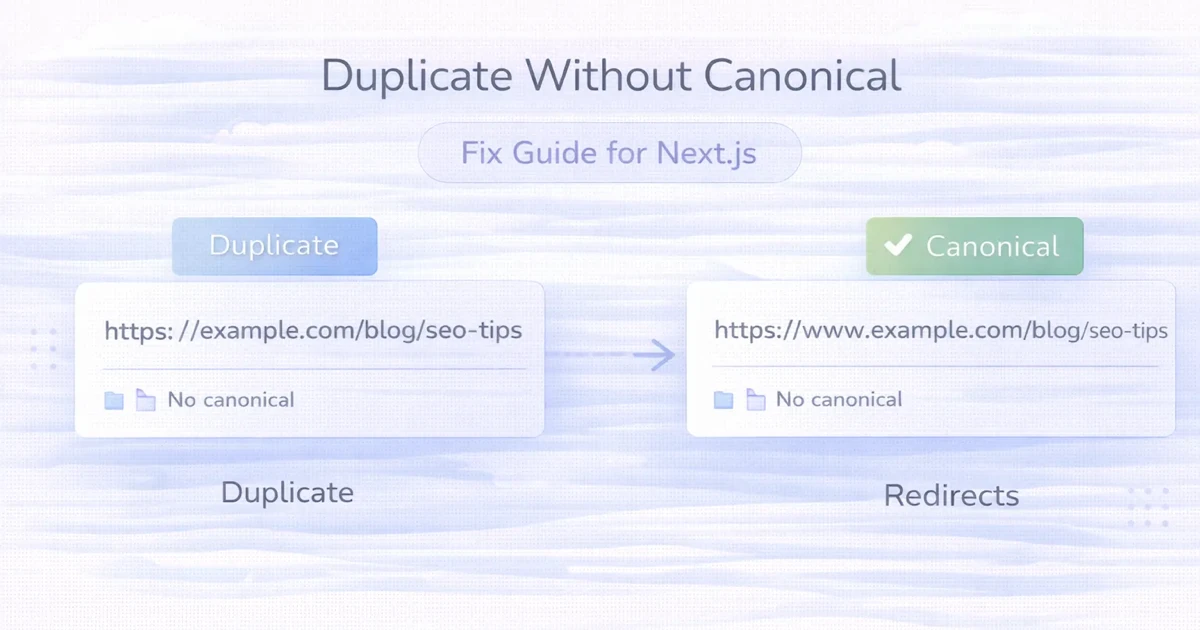
April 2, 2026
Fix Duplicate Without User-Selected Canonical in Next.js
Fix Duplicate without user-selected canonical in Next.js by aligning rendered canonicals, redirects, sitemap URLs, internal links, parameters, and final HTML.
Read articlePublished Updated
How to avoid duplicate canonical issues in Next.js with metadataBase, canonical URLs, sitemap, redirects, www consistency, and QA checks.
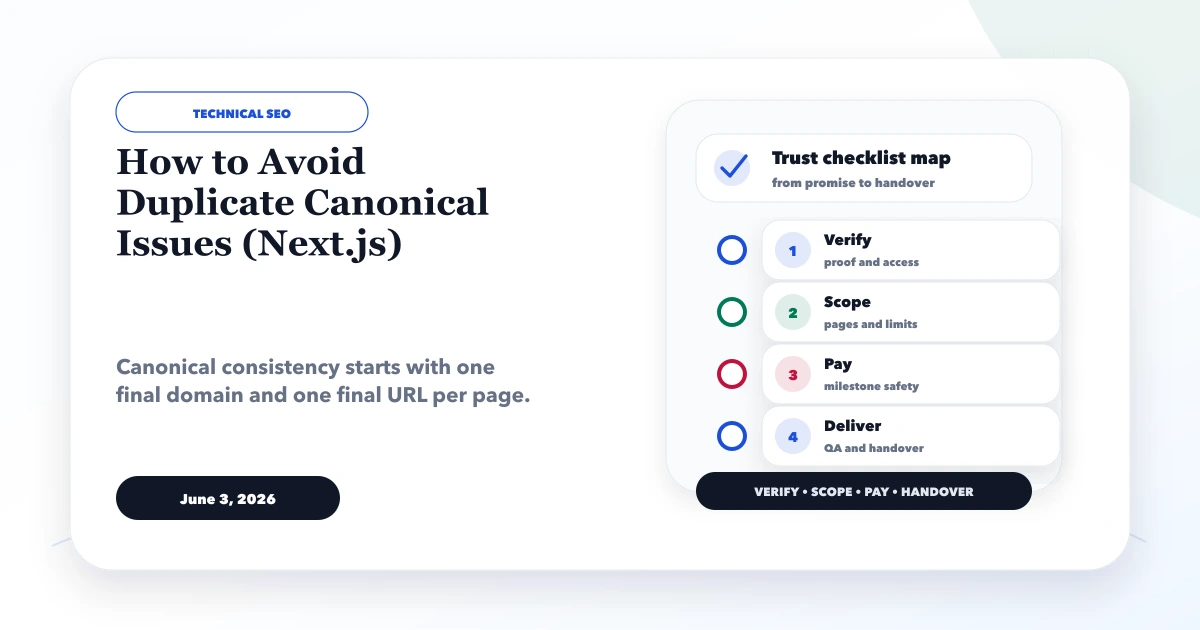
This guide explains how to avoid duplicate canonical issues in Next.js by making host redirects, route metadata, Open Graph URLs, structured data, internal links, and sitemap output agree on one final URL.
A canonical is a consolidation signal, not a repair for every weak or duplicated page. If two routes should not both exist, a redirect or content decision may be clearer. If both pages are useful and distinct, each normally needs its own self-canonical and intent.
By Tushar C. (Founder, VASUYASHII). Reviewed by VASUYASHII Editorial for practical website development, vendor verification, project scope, payment safety, launch QA, security, maintenance, and technical SEO.
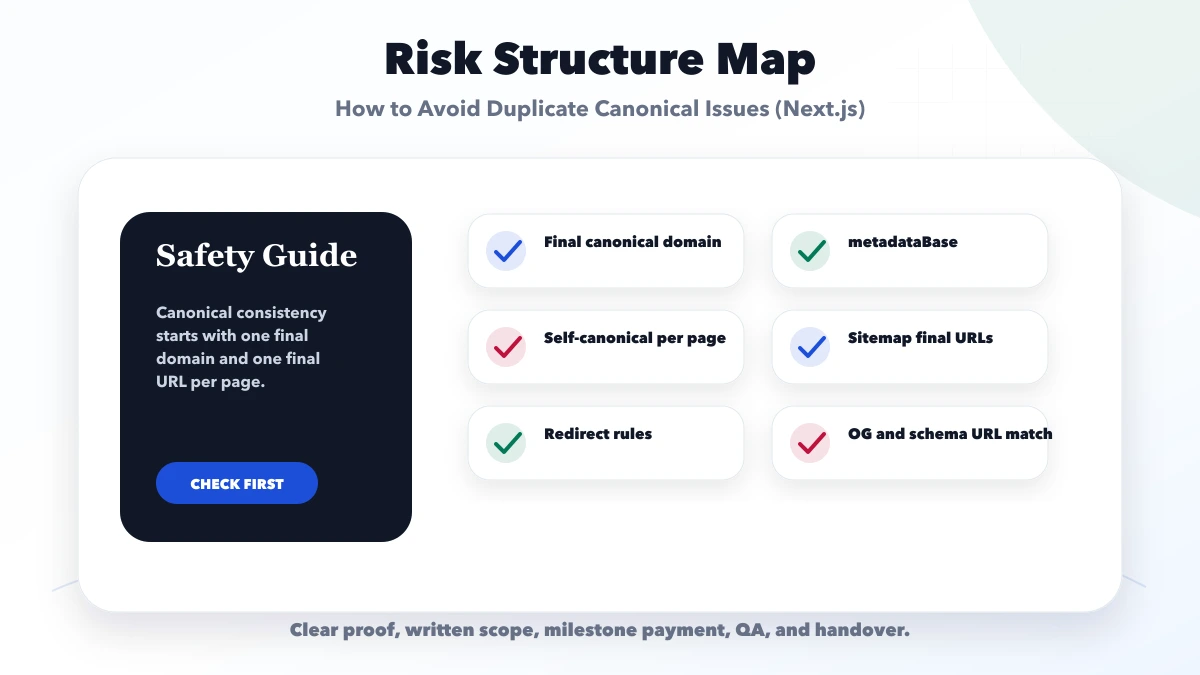
Avoid duplicate canonical issues in Next.js by using one final domain, consistent metadataBase, self-canonical URLs, matching Open Graph and schema URLs, clean sitemap URLs, direct redirects, and no mixed www/non-www internal links.
Suppose a site publishes https://www.example.com/blog/post, but the sitemap lists the non-www host, a layout sets the homepage as the Open Graph URL, and an old HTTP route redirects through two intermediates. The rendered page may still have a correct canonical, yet Google receives mixed discovery and duplication signals.
Start with the final public URL, then trace every place that can emit or reference it. The goal is one direct redirect from variants and one consistent self-canonical on the indexable destination.
Each check should be specific enough to verify. Vague statements like "SEO included", "premium design", or "full support" should be converted into page names, fields, features, timelines, access details, or support limits.
| Area | What to verify | Safe action |
|---|---|---|
| Domain consistency | HTTPS www or chosen final domain | Prevents duplicate host signals |
| Metadata consistency | canonical, og:url, schema URL | Prevents mixed page signals |
| Sitemap consistency | Only final indexable URLs | Prevents redirected URLs in sitemap |
A safe workflow does not mean slow delivery. It means the project has enough clarity that both sides can move quickly without guessing.
| Situation | Preferred action | Canonical role |
|---|---|---|
| HTTP, apex/non-www, or retired host variant | Direct permanent redirect to final host | Destination remains self-canonical |
| Old slug permanently replaced | Direct redirect to the closest replacement | Replacement remains self-canonical |
| Tracking/query parameters showing same content | Keep clean internal links; canonical to clean URL where appropriate | Consolidates parameter variants |
| Two useful pages with different intent | Keep both and differentiate content | Each page self-canonical |
| Paginated archive | Keep pages crawlable when they expose unique items | Each pagination URL normally self-canonical |
| Thin city duplicates | Review business value and consolidate or rewrite | Do not use canonical as a substitute for a content decision |
Google's duplicate URL consolidation guidance explains that redirects and rel="canonical" are strong signals, while sitemap inclusion is weaker. These signals should agree rather than point in different directions.
Set the final origin once in the root layout and define page-specific canonical paths:
export const metadata = {
  metadataBase: new URL("https://www.example.com"),
  alternates: { canonical: "/" },
};
For a dynamic article, derive the URL from the validated slug:
export async function generateMetadata({ params }) {
  const { slug } = await params;
  const path = `/blog/${slug}`;

  return {
    alternates: { canonical: path },
    openGraph: { url: path },
  };
}
The exact code depends on the Next.js version and route. Confirm behavior against the official Next.js <code>generateMetadata</code> reference, then inspect the generated HTML rather than assuming the metadata object renders as intended.
For an article, align these values:
og:url;url or mainEntityOfPage;Use absolute final URLs in canonical and structured data. Relative internal links are safe for normal site navigation and avoid accidentally hard-coding the wrong host.
Test the same path across:
http://example.com/path;https://example.com/path;http://www.example.com/path;https://www.example.com/path.Each non-final variant should reach the matching final path without a loop. Record final status, final URL, and redirect count. Hosting-platform domain settings should handle host and protocol normalization before application route logic where possible.
After a production build:
Search Console's "Alternate page with proper canonical tag" can be expected for a duplicate variant. Investigate when Google selects a different canonical for a URL that should be unique, when the canonical points to the wrong slug, or when the alternate URL is the one being promoted internally.
The current VASUYASHII site uses https://www.vasuyashii.com as the final origin. Blog canonicals are generated from validated slugs, the sitemap emits final-www URLs, and article structured data uses the same public page address. Internal navigation normally uses relative routes so a copied non-www origin does not spread through content.
This pattern also treats old-host reports correctly: the non-www URL is expected to redirect and should not be requested for indexing. Search Console may retain historical examples after the production behavior is fixed, so current live headers and generated HTML should be checked before another code change.
When URL Inspection shows a Google-selected canonical different from the declared one, compare:
Do not repeatedly request indexing while these signals conflict. Correct the source, deploy, verify the final response and HTML, then allow recrawling. A declared canonical does not obligate Google to choose a weak or substantially duplicated page.
Before changing a slug or canonical, export the affected URL list and identify incoming links, sitemap entries, navigation references, and replacement coverage. Use a direct redirect when a public URL is permanently replaced. Update internal links to the destination rather than relying on the redirect forever.
After deployment, test both the old and new paths, inspect the new canonical, and confirm that no redirecting URL remains in the sitemap. Keep a record of the change so a future content generator does not recreate the retired route.
Use this roadmap to keep risk controlled. For larger websites, add written approvals at each stage: scope, design, staging, launch, and final handover.
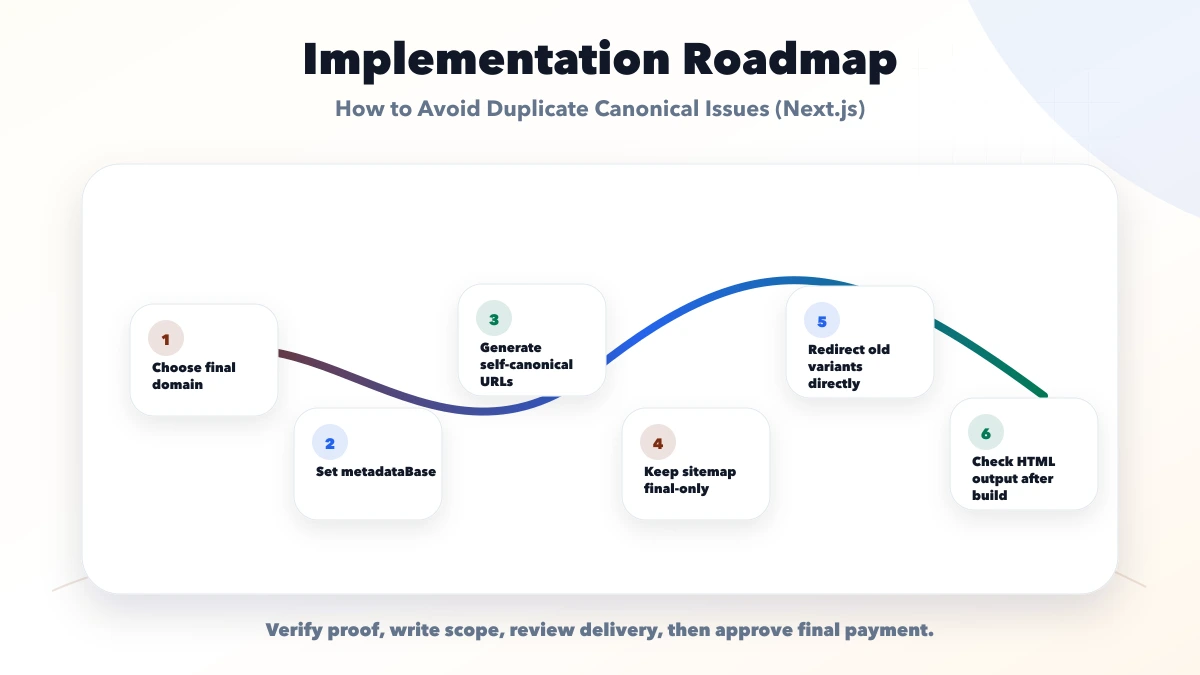
This checklist protects the project from avoidable disputes. It also gives the client a clear reason to approve, pause, or ask for clarification.
VASUYASHII would first map the business goal, scope, pages, proof, timeline, access needs, lead flow, SEO basics, and support expectations. Then we would create a phase-wise plan with clear deliverables.
Useful links: web application services, software development, integrations, services, and contact.
Avoid approving work only because it looks good in one screenshot. Real delivery includes working forms, mobile layout, SEO basics, access handover, tracking, support, and clear ownership.
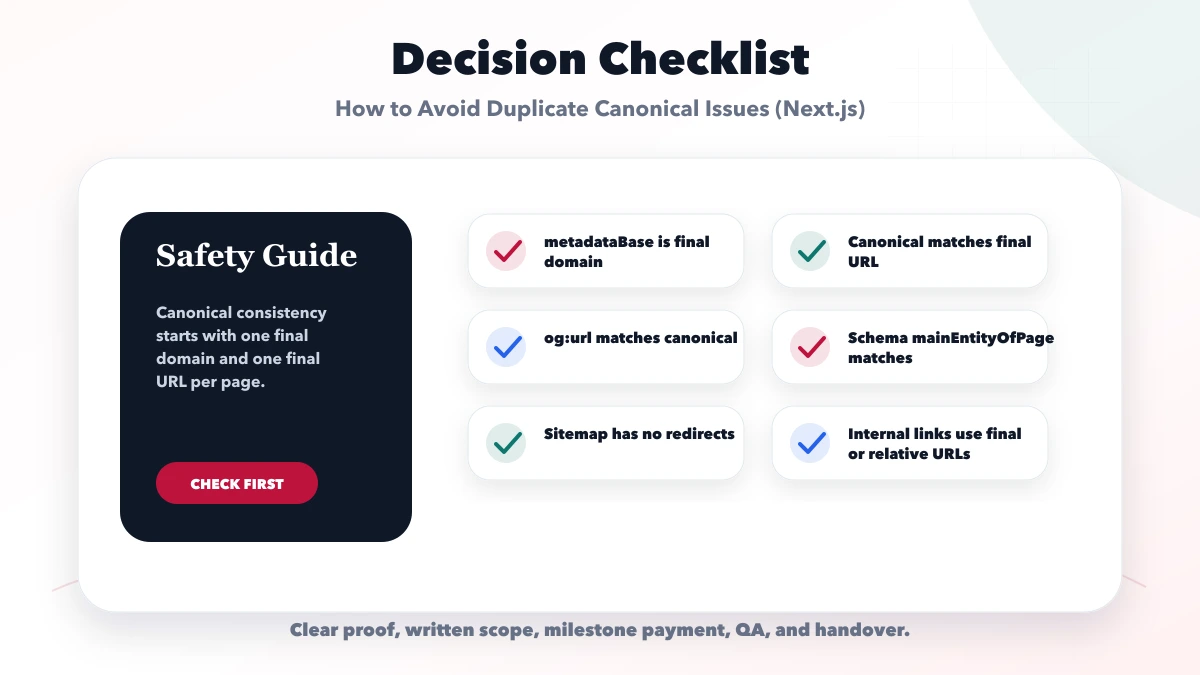
Mixed domains, wrong metadataBase, duplicate slugs, sitemap redirects, URL variants, and inconsistent structured data can cause issues.
No. It should include only final canonical URLs that return 200.
Absolute final URLs are safest for canonical, OG, and schema consistency.
No. It can be expected when Google sees duplicates that correctly canonicalize to a stronger page.
Yes. We can audit Next.js metadata, sitemap, redirects, structured data, and GSC reports.
If you want a practical plan for how to avoid duplicate canonical issues Next.js, VASUYASHII can help with scope, design, development, SEO setup, integrations, tracking, launch, and maintenance.
Related Articles
April 2, 2026
Fix Duplicate without user-selected canonical in Next.js by aligning rendered canonicals, redirects, sitemap URLs, internal links, parameters, and final HTML.
Read article
May 21, 2026
Discovered Not Indexed fix: practical 2026 guide with checklist, pricing, timeline, risks, tools, FAQs, and Indian business tips today safely before launch.
Read article
March 28, 2026
Google Search Console indexing guide for 2026: how to get pages indexed faster without spam, common issues, checks, and practical workflow.
Read article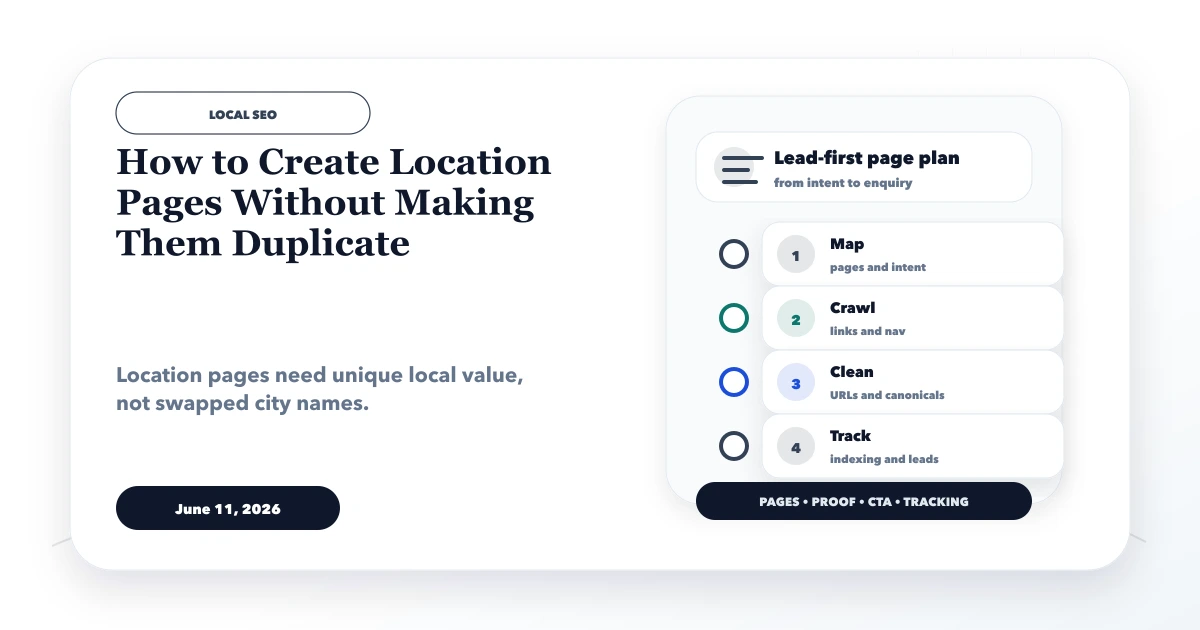
June 11, 2026
How to create location pages without duplicate content using unique local intent, services, proof, FAQs, internal links, and canonical checklist.
Read article