
May 16, 2026
SaaS Pricing Page Best Practices for 2026
Improve a SaaS pricing page with clear plans, value metrics, feature limits, billing terms, trust signals, FAQs, comparison tables, and conversion tracking.
Read articlePublished Updated
Build an SEO-friendly pricing page with clear packages or cost drivers, inclusions, exclusions, comparisons, FAQs, internal links, and qualified CTAs.
A pricing page should reduce uncertainty without pretending every customer has the same requirement. It can show fixed plans, starting prices, realistic bands, module pricing, or the variables used to prepare a quote. The right model depends on how repeatable the product or service is.
Ranking is not created by adding the word “pricing” to a heading. The page must satisfy the buyer's comparison task, remain consistent with the offer, link into the service architecture, and stay accurate after prices or scope change.
An effective pricing page includes:
If the service cannot responsibly show a fixed price, explain the estimation method and provide example bands with assumptions.
Pricing queries can mean different tasks:
Do not combine unrelated intents on one page. A SaaS product pricing page and a “custom CRM development cost” guide need different evidence and CTAs.
| Model | Best fit | What must be clear |
|---|---|---|
| Fixed plan | Repeatable product/package | Features, limits, billing period, tax, cancellation |
| Starting price | Service with a stable minimum | Assumptions and what increases cost |
| Price range | Variable but comparable projects | Scope examples and exclusions |
| Module pricing | Business software delivered in phases | Base platform, dependencies, implementation |
| Usage pricing | APIs, messages, storage, seats | Unit, included quota, overage, measurement |
| Custom quote | High-variance work | Discovery process and estimate inputs |
Avoid “Contact us for price” as the entire page. Even custom work can explain cost drivers, typical phases, and what information produces an accurate quote.
State the pricing model and audience. If prices exclude GST or third-party fees, say so near the figures.
Use descriptive names tied to outcomes rather than “Silver/Gold/Platinum.” Show who each option suits and the core limitation.
Keep rows decision-relevant. Group setup, core features, integrations, support, ownership, and limits. Avoid dozens of checkmarks without context.
Explain users, roles, pages/modules, data migration, integrations, content, design, testing, security, hosting, support, and compliance boundaries.
Separate optional work. Examples include paid APIs, gateway fees, WhatsApp usage, content writing, photography, mobile apps, desktop apps, advanced accounting, or statutory integrations.
Explain discovery, written scope, milestones, change control, acceptance, launch, and support.
Answer buyer objections and offer the correct action: start trial, choose plan, request scoped estimate, or share requirements.
For a fixed website package, define:
“Five-page website” is not enough. A page with a calculator, searchable catalogue, or account login is not equivalent to a static About page.
For software projects, price by accepted modules and workflow risk:
Use a discovery or phase-one estimate when uncertainty is high. Do not quote a full ERP from a feature-name list.
A product page can show monthly/annual billing, trial, plan limits, included support, setup/migration, cancellation, and renewal. State whether prices are introductory, early access, or permanent.
Current VASUYASHII Business Suite uses transparent early-access positioning for its current billing and inventory scope while separating custom integrations, advanced accounting, e-invoice/e-way bill work, and automation. This is a first-party example of keeping product price separate from custom implementation. See the Business Suite product page.
A pricing page should sit under the correct product or service parent. Use one primary canonical URL. Link from:
Do not create several near-identical pages such as “website price,” “website pricing,” “website package cost,” and “website development charges” without distinct intent. Consolidate or differentiate them.
Write a literal title that names the offer and pricing task. Examples:
The H1 can match closely. The meta description should explain the pricing model, inclusions, and decision value without promising a rank or lowest price.
Useful pricing content answers:
Avoid generic introductions about digital transformation. Put the answer before the company pitch.
Use structured data only when it matches visible content. A product with a genuine visible offer may use applicable Product/Offer data. A service page should not invent a fixed offer, rating, review, or price merely to qualify for rich results.
Validate JSON-LD and keep currency, availability, URL, and price consistent. Structured data does not guarantee enhanced search appearance.
A calculator can help when inputs reliably map to rules. State that the result is indicative and show assumptions. Do not request unnecessary personal data before showing the estimate.
For custom software, useful inputs may include user roles, modules, platforms, integrations, migration volume, and support. Avoid pretending a calculator can price unknown security, workflow, or legacy-system risk precisely.
Use one primary CTA per pricing state:
Give visitors a way to ask a question without forcing an account. Keep WhatsApp, phone, and form tracking distinct.
Useful proof includes real product screenshots, a live demo, written scope examples, current FAQs, verified reviews, support terms, security/ownership explanation, and an identifiable business contact.
Do not publish fake crossed-out prices, permanent countdowns, invented scarcity, unsupported customer counts, or copied competitor comparisons.
Show ongoing costs where relevant:
A low development price with unclear operations can be more expensive over a year.
Assign an owner and review date. Update the page when prices, limits, features, tax display, support, or third-party dependencies change. Preserve URL stability unless a migration is necessary.
If a plan is discontinued, explain the current option and redirect only when there is a true replacement. Do not leave stale offers indexable indefinitely.
Track:
Do not measure success only by page views. Pricing pages should improve qualification and decision speed.
If fixed pricing is impossible, still explain bands, scope units, and drivers.
Buyers compare figures that may not include the same deliverables.
Your delivery capability and ownership model may differ.
Several pages compete for one intent and become difficult to maintain.
Structured data must match what users can see.
Hosting, usage, maintenance, and support affect the real decision.
It can satisfy commercial search intent and strengthen internal architecture when it offers accurate, useful comparison information. It does not guarantee rankings.
Only when scope is repeatable. Otherwise show starting points or bands with assumptions and explain how the final quote is prepared.
State clearly whether tax is included or additional and follow applicable invoicing requirements.
Yes, when the minimum is genuinely available and the conditions are visible. Do not use a teaser price nobody can buy.
Review whenever scope, costs, limits, or policy changes and on a scheduled cadence. Display/update metadata where useful.
Share users, roles, workflows, modules, data, integrations, platforms, reports, migration, timeline, and support expectations.
Use the accurate software quote checklist and website package inclusions guide to define scope. For a written estimate, review services or contact VASUYASHII.
Related Articles
May 16, 2026
Improve a SaaS pricing page with clear plans, value metrics, feature limits, billing terms, trust signals, FAQs, comparison tables, and conversion tracking.
Read article
April 22, 2026
Build an SEO pricing page with clear scope, ranges, cost drivers, comparison tables, FAQs, schema boundaries, internal links, and conversion tracking.
Read article
March 28, 2026
How to write a service page that ranks: SEO and conversion structure, page sections, proof blocks, internal links, and mistakes to avoid.
Read article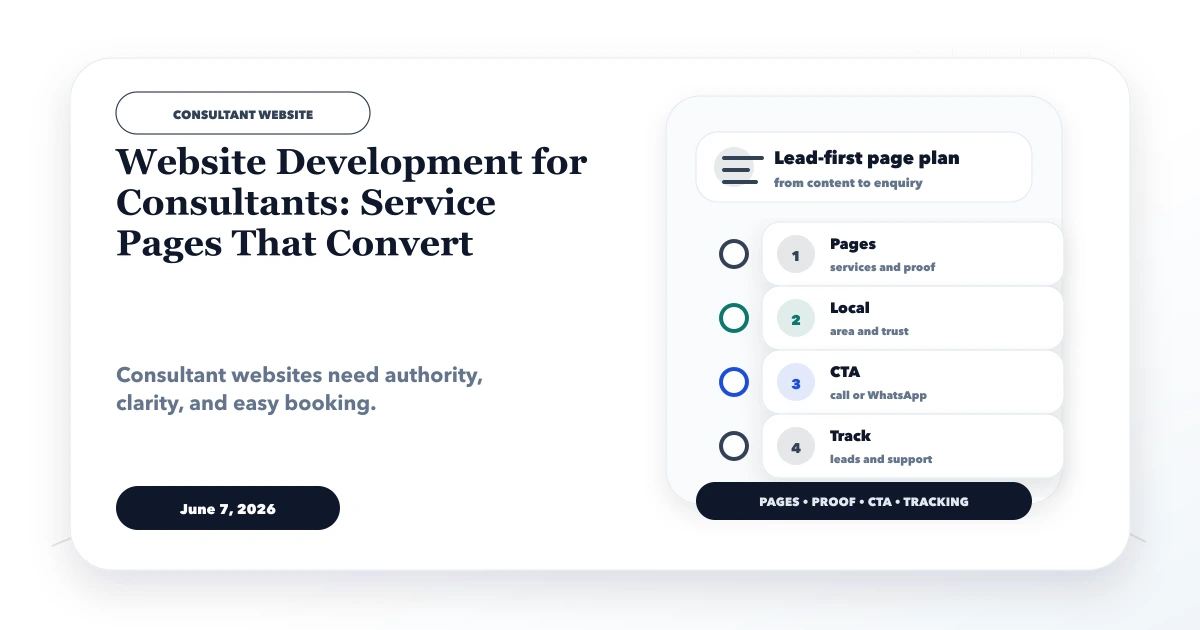
June 7, 2026
Plan a consultant website with focused offers, authority proof, service pages, case studies, qualification forms, booking flow, analytics, and SEO.
Read article