
May 11, 2026
Service Page vs Landing Page: Which Ranks Better?
Compare service pages and landing pages for SEO, paid campaigns, conversions, indexing, content reuse, tracking, canonicals, and a practical hybrid strategy.
Read articlePublished Updated
Build an SEO pricing page with clear scope, ranges, cost drivers, comparison tables, FAQs, schema boundaries, internal links, and conversion tracking.
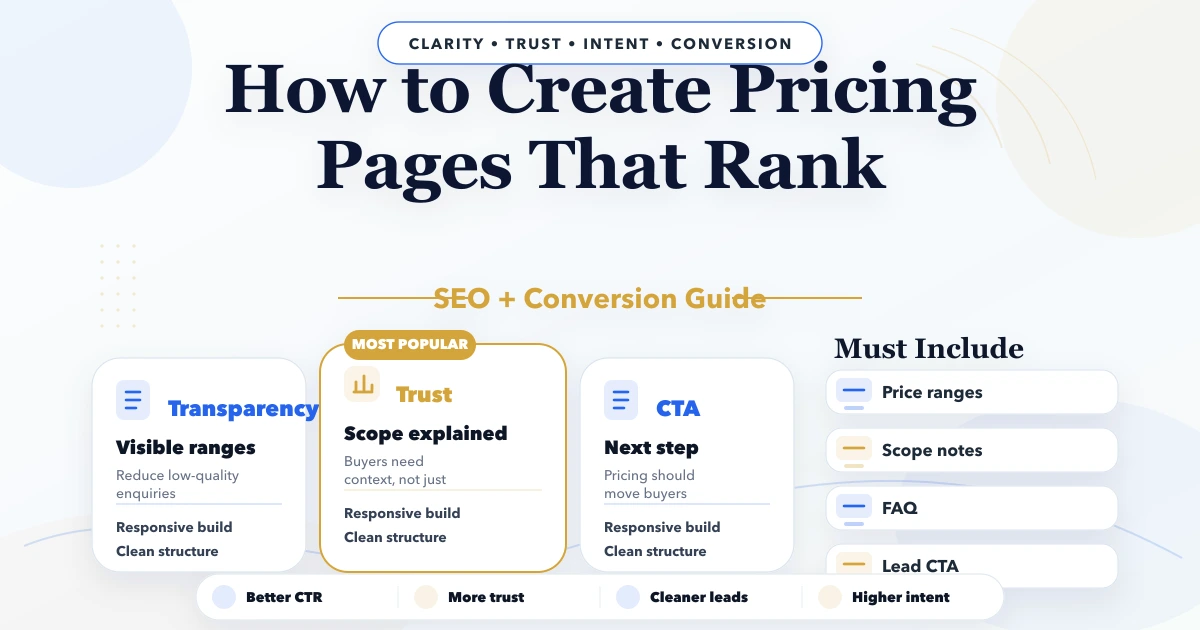
A pricing page can attract high-intent searches because the visitor is comparing budget, deliverables, and risk. It can also lose trust quickly when it hides every number, publishes unrealistic “starting from” claims, or uses the same city-and-service template across dozens of URLs.
The page should help a qualified buyer estimate fit before contacting the business. Ranking is not guaranteed by word count or schema. A strong pricing page combines one clear search intent, honest commercial boundaries, useful comparison information, internal authority, and a conversion path that respects the buyer's stage.
By Tushar C. (Founder, VASUYASHII). This guide reflects practical website and SEO implementation. Search performance depends on competition, demand, authority, page quality, technical health, and Google systems; no section below guarantees a position or indexing outcome.
An SEO pricing page should state what is being priced, who it is for, a genuine range or a transparent quote method, included and excluded work, major cost drivers, timeline factors, comparison criteria, FAQs, and the next step. Link it from the relevant service hub and supporting guides. Keep title, canonical, structured data, and Open Graph URL aligned with the final URL.
Different searches need different pages:
| Search intent | Useful page response | Wrong response |
|---|---|---|
| “website development cost” | Scope bands, page types, cost drivers | One unexplained package |
| “CRM software cost” | Ready-made versus custom, modules, users | Website design pricing |
| “landing page price” | Sections, copy, integrations, testing | Full ecommerce quote |
| “maintenance cost” | Monthly tasks, SLA, exclusions | One-time development list |
| “how to get software quote” | Requirement checklist and comparison method | Sales pitch only |
Do not combine every service into one broad cost article merely to capture traffic. A pricing page should have a primary commercial decision, while related services receive contextual links.
Before publishing a number, define the unit being sold. For a website that might be pages and integrations; for custom software it may be modules, roles, workflows, reports, migration, and support.
A useful range includes assumptions. For example: “This range covers a five-page business website using approved content, one enquiry form, responsive implementation, basic on-page setup, and one revision cycle. Copywriting, custom portal development, paid tools, and ongoing SEO are separate.” The assumptions are more valuable than a low headline price.
If the business cannot maintain public rates, explain the quote process and provide representative scope examples. “Contact for price” with no context is not buyer-friendly.
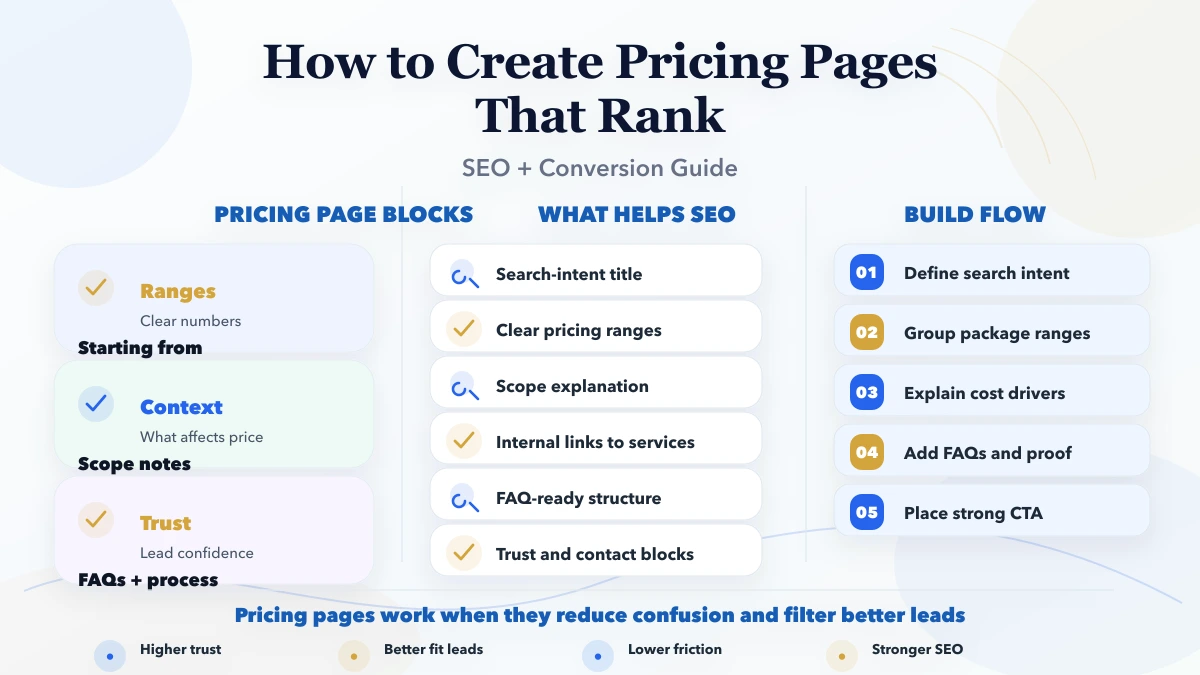
State the usual range or why a fixed range would be misleading. Name the service, market, current year when useful, and the variables that change the quote. Avoid a long company story before the answer.
Use three meaningful levels only when the business genuinely sells them. Compare deliverables, limits, timeline assumptions, support, and ideal buyer. Do not invent a “premium” tier that only changes adjective-heavy wording.
Explain how content, design, functionality, roles, integrations, data migration, testing, performance, security, and support affect effort. Buyers should understand why two proposals differ.
Make both visible. Common exclusions include domain/hosting fees, paid plugins, taxes, third-party API charges, content production, bulk data entry, legal review, ongoing marketing, and changes outside approved scope.
Describe discovery, scope approval, design, build, testing, deployment, and support. If payment terms are discussed, explain milestone logic without publishing terms the business will not honour consistently.
Link relevant services, screenshots, demos clearly labelled as demos, requirement templates, and related service pages. Proof should demonstrate capability, not fabricated customer outcomes.
Answer revision limits, ownership, hosting, maintenance, timeline, content, integrations, and support. Offer a requirement checklist or focused call instead of demanding a phone number before providing value.
Use a title that reflects the exact service and price intent, usually within the project's established source-title range. The H1 can be more natural but should not target a different service. Write a unique description that explains the decision value rather than repeating the title.
Subheadings should match buyer questions such as “What changes the cost?”, “What is included?”, and “How should quotes be compared?” Do not insert the focus keyword into every heading. Natural vocabulary helps the page cover the topic without reading like a template.
A commercial pricing page should receive links from:
It should link back to the service, supporting guides, proof, and contact path. Use descriptive anchors such as “custom software scope checklist,” not repeated exact-match anchors in every post. See the internal linking plan for service pages for a complete model.
Use Service, Product, Offer, or FAQ structured data only when the visible page supports the properties. Do not mark an approximate project range as a fixed purchasable offer. Currency, amount, availability, review, and rating values must match visible, genuine information.
FAQ schema does not guarantee a rich result. Its primary value is structured consistency; visible FAQs should remain useful even if Google shows no enhancement. Validate JSON-LD and keep canonical, Open Graph URL, and schema URL on the same final https://www.vasuyashii.com page.
Before creating another pricing page, search the site for the same service and intent. One strong “website development cost in Delhi” page may be better than separate near-identical price pages for every locality. Differentiate only when pricing, service delivery, or buyer need genuinely changes.
If two existing URLs overlap, compare GSC queries, clicks, links, leads, and content purpose before merging or redirecting. Do not use canonical tags as a shortcut for weak differentiation without understanding which page should be primary.
Pricing visitors may not be ready for a sales call. Offer several next actions:
Track valid form submission, WhatsApp click, requirement-resource use, and project-view transitions. Do not send names, phone numbers, email addresses, budgets, or free-text requirements to analytics platforms.
VASUYASHII's content architecture separates website development, web applications, and custom software, CRM and ERP. This makes cost discussions more precise because a lead-generation website is not priced like a role-based operations platform.
The software project requirement template gives buyers a way to document users, workflows, reports, integrations, and acceptance criteria before asking for a quote. That is first-party process evidence, not a promise that every project has the same cost or timeline.
No. It should provide enough information to estimate fit. A genuine range with assumptions or a transparent quote method is better than either a false fixed price or no guidance.
Long enough to answer the buyer's cost decision. Scope clarity, comparison, exclusions, proof, and FAQs matter more than a fixed word target.
A strong regional page can serve several locations when the offer is the same. Create location pricing pages only when they contain real, distinct service and commercial value.
Only if the figures are reviewed and updated. An old page labelled with a new year but containing unchanged estimates reduces trust.
Review ranges, assumptions, third-party costs, included work, screenshots, internal links, and FAQs. Display a meaningful update date only when the content changes.
Use impressions, CTR, relevant query coverage, assisted paths, qualified enquiries, and sales feedback. A traffic increase with irrelevant budget expectations is not a complete win.
Select one commercial service, collect three real past scope patterns without disclosing private client data, and write the assumptions that changed effort. That material is enough to create an honest first pricing page.
For the full implementation checklist covering packages, custom quotes, schema, conversion paths, and maintenance, continue with how to build an SEO-friendly pricing page.
Related Articles
May 11, 2026
Compare service pages and landing pages for SEO, paid campaigns, conversions, indexing, content reuse, tracking, canonicals, and a practical hybrid strategy.
Read article
May 10, 2026
Build an SEO-friendly pricing page with clear packages or cost drivers, inclusions, exclusions, comparisons, FAQs, internal links, and qualified CTAs.
Read article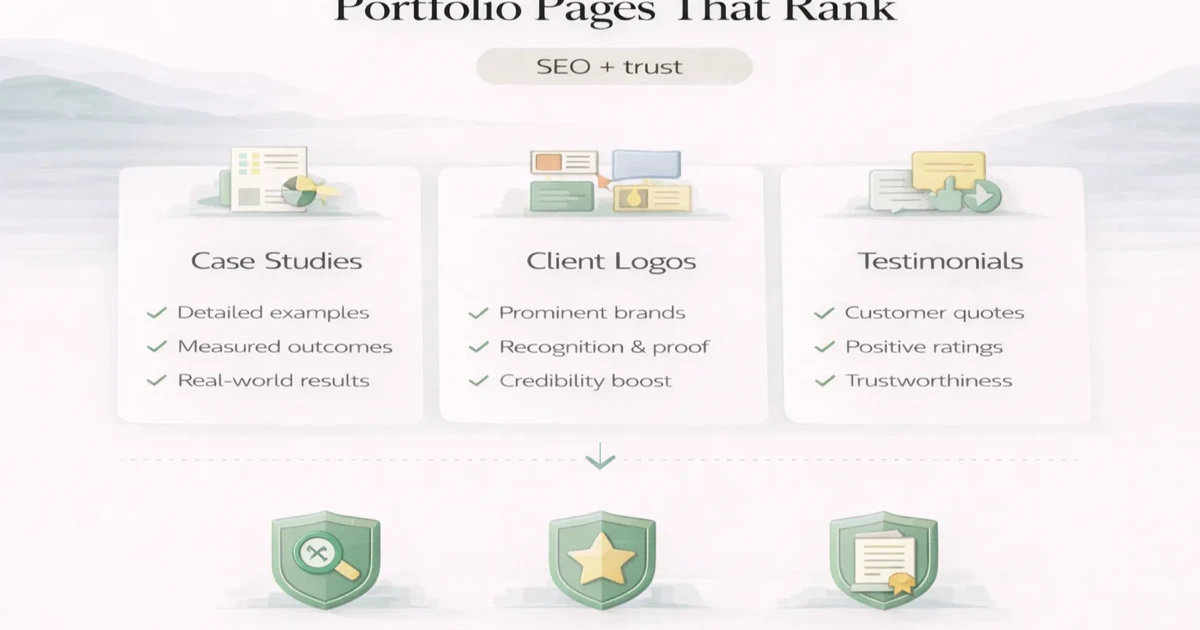
April 6, 2026
Plan portfolio pages that support SEO and buyer trust with verified evidence, clear indexing rules, useful project detail and honest lifecycle management.
Read article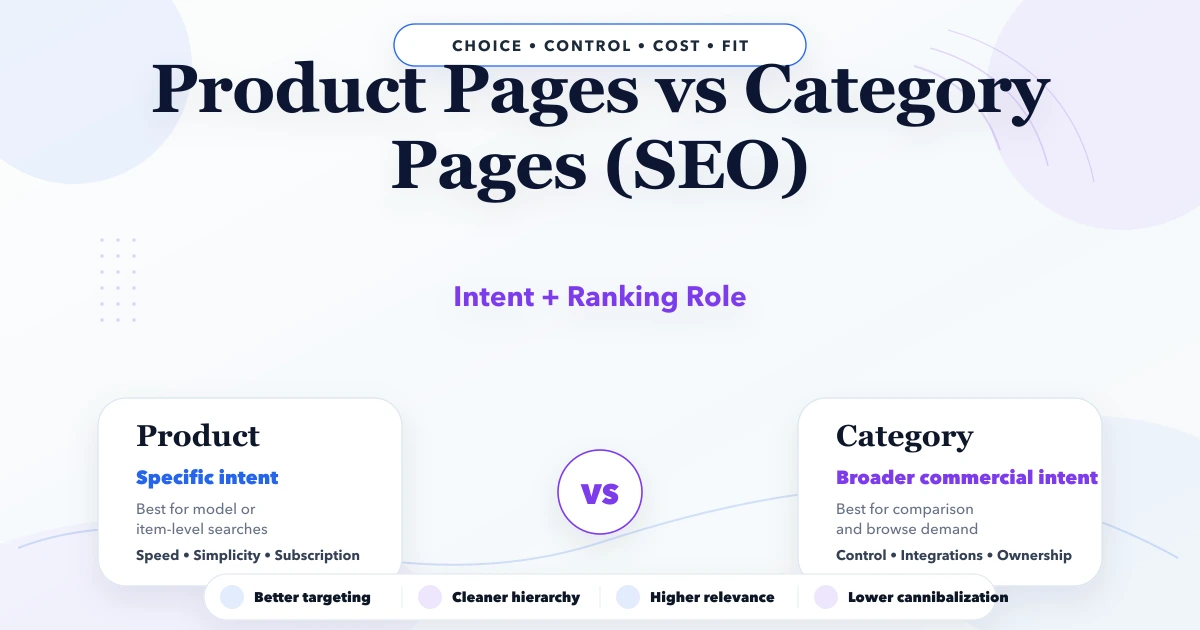
April 28, 2026
Product pages vs category pages SEO: intent, internal linking, pricing, structure, and practical decision framework for ecommerce growth.
Read article