
May 20, 2026
Service Page SEO Template: Rank and Convert
Use this service page SEO template to structure search intent, proof, FAQs, internal links, conversion CTAs, local relevance, tracking, and content updates.
Read articlePublished Updated
Use this service page SEO template to structure intent, headings, proof, process, pricing context, FAQs, internal links, and conversion-focused CTAs.
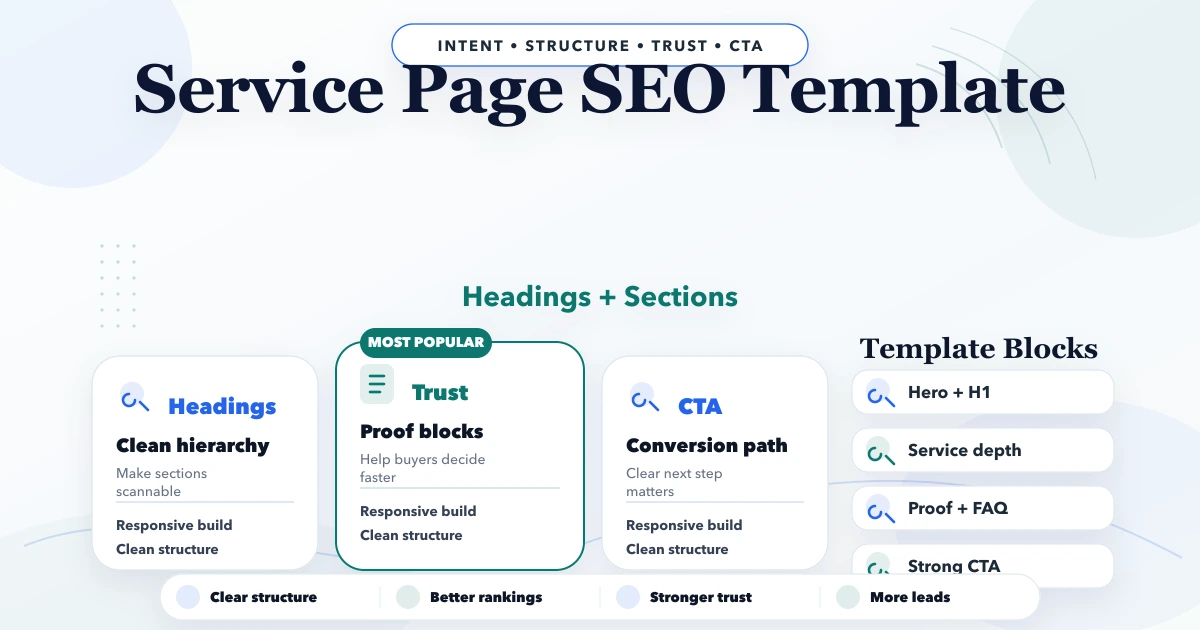
A service page has two jobs: satisfy a specific commercial search intent and help a qualified visitor decide what to do next. A page that only repeats keywords cannot do either. It needs a clear offer, evidence, scope boundaries, process, decision guidance, and a conversion path.
This template is for service businesses and software companies creating or rebuilding a core money page. It shows what each section must answer, how H2 and H3 headings should support the decision journey, and how to avoid turning city and service variants into duplicate pages.
By Tushar C. (Founder, VASUYASHII). Reviewed by VASUYASHII Editorial for practical scope, pricing, implementation clarity, and local business relevance.
The fastest safe route is to fix structure before chasing shortcuts: improve page intent, internal links, headings, schema, crawl paths, and proof signals.
| Work type | Typical cost | Timeline |
|---|---|---|
| Basic audit and fixes | ₹8,000 to ₹20,000 | 3 to 7 days |
| Content + internal link cleanup | ₹20,000 to ₹55,000 | 2 to 4 weeks |
| Full SEO system setup | ₹55,000 to ₹1.5 lakh+ | 4 to 8 weeks |
Review the page as a buyer, an editor, and a search crawler. The buyer checks fit, evidence, risk, and next step. The editor checks whether claims, prices, screenshots, and links can stay current. The crawl review checks canonical URL, metadata, headings, schema, sitemap discovery, and parent-child internal links.
Use Search Console data after publication to separate an indexing problem from a click or intent problem. Impressions with weak CTR call for title and snippet work; rankings with irrelevant queries call for clearer intent; no discovery calls for crawl-path and sitemap checks.
A practical SEO implementation should include:
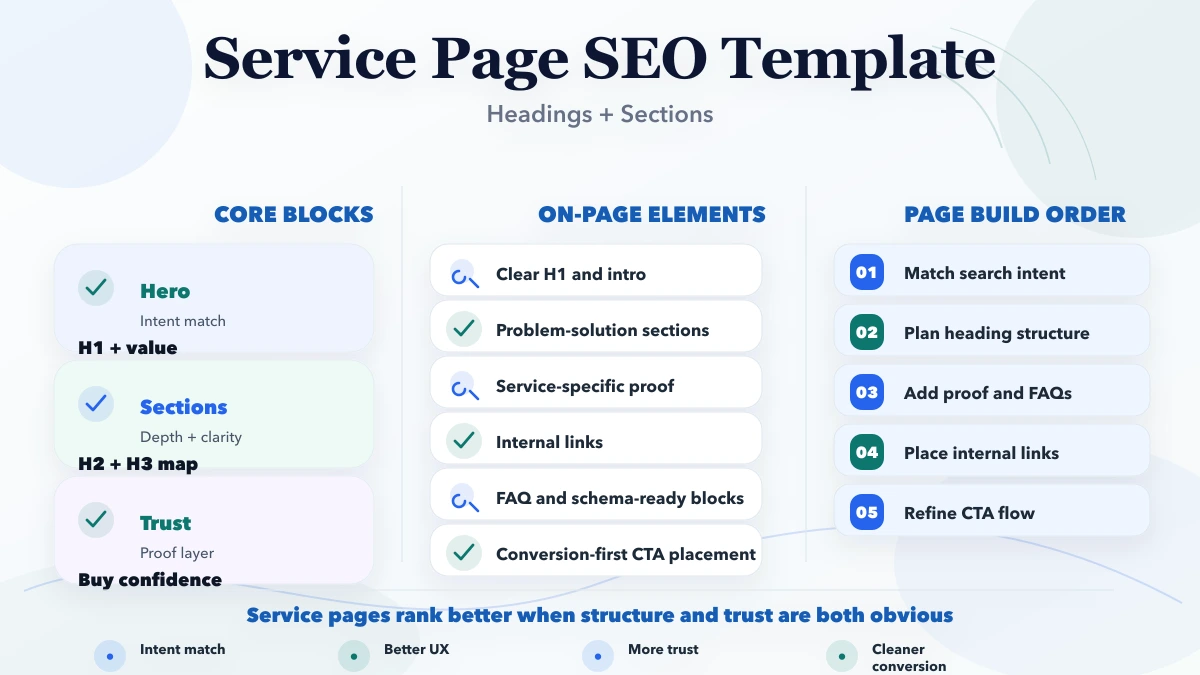
Use the following sequence as a decision framework, not a rigid visual template:
The sections should follow how a buyer evaluates risk. A visitor usually wants to know whether the service fits, whether the provider can deliver, what the engagement involves, and what happens next.
| Heading level | Example | Question answered |
|---|---|---|
| H1 | Custom CRM Development for Indian SMEs | What exact service is this? |
| H2 | Who Needs a Custom CRM? | Is this relevant to my situation? |
| H2 | CRM Modules and Deliverables | What will I receive? |
| H3 | Lead Assignment and Follow-up | How does one module work? |
| H2 | Implementation Process | How will the project run? |
| H2 | Cost and Timeline Factors | What changes the quote? |
| H2 | FAQs | What concerns remain? |
Use one H1. Use H2s for major decision sections and H3s only to divide a real subsection. Do not add headings merely to insert keyword variants.
The first paragraph should give a direct answer in plain language. Then clarify the target customer and outcome. For example, a page about CRM development should not open with a history of customer relationship management. It should explain what the system manages, which businesses need custom workflows, and what the reader will learn about modules, integrations, cost, and rollout.
Include a limitation early when it prevents poor enquiries. A custom build may not suit a small team whose process already fits an affordable ready-made CRM. Honest fit guidance improves trust and saves sales time.
“We deliver quality solutions” is not proof. Better evidence includes a working demo, a named process, an anonymized workflow example, an interface screenshot with context, a measured result that can be substantiated, or a detailed explanation of how the team handles migration and support.
Match proof to the service. A restaurant demo does not prove ERP implementation ability. If client names or metrics cannot be published, show the decision process, testing method, deliverable sample, and product evidence you can verify.
Explain what changes the estimate: number of pages or modules, content readiness, integrations, user roles, migration, reports, approvals, testing, training, and support. A range is useful only when its assumptions are visible.
For a website, separate design/content scope from development and recurring costs. For software, separate discovery, first release, integrations, migration, and maintenance. This helps buyers compare proposals that otherwise use the same package name for different work.
Link to pages that reduce the next decision. A core service page can link to a related product or demo, a process or cost guide, one relevant case or project proof, and the contact route. Supporting blogs should link back to the strongest parent service page using natural anchors.
Avoid adding a long unrelated blog list. Internal links should explain relationships: a security article supports web app development; an implementation-cost guide supports software development; a local hub supports a relevant service-area page. Review the internal linking plan for service pages and the main software development service for practical pathways.
A location page needs unique service evidence or decision value: actual service coverage, local customer types, delivery model, travel or onsite expectations, relevant proof, and local questions. Replacing only the city name creates duplicate intent and weakens the cluster.
If there is no unique local value, keep one strong regional service page and mention supported areas naturally. When a separate page is justified, connect it to the parent service page and avoid competing for the exact same query.
The fastest safe route is to fix structure before chasing shortcuts: improve page intent, internal links, headings, schema, crawl paths, and proof signals.
| Work type | Typical cost | Timeline |
|---|---|---|
| Basic audit and fixes | ₹8,000 to ₹20,000 | 3 to 7 days |
| Content + internal link cleanup | ₹20,000 to ₹55,000 | 2 to 4 weeks |
| Full SEO system setup | ₹55,000 to ₹1.5 lakh+ | 4 to 8 weeks |
The page needs editable content, stable URLs, page-level title and description control, self-canonical metadata, responsive images, and crawlable links. Use appropriate schema only when the visible page supports its properties. GA4 can measure CTA interaction, while Search Console shows queries, impressions, clicks, and indexing state.
Cost changes with the number of money pages, search-intent research, subject-matter interviews, proof collection, copywriting depth, design changes, schema, analytics events, internal-link cleanup, and technical corrections. Rewriting one established page is a different engagement from creating a service architecture and consolidating overlapping pages.
VASUYASHII serves relevant businesses across Delhi NCR, but a service page should mention a location only when delivery, evidence, or buyer questions genuinely differ. Regional coverage is not a reason to publish copied city variants.
Before comparing SEO or content proposals, identify the page’s primary query, parent service, conversion action, available evidence, overlapping URLs, and post-launch measurement owner. These inputs make deliverables and estimates comparable.
This template is designed for a durable service resource. Use the service page vs landing page guide before reusing it for paid campaigns, because index controls, message match, navigation, tracking and expiry may need a different treatment.
Start by writing the one-sentence search intent, identifying the strongest existing URL, and collecting the sales questions and proof needed to answer that intent. Then build the outline.
For focused SEO cleanup, small engagements can start around ₹8,000 to ₹20,000, while deeper strategy and implementation costs more.
Simple scopes can move in days or a few weeks. Multi-module systems or deeper SEO work need phased timelines.
Use a reusable content structure, but do not reuse the same claims and examples. The visible copy must reflect this service’s buyers, scope, process, evidence, risks, and decision criteria.
Avoid vague scope, duplicate content, missing tracking, no owner dashboard, and launching without a clear support plan.
Yes. A clean first phase can expand into more pages, modules, integrations, automation, and reporting.
For a focused service-page plan, share the target service, existing URL, priority region, buyer questions, available proof, competing pages, and desired lead action. VASUYASHII can map the recommended outline and implementation scope.
Related Articles
May 20, 2026
Use this service page SEO template to structure search intent, proof, FAQs, internal links, conversion CTAs, local relevance, tracking, and content updates.
Read article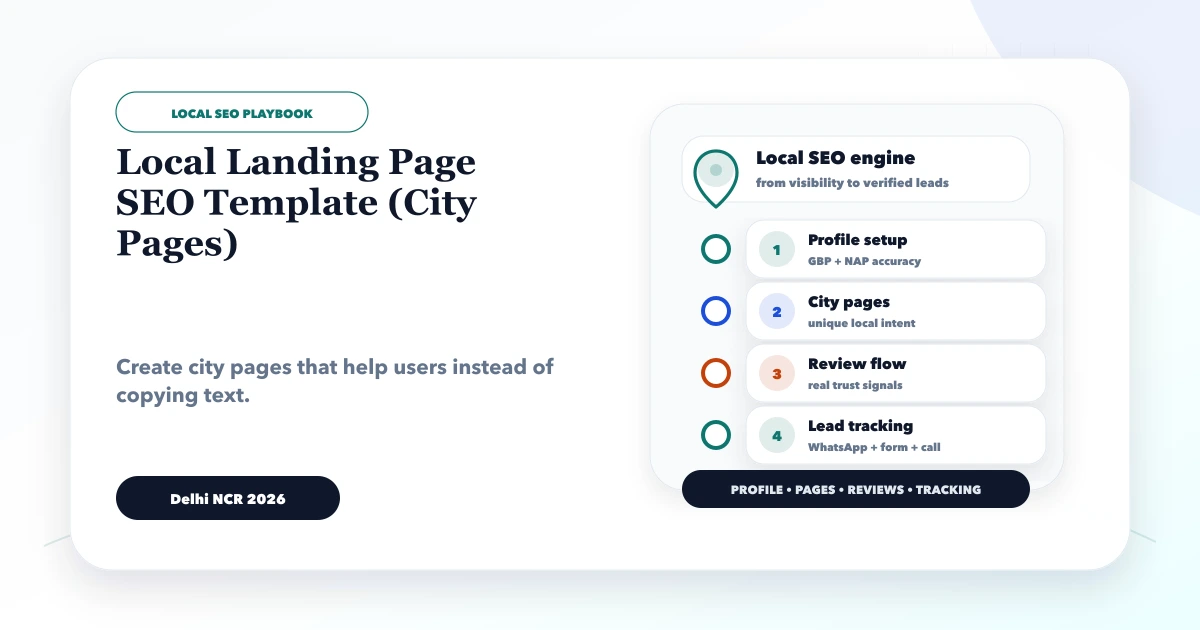
May 29, 2026
Local landing page SEO template for city pages: title, intro, service scope, local proof, pricing, FAQs, internal links, CTA, and spam checks.
Read article
March 28, 2026
How to write a service page that ranks: SEO and conversion structure, page sections, proof blocks, internal links, and mistakes to avoid.
Read article
June 4, 2026
How to write service page content that ranks with search intent, headings, proof, FAQs, internal links, CTA, and content checklist.
Read article