
May 29, 2026
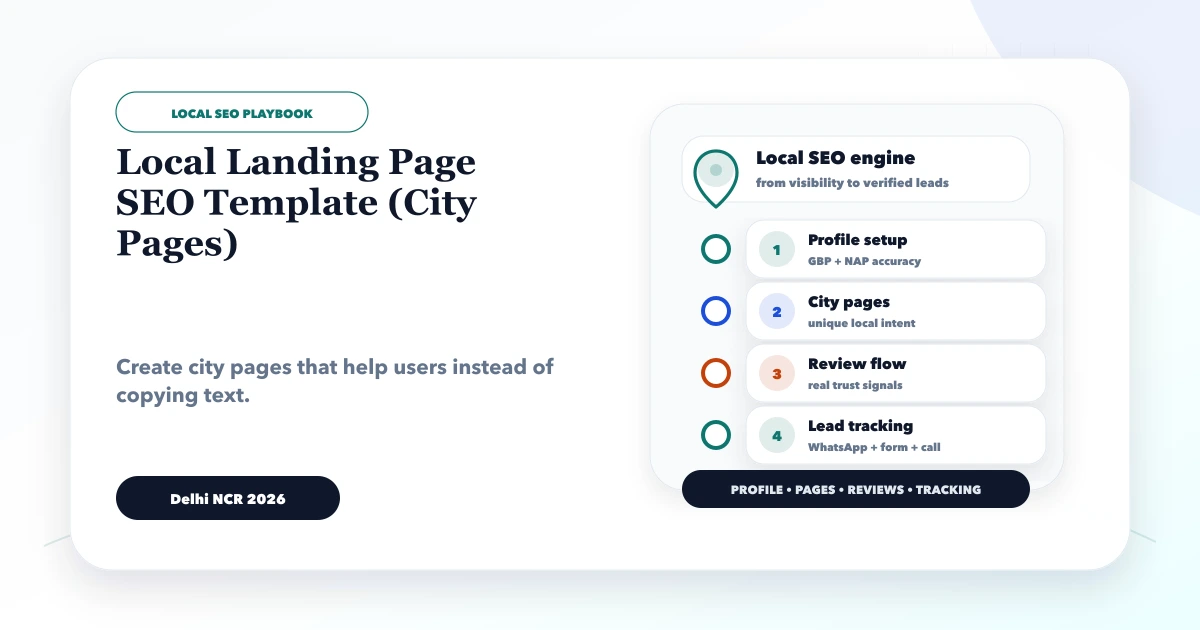
Local Landing Page SEO Template (City Pages)
Local landing page SEO template for city pages: title, intro, service scope, local proof, pricing, FAQs, internal links, CTA, and spam checks.
Read articlePublished Updated
Use a local landing page template with unique service intent, genuine city proof, useful pricing, FAQs, internal links, conversion tracking, and quality checks.
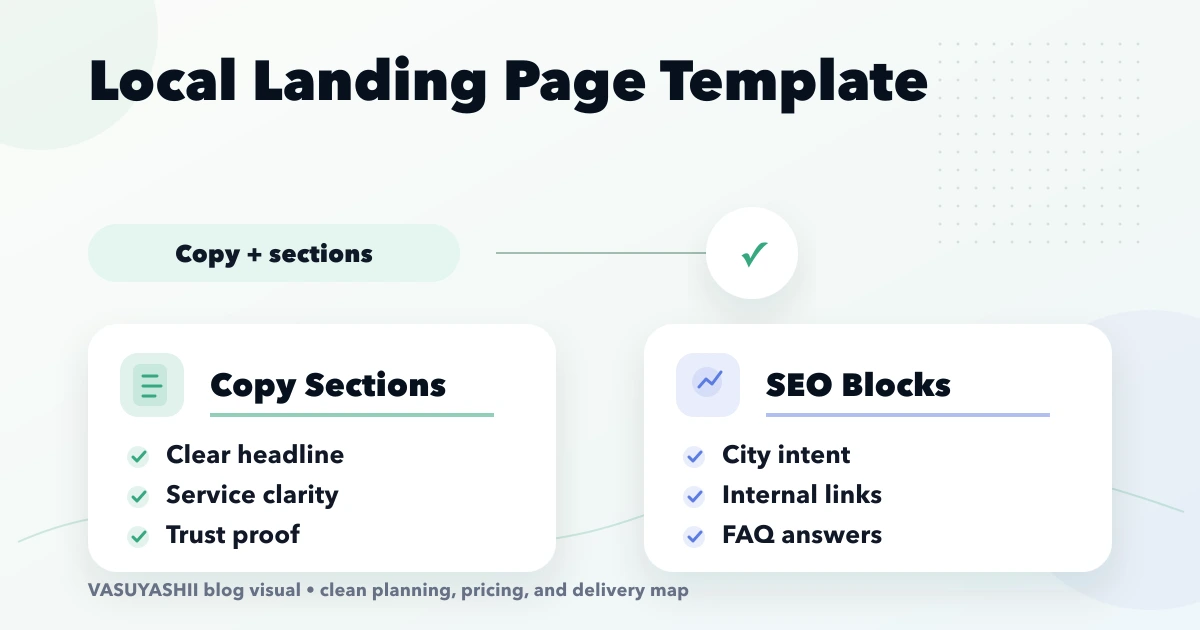
local landing page template is important for service businesses creating city or locality pages without falling into thin, repeated SEO content. A local landing page template should help real customers understand service fit, proof, pricing expectation, and next steps. This guide is for businesses building service + city pages that need leads without creating near-duplicate spam. This guide is written for Indian SMB owners who want practical scope, cost, timeline, and decision clarity without generic theory.
By Tushar C. (Founder, VASUYASHII). Reviewed by VASUYASHII Editorial for practical scope, pricing, implementation clarity, and local business relevance.
| Scope | Typical range |
|---|---|
| Single local page copy + layout | ₹8,000 to ₹20,000 |
| 5-page local cluster | ₹30,000 to ₹80,000 |
| SEO landing page system | ₹80,000 to ₹2 lakh+ |
A city page should be published only when the business genuinely serves that area and can answer location-specific buyer questions. Before writing, record the service offered, delivery model, realistic response process, relevant proof, common local requirement, and the parent service page.
Do not publish when the only unique field is the city name. In that case, strengthen the parent service-area page and mention the location naturally instead of creating another indexable URL.
Use this evidence matrix before approving a URL:
| Evidence question | Publish when | Consolidate when |
|---|---|---|
| Is the area genuinely served? | Delivery and response process are documented | The location is only a keyword target |
| Is buyer intent different? | Local constraints change scope or decision | The answer is identical to the parent page |
| Is there local proof? | Approved project, review, event, route, or operating detail exists | Proof would be invented or borrowed |
| Can the page stay current? | An owner can update service and contact facts | No person owns future accuracy |
| Does the page add navigation value? | It helps a user choose or contact | It exists only for the sitemap |
Do not create every possible service-location combination. Start with one parent service page and only the most defensible location pages.
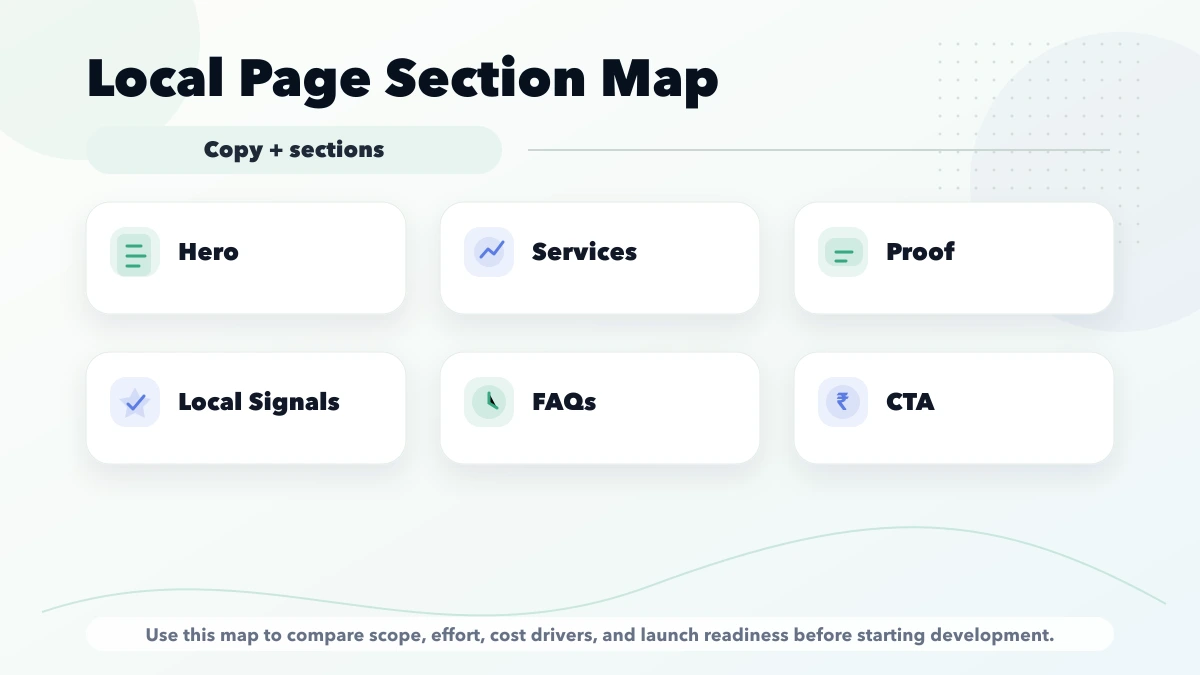
| Section | Required content |
|---|---|
| Hero | Service, location, buyer outcome, and direct next step |
| Fit | Who the service is suitable for and who it is not for |
| Scope | Exact deliverables, exclusions, timeline, and dependencies |
| Local context | Genuine service method, approved project, review, or operational detail |
| Proof | Relevant case study, portfolio item, process evidence, or public review |
| Decision help | Pricing factors, comparison checklist, mistakes, and FAQs |
| Conversion | Form, phone, or WhatsApp action with lead-source tracking |
Replace each evidence field with verified information. Never manufacture an address, office, customer, project result, or review to make the page appear local.
Useful local copy can explain how discovery, meetings, onsite work, delivery, support, or response times operate for that area. It can identify genuine business types served, common project constraints observed there, and the documents a buyer should prepare. Every statement should remain useful if the city keyword is removed.
Weak filler includes generic weather, population, landmarks unrelated to delivery, repeated "best company" claims, or lists of neighbourhoods added only for keyword density. A map or local image is useful only when it represents the real business or service context.
Use a consistent design template if it improves usability, but do not repeat the same paragraphs. Shared components and unique evidence can coexist.
The parent service page should link to important city pages from a useful service-area section. Each city page should link back to that parent, one relevant project or proof page, and a small number of related guides. Avoid creating a footer block with dozens of keyword-heavy city links.
Use descriptive anchors based on the destination’s purpose. The page should remain understandable even if the location keyword appears only where it helps the buyer.
Keep the hierarchy simple. A service hub should explain the main offer, while a location page should answer location-specific delivery and buying questions. Avoid multiple URLs that differ only by word order, such as /web-developer-noida and /website-development-company-noida.
Track the page path with contact, WhatsApp, and form events so the sales team knows which local promise produced the enquiry. Analytics should not contain personal form values. Compare qualified leads, not only page views.
If two pages begin competing for the same queries, decide which page best satisfies the intent. Strengthen internal links toward that page and rewrite the other around a genuinely different need. Do not add arbitrary canonicals merely to hide weak differentiation.
For the parent architecture, use the Local SEO for Web Development Companies hub and Website Development Delhi NCR hub.
Review location pages using Search Console, enquiries, business coverage, and content accuracy. A page with no defensible local value should be improved or consolidated into the relevant parent. If a URL is retired, redirect it to the closest genuinely equivalent page rather than the homepage.
Do not make consolidation decisions from traffic alone. A new or seasonal location may have little data. Combine traffic evidence with service-area reality, uniqueness, link structure, and whether the page answers a useful local decision.
VASUYASHII currently uses a location-content freeze for new city and "near me" posts while existing clusters are improved. A location page should not claim a local office, client, response time, ranking, or project result without verifiable evidence. Demo pages are illustrative and are not local client proof.
For each retained page, keep an internal evidence note with the service-area basis, approved facts, owner, review date, parent page, and incoming links. This makes future updates auditable and helps remove claims that become outdated.
The final page should help a local buyer decide whether the service fits, what information to prepare, and how delivery works. If it cannot do that better than the parent page, do not index a separate URL.
Start with a short discovery checklist that defines users, workflow, required outputs, and success metric.
Yes. A phased build is usually safer because it keeps cost and adoption under control.
Avoid building too many advanced features before the core workflow is tested with real users.
Compare exact deliverables, timeline, ownership, support, and reporting instead of only the final price.
No. Custom development is useful when workflow, roles, reports, or integrations are specific to your business.
Yes, if the first phase is scoped around one clear business problem.
Related Articles
May 29, 2026
Local landing page SEO template for city pages: title, intro, service scope, local proof, pricing, FAQs, internal links, CTA, and spam checks.
Read article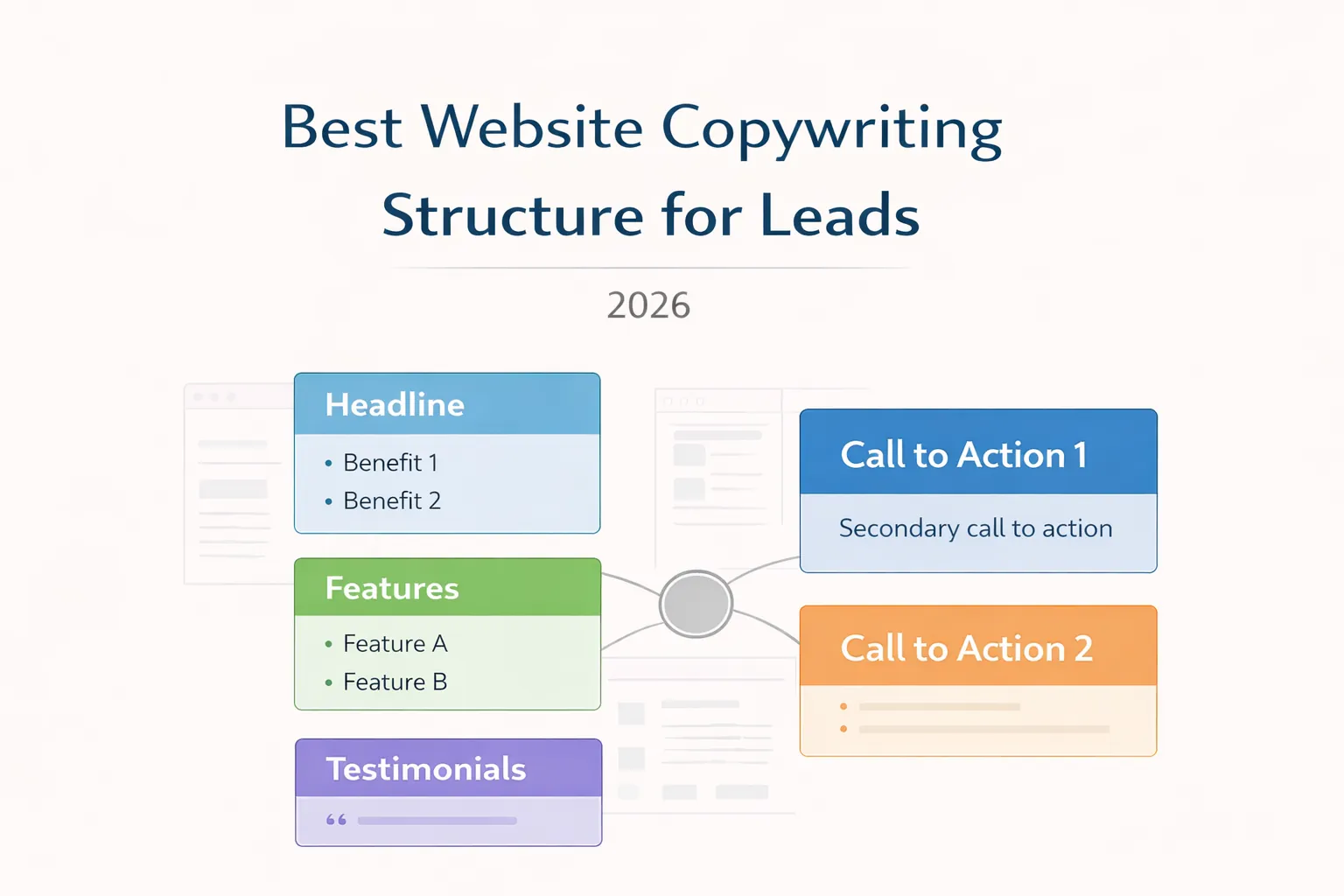
March 29, 2026
Write website copy for better leads using clear positioning, customer language, proof, objection handling, qualification and measurable calls to action.
Read article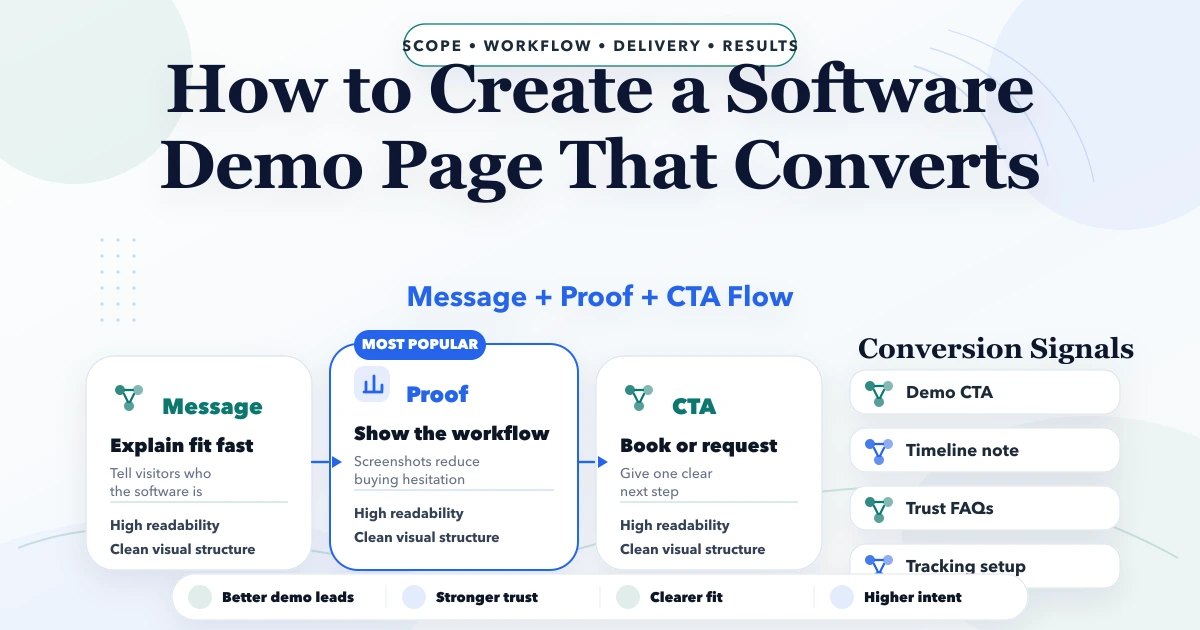
April 26, 2026
Software demo page that converts: page structure, pricing, proof blocks, CTA flow, tech stack, and launch checklist for better leads.
Read article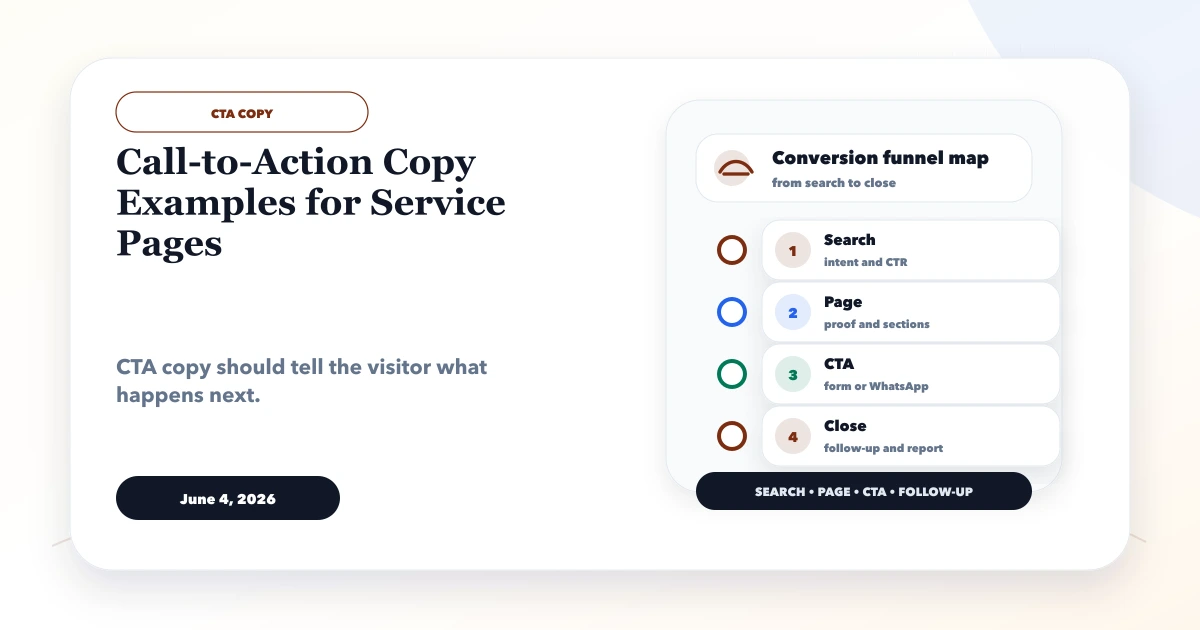
June 4, 2026
Call-to-action copy examples for service pages with WhatsApp, form, demo, quote, consultation, audit, and service-specific CTA templates.
Read article