
March 28, 2026
How to Write a Service Page That Ranks (SEO + Conversion)
How to write a service page that ranks: SEO and conversion structure, page sections, proof blocks, internal links, and mistakes to avoid.
Read articlePublished Updated
How to write service page content that ranks with search intent, headings, proof, FAQs, internal links, CTA, and content checklist.
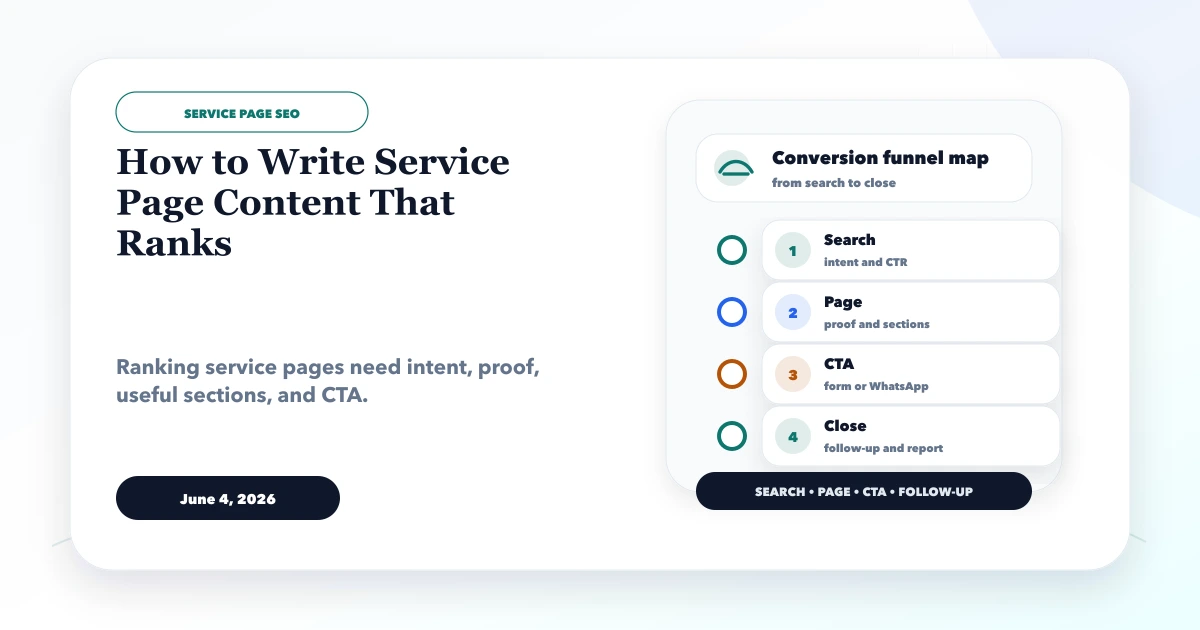
Learning how to write service page content that ranks begins with the buyer's decision, not a target word count. The page must define the service, audience, deliverables, evidence, boundaries, process, and next step more clearly than a generic directory listing or AI-written summary.
Search visibility and conversion are connected but not identical. A page can match a keyword and still fail to create trust; it can also persuade existing visitors while remaining too vague for search engines to understand its primary intent.
By Tushar C. (Founder, VASUYASHII). Reviewed by VASUYASHII Editorial for practical SEO, landing pages, WhatsApp funnels, GA4 event tracking, conversion copy, service page content, and business website delivery.
Write service page content that ranks by matching search intent, using a clear H1, explaining services, adding proof, pricing context, process, FAQs, internal links, related pages, and CTA. Avoid thin generic copy and keyword stuffing.
A software company has one page titled "Our Solutions." It mentions websites, apps, CRM, ERP, automation, and SEO in three paragraphs. Buyers cannot tell what each engagement includes, and the same URL attempts to rank for unrelated commercial searches.
A stronger structure keeps a useful service directory, then creates dedicated pages where the buyer, workflow, scope, proof, and CTA are genuinely different. The custom software page can explain roles, records, integrations, reports, phasing, and ownership while linking narrower questions to supporting guides.
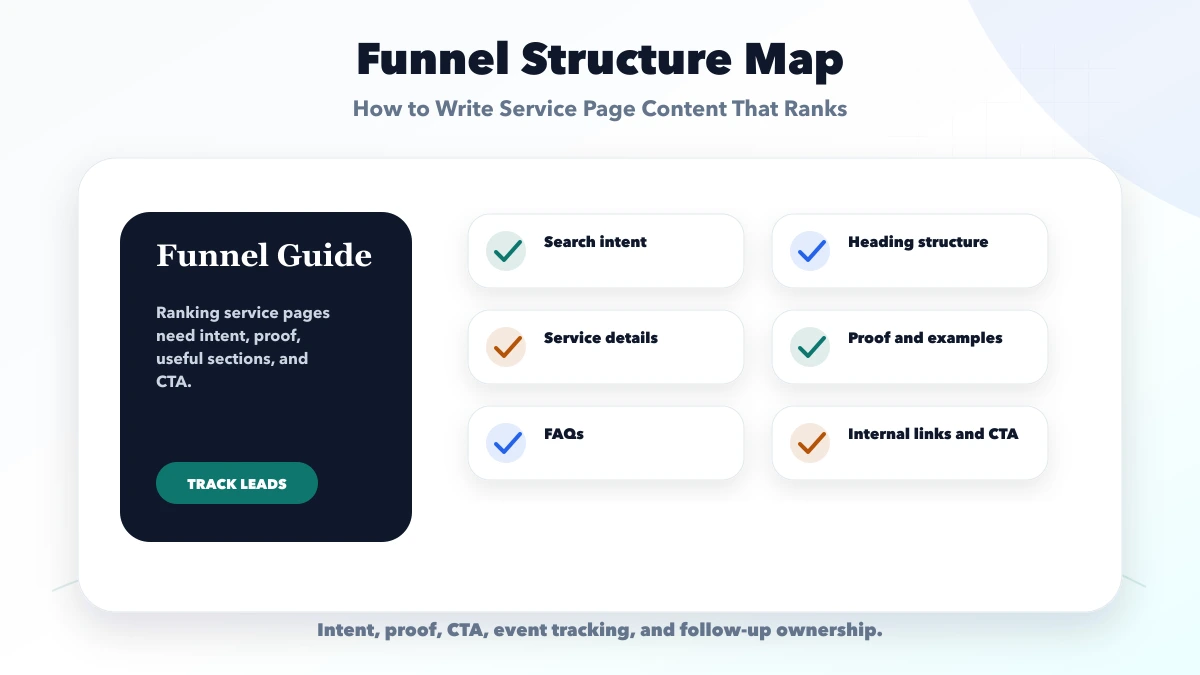
Each check should connect to a real buyer action. If a section, title, button, or event does not help search visibility, trust, contact, tracking, or follow-up, it should be simplified or moved.
| Funnel area | What to include | Why it matters |
|---|---|---|
| Core content | What you do, who it helps, CTA | Minimum useful page |
| SEO content | Intent, proof, process, FAQs, links | Rank and convert |
| Cluster content | Related blogs and service pages | Build topical depth |
The right funnel setup depends on the page goal. SEO pages need intent clarity and internal links. Landing pages need proof and CTA. WhatsApp and forms need tracking and follow-up ownership.
Interview the person who scopes or delivers the service. Capture:
This material creates expert content. Without it, the writer usually repeats surface-level benefits already present on competing pages.
Review the current search results and note whether the query expects a provider, definition, cost guide, comparison, or local service. A commercial service page should not become a long tutorial merely to capture every related keyword.
Write one positioning sentence:
We help [specific buyer] achieve [useful outcome] through [service], with [important scope or differentiator].
Use related phrases naturally where they clarify scope. Do not create separate pages for minor wording variations unless they represent a different offer or buyer decision.
| Section | Question it must answer |
|---|---|
| H1 and opening | What is offered, for whom, and why should the visitor continue? |
| Problem and fit | Which operating or commercial problem does this solve? |
| Deliverables | What is included in the engagement or first phase? |
| Workflow | How will discovery, build, review, launch, and support work? |
| Proof | Which current screenshots, reviews, case studies, demos, or process artifacts support the claims? |
| Cost and timeline context | Which decisions change effort, price, and schedule? |
| Boundaries | What is excluded, optional, dependent on third parties, or future work? |
| FAQs | What objections remain after reading the main page? |
| CTA | What information should the buyer share for the next useful step? |
The sequence can change, but the evidence and decision coverage should remain.
Create a claim ledger while writing:
| Claim | Required evidence |
|---|---|
| "Mobile-friendly" | Tested responsive screens or QA description |
| "Fast" | Measured page or clearly defined optimization process |
| "Secure" | Specific controls, testing boundary, and maintenance owner |
| "Experienced" | Verifiable projects, product work, author profile, or delivery artifacts |
| "Generates leads" | Tracking setup and approved outcomes, not a guaranteed promise |
If evidence is unavailable, narrow the claim. Clearly labelled demos can demonstrate interface capability, but they are not customer case studies.
Link upward to the service directory, sideways to a closely related service only when useful, and downward to a few support guides. Supporting blogs should link back to this service page using descriptive anchors.
Avoid placing the same list of five commercial links in every article. Internal links should help the reader make the current decision. Google's helpful content guidance emphasizes people-first material that demonstrates first-hand expertise and gives readers enough information to achieve their purpose.
Use Search Console queries to see whether Google understands the intended topic. Review CTA clicks, successful forms, qualified leads, and sales questions. Improve sections that receive impressions but do not answer the actual query; do not repeatedly change titles or publish another overlapping page without evidence.
The current VASUYASHII service structure separates web applications, mobile apps, custom software, and integrations instead of presenting them as one generic technology offer. Each page explains relevant workflows, first-phase decisions, FAQs, related resources, and a contextual contact action.
The contact URL can carry a controlled service key, and the form preselects the matching requirement after validating that key against known options. This preserves buyer intent without allowing arbitrary query text to become form content.
This implementation is useful proof of the writing principle: the page promise, navigation label, contact context, analytics parameter, and sales requirement should use the same service model. When these labels drift, reporting and follow-up become harder even if the prose still reads well.
The service pages should continue to improve through real enquiries, approved work evidence, and current Search Console queries. The published structure is a maintained baseline, not a guaranteed ranking result.
Before release, ask someone outside the delivery team to read the page and explain the offer, buyer fit, first phase, evidence, exclusions, and next step. If they cannot, revise the information hierarchy before adding more keywords. Clarity is a content requirement, not a final design polish item.
Use this roadmap to build one measurable improvement at a time. Review the result before adding more tools, pages, events, or automations.
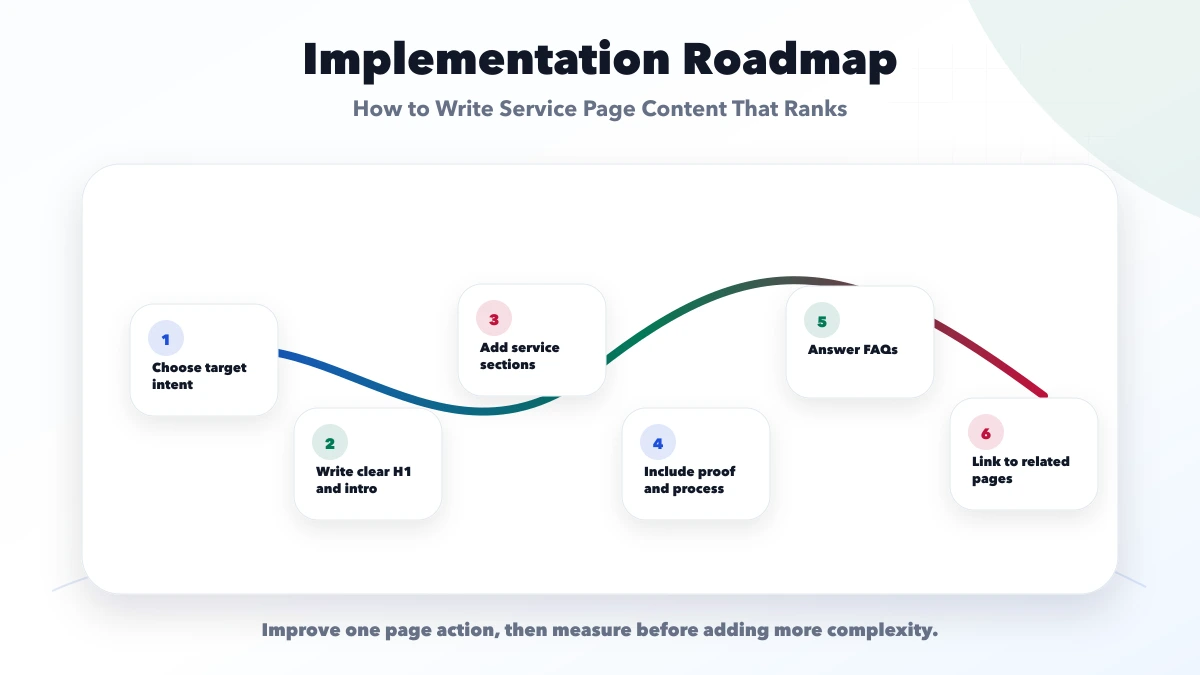
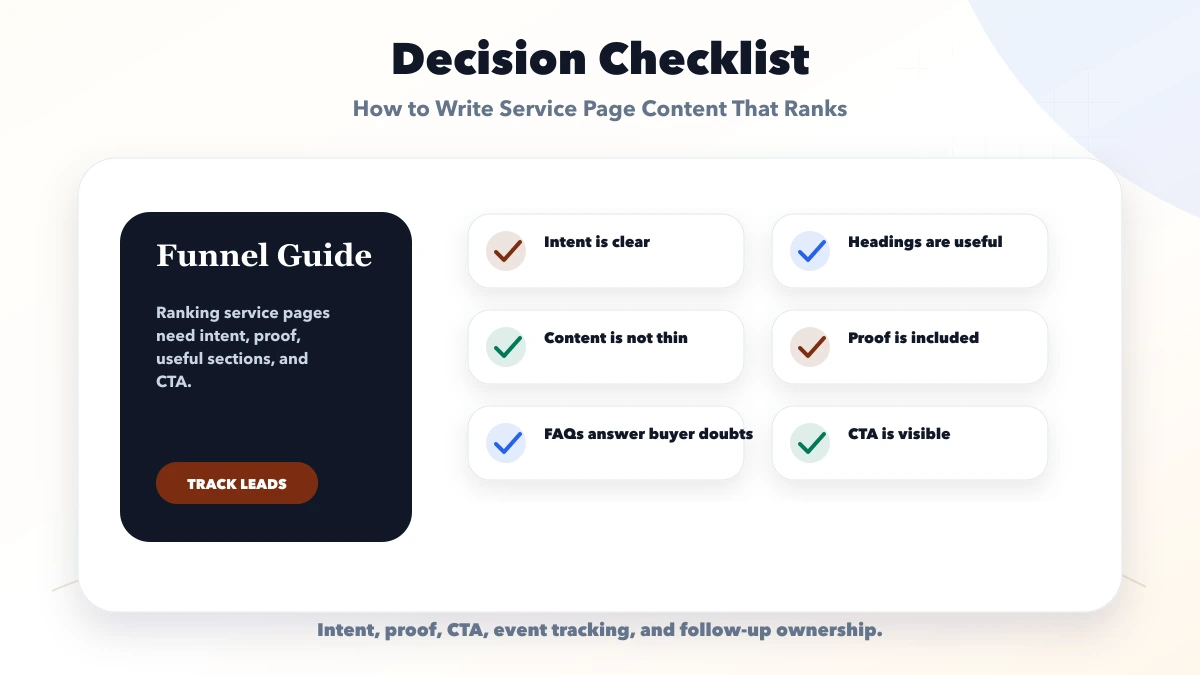
This checklist protects the page from looking complete but failing commercially. A good page should make the next step obvious and measurable.
VASUYASHII would first map search intent, page structure, proof, CTA, WhatsApp or form flow, GA4 events, lead source, and follow-up ownership. Then we would improve the page or funnel in phases.
Useful links: web application services, software development, integrations, services, and contact.
Avoid judging conversion only by page design. Leads usually improve when message clarity, proof, CTA, speed, tracking, and follow-up work together.
Content depth is only one part of the decision. The service page vs landing page comparison explains architecture, indexing, canonicals, internal links, message match, testing, and the hybrid model for organic and paid traffic.
Intent match, depth, useful headings, proof, FAQs, internal links, and technical SEO all matter.
Long enough to answer buyer questions without filler. Many service pages need detailed sections and FAQs.
Pricing context helps when buyers compare vendors, even if exact quote depends on scope.
Yes. Similar pages without unique intent can create quality and canonical problems.
Yes. We can create service pages that are structured for SEO and lead conversion.
If you want a practical plan for how to write service page content that ranks, VASUYASHII can help with scope, design, development, SEO setup, integrations, tracking, launch, and maintenance.
Related Articles
March 28, 2026
How to write a service page that ranks: SEO and conversion structure, page sections, proof blocks, internal links, and mistakes to avoid.
Read article
May 20, 2026
Use this service page SEO template to structure search intent, proof, FAQs, internal links, conversion CTAs, local relevance, tracking, and content updates.
Read article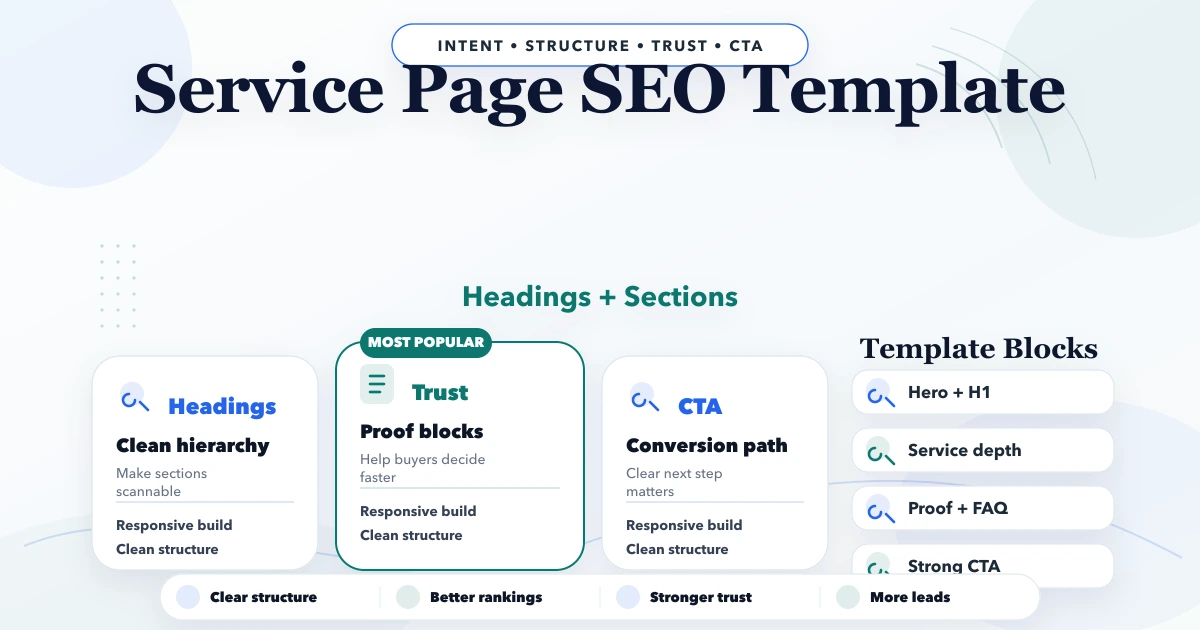
April 22, 2026
Use this service page SEO template to structure intent, headings, proof, process, pricing context, FAQs, internal links, and conversion-focused CTAs.
Read article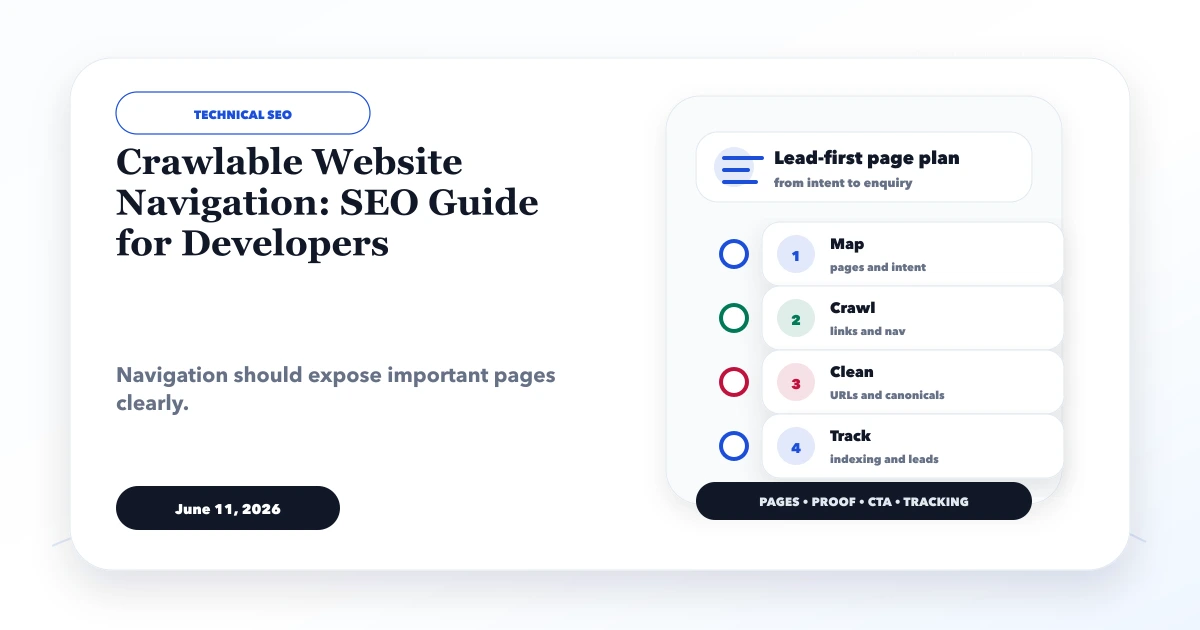
June 11, 2026
Build crawlable website navigation with real anchor links, logical hierarchy, accessible menus, pagination, descriptive anchors and repeatable SEO validation.
Read article