
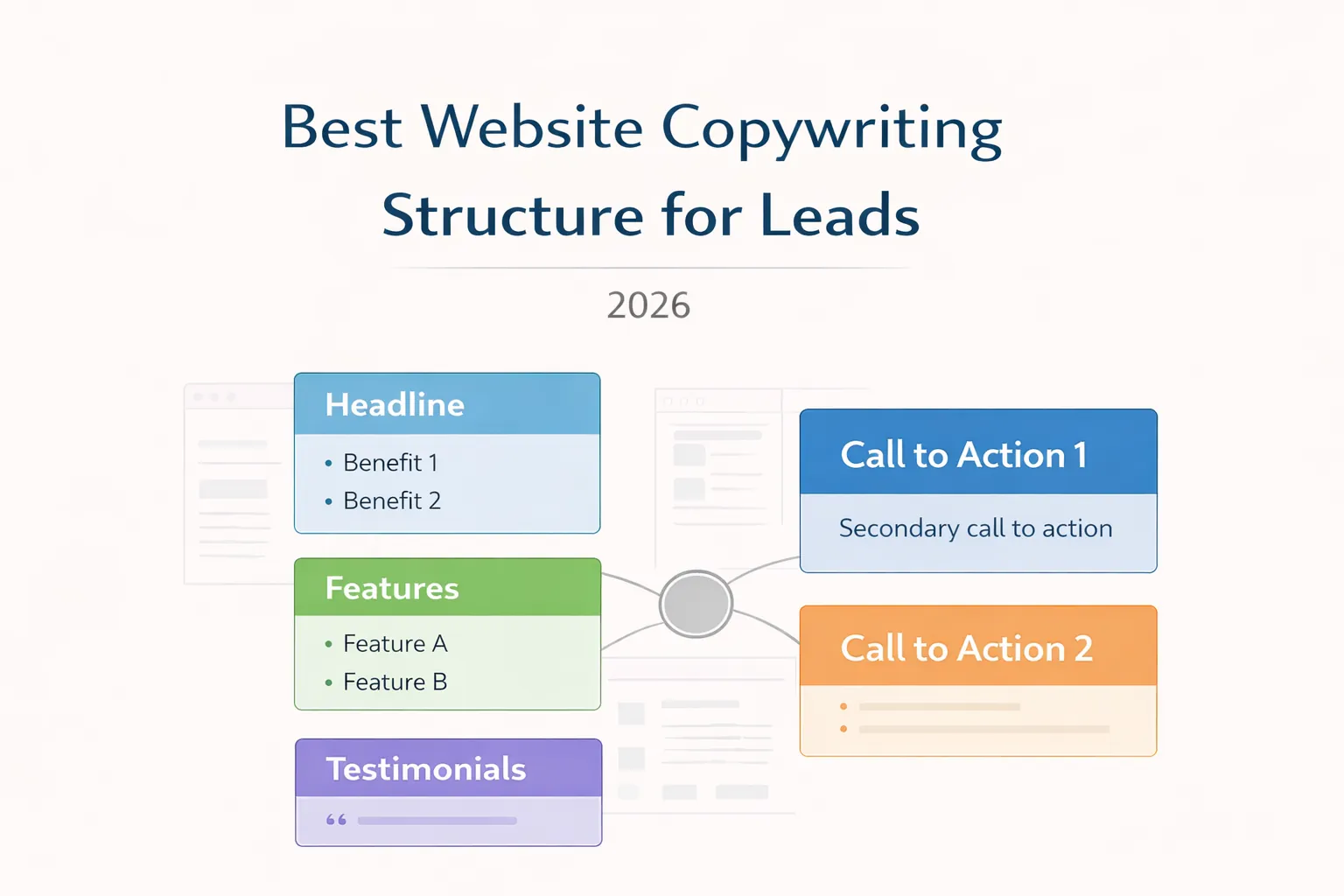
March 29, 2026
Website Copywriting Structure for Better Leads
Write website copy for better leads using clear positioning, customer language, proof, objection handling, qualification and measurable calls to action.
Read articlePublished Updated
Write service-business website copy with clear buyer intent, proof, scope, objections, pricing context, useful CTAs, SEO structure and conversion measurement.
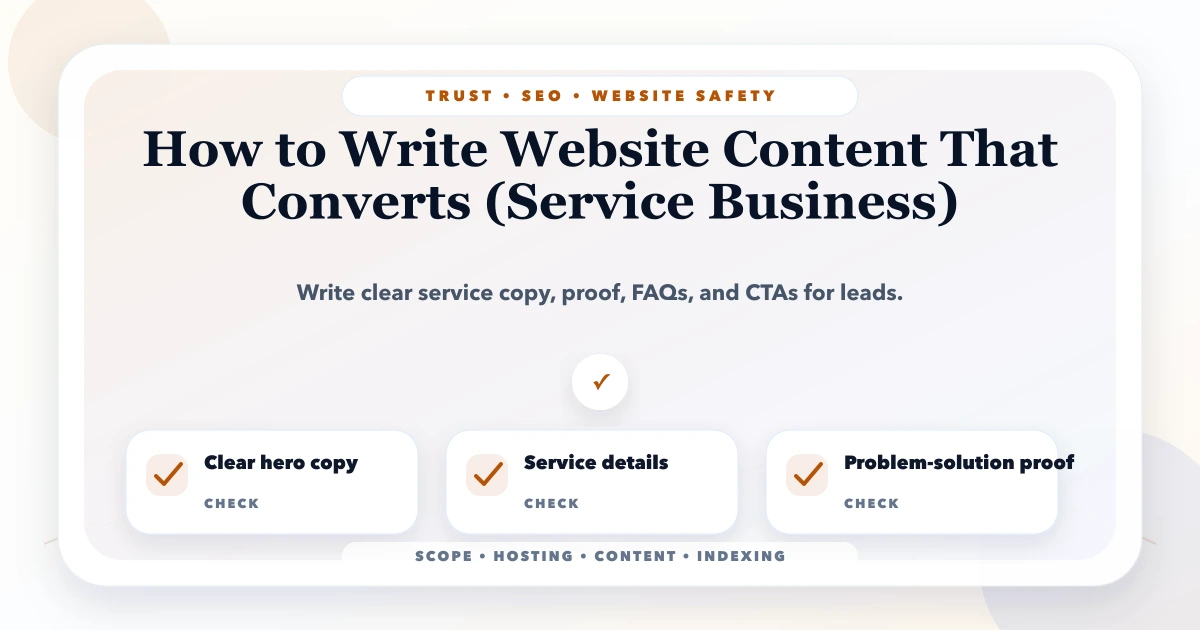
To write website content that converts, make the buyer's next decision easier on every section. A service-business page should identify who the service is for, what problem it handles, what is included, how delivery works, what proof is available, what changes cost or timeline, and what the visitor should do next. Clever slogans cannot compensate for missing scope or weak trust.
This guide provides a practical method for Indian service businesses, consultants, agencies, clinics, professional firms, contractors, and software companies. It connects conversion copy with search intent, evidence, lead qualification, and measurement.
By Tushar C. (Founder, VASUYASHII). Reviewed by VASUYASHII Editorial for service-page planning, search intent, lead generation, proof boundaries, CTA design, analytics, and website delivery. Examples are writing models, not claims about a specific business result.
Write the page in this order:
The primary keyword should appear naturally in the title, H1, opening answer, relevant headings, and internal links. Do not repeat it in every paragraph. The goal is to satisfy the buyer's intent, not hit a density number.
Before drafting, collect the language customers already use. Useful sources include:
Record the exact question, who asked it, the stage of the buying process, and the approved answer. Do not copy private customer information into public content.
Create four lists:
| List | Example for a software company |
|---|---|
| Desired outcomes | Reduce duplicate data entry, see stock, track enquiries |
| Current frustrations | Spreadsheet errors, missed follow-up, unclear ownership |
| Buying objections | Cost, timeline, support, data safety, staff adoption |
| Proof required | Real product screen, process, current scope, demo, support terms |
These lists are stronger inputs than starting with a blank page and generic AI prompt.
A page should have one primary job. Compare these intents:
One page can support related questions, but it should not try to rank for every stage. A service page should sell the service with enough decision detail. A cost guide should explain price factors and quotation inputs. A comparison should help choose between approaches.
When several pages target the same intent, differentiate them or consolidate based on evidence. Avoid creating another page simply because a keyword variation exists.
The first viewport should quickly communicate:
Weak version:
Transforming ideas into digital excellence.
Stronger model:
Custom inventory and billing software for Indian distributors. Track products, purchases, invoices, collections, and company-wise reports in one web app. Request a workflow review.
The stronger version is not universally correct, but it gives the buyer concrete information. Use a short supporting paragraph for boundaries rather than filling the heading with every keyword.
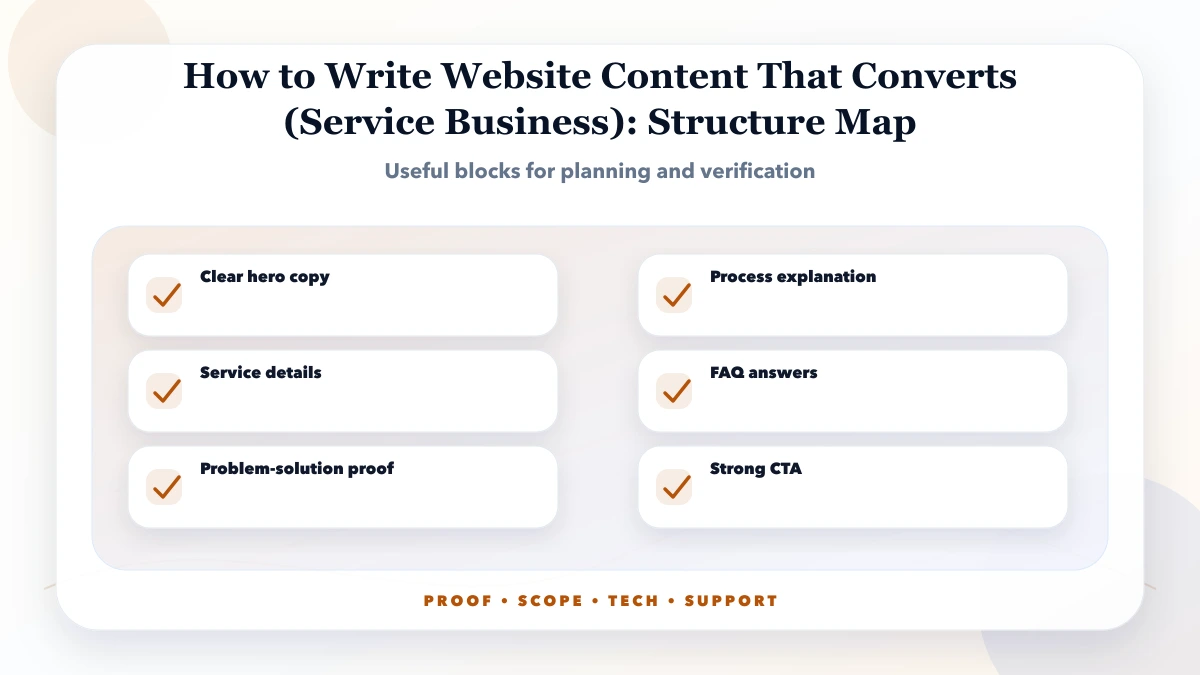
Name the business type, operating situation, or problem. Avoid claiming suitability for every industry.
Describe the current workflow and why it matters. Use observable effects such as repeated entry, slow response, missing status, stock mismatch, or manual reports. Do not invent revenue or time savings.
List deliverables with enough detail to compare proposals. For a website, this may include discovery, information architecture, responsive implementation, content integration, forms, metadata, analytics events, testing, deployment, and handover.
Exclusions build trust. Examples might be content writing, paid ads, third-party subscriptions, photography, advanced automation, migration, or ongoing support unless quoted.
Explain discovery, approvals, content ownership, design, development, testing, launch, and support. State what the client must provide and who approves each stage.
Use current, permission-approved proof: product screenshots, demo access, verified reviews, a documented method, client-approved examples, or measurable results with source and context. Do not keep outdated work online only to make the proof section look larger.
Explain cost drivers, quotation inputs, payment stages, and timeline dependencies. A realistic range requires assumptions. If no responsible range is available, state what is needed for an accurate quote.
Answer specific concerns: ownership, support, migration, security, changes, cancellation, maintenance, staff training, and vendor lock-in.
Invite the next appropriate action: request a quote, schedule discovery, try a demo, submit requirements, or contact on WhatsApp.
Use this writing pattern:
Feature + operating context + buyer value + boundary.
Example:
Role-based access lets administrators decide which team members can view or change company records, reducing unnecessary access. Exact permissions depend on the configured module and should be tested before rollout.
This is better than "advanced role management" because it explains the use and avoids unsupported breadth.
Avoid translating every feature into a dramatic financial promise. "Automated reports save 80% time" needs real measurement. If evidence is unavailable, explain the workflow improvement without inventing a percentage.
Different buyers need different proof:
| Buyer question | Useful proof |
|---|---|
| Can the product do this today? | Current screenshot or live demo |
| Does the team understand the workflow? | Specific discovery and implementation method |
| Is this claim real? | Source, date, approved result, or verifiable review |
| Will my data remain mine? | Ownership, export, backup, access and exit terms |
| What happens after launch? | Written support scope and response process |
Remove stale case studies, screenshots, metrics, certifications, client logos, or product features when they no longer represent the current business. Honest proof has a stronger long-term value than a large outdated showcase.
Price content can improve qualification when it explains assumptions. Include:
For custom services, list the inputs required for a quote: users, workflows, integrations, data migration, reports, platforms, deadline, and support. Avoid "starting at" pricing that almost no real buyer can purchase.
A high-intent visitor may want "Request a Quote." A research-stage visitor may prefer "See Current Features" or "Download the Requirement Checklist." Use one primary CTA and a relevant secondary option.
Good CTA copy states the action:
Avoid using a vague "Learn More" for every button. Do not promise a free demo, audit, or consultation unless the business has a real process to deliver it.
WhatsApp buttons should use a prefilled message that identifies the page and requirement. Track the click, but do not count it as a qualified lead until the visitor shares enough information.
Use one H1, descriptive H2 and H3 headings, short paragraphs, bullets, tables, and internal links. Keep important answers in visible HTML. Avoid hidden tabs for all core content, PDF-only service details, and headings written only for keywords.
Internal links should connect the service page to:
Descriptive anchors provide more context than repeated "click here" links. For example, link to custom software and ERP services or web application development using the actual topic.
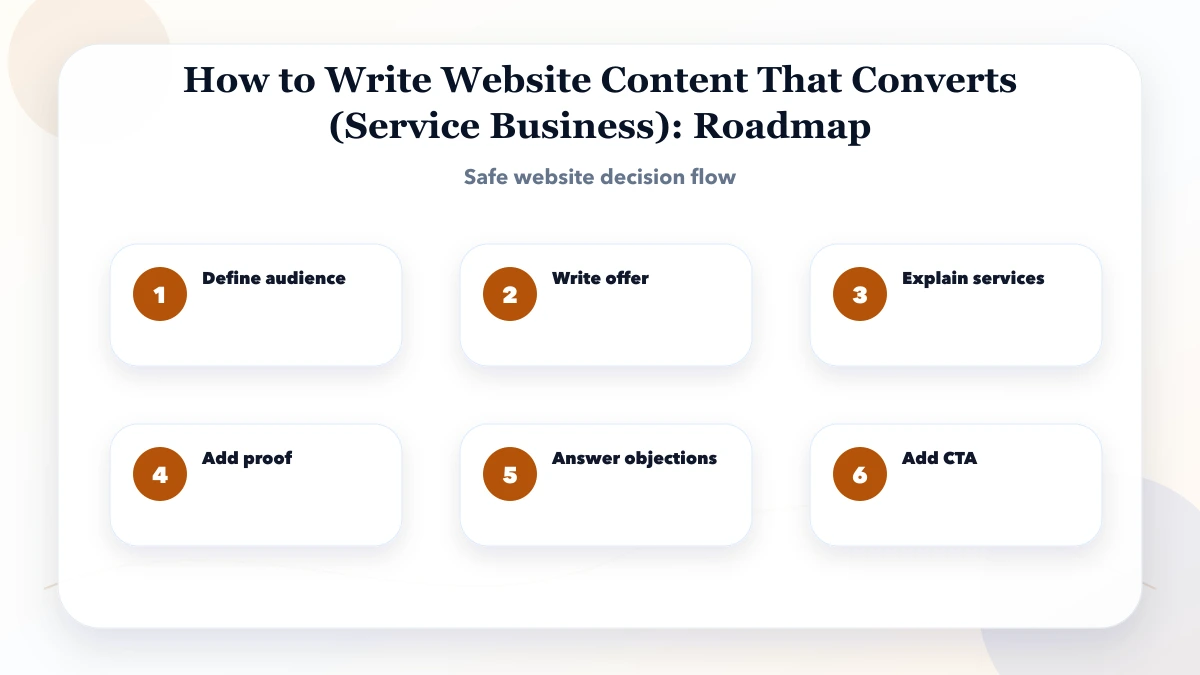
Score each important page before launch:
| Review area | Pass question |
|---|---|
| Relevance | Can the target buyer identify the service in five seconds? |
| Scope | Are inclusions, exclusions, and responsibilities clear? |
| Evidence | Can every important claim be verified? |
| Objections | Does the page answer cost, timeline, ownership, support, and risk? |
| Search intent | Does the content match the query and page type? |
| Conversion | Is the next step useful and working? |
| Maintenance | Is an owner assigned to update facts and proof? |
VASUYASHII would begin with the target buyer, current offer, sales questions, real delivery process, evidence, and qualification needs. We would remove unsupported or outdated proof, map one intent per page, write clear scope and boundaries, and connect CTA events to the actual follow-up process.
Relevant resources include the website copywriting guide for leads, service-page content guide, CTA copy examples, contact-page conversion guide, and lead tracking with GA4.
Review website services, web application development, custom software services, and contact options.
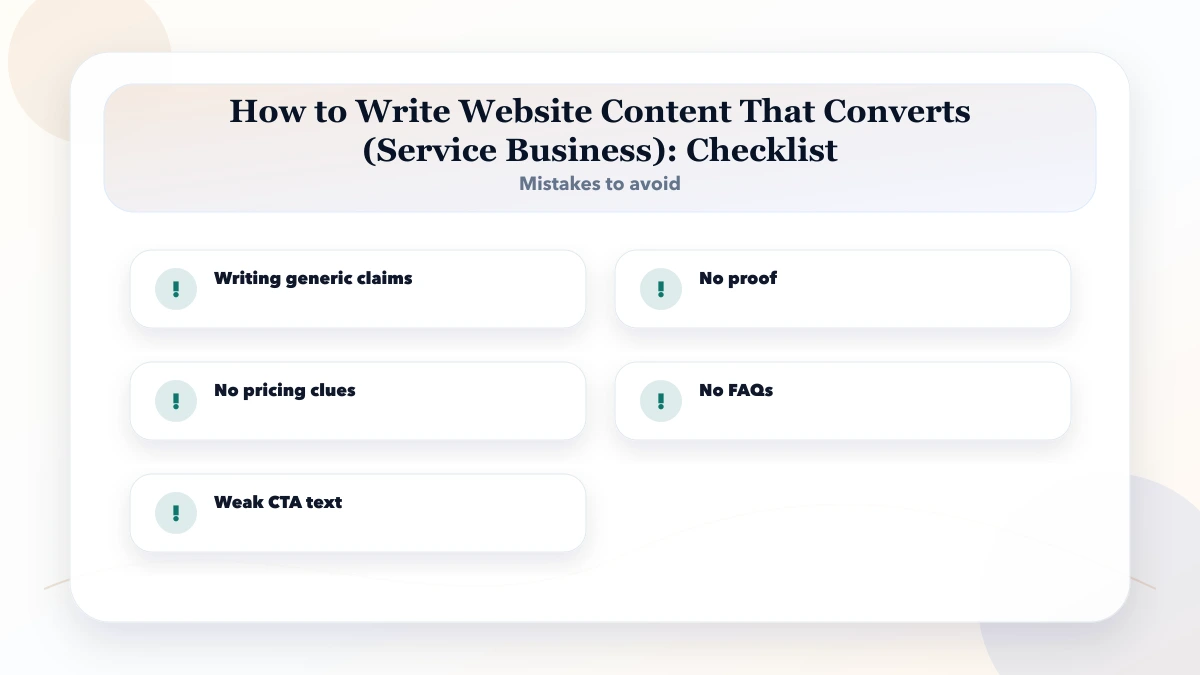
Use enough content to answer the buyer's decision questions without padding. Scope, process, proof, objections, cost context, FAQs, and CTA often require depth, but word count itself is not the goal.
No. The homepage should establish positioning, priority services, proof, and routes. Give important services dedicated pages where buyers can evaluate scope and fit.
Choose one primary intent and natural related language. Do not combine unrelated service, cost, comparison, and location intents simply to target more keywords.
Include a fixed price only when the offer and assumptions are stable. Otherwise explain pricing models, cost drivers, minimum scope, and what is needed for an accurate quotation.
AI can help organize information, but the business must supply real services, process, evidence, boundaries, and review. Generic AI text without firsthand input creates similarity and trust problems.
Use the next action the business can actually fulfil: request a quote, submit a brief, schedule discovery, try a demo, or start a qualified WhatsApp conversation. Match it to the page's buyer stage.
Track qualified form submissions, calls, WhatsApp conversations, response time, sales acceptance, proposals, and wins by landing page. Combine analytics with sales feedback instead of relying only on CTR.
Choose one commercial page and collect ten real buyer questions, current scope, exclusions, process, proof, and CTA ownership. Rewrite that page using the decision structure above before changing the full website.
Related Articles
March 29, 2026
Write website copy for better leads using clear positioning, customer language, proof, objection handling, qualification and measurable calls to action.
Read article
June 11, 2026
Use practical homepage hero formulas for service businesses with clear audience, offer, proof, CTA hierarchy, mobile layout, and conversion tracking.
Read article
June 4, 2026
Write a credible Why Choose Us section using specific fit, proof, process, ownership and risk reduction. Adapt six practical templates without vague claims.
Read article
June 5, 2026
Prepare accurate website content for a new business: services, proof, process, FAQs, images, contact details, SEO fields, policies, and ownership.
Read article