
May 21, 2026
Website Copy That Converts for Service Businesses
Write service-business website copy with clear buyer intent, proof, scope, objections, pricing context, useful CTAs, SEO structure and conversion measurement.
Read articlePublished Updated
Write a credible Why Choose Us section using specific fit, proof, process, ownership and risk reduction. Adapt six practical templates without vague claims.
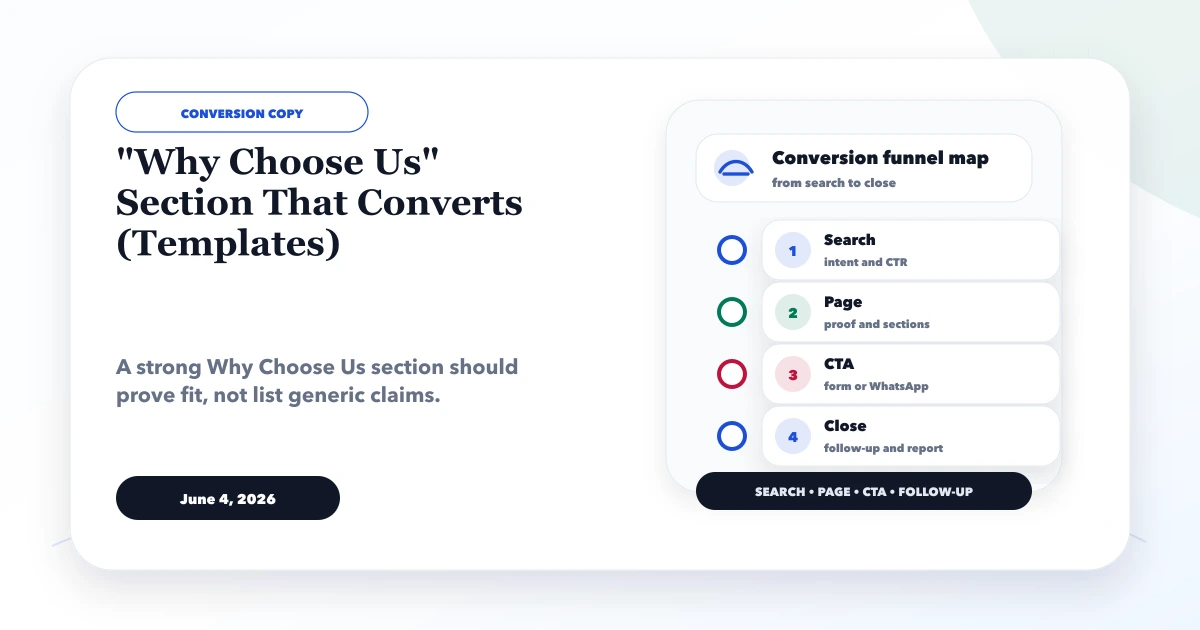
Most “Why Choose Us” sections say reliable, affordable, experienced, customer-focused, and high quality. Competitors make the same claims, so the visitor learns very little. A useful section explains who the business fits, how it works, what evidence supports the promise, and which risks are reduced.
The purpose is not to declare that the company is the best. It is to help the right buyer compare the provider with a credible alternative.
Build each reason from four parts:
| Weak claim | Specific version |
|---|---|
| We deliver quality | Every launch follows a page, form, mobile, metadata, and handover checklist |
| We are transparent | Scope, exclusions, third-party fees, milestones, and account ownership are written before build |
| We offer support | The proposal names the support period, channel, covered defects, and billable changes |
| We are experts | Show relevant decisions, implementation evidence, and author credentials |
| We are affordable | Explain scope options and total-cost drivers without hiding renewals |
A claim becomes persuasive when a buyer can imagine the working relationship and check the supporting evidence.
The “Why Choose Us” block should appear after the visitor understands the offer. On a service page, that may be after scope and before process or proof. On a landing page, it may sit near the conversion block. On an About page, the same information can be deeper and more identity-focused.
Do not place a wall of badges immediately under an unclear hero. First answer what is offered and for whom. The service-page content guide covers the wider page sequence.
Use when buyers fear delays, confusion, or inconsistent delivery.
A clear project path from requirement to handover
We begin by confirming the business goal, pages, content responsibility, required actions, and account ownership. You review the page plan before development, test the staging version before launch, and receive the agreed access and handover items at completion.
This template works only if the business actually follows the process.
Use when the provider serves a defined customer or problem.
Built around B2B enquiries, not generic traffic
We structure manufacturer and distributor websites around product categories, capabilities, service areas, certifications, RFQ details, and sales follow-up. The goal is to help a buyer qualify fit before sending an enquiry.
Do not claim a niche simply by listing industry names. Demonstrate the decisions that change for that niche.
Use when buyers have previously lost access or faced hidden charges.
Your domain, business accounts, and approved assets stay under your control
We document who owns the domain, hosting, analytics, Search Console, source access, licences, and lead destinations. Known third-party renewals and exclusions are identified before approval, not after launch.
Avoid promising universal source ownership if a licensed SaaS platform has different terms. State the real arrangement.
Use for software, integrations, booking, payments, or workflows where failure handling matters.
We plan for retries, permissions, and exceptions before launch
A successful screen is only one path. We also review invalid data, duplicate submissions, API failures, role access, audit needs, and recovery. The agreed acceptance checks cover the workflows your team will operate.
This differentiates operational work from visual mockups without inventing uptime claims.
Use when the buyer wants a focused first phase rather than an enterprise transformation.
Start with the workflow that creates the clearest business value
We separate essential work from later improvements, define the first usable phase, and make dependencies visible. This helps small teams avoid paying for modules they cannot yet operate or maintain.
Do not describe every project as an MVP. A simple complete website may not need software-style phasing.
Use when quality is visual but buyers still need a rational comparison.
Design decisions tied to the message and conversion path
We do not apply one visual style to every business. Typography, imagery, hierarchy, motion, and CTA placement are selected around the audience, content, mobile use, and action the page must support.
A gallery alone shows appearance. A short decision explanation shows expertise.
State the relevant experience, role, years if accurate, and work type. Link to a detailed proof page or author profile. Do not use a number that cannot be substantiated.
Explain the conditions: ready content, agreed scope, response times, and revision limits. A timeline range is safer than an absolute promise.
Show what keeps cost controlled: reusable components, phased scope, client-provided content, or defined support. Do not imply low cost and unlimited custom work simultaneously.
Name relevant practices such as access control, validated inputs, secure hosting configuration, backup, dependency maintenance, or company-scoped APIs. Avoid “100% secure.”
List technical and content foundations: crawlable navigation, metadata, sitemap, canonical URLs, performance, structured data where relevant, and internal links. Do not guarantee rankings.
If the section says “clear handover,” link the handover checklist or show its categories. If it says “mobile-first,” display a real mobile screen rather than a phone icon. If it says “industry understanding,” show the relevant page structure or terminology.
Proof types include:
The case study page template explains how to present deeper project evidence. The portfolio page guide focuses on browsing and comparison.
“Best,” “number one,” “guaranteed,” “world-class,” and “100% satisfaction” create an evidence burden. If the page cannot prove them, replace them with a concrete practice or buyer fit.
Instead of:
The best web development company with guaranteed results.
Use:
Website scope, lead actions, account ownership, mobile QA, and launch handover are defined before final approval.
The second statement is narrower but more useful.
Use three to five strong reasons, not twelve weak cards. Each reason can include a short heading, one explanation, and one proof link or detail. Keep icon use consistent and do not rely on icon meaning alone.
On mobile:
Early visitors need relevance: do you understand the problem? Evaluating visitors need proof and process. High-intent visitors need scope, ownership, response expectations, and the next step.
A homepage may use three broad reasons and link to deeper proof. A service page should use reasons specific to that service. Repeating the same section across every page weakens relevance.
A software company has four reasons: “Quality,” “Innovation,” “Support,” and “Affordable.” A more credible version for a custom inventory project might be:
The rewritten section makes a buyer's evaluation easier. This is an illustrative example.
VASUYASHII writes this section after the offer, scope, process, and evidence are known. We do not begin with adjectives. We identify likely buyer objections, connect each reason to an actual working practice, and remove claims that cannot be supported publicly.
For a lead-focused site, the website development service aligns this copy with page architecture and CTAs. For software workflows, the software development service uses process, permissions, and operational evidence instead of generic design claims.
Three to five well-supported reasons are usually easier to scan than a large grid. Add more only when each resolves a distinct buyer concern.
Only if the pricing advantage is real and explainable. “Affordable” without scope is weak. A transparent phase or total-cost approach is more useful.
No. Testimonials show customer perception; the section explains fit and working practices. They can support each other.
It can, but tailor the reasons. A website project and an API integration have different risks, evidence, and delivery concerns.
It is one signal, not a complete reason. Explain the relevant work, role, and decisions that experience enables.
Use the next logical action: view proof, review process, request scope, try a demo, or contact the team. The label should match the destination.
Replace each adjective in the current section with a verifiable practice. Keep only the reasons that help the target buyer compare fit. For a full service-page rewrite, contact VASUYASHII.
Related Articles
May 21, 2026
Write service-business website copy with clear buyer intent, proof, scope, objections, pricing context, useful CTAs, SEO structure and conversion measurement.
Read article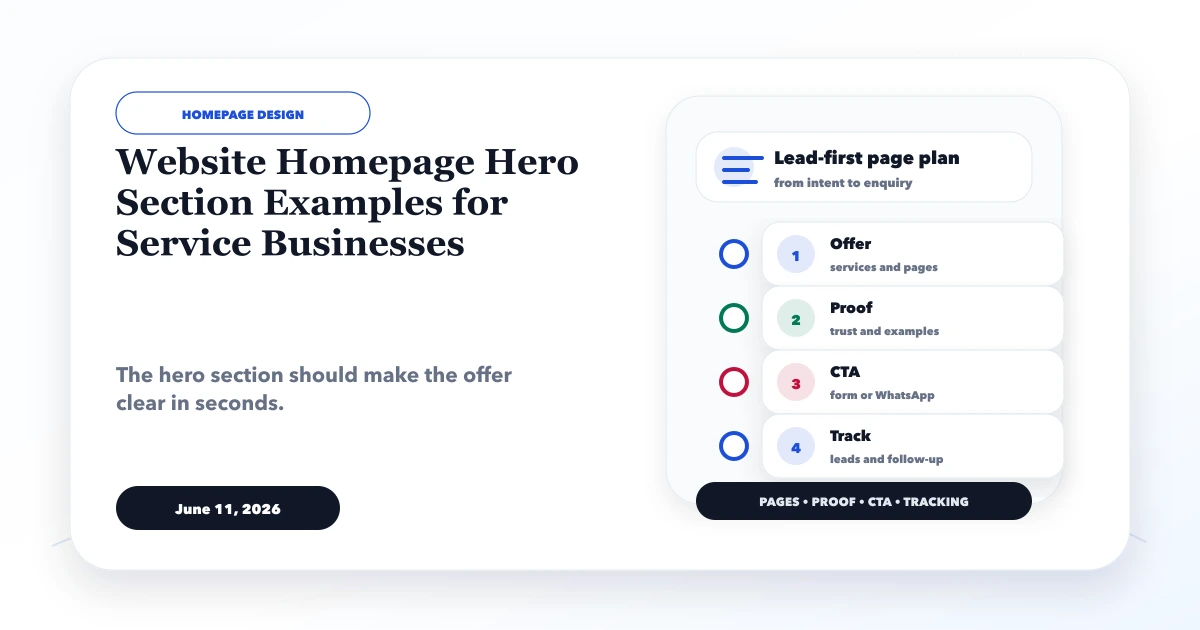
June 11, 2026
Use practical homepage hero formulas for service businesses with clear audience, offer, proof, CTA hierarchy, mobile layout, and conversion tracking.
Read article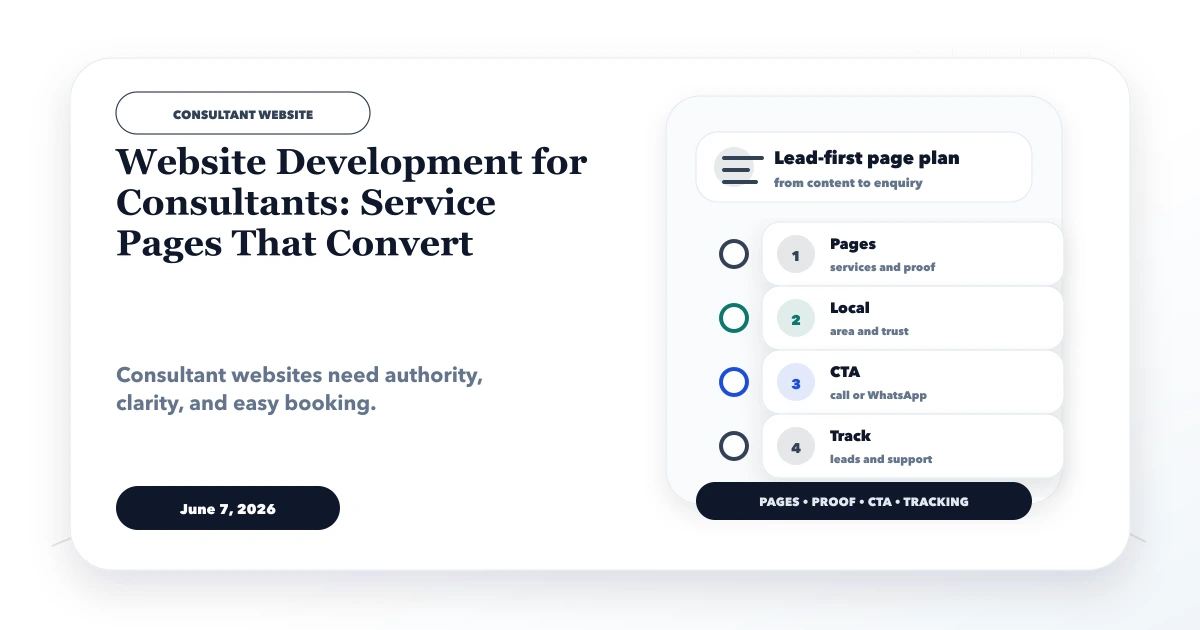
June 7, 2026
Plan a consultant website with focused offers, authority proof, service pages, case studies, qualification forms, booking flow, analytics, and SEO.
Read article
June 7, 2026
Plan a law firm website with clear practice areas, verified advocate profiles, confidential enquiry handling, ethical proof, local SEO, and secure handoff.
Read article