
June 4, 2026
Call-to-Action Copy Examples for Service Pages
Call-to-action copy examples for service pages with WhatsApp, form, demo, quote, consultation, audit, and service-specific CTA templates.
Read articlePublished Updated
Write service website copy that earns qualified leads with customer language, clear offers, specific proof, objection handling and useful calls to action.
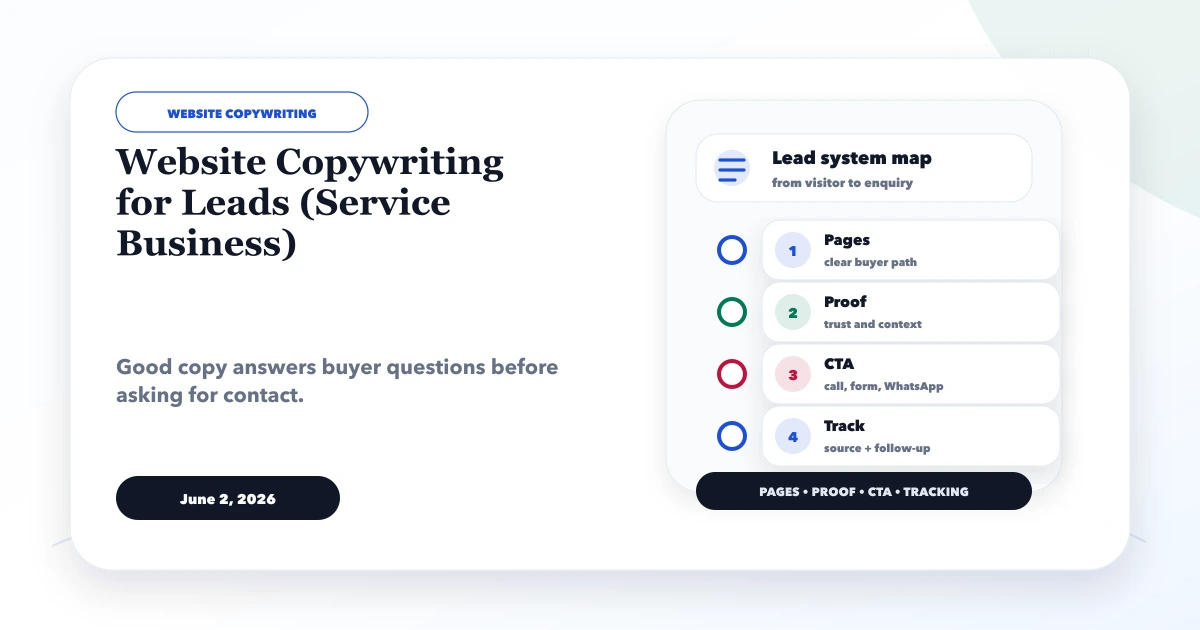
Lead-focused website copy helps a suitable buyer understand the service, recognise whether it fits, trust the evidence and take a sensible next step.
It is not a collection of impressive adjectives. Phrases such as “innovative solutions,” “unmatched quality” and “customer-centric excellence” are weak unless the page explains what the company does, for whom, under what conditions and with what proof.
This guide is a practical writing workflow for service businesses. It focuses on collecting real customer language, building a clear offer, writing page-specific copy and improving it using enquiry quality rather than guesswork.
Before writing, answer seven questions:
If those answers are vague, changing the headline font or CTA colour will not fix the message.
Collect source material from the people closest to customers:
The objective is to learn the language customers actually use. A software company may call a service “workflow automation,” while a buyer asks, “Can my team stop copying order details from WhatsApp into Excel?” The buyer’s wording usually creates clearer copy.
Complete this one-page brief before drafting:
| Field | Example |
|---|---|
| Primary audience | Delhi NCR distributor with manual sales operations |
| Trigger | Missed follow-ups and duplicate spreadsheet entry |
| Offer | Custom enquiry and quotation workflow |
| Included | Discovery, web app, roles, reports and handover |
| Excluded | Full accounting and enterprise ERP replacement |
| Proof | Live demo, process map, approved client review |
| Objection | Concern about staff adoption |
| Next action | Share current workflow for a scope discussion |
Use one brief per important page. Reusing the same brief for every service produces repetitive copy.
Different pages serve different decisions.
The homepage should explain the business category, primary audience and key routes. It should not contain the full detail of every service.
A service page should answer:
A location page needs genuine service-area value, not a city name inserted into generic copy. Explain delivery model, relevant local context, availability and proof. Read the guide to creating service-city pages without spam before scaling them.
A product page should explain the real modules, current capabilities, limitations, setup and trial or demo route. Roadmap features must not be described as available.
The contact page should set expectations: what information to send, what response follows and which requests fit.
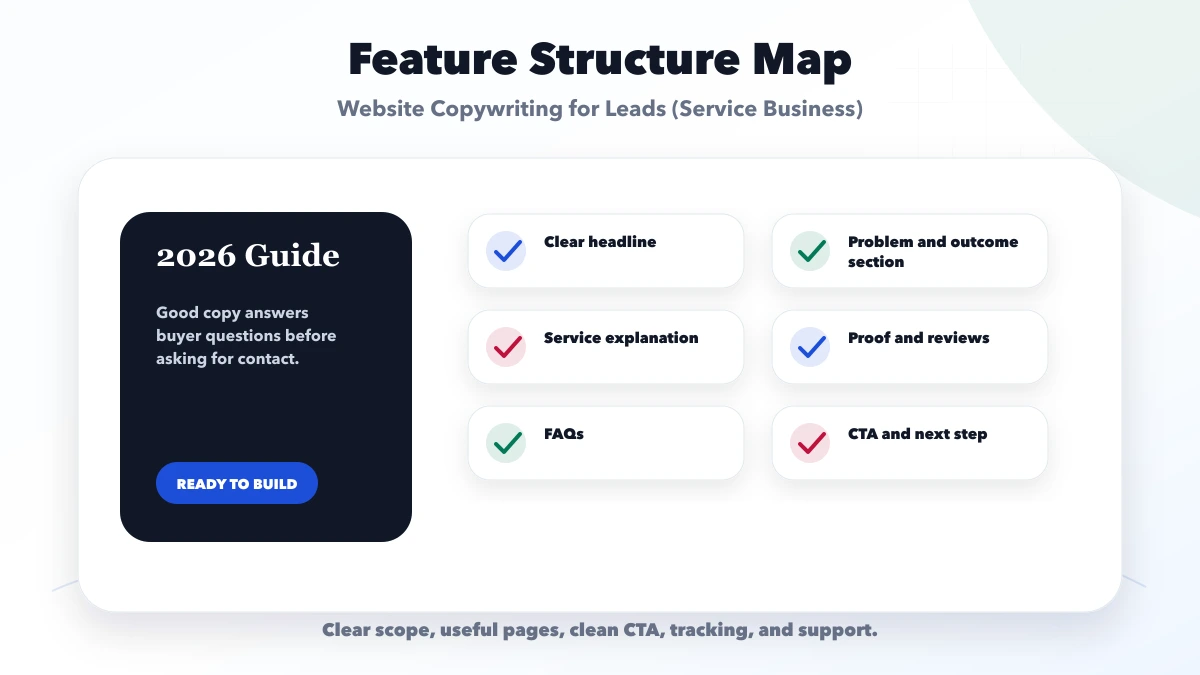
The first screen should answer three questions quickly:
A practical pattern:
Custom billing and inventory software for Indian trading businesses Manage GST invoices, stock, purchases and payments in one company-scoped system. Try the live demo or discuss setup.
The headline names the offer and audience. The supporting line explains concrete jobs. The CTAs match different levels of readiness.
Avoid:
Transforming possibilities through next-generation digital excellence.
It may sound polished but communicates no useful buying information.
Describe recognisable operational friction:
Do not exaggerate fear or imply guaranteed failure. Good copy lets the buyer self-identify.
Translate a service label into deliverables.
Instead of:
We build scalable web solutions.
Write:
The project can include requirement mapping, responsive screens, role-based access, admin workflows, API integrations, reports, deployment and handover. Final scope depends on the users, data and approvals involved.
This copy also creates a natural boundary: “can include” does not promise every module in every package.
Use headings that answer real questions:
Descriptive headings help scanning and reduce dependence on generic “Our Solutions” blocks.
Proof should be accurate and labelled.
| Proof type | Strong version | Weak version |
|---|---|---|
| Review | Named or source-verifiable feedback with permission | Anonymous praise with no context |
| Demo | Clearly labelled live or sample experience | Demo presented as client result |
| Screenshot | Caption explains the workflow shown | Decorative unreadable mockup |
| Metric | Baseline, source and period provided | Unsupported percentage |
| Process | Real stages and approval points | Generic icons |
| Credential | Current and verifiable | Expired badge |
For proof governance and placement, use the guide to building trust with proof and demos.
List the questions buyers ask before signing:
Answer with conditions and boundaries. For example:
Existing data can be reviewed for import. Final migration scope depends on file quality, field mapping and validation requirements.
That is more credible than “seamless migration guaranteed.”
Not every visitor is ready for the same action.
Use one primary CTA per section. Too many equal buttons create hesitation.
“Contact us” gives no preparation guidance. Add a useful prompt:
Share the service required, current process, target users, preferred timeline and any existing website or software link.
For WhatsApp, prefill a short message without collecting sensitive information:
Hi VASUYASHII, I want to discuss a business website/web app. My business type is __ and the main requirement is __.
Avoid forcing buyers to submit a long brief before they understand whether the service fits.
If the service is offered in Delhi NCR or another defined area, state the delivery model accurately:
Do not create false addresses, fake local teams or repeated pages for every nearby locality. Review the local SEO spam prevention guide.
Once the page is useful:
Do not force an exact keyword into every heading. Search engines and buyers need meaning, not repetition.
Check modules, locations, pricing, support, timelines and claims against the current offer.
Replace words such as “best,” “advanced” and “powerful” with concrete information.
Compare the copy with actual enquiry wording. Remove internal jargon.
Shorten paragraphs, strengthen headings and use tables or lists only where they improve comparison.
Label demos, forecasts, roadmap items and limitations clearly.
Check that each CTA tells the visitor what happens next.
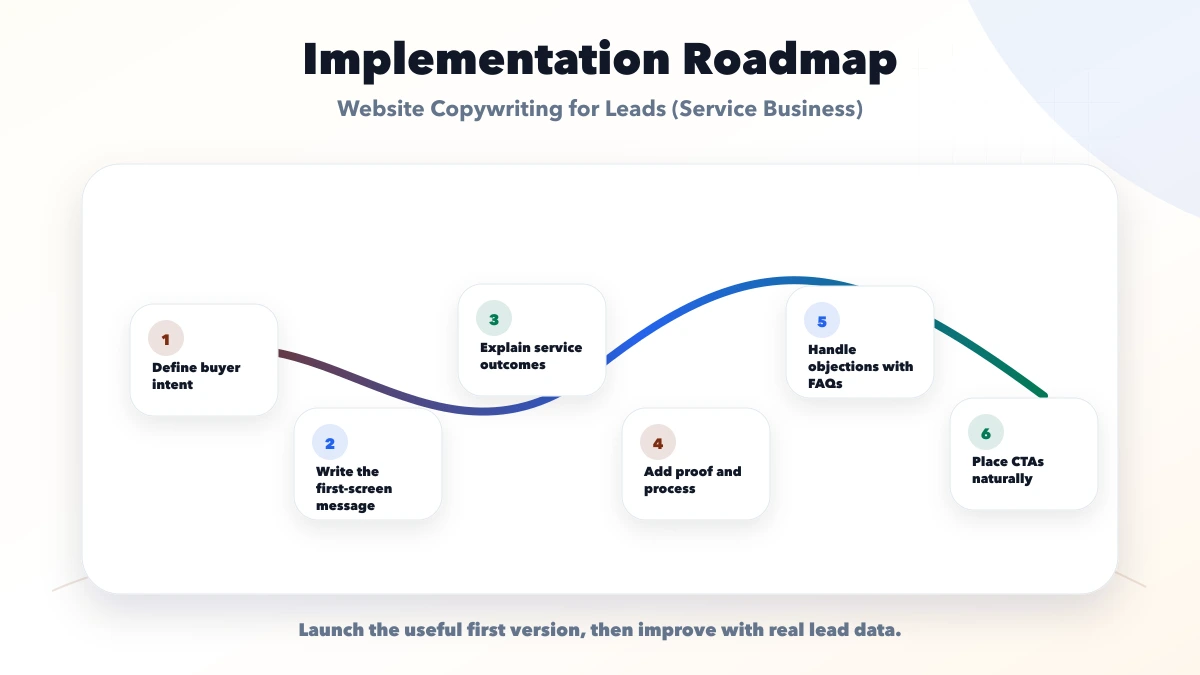
Track:
A higher number of irrelevant enquiries is not necessarily an improvement. Review the words buyers use after launch and update copy where confusion appears.
Consider a small automation company receiving enquiries for websites, mobile apps, SEO and full ERP systems through one generic form.
The better copy strategy would:
This can reduce ambiguous “price?” messages even before traffic changes.
VASUYASHII provides business websites, web applications, software development and integrations. The public copy should distinguish current services and product capabilities from future roadmap items.
For custom work, the final quote depends on scope, roles, integrations, data, reporting and acceptance requirements. Published guidance and demos help buyers evaluate direction; they are not a universal promise of price, timeline or business outcome.
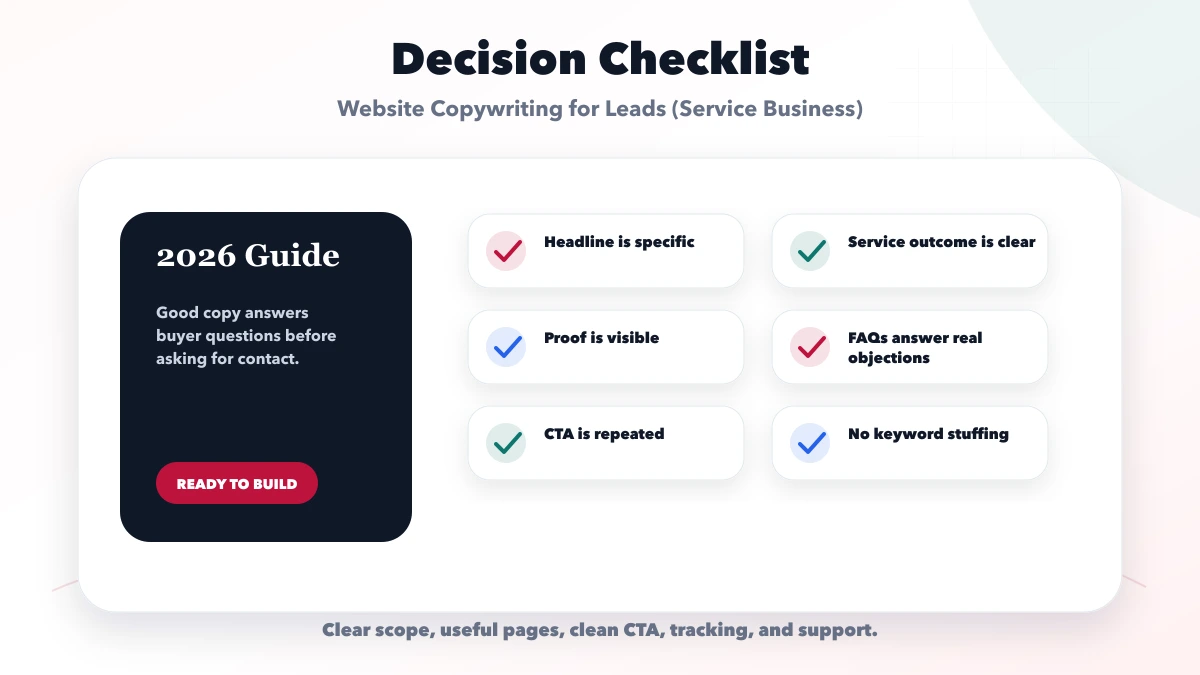
It is copy designed to help a suitable visitor understand fit, evidence, scope and next action. It also helps unsuitable visitors self-select out.
Define the offer and write the priority service pages first. The homepage can then summarise those routes accurately.
Use enough words to answer the buyer’s decision questions. A complete 1,000-word page can outperform a repetitive 2,500-word page.
Yes, when it clarifies intent, adds useful answers and supports internal linking. Copy alone cannot fix technical, authority or demand problems.
Show fixed prices when the scope is standard. For custom work, explain planning bands or cost drivers and state that the final quote follows requirement review.
Review priority pages when the offer changes, new objections appear, proof becomes stale or search performance shows a clear mismatch.
Correct obvious formatting only with care. Do not change the meaning. Keep source evidence and obtain permission for identifiable use.
It should match the page: “Share your current workflow” is appropriate for custom software, while “Try the live demo” suits a product evaluation.
Review VASUYASHII services, explore the demo collection or share your current requirement. Useful copy begins with a clear offer and verifiable evidence, not a list of promotional adjectives.
Related Articles
June 4, 2026
Call-to-action copy examples for service pages with WhatsApp, form, demo, quote, consultation, audit, and service-specific CTA templates.
Read article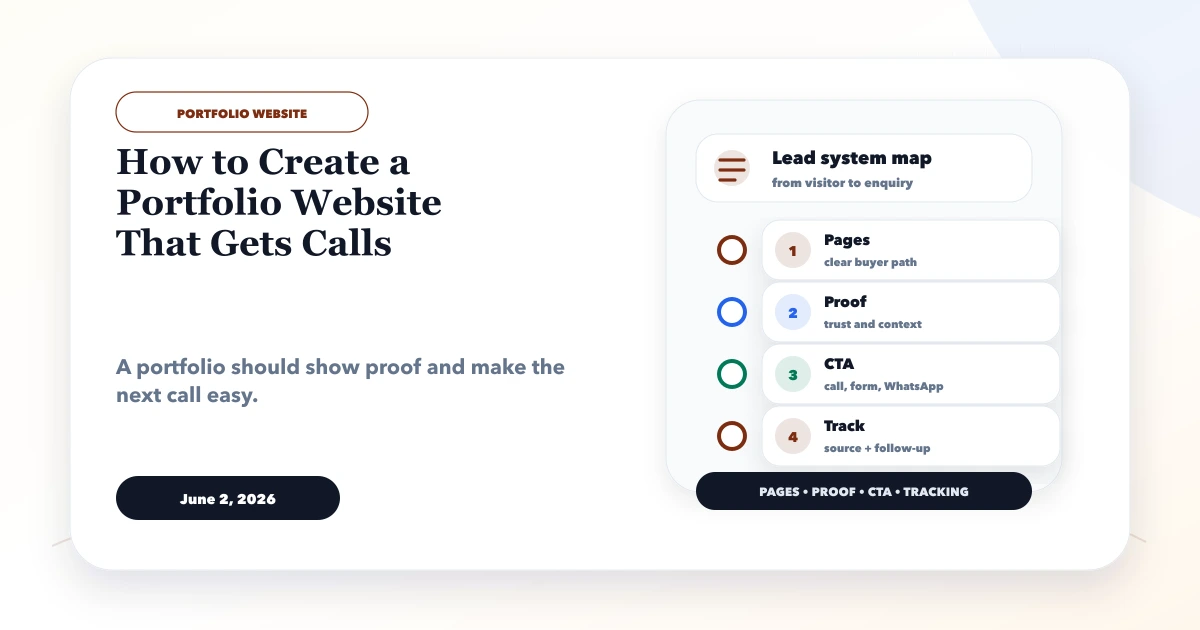
June 2, 2026
Build a portfolio website that earns calls with clear positioning, honest project proof, case studies, lead qualification, tracking, and fast contact paths.
Read article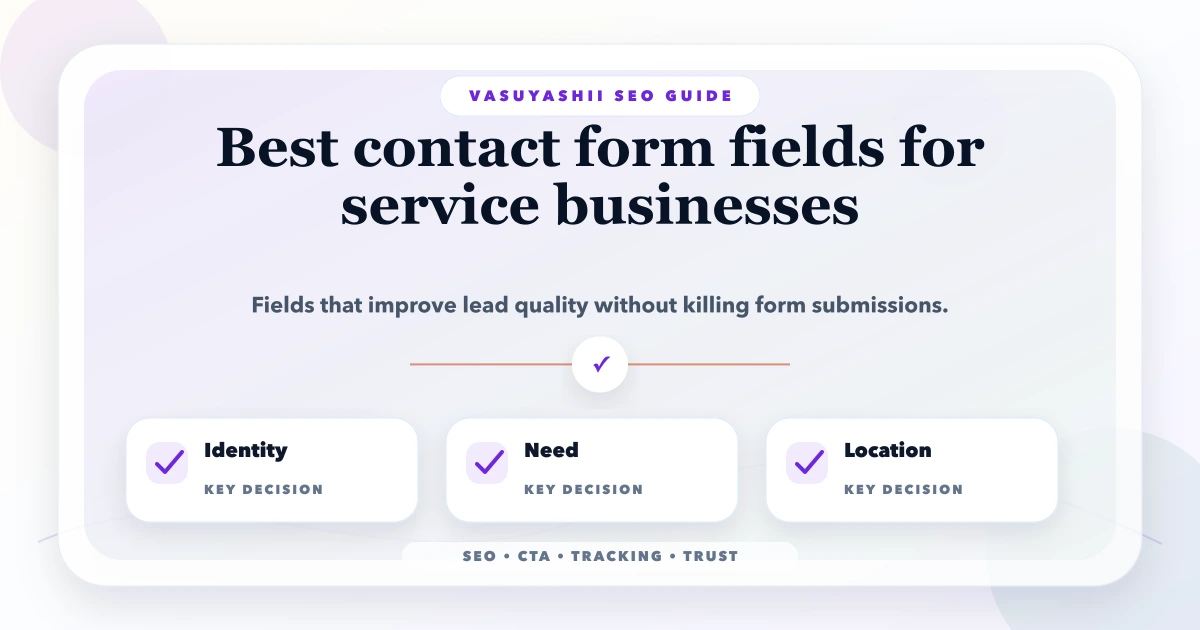
May 11, 2026
best contact form fields for service businesses: practical 2026 guide with structure, pricing, checklist, mistakes, FAQs, tracking tips, and next steps.
Read article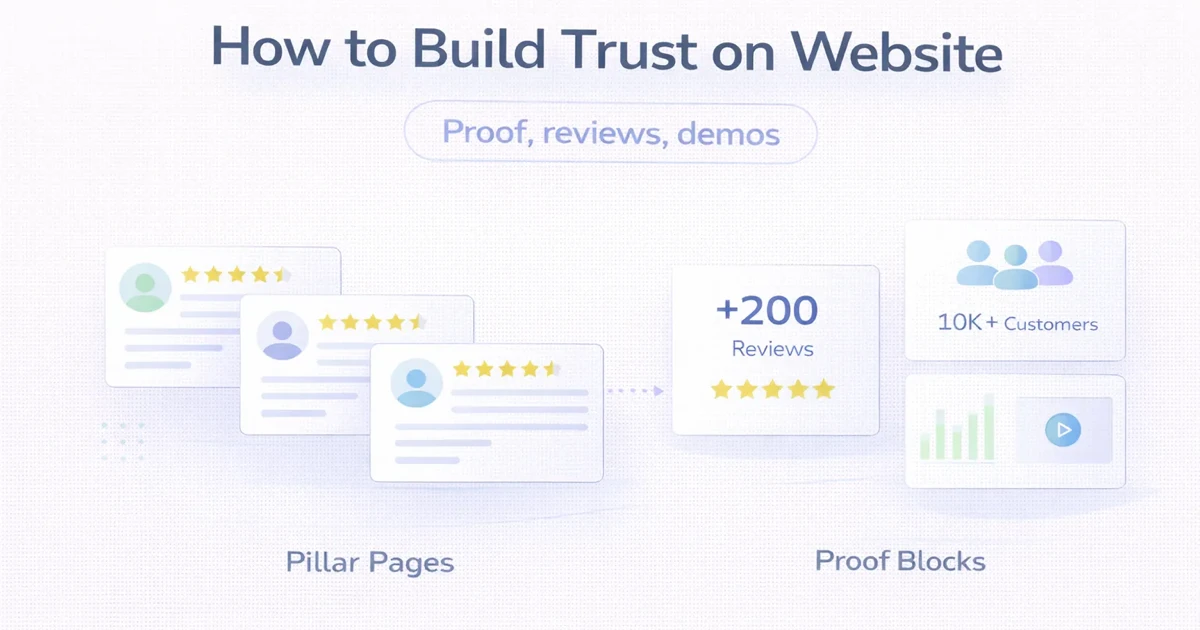
March 31, 2026
Build website trust with verified reviews, clearly labelled demos, safe screenshots, transparent process, current business details and honest proof placement.
Read article