
June 11, 2026
Website Quote Request Page: Fields and Follow-up
Design a website quote request page with scope-aware fields, budget and timeline context, privacy-safe attachments, confirmation, and lead follow-up.
Read articlePublished Updated
Plan a website development landing page with a focused offer, proof, process, scope, qualification form, WhatsApp CTA, FAQs, tracking and follow-up workflow.
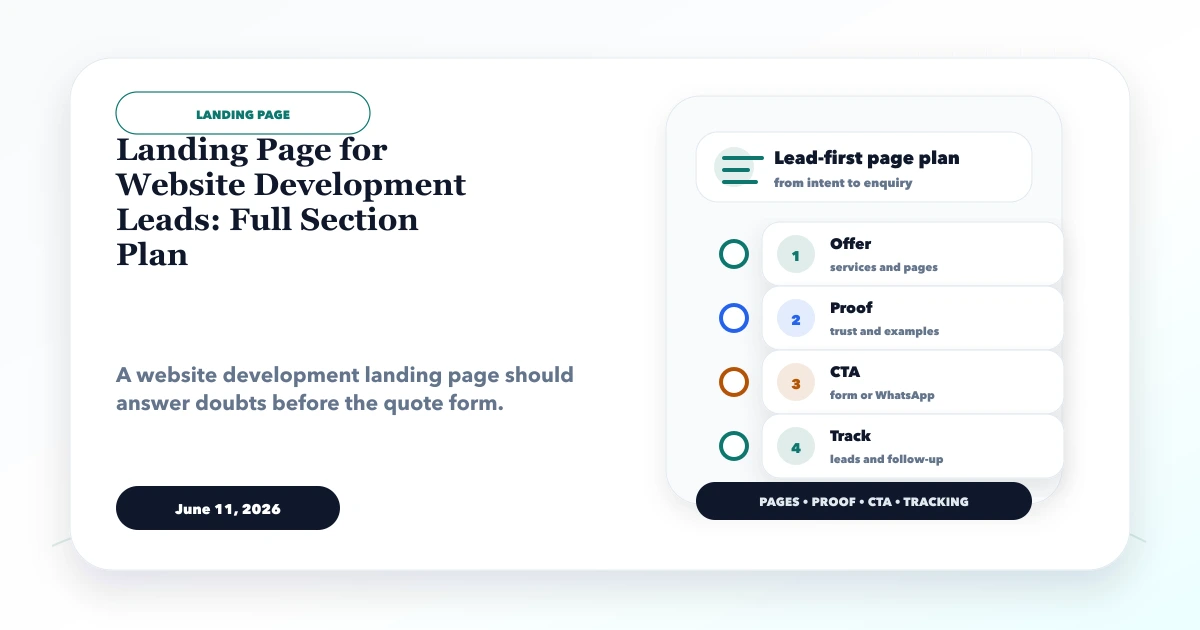
A website development landing page should help a specific buyer decide whether to start a conversation. It is not a compressed agency homepage and it should not list every technology, service, city, package, and promise in one scroll.
The strongest page connects one traffic intent to one offer, provides enough evidence to reduce risk, asks for the information needed for a useful response, and routes the enquiry into a real follow-up process. This guide gives a complete section and measurement plan for Indian web-development leads.
Write these six inputs before designing:
| Input | Example |
|---|---|
| Audience | Ghaziabad small businesses replacing an outdated site |
| Problem | Website gets visits but few valid enquiries |
| Offer | Lead-focused redesign with content and tracking plan |
| Traffic source | Google Search campaign or focused organic query |
| Primary action | Request a website review |
| Qualification need | Current URL, business type, goal, timeline |
If the page must serve restaurant owners, manufacturers, SaaS founders, ecommerce sellers, and job seekers together, the offer is probably too broad.
The exact sequence can change, but every section should answer a decision question.
Do not add sections because another agency page has them. Add them because a real buyer question remains unanswered.
The hero needs four elements:
Weak:
We create digital excellence for tomorrow.
Clearer:
Lead-focused websites for Indian service businesses.
Plan the pages, proof, forms, WhatsApp flow, tracking, and launch around the enquiries your team can actually handle.
Primary CTA: Request a website review
Secondary CTA: Explore relevant demo websites
The CTA should describe what happens next. Do not label a sales call as “Get Free Demo” if no working demo is provided.
List recognisable symptoms, not exaggerated threats:
This section should help a qualified visitor self-identify. It should not shame businesses with older websites.
Avoid a feature wall. Group deliverables by purpose.
| Buyer need | Possible deliverables |
|---|---|
| Explain the offer | Page hierarchy, service copy structure, FAQs |
| Build trust | Real proof, team/business identity, process, policies |
| Generate leads | CTA hierarchy, forms, WhatsApp, call actions |
| Support search | Crawlable pages, metadata, sitemap, internal links |
| Work on mobile | Responsive layout, touch targets, fast first screen |
| Measure results | GA4 events, Search Console, lead-source fields |
| Operate safely | Domain ownership, access, backup, handover |
Link important concepts to deeper pages instead of placing every detail on the campaign page. The small-business lead-first website plan is useful for visitors needing broader planning.
Proof should match the claim. Options include:
Do not use unrelated logos, anonymous praise, purchased badges, or fictional projects presented as clients. If confidentiality limits public examples, explain what can be shown during a call.
A compact process can be more persuasive than another adjective-heavy paragraph.
Confirm business type, visitor, current URL, lead channels, content status, pages, and constraints.
Agree on information architecture, primary actions, proof, form fields, and analytics events.
Create responsive sections and required functionality within the approved scope.
Review final business details, links, forms, mobile layout, metadata, performance, and accessibility.
Confirm accounts, domain, deployment, analytics, Search Console, backup, and support period.
Each stage needs an owner and approval condition. “We design, develop, deploy” is not enough to explain collaboration.
Lead quality improves when buyers understand fit. State whether the offer includes:
Also state common exclusions such as paid advertising, ongoing SEO retainers, third-party subscriptions, ecommerce, custom dashboards, advanced integrations, or multilingual content unless quoted. Clarity filters unsuitable leads before a sales call.
Website cost depends on page depth, original content, visual system, integrations, CMS needs, migration, tracking, and review complexity. A page can provide pricing logic without pretending every project is identical.
Useful options:
Link to a relevant business website cost guide for visitors researching budget. Do not bury major recurring fees until after the lead submits.
Answer operational concerns near the conversion point:
This is especially important when the page asks for an advance or detailed business information.
Use questions that arise before purchase, not filler created to repeat the keyword. Good topics include timeline, content, ownership, redesign migration, SEO scope, hosting, support, and required client inputs.
Keep each answer direct and link to deeper material only where it helps. The SEO FAQ guide explains how to research and maintain useful questions without relying on obsolete rich-result promises.
Repeat the fit, state what the visitor should send, and set a realistic response expectation.
Example:
Share your current website, business type, main service, and lead goal. We will review the requirement and tell you whether a focused landing page, multi-page website, or web application is the better next step.
Primary CTA: Request a website review
Secondary: Message on WhatsApp
Do not show three phone numbers, two forms, a chatbot, calendar, and email as equal primary actions.
Ask only what supports the next response.
Recommended initial fields:
Budget and timeline can help qualification but should be optional or explained. A visitor early in planning may not know either. Preserve entered data after a recoverable error and do not claim success before the lead reaches the intended system.
The contact page conversion guide covers validation, spam, delivery, and response states.
Use a business-controlled number and a prefilled message that includes safe page context:
Hi VASUYASHII, I am reviewing a website development project. My business type is __ and the main goal is __.
Do not put sensitive form details into the URL. Track the click as an intent signal, but do not count it as a qualified lead until the conversation is received and assessed.
| Event | When it should fire | Useful properties |
|---|---|---|
contact_click | Visitor opens contact route | source page, section |
whatsapp_click | WhatsApp action is activated | source page, campaign |
form_start | First meaningful field interaction | form type, page |
generate_lead | Valid form reaches handling path | service category, source page |
demo_open | Relevant demo is opened | demo id, source page |
Exclude names, phone numbers, email addresses, and message contents from analytics. Connect events to lead quality and sales outcomes instead of celebrating button clicks alone.
Match the advertisement and keyword closely. Remove unrelated navigation only when it helps the campaign without reducing trust or accessibility.
Provide deeper explanatory content, crawlable internal links, and clear ownership. The page must satisfy the query beyond the CTA.
Explain the relationship and preserve attribution. The visitor may already trust the referring source but still needs scope and process clarity.
Address the reason the visitor did not act earlier: proof, timing, budget, process, or fit. Do not create false urgency.
Consider a Noida accounting firm searching for a website redesign. The campaign page targets professional service firms, not every industry. It opens with a lead-focused redesign offer, explains trust and enquiry problems, shows a labelled sample information architecture, lists scope, outlines the review process, offers a budget framework, and asks for the current URL.
This page is more likely to produce a useful conversation than a generic agency page with 25 technology logos. The example is illustrative and not a reported client result.
VASUYASHII begins with traffic intent, buyer decision, lead channel, and follow-up ownership. We design the section order after these are clear. The form, WhatsApp message, analytics event, and recipient are tested as one workflow.
Our website development service handles the broader site architecture. For a focused campaign or service launch, contact VASUYASHII with the audience, offer, and traffic source so the landing-page scope can be evaluated separately.
It depends on traffic and trust needs. A campaign page may use reduced navigation, while an organic service page benefits from broader crawlable context. Always retain essential identity, privacy, and accessibility routes.
Use the channel the business can handle reliably and the buyer is likely to use. A structured form supports qualification; WhatsApp lowers friction. One can be primary and the other secondary.
Long enough to answer the buyer's decision questions without repetition. Complexity, price, trust, and traffic awareness matter more than a fixed word count.
Display packages when boundaries are stable and genuinely comparable. For variable projects, show cost drivers or example phases and request a scoped review.
One strong regional page may be better than many duplicated city pages. Create separate pages only when service, proof, availability, content, or local value is genuinely distinct.
Wait for enough qualified traffic to compare meaningfully. Validate tracking immediately, then review lead quality, source, device, and sales progression rather than making changes after a few visits.
Create the campaign brief before opening a page builder. Once audience, offer, action, and follow-up are agreed, the sections become much easier to prioritise.
Related Articles
June 11, 2026
Design a website quote request page with scope-aware fields, budget and timeline context, privacy-safe attachments, confirmation, and lead follow-up.
Read article
June 4, 2026
Build a higher-converting service landing page with intent-matched sections, proof, offer clarity, CTA hierarchy, lead qualification, analytics, and mobile QA.
Read article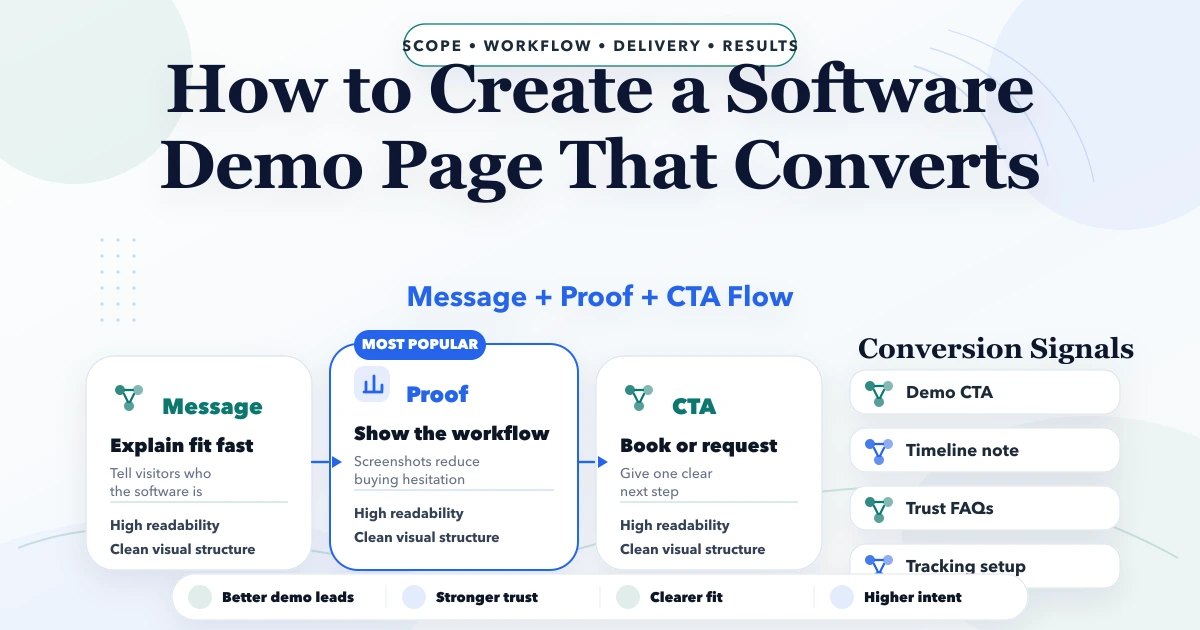
April 26, 2026
Software demo page that converts: page structure, pricing, proof blocks, CTA flow, tech stack, and launch checklist for better leads.
Read article
June 10, 2026
Build computer institute course pages with syllabus, tools, batch and fee details, honest certificate proof, demo-class leads, and clear follow-up.
Read article